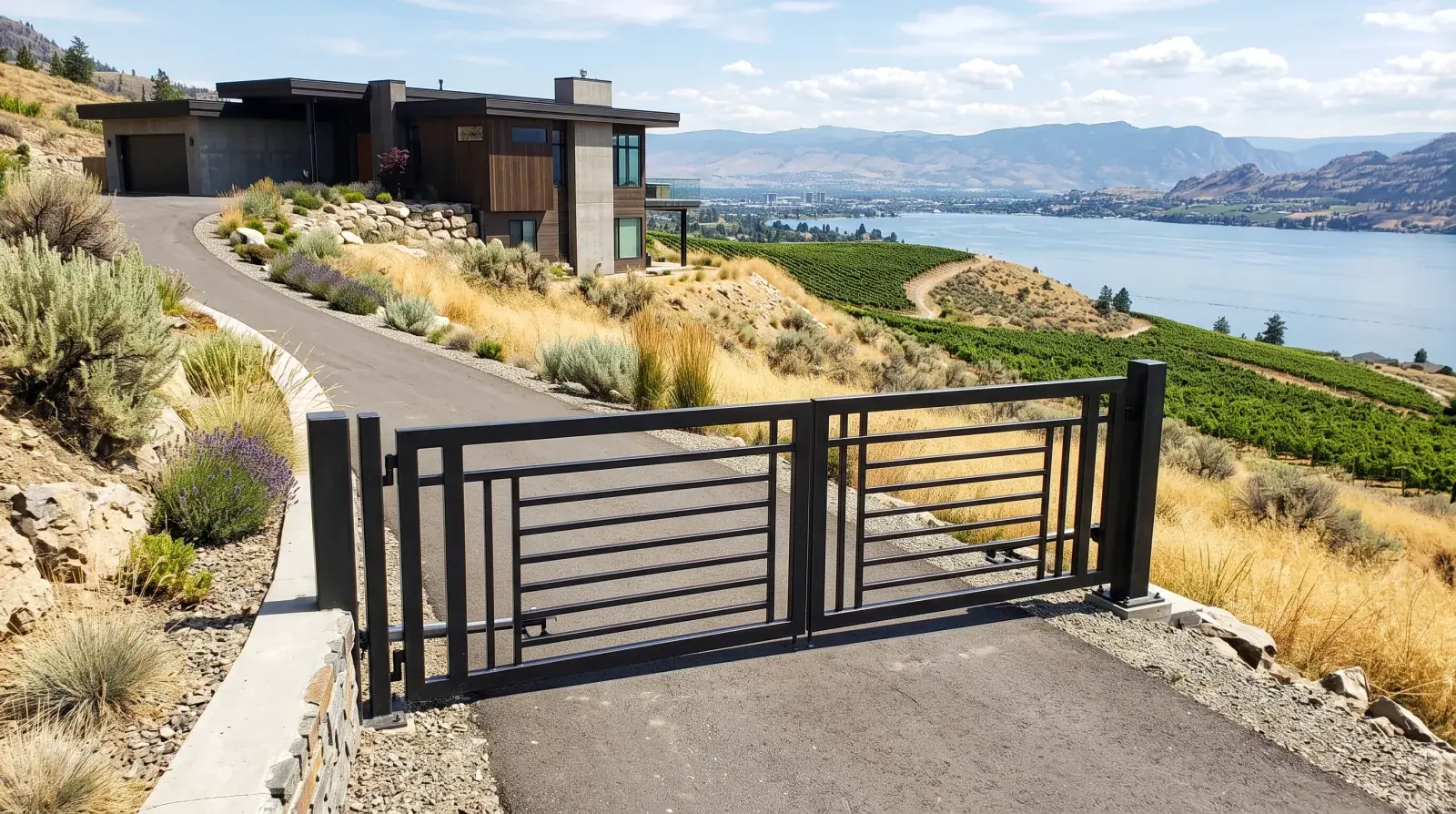
A driveway gate is a climate decision as much as a design one. The gate we would build for a rainy North Shore lot and the gate we would build for a sun-baked hillside above Okanagan Lake share the same steel, but not the same finish spec or the same priorities. Kelowna throws three things at a gate that the coast does not: relentless summer UV, dry heat that swings hard between day and night, and genuine wildfire risk on interface properties. Steel can answer all three, but only if it is specified for the Okanagan and not copied from a coastal job.
We fabricate custom steel gates at our shop in Burnaby and install them across the Interior, including Kelowna. That reach is not marketing. It grew out of the stair work we delivered for Interior Health in Kamloops and Kelowna, which is the reason we now treat the Interior as a full service area. Our post on serving the BC Interior from a Burnaby steel shop explains how that delivery model works.
Finish first: the Okanagan sun is the real test
On the coast, the thing that ages a steel gate is moisture and salt air. In Kelowna, it is ultraviolet light and heat. A powder coat that performs perfectly in Vancouver can chalk and lose colour within a few summers on an exposed Okanagan gate if the surface prep and the coating were not chosen for that UV load.
The fix is not exotic, it is discipline. Properly prepared steel, a coating system rated for high-UV exposure, and, where the exposure justifies it, hot-dip galvanizing beneath the powder coat so the steel is protected even if the finish is ever nicked. We think about finish the same way for hot Interior sites as we do for railings, which we covered in our post on Kamloops steel railing finishes for UV and heat. The principle carries straight over to a driveway gate: match the finish to the exposure, not to a generic spec sheet.
Steel and the wildfire interface
Many Kelowna properties sit in the wildland-urban interface, where the built edge meets forest and grassland. Ember-driven ignition is the main way homes are lost in these fires, and every combustible surface near the house is a liability. A wood gate at the driveway is exactly that kind of surface.
Steel is non-combustible. A steel gate and a steel fence will not catch from wind-blown embers the way timber can. That gives a steel entrance a second job on an interface lot: it looks like clean modern architecture and it removes a fuel source at the same time. We explored this in depth in our post on non-combustible steel for the Kelowna wildfire interface, and the driveway gate is one of the most visible places to apply it.
Building for hillside and sloped driveways
Okanagan lots love a slope. A gate on a hillside driveway has to account for grade, and the geometry often decides the gate type. A steep or curved approach frequently points toward a slide gate, which rolls sideways rather than arcing into the grade, or a swing gate with its arc carefully planned around the slope and any retaining walls. We survey the site before committing to a gate and operator type, because a design that ignores the grade fights the driveway forever.
Footings matter more on a slope, too. A gate post that shifts even slightly throws an automated gate out of square and wears the operator. Engineered footings on a hillside are not optional, they are what keeps the gate running for years.
Automation that survives Interior conditions
Most Kelowna gates we build are automated, and the automation has to suit the setting. Battery backup keeps the gate cycling when a storm or a heat-driven grid event drops the power. A manual release lets you move the gate by hand when you need to. For rural properties well away from a power source, solar charging runs the operator off a panel and battery, which saves trenching a long power run across a large lot.
The mechanics are the same as any quality gate, and we cover them in our guide to gate operators and automation. What changes in the Okanagan is planning the system around outages and distance from power. Every automated gate also has to meet the UL 325 safety standard, which we break down in our post on UL 325 gate safety.
Permits: Kelowna is not Vancouver
Here is a local detail worth knowing. A hardwired gate motor is electrical work that needs a permit and inspection. In Kelowna and most of British Columbia, that runs through Technical Safety BC. That is different from Vancouver and Burnaby, which run their own electrical inspection. So the permit path for a Kelowna gate follows the provincial process rather than a city one. We sort this out before the power run is trenched.
How the Burnaby-to-Kelowna build works
People sometimes assume a Burnaby shop means a compromise for an Interior job. It is the opposite. We detail and fabricate the gate under shop supervision in Burnaby, where our equipment and quality control live, then mobilize a crew to install in Kelowna. It is the same model that let us deliver institutional stair work across the Thompson-Okanagan, and it means an Okanagan gate gets the same welds and the same finish standard as one going up in West Vancouver.
If you are planning a driveway gate for a Kelowna property, request a quote or call us at +1 (604) 294 0409. Tell us about the entrance, the slope, and the exposure, and we will scope a gate built for the Okanagan sun rather than the coast. You can also explore our full driveway gates and entry systems work for design ideas.