The gate is the part people photograph. The operator is the part that decides whether the whole thing still works in year eight. It is the motor and controller that turn a heavy steel gate into something you roll up to and drive through without touching. Get it right and the gate feels effortless for a decade. Get it wrong, or bolt it to a gate that was not built for it, and you are booking a service call every winter.
We build automated steel gates across Metro Vancouver, and the single most useful thing a homeowner can know is this: the operator choice starts before the gate is designed, not after. Here is how the automation actually works, and why it shapes the steel.
Swing operators versus slide operators
The gate type usually decides the operator family. If you want a deeper look at choosing between the two gate styles, our post on swing versus slide driveway gates covers that decision. Here we are focused on the motor.
Swing gate operators rotate the gate leaf on its hinges. There are three common types. An articulated arm operator mimics an elbow and works well on wide piers. A linear ram operator is a straight actuator that extends and retracts to push the leaf. An underground operator hides below the hinge point for a clean look where the design cannot show hardware. Swing operators are common on properties with a driveway that has room for the gate to arc open.
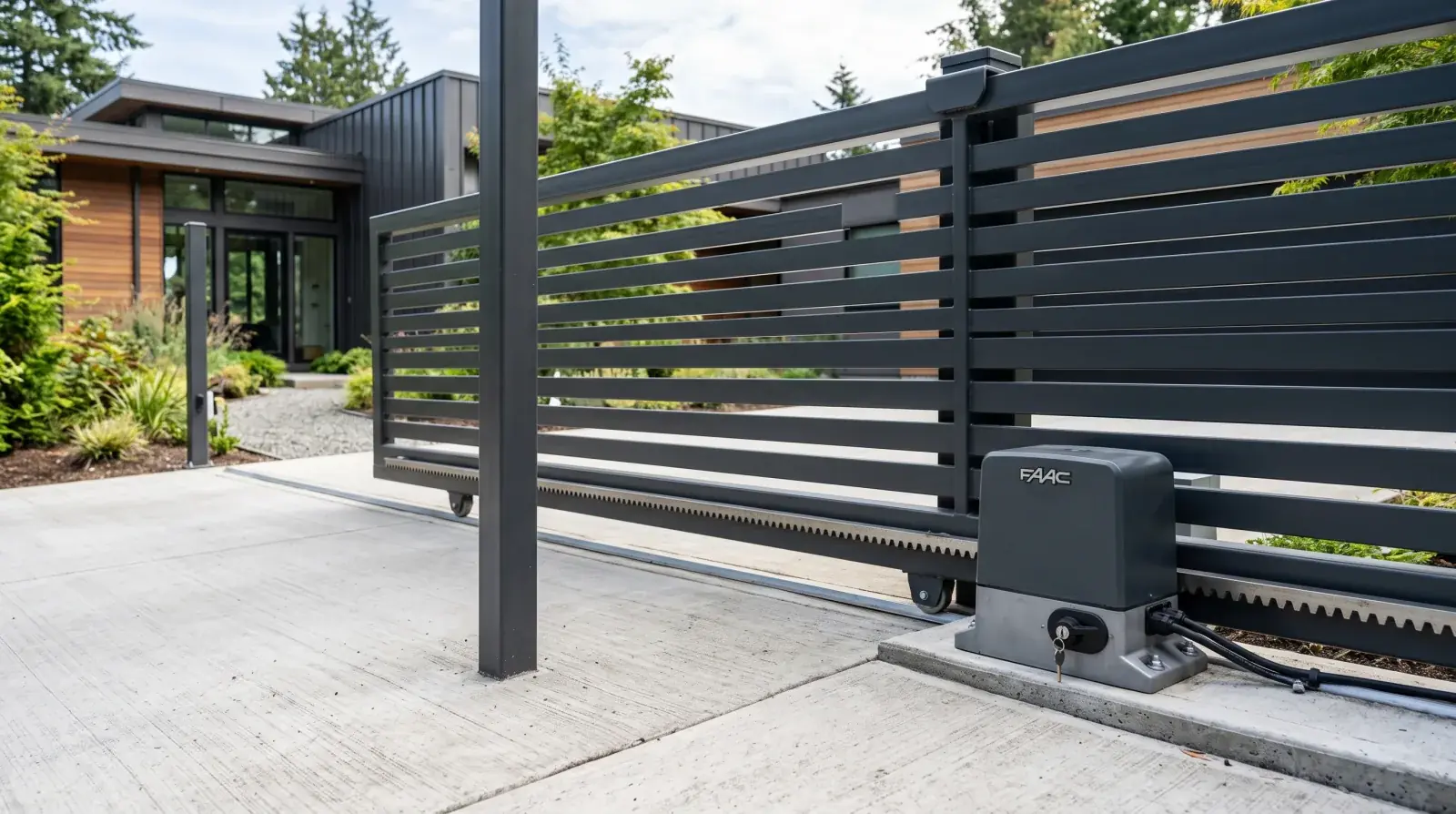
Slide gate operators are almost always rack-and-pinion. A toothed rack runs along the bottom of the gate, and a geared wheel on the operator drives it, rolling the gate sideways across the opening. Slide gates suit sloped driveways and properties where a swing gate would arc into a car or a hill. Much of our slide gate work in Vancouver and Burnaby uses this drive because city lots often lack the swing room.
Power, battery backup, and our climate
Most operators are hardwired to a dedicated circuit brought out to the gate. That power run is real electrical work, which we will come back to.
Two features matter more in Metro Vancouver than sales brochures admit. The first is battery backup. Winter storms on the North Shore and in Coquitlam knock out power, and a gate you cannot open is a gate that traps your car in or out. A quality operator keeps cycling on battery through an outage. The second is a manual release, a key or lever that disconnects the motor so you can move the gate by hand. Every automated gate needs one, and every owner should know where it is before they need it.
For gates far from a power source, solar charging can run the operator off a panel and battery, which saves trenching a long power run across a large property.
Access: how you actually get in
Automation is only useful if the right people can open the gate easily and the wrong people cannot. The common options are a remote fob in the car, a keypad on a pedestal, a phone app, and a call box or intercom for guests and deliveries. On the way out, a vehicle exit loop buried in the driveway senses your car and opens the gate automatically so you never stop.
Most homeowners we work with use a mix. Family gets fobs or the app, guests use the call box, and the exit loop handles departures. Access hardware is a topic on its own, and our gate automation and operators guide goes deeper on the equipment side.
Safety loops and UL 325
A safety loop is a wire loop set into the concrete that detects a vehicle by its metal mass and stops the gate from closing on it. It is genuinely useful, but it is not a substitute for the entrapment protection the safety standard requires.
Every automated gate has to meet UL 325, which since January 2016 requires two independent, monitored means of entrapment protection at each pinch point, per LiftMaster’s UL 325 guidance. That means the operator’s inherent reversing plus a monitored photo eye or safety edge. The safety loop protects against crushing a car. The photo eyes and edges protect people and pets. You want all of it, and we cover the standard in full in our post on UL 325 gate safety.
Why automation changes the steel
Here is the part shops skip. A manual gate gets pushed a few times a day by a person. An automated gate gets driven by a motor thousands of times a year, and the motor does not baby it. That changes everything about how the gate is fabricated.
An automated gate needs a stiffer frame so it does not flex and bind the operator. It needs heavier hinges on a swing gate or a properly aligned track and rollers on a slide gate. And it needs real footings, because a post that shifts even slightly throws the gate out of square and the operator starts fighting it. This is exactly why we prefer to detail a gate for automation from the start, and why automating an old manual gate sometimes means rebuilding it. Our guide on gate footings and engineering explains the foundation side.
We had a job in Surrey where another shop’s gate flexed every time someone leaned on it. Automating that gate as-is would have burned out the operator within a season. We rebuilt the leaf stiffer and reset the posts before the motor ever went on.
Permits and inspection
Because a hardwired operator is electrical work, it needs an electrical permit and inspection. Across most of British Columbia that runs through Technical Safety BC. In the City of Vancouver and the City of Burnaby, the city runs its own electrical inspection instead, so the process differs by municipality. We plan the power run and the permit before the driveway concrete is poured, since retrofitting conduit afterward is costly and easy to avoid.
Getting the operator right
An automated gate is a system: the steel, the operator, the footings, the sensors, and the access hardware all have to be designed together. When they are, the gate feels like it barely exists, you drive up and it opens. When they are not, you feel every shortcut, usually in January.
If you are planning an automated entrance anywhere from Vancouver to North Vancouver, request a quote and we will size the operator to the gate, the site, and how you actually use the driveway.