
Resource hub, Metro Vancouver
Driveway gates & entry systems in Metro Vancouver
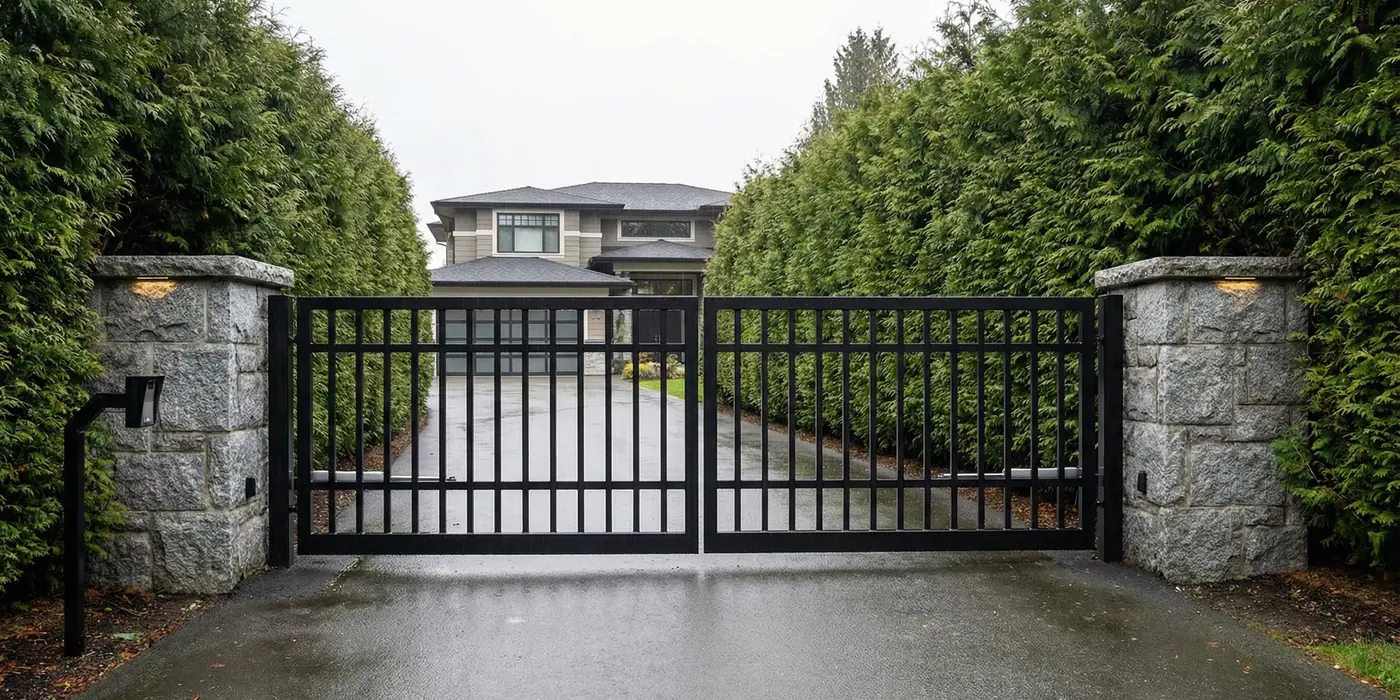
A driveway gate is four projects at once: a metalwork project, an electrical project, a civil project, and a site-specific design exercise. Get the metalwork right and the gate fails because the footings undermine in the first wet season. Get the footings right and it fails because the operator was undersized for the wind exposure. Get the engineering right and it still fails inspection because the safety sensors were not commissioned to UL 325. This hub covers all four, from the first sketch through commissioning, for property owners, builders, and architects planning a custom driveway gate anywhere in Metro Vancouver.
Why this matters: Most gate problems we get called to fix were created before the gate was installed. Wrong gate type for the driveway geometry. Operator too light for the leaf weight or the site wind load. Footings poured to unknown spec. No permit, no UL 325 sensors, no Technical Safety BC inspection, and a gate that the insurer won't cover after a claim. Reading this hub before you sign a fabrication contract saves real money. Start with the swing vs slide guide if you are still choosing the gate type.
What types of custom driveway gates can be fabricated in Metro Vancouver?
Six configurations cover almost every custom driveway gate built in Metro Vancouver. The right choice is driven by the driveway geometry, the side-yard clearance, the grade, the wind exposure, and how the gate has to behave for daily use.
| Gate type | Best for | Typical operator | Notes |
|---|---|---|---|
| Single swing | 8 to 10 ft openings, narrow driveways | Linear arm operator | Simplest, lowest cost |
| Double swing | 10 to 18 ft openings, most residential | Two linear arms or underground hydraulic | Most common Metro Vancouver spec |
| Cantilever slide | Short driveways, uphill grades | Rack-drive operator | No ground track; needs side-yard runway |
| V-track slide | Wide flat driveways | Rack-drive operator | Requires level ground track |
| Bi-parting slide | 20+ ft commercial openings | Two synchronised rack drives | Industrial / commercial scale |
| Estate (forged detail) | Heritage and luxury residential | Underground hydraulic | Highest cost; longest lead time |
Guide
Swing vs Slide
How to choose between swing, double swing, cantilever slide, and V-track slide gates. Site geometry, grade, clearance, and operator considerations for Metro Vancouver driveways.
Guide
Automation & Operators
Linear arm, underground hydraulic, and rack-drive operators for residential and commercial driveway gates. Power supply, low-voltage wiring, keypad, intercom, cellular, and app integrations.
Guide
Safety & UL 325
What UL 325 entrapment protection requires on every powered vehicular gate in BC, primary and secondary sensors, the BC Electrical Code permit path, and how Technical Safety BC inspection actually works.
Guide
Footings & Engineering
Concrete footing depth, post sizing, and wind-load engineering for custom driveway gates in Metro Vancouver, including hillside North Shore sites and Sea-to-Sky exposure.
Guide
Materials & Finishes
Mild steel, hot-dip galvanized, aluminum, and stainless options for driveway gates in the Pacific Northwest climate. Powder coat colour systems, duplex finishes, and what each material costs to maintain.
Guide
Cost Guide
What custom driveway gates actually cost in Metro Vancouver in 2026, broken down by configuration, manual swing, automated swing, slide, cantilever, and estate gates with full smart access.
Guide
Permits & Bylaws
Permit requirements for driveway gates across Metro Vancouver, City of Vancouver bylaws, electrical permits through Technical Safety BC, building permits for gate posts, and municipality-by-municipality differences.
Guide
Pedestrian Gates
Custom fabricated pedestrian gates for walkways, side entries, and garden access in Metro Vancouver, types, materials, sizing, latch and lock hardware, and the difference between a side gate and a security gate.
What does a complete driveway gate project involve, metalwork, footings, electrical, and code?
1. The metalwork
The gate frame is structural steel, typically HSS tube for the perimeter, flat bar or square bar for infill pickets, plate steel for hinge boxes and operator brackets. Every weld on the structural frame is performed under our C.W.B. certification to CSA W47.1. Hinge boxes are oversized and gusseted to handle decades of cyclic loading; weld preparation matches the wall thickness of the tube; finish prep is shot-blast or grind to bare steel before galvanizing or powder coat. Mild steel with paint over rust is the most common failure mode on cheap gates, it is not a finish system that survives the Pacific Northwest. The materials and finishes guide covers what we actually specify.
2. The civil work
A gate post takes the entire weight of the leaf, plus the dynamic loads of opening and closing thousands of times, plus the lateral wind load on the leaf area. Standard Metro Vancouver residential conditions need reinforced concrete footings 400 to 600 mm diameter and at least 1.2 m deep below frost line. Wind-exposed sites, North Shore hillside, West Vancouver waterfront, Sea-to-Sky, need 1.5 to 2 m depth and wider diameters. Soft or expansive soils may require helical piles or engineered widened pads. The footings have to cure for a minimum of 7 days before the gate can be hung. The footings page walks through the calculations and where the rules of thumb break.
3. The electrical and automation
Every powered gate is also a low-voltage and AC electrical system. AC supply runs from the house panel to an operator pad through buried conduit, sized for the operator load and any accessories. Low-voltage runs feed photo eyes, safety edges, keypads, intercoms, cameras, and access control. The hardwired AC connection requires an electrical permit through Technical Safety BC and a licensed electrician, we coordinate this on every automated install. The operators and automation page covers operator types, smart access integration, and how the wiring actually runs.
4. The safety code
Every powered vehicular gate in BC must meet UL 325 entrapment protection, primary plus secondary sensors on each direction of travel, with the operator reversing on obstruction within 2 seconds. Insurance carriers increasingly require documented UL 325 compliance after a claim, and Technical Safety BC verifies the sensor function during electrical inspection. The cost of doing this correctly at install is trivial; the cost of retrofitting after an entrapment incident is not. The safety and UL 325 page spells out exactly what is required.
How does the driveway gate fabrication and installation process work?
- Site visit (week 0): Driveway measurement, slope check, side-yard clearance check, power availability, soil observation, and design discussion. Free for Metro Vancouver residential projects.
- Design and quote (week 1): Design sketch, operator specification, automation scope, and fixed-price quote. For complex sites we provide two options (swing vs slide, two style directions) so the trade-offs are visible.
- Engineering and permit (weeks 1 to 3): Engineered drawings if required by the municipality; electrical permit through Technical Safety BC for any automated gate; building permit for the gate posts and pad as required.
- Footings (weeks 3 to 4): Reinforced concrete footings poured at the gate post locations. Minimum 7-day cure before steel goes in.
- Shop fabrication (weeks 3 to 7, parallel): Gate leaves, posts, hinge boxes, and operator mount plates fabricated at our Burnaby shop. C.W.B. certified throughout.
- Finishing (weeks 7 to 8): Hot-dip galvanizing for exterior steel followed by powder coat, the duplex finish is the durable answer for the Pacific Northwest. Galvanizing adds 5 to 7 days because it goes to a specialty facility.
- Electrical rough-in (week 8): Conduit and wiring from the house panel to the gate location, completed by a licensed electrician.
- Installation and commissioning (week 9 to 10): Gate hanging, operator installation, safety sensor placement, programming, and Technical Safety BC inspection. Owner walkthrough on operation, smart access setup, and warranty documentation.
Driveway gates by city
City-specific pages and blog guides for Metro Vancouver and the Sea-to-Sky corridor:
Why choose Jeff and Simon for custom driveway gates in Metro Vancouver?
Three things matter when picking a driveway gate fabricator: certification, integrated process, and field experience with the local code. We are C.W.B. certified to CSA W47.1, the structural welding standard. We run fabrication and installation as one workflow from our Burnaby shop, which keeps quality control tight and the accountability single-threaded. And we have installed gates across every municipality in Metro Vancouver, which means the local permit and inspection workflow is not a learning curve on your project.
Practically, the shop is on Douglas Road in Burnaby, within a 10 to 60 minute drive of every Metro Vancouver project site. Site visits, follow-up adjustments, and warranty service calls are practical instead of expensive.
Related reading
- Swing vs slide gate guide, Metro Vancouver
- Custom metal gates, what shapes the design
- Driveway gate cost, what drives the number
- Permits for railings, gates, and fences in Vancouver
- Metal fence cost, for property owners pairing fence and gate
FAQs about driveway gates and entry systems
How much does a custom driveway gate cost in Metro Vancouver?
A manual single swing pedestrian gate is the entry tier. Most automated double swing residential driveway gates with mid-tier operators and keypad entry sit in the mid-range. Cantilever slide gates and estate gates with underground hydraulic operators, video intercoms, and integrated cameras sit at the top. Every gate is quoted per project, see <a href="/driveway-gates/cost-guide/">the gate cost guide</a> for the full breakdown by configuration.
Swing or slide, which is right for my driveway?
Swing gates are simpler, cheaper, and the right choice when the driveway has clear space behind the gate line equal to the leaf length. Slide gates are the right choice for short urban driveways, uphill grades, and properties where swing clearance is unavailable. About 70% of Metro Vancouver residential installs are swing because most driveway geometries allow it. <a href="/driveway-gates/swing-vs-slide/">The full swing vs slide decision guide</a> walks through every site condition.
Do I need a permit for an automatic driveway gate in BC?
For manual gates: usually no permit unless gate posts involve structural footings above municipal thresholds. For automatic gates: any hardwired AC-powered operator requires an electrical permit through <a href="https://www.technicalsafetybc.ca/" target="_blank" rel="noopener">Technical Safety BC</a>, and the gate posts and operator pad usually require a building permit from the local municipality. Battery and solar operators without AC wiring sit in a grey area that should be confirmed with the municipality before installation. See <a href="/driveway-gates/permits-vancouver/">the permits guide</a> for municipality-by-municipality detail.
What safety features does BC code require on a powered gate?
Every powered vehicular gate in BC must comply with <a href="https://www.ul.com/news/ul-325-driveway-gate-operators" target="_blank" rel="noopener">UL 325 entrapment protection</a>. That means primary plus secondary entrapment sensors on each direction of travel, typically photo eyes plus safety edges, and the operator must reverse on obstruction within 2 seconds. <a href="https://www.technicalsafetybc.ca/" target="_blank" rel="noopener">Technical Safety BC</a> verifies these during electrical inspection. Our <a href="/driveway-gates/safety-code-ul325/">safety code page</a> covers the requirements in plain language.
How long does a driveway gate project take from quote to installation?
A standard custom driveway gate runs 6 to 10 weeks from approved drawings to a functioning installation. Roughly: 1 week for shop drawings, 3 to 5 weeks for fabrication and finishing, 1 to 2 weeks for footings and electrical coordination, and 1 week for hanging and operator commissioning. Estate gates with custom forged detail or imported operators can run 10 to 14 weeks.
What kind of footings does a steel driveway gate need?
Standard Metro Vancouver residential conditions need reinforced concrete footings 400 to 600 mm diameter and at least 1.2 m deep. Wind-exposed sites on the North Shore or Sea-to-Sky corridor need 1.5 to 2 m deep footings and wider diameters to resist lateral wind loads on tall gate leaves. Soft or expansive soils may require engineered footings with helical piles. <a href="/driveway-gates/footings-engineering/">The footings and engineering page</a> covers the calculations.
Can I integrate a driveway gate with smart home access?
Yes, and on most mid-range and premium installs we now do, smart access is part of the base spec. Common integrations: cellular access control with remote code issuance for deliveries, video intercoms (wired or wireless), camera systems at the gate, and app control. Smart access scope is quoted as an add-on to the base automation, depending on which integrations you include and what existing house systems you are tying into.
Does the Vancouver climate cause problems with gate operation?
Lower-elevation Metro Vancouver rarely sees sustained cold or heavy snow, so gate operation is not typically affected. For Squamish and Whistler installations, we spec operators rated for sub-zero temperatures and include heaters in the operator housing. Slide gates need attention to clearing the track during snow; swing gates handle snow better because the sweep path is above ground. Salt air on waterfront properties drives the choice toward 316 stainless hardware and duplex galvanized-plus-powder coat finishes.
Are you certified to weld structural gate elements?
Yes. Jeff and Simon Ironworks is C.W.B. (Canadian Welding Bureau) certified to <a href="https://www.cwbgroup.org/services/certification/company-certification/csa-w471-fusion-welding-of-steel" target="_blank" rel="noopener">CSA W47.1</a>. Every structural weld on a gate frame, hinge plate, post, or operator mount is performed by qualified welders under our certified procedures. This is the certification structural engineers reference and that the BC building inspector checks.
Do you handle both fabrication and installation?
Yes. We fabricate every gate at our Burnaby shop and install with our own crews on Metro Vancouver projects. For automated gates we also handle gate hanging, operator installation, sensor commissioning, and programming. Electrical conduit and the AC connection are coordinated with a licensed electrician. Operator commissioning is followed by Technical Safety BC inspection.
Get in touch
Need a fabrication quote?
Send drawings, photos, or even a rough description. We will review what you have and follow up with a quote or a conversation about next steps.