Metal fences are one of those items where the price range is so wide it’s almost useless without context. Ask “how much does a metal fence cost?” and the honest answer is “it depends”, a basic post-and-rail run and a full-height solid-panel privacy fence are different projects by an order of magnitude, and both are legitimate “metal fences.”
At our Burnaby shop, we fabricate custom metal fences for residential and commercial properties across Metro Vancouver. Horizontal slat fences for modern homes in East Vancouver. Ornamental picket fences for heritage properties in New Westminster. Security perimeter fencing for commercial sites in Richmond and Surrey. Each one prices out differently based on the specifics. This post walks through how each variable moves the number, so when you ask for a quote you know what decisions drive cost.
The five variables that drive cost
- Material, mild steel, aluminum, or stainless
- Style, post-and-rail, picket, horizontal slat, privacy panel, decorative
- Height, residential (up to 6 ft) or commercial (8 to 10 ft)
- Finish, powder coat only, zinc-rich primer plus powder coat, or duplex (galvanize plus powder)
- Site conditions, flat ground vs. slope, soil vs. rock, access for equipment
Each variable independently moves the price, and they compound. A commercial anti-climb fence in stainless steel on a rocky West Vancouver site is an entirely different project from a residential picket fence in mild steel on flat Burnaby soil.
Material cost: steel vs. aluminum vs. stainless
The material choice is the first fork in the road, and it affects both the upfront cost and the long-term maintenance picture.
Mild steel, the workhorse
Mild (carbon) steel is the default material for custom metal fences in Metro Vancouver. It’s the most affordable, the easiest to weld, and it takes powder coat beautifully. A skilled welder can produce cleaner, tighter joints in mild steel than in any other material, which is why the best-looking custom fences are almost always steel.
The catch: steel rusts. In Metro Vancouver’s 1,200 mm of annual rain, an unprotected steel fence will show surface rust within 6 months. Proper finishing is non-negotiable.
| Steel fence finish | Expected life |
|---|---|
| Powder coat only | 8 to 12 years before touch-up |
| Zinc-rich primer + powder coat | 12 to 18 years |
| Hot-dip galvanize + powder coat (duplex) | 25 to 40 years |
We recommend duplex finishing for every exterior steel fence in Metro Vancouver. The galvanizing protects the steel even if the powder coat gets chipped by a lawnmower, a branch, or just wear and tear. The duplex upgrade adds to the upfront cost but eliminates the need for refinishing for decades.
Aluminum, maintenance-free at a premium
Aluminum fences cost more than steel but require zero maintenance. Aluminum doesn’t rust, the natural oxide layer protects it from corrosion, and it holds paint or powder coat indefinitely without the underlying metal degrading.
The trade-off with aluminum, beyond cost, is weld aesthetics. Aluminum welding (TIG with argon shielding) produces a different bead appearance than steel welding, and grinding aluminum welds smooth takes more time and skill. For a fence where the welds are visible, steel produces a cleaner look at lower cost. For a fence where the joints are hidden by the design (horizontal slats overlapping the frame, for instance), aluminum’s maintenance advantage makes it worth considering.
Aluminum makes the most sense for waterfront properties in West Vancouver and North Vancouver where salt air is a factor, and for clients who genuinely don’t want to think about fence maintenance for the life of the property.
Stainless steel, the premium option
Stainless steel fences are rare in residential work, we build maybe 2 to 3 per year, but they show up on high-end properties and commercial projects where the architect specifies exposed stainless as part of the design language.
Grade 316 is required for marine environments, waterfront West Vancouver properties, False Creek, Coal Harbour. Grade 304 works for all other Metro Vancouver locations. The material is beautiful and permanent, but the premium over mild steel is significant. Unless the stainless finish is the point of the design, the budget is often better spent on a steel fence with duplex finish and a gate upgrade.
Design styles and what drives their cost
Standard picket fence
The traditional metal fence: vertical pickets (round, square, or flat bar) welded between top and bottom horizontal rails, hung between posts at 6 to 8 ft centres. This is the most cost-effective custom metal fence style and the one most associated with traditional residential properties.
Cost drivers:
- Picket size: 5/8” round bar is cheapest; 3/4” square tube is mid-range; 1” flat bar is premium
- Picket spacing: 4” centres use more pickets per panel than 5” or 6” centres
- Top detail: straight-cut tops are standard; spear points, scrolls, or finials add fabrication time
- Height: a 4 ft picket fence uses noticeably less material than a 6 ft fence
Horizontal slat fence
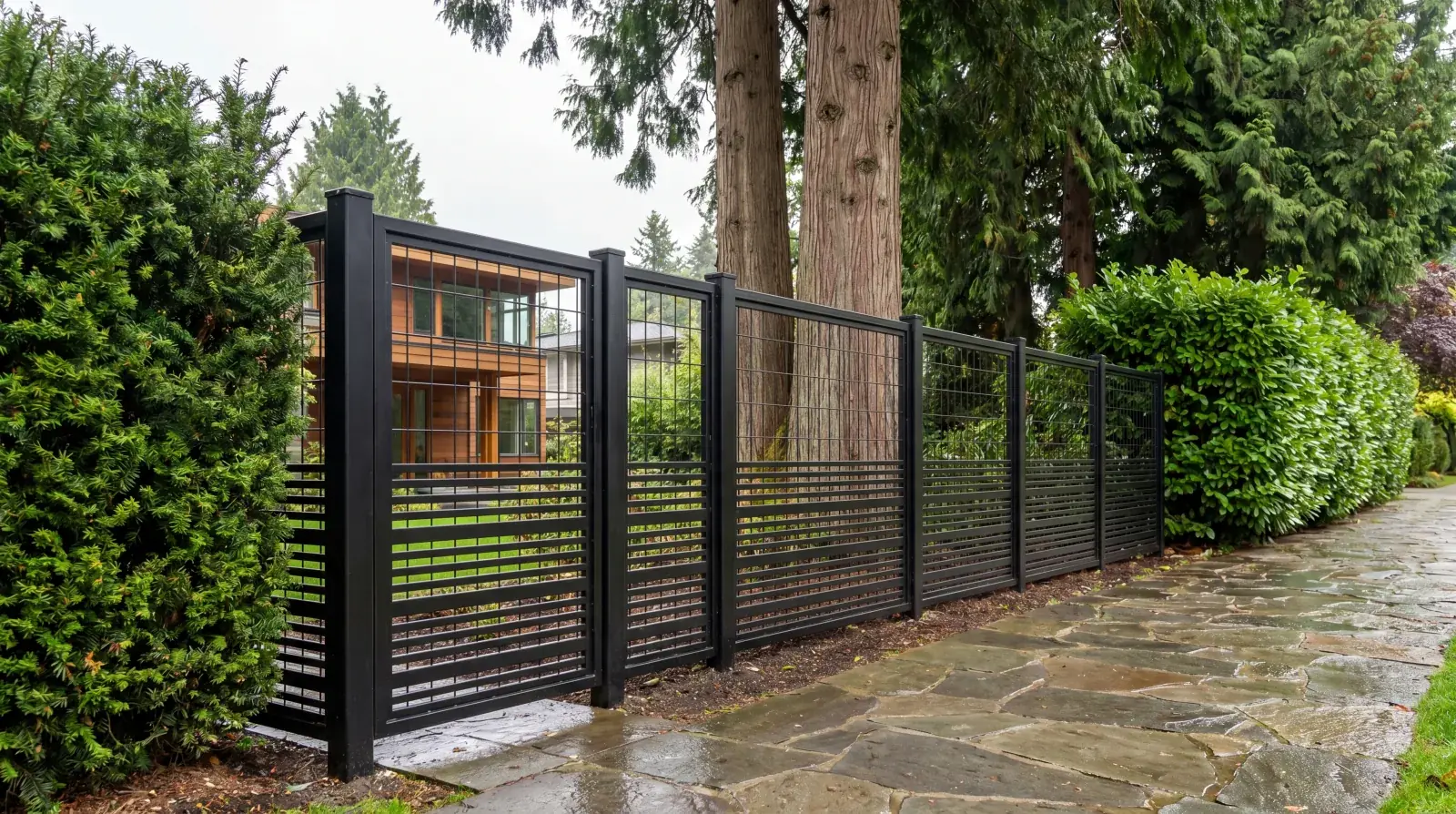
The dominant residential fence style in Metro Vancouver right now. Horizontal flat bars or rectangular tubes span between vertical posts, creating a contemporary linear look that complements the flat-roof modern homes being built across Burnaby, Vancouver, and the Tri-Cities.
Slat spacing determines material use and privacy:
| Slat spacing | Material use | Privacy level |
|---|---|---|
| 2” gap between slats | Standard | Low, can see through |
| 1” gap between slats | 30% more material | Medium, blurred visibility |
| 1/2” gap between slats | 50% more material | High, almost opaque |
| No gap (overlapping slats) | Maximum material | Full privacy |
The slat material also matters. 1x2” rectangular tube is the standard and most affordable. 1x3” flat bar gives a wider, more substantial look but uses more steel per slat. Some clients request mixed-width slats (alternating 1” and 2” widths) for a textured effect, this adds to fabrication cost because of the additional handling and layout work.
Privacy panel fence
A full privacy metal fence uses solid steel panels, either flat sheet (16 ga or 14 ga) or perforated sheet, welded into a frame between posts. This is the metal equivalent of a solid wood fence, and it’s the highest-privacy option available in metal.
Solid panel fences are heavier than picket or slat designs, which means heavier posts and deeper footings. A 6 ft solid panel fence generates significant wind load, in Metro Vancouver’s winter storms, a 100 LF solid fence can see wind loads of 20 to 30 lbs per square foot on the face. The posts and footings need to be engineered for that load, especially on exposed sites in Squamish, North Vancouver, or the West Vancouver waterfront.
Perforated panel is an alternative that provides visual privacy while reducing wind load by 30 to 50%. The perforations (typically 1/4” or 3/8” holes in a regular pattern) blur the view through the fence without creating a solid wind sail. Perforated panel fencing often costs similar to solid panel, the perforation adds a processing step but reduces the total wind load on the posts, which can simplify the footing design.
Decorative and ornamental
Decorative metal fences include scrollwork, forged elements, cast components, and any design that goes beyond straight bars and flat panels. This style is most common on heritage properties in Vancouver’s Shaughnessy, Kerrisdale, and South Granville neighbourhoods, and on estate properties in West Vancouver.
The cost premium is almost entirely labour. A decorative panel with forged scrolls and cast rosettes might use less steel than a heavy horizontal slat fence, but the fabrication time, bending, forging, assembling, grinding, is several times longer per panel. A single decorative panel with hand-forged elements can take 8 to 12 hours of shop time; a standard slat panel takes 2 to 3 hours.
Our custom metal gates page covers decorative gate styles that coordinate with ornamental fencing.
Fence post installation: the hidden cost centre
The posts are where most of the installation cost lives. The fence panels themselves are fabricated in the shop and bolt or weld to the posts on site, that’s the straightforward part. The posts need footings, and footings are where ground conditions, access, and municipality requirements complicate the budget.
Post footing options
| Footing type | Best for |
|---|---|
| Concrete sonotube (standard) | New installation, normal soil |
| Core-drilled into existing concrete | Fences on concrete pads, retaining walls |
| Helical pile (screw pile) | Rocky ground, frost-prone areas, minimal disturbance |
| Surface-mount base plate | Mounting to existing concrete slab or wall |
The standard approach for a residential fence on soil in Burnaby, Coquitlam, or Richmond is a concrete sonotube footing, 12” diameter, 3 to 4 ft deep, with the steel post set in wet concrete. The number of footings is driven by the total fence length and the post spacing, closer spacing means more footings.
Rocky sites in North Vancouver and West Vancouver are the budget busters. When the auger hits rock at 12 inches instead of the required 36 inches, the installer switches to a rock drill or core drill, and the per-post time can double. On severely rocky sites, helical piles (steel screw piles driven into the ground) are often more cost-effective than trying to drill through rock for concrete footings.
Slope and grade
Sloped installations are common across Metro Vancouver, our region isn’t known for flat lots. A fence on a slope costs more than the same fence on flat ground because:
- Each panel is custom-sized to the grade between posts
- Post heights vary (the downhill posts are longer)
- Racking hardware (if the panels tilt to follow the slope) adds connection complexity
- Stepped panels create triangular gaps at the base that need infill
On gentle slopes (under 10%), racking is usually the cleanest approach, each panel tilts slightly to follow the grade, and the top rail follows a continuous slope. On steep slopes (10 to 25%), stepping is more practical, panels stay level and drop at each post, creating a stair-step profile.
Permit requirements by Metro Vancouver municipality
Fence permit requirements vary across Metro Vancouver, and they’re tied to height and location on the lot, not to the fence material. Steel, aluminum, wood, and chain link all follow the same rules.
| Municipality | Max height without permit (front yard) | Max height without permit (rear/side yard) | Notes |
|---|---|---|---|
| Vancouver | 1.2 m (4 ft) | 1.8 m (6 ft) | Corner lots have sightline triangle restrictions |
| Burnaby | 1.2 m (4 ft) | 1.8 m (6 ft) | Some zones allow 2.4 m with permit |
| Coquitlam | 1.2 m (4 ft) | 1.8 m (6 ft) | Heritage areas may have design restrictions |
| North Vancouver (City) | 1.2 m (4 ft) | 1.8 m (6 ft) | Steep lots may need geotechnical assessment for tall fences |
| North Vancouver (District) | 1.2 m (4 ft) | 1.8 m (6 ft) | Similar to City |
| West Vancouver | 1.2 m (4 ft) | 1.8 m (6 ft) | Design review may be required in heritage/character areas |
| New Westminster | 1.2 m (4 ft) | 1.8 m (6 ft) | Heritage conservation areas have additional rules |
| Richmond | 1.2 m (4 ft) | 1.8 m (6 ft) | |
| Surrey | 1.2 m (4 ft) | 1.85 m (6 ft) |
Our permits guide for railings, gates, and fences covers the full permit process across Metro Vancouver.
Key rules that catch people off guard:
Front yard height limits are strict. A 6 ft fence in the front yard requires a variance in most Metro Vancouver municipalities, and variances are not guaranteed. Many homeowners who want privacy from the street end up with a 4 ft fence in front and a 6 ft fence starting at the front corner of the house.
Corner lots have sightline restrictions. Most municipalities require a sightline triangle at the corner, an area where fences cannot exceed 0.9 to 1.0 m (3 ft) to maintain driver visibility. This affects fence layout and sometimes requires a shorter panel at the corner.
Setbacks from property lines. Fences are typically permitted on or near the property line, but some municipalities require a 6 to 12 inch setback. Building a fence exactly on the property line requires agreement from the adjacent property owner in some jurisdictions.
Metal fence vs. wood fence: the real comparison
Wood fences are the default in Metro Vancouver, cedar privacy fences dominate residential neighbourhoods from Burnaby to Langley. How does a custom metal fence compare?
| Factor | Wood (cedar) fence | Metal (steel) fence |
|---|---|---|
| Upfront cost | Lower | Higher |
| Lifespan | 10 to 20 years | 25 to 40+ years |
| Maintenance | Stain/seal every 2 to 3 years | Touch-up every 10 to 15 years (duplex: none for 25+ years) |
| Wind resistance | Moderate, panels can blow out | High, welded connections hold |
| Fire resistance | Low, cedar burns | High, steel doesn’t burn |
| Customization | Limited to carpentry techniques | Unlimited, any shape, pattern, or detail |
| Permit | Same height rules as metal | Same height rules as wood |
The upfront cost difference is significant, a metal privacy fence costs more than a cedar fence. The lifetime cost is closer because the metal fence lasts 2 to 3x longer and requires less maintenance. On a 20-year analysis, a duplex-finished steel fence often costs less per year than a cedar fence that gets replaced once and maintained regularly.
The real reason homeowners choose metal over wood is design flexibility and durability. A horizontal slat steel fence in matte black doesn’t exist in wood, you can approximate it with horizontal cedar boards, but the look is different. A steel picket fence with decorative elements isn’t possible in wood. And a steel fence doesn’t rot at the base, warp in the rain, or attract carpenter ants, all common problems with cedar fences in Metro Vancouver’s wet climate.
Coordinating fences with gates
Most residential fence projects include at least one gate, a pedestrian gate, a driveway gate, or both. The fence and gate should be designed and fabricated together to ensure matching style, material, and finish.
For projects that include both fence and gate, we design them as a package, same post style, same picket or slat profile, same finish batch. This ensures a consistent look and avoids the colour mismatch that happens when the fence and gate are powder coated in separate batches.
Our driveway gate project guide breaks down gate cost drivers in detail, and our custom driveway gates page has project photos.
Commercial metal fencing
Commercial metal fences follow different rules than residential. Heights are taller (8 to 10 ft), material gauges are heavier, and the design often includes anti-climb features (no horizontal rails that could serve as footholds, or outward-angled top sections).
Commercial projects in Richmond, Surrey, and Langley, where industrial and warehouse properties are concentrated, make up a significant portion of our commercial fencing work. The scope is typically larger (500 to 2,000 LF), the material is heavier, and the installation timeline is tighter because commercial construction schedules don’t wait.
Our residential metal projects page and driveway gates page have project photos showing fence and gate combinations we’ve built across Metro Vancouver. For a quote on your specific fence project, residential or commercial, use the form on our contact page with the total linear footage, desired height, and any known site conditions (slope, rocky ground, existing concrete).