
Railing system guide
Exterior deck and balcony railings
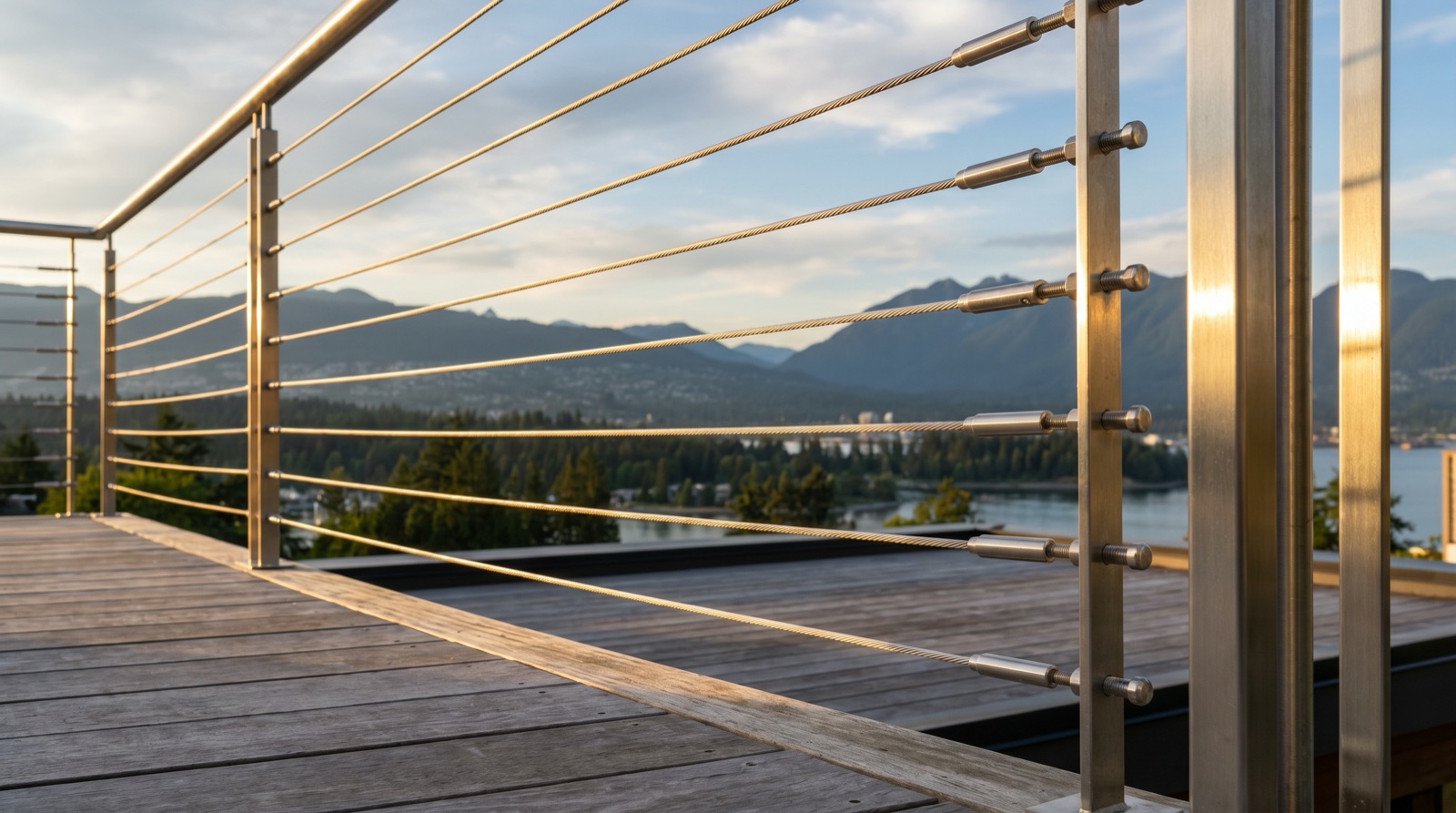
The Vancouver climate is particular about exterior metal. Coastal humidity, wind-driven rain, and salt air on waterfront properties combine to expose every shortcut in material specification, finish, and anchorage. Done right, an exterior deck railing lasts 50 years with minor maintenance. Done wrong, the same railing is replaced in 8 years with corrosion at the base plates and rust streaking down the deck below.
The single decision that matters most: material and finish specification. Hot-dip galvanized steel, 316 stainless, or marine-grade powder-coated aluminum. Anything else compromises long-term performance in this climate. Bare mild steel with wet paint is what we replace, not what we build.
Material options for exterior deck railings
Hot-dip galvanized steel
The default exterior choice for most Metro Vancouver decks. ASTM A123 hot-dip galvanizing puts a 100+ micron zinc coating on the steel that gives 50+ year service life under typical exterior exposure. The visible "spangle" finish is industrial, works well on functional decks, fire escape access, and properties where a utilitarian aesthetic fits. For an architectural finish, the galvanized steel can be top-coated with powder coat (a "duplex system") combining corrosion protection with a designed colour finish.
316 stainless steel
The right answer for waterfront properties exposed to salt air, and for premium architectural installations where the brushed-stainless aesthetic is the design intent. 316 grade specifically, 304 stainless will pit and stain in chloride-rich coastal air within a few years. Stainless costs significantly more than galvanized steel but is the only metal we specify with confidence on direct salt-water exposure. See our 304 vs 316 stainless guide.
Powder-coated marine-grade aluminum
Used on multi-unit residential balconies where weight on the deck slab matters, and on light-duty residential installations. Aluminum alloy 6061-T6 or 6063-T5 with a marine-grade powder coat gives 30 to 40 years of service before the finish needs refreshing. Trade-offs: aluminum is less stiff than steel for the same section size, so posts have to be larger; welds require specific filler and procedure; aluminum top rails ring under impact more than steel.
Marine-grade aluminum (anodized)
Anodized aluminum (instead of powder coat) for very high-end installations where the architect wants a specific anodized finish, typically matte clear, dark bronze, or black anodized. Cost premium over powder coat; finish lasts longer because the anodized layer is part of the metal rather than a coating on top of it.
Anchorage to a wood-framed deck
Wood deck framing was not designed with current code-loaded railings in mind. Most existing decks need reinforcement at post locations to handle the BCBC top rail load (0.5 kN/m residential, 0.7 kN/m commercial) and concentrated point loads (0.9 kN). Configurations we use:
- Through-bolted to rim joist with backing: M12 through-bolts with structural backing inside the joist cavity. Acceptable on adequately stiff rim joists; pull-out testing recommended for older or marginal framing.
- Continuous steel angle along deck edge: 75 × 75 × 6 mm galvanized steel angle bolted to multiple joists, with posts welded or bolted to the angle. The most reliable approach for serious cable or glass railings on wood-framed decks.
- Side-mounted (fascia) anchorage: Posts bolted to the outside face of the rim joist with a continuous steel plate behind the fascia. Frees the deck surface of post obstructions; demands more careful structural detailing.
Lag screws into the top of a wood deck plate are not adequate for current code loading. Inspectors check for proper through-bolted connections during final inspection; we don't fabricate or install railings with lag-screw post anchorage on new work.
Anchorage to a concrete balcony
- Surface-mounted base plate: Most common on existing concrete balconies. Stainless or galvanized base plate bolted to the slab with epoxy or expansion anchors sized for the calculated load. Edge distance to the slab edge must satisfy the anchor spec, typically 75 mm minimum.
- Through-slab connection: Posts pass through the slab with a base plate above and a backing plate below, bolted through. Used on commercial work where the load demands more capacity than surface-mounted anchors deliver.
- Core-drilled embedded: Post embedded into a cored hole and grouted. Visually clean (no base plate visible) but harder to inspect and replace; uncommon now relative to surface-mounted approaches.
Drainage and water management
The single most common long-term failure mode on exterior railings is water sitting in connections, under base plates, in hollow post cavities, in unsealed weld joints. Three rules we follow:
- Sloped top rail caps: Top rails finish with a sloped or rounded profile that sheds water rather than letting it sit on the surface. Flat-topped flat bar accumulates water at every joint.
- Galvanizing weep holes: Hollow steel sections (HSS posts and tube top rails) get weep holes drilled at the bottom so the galvanizing process drains and ongoing service water can drain. ASTM A123 specifies minimum hole size and location.
- Sealed base plate joints: Polyurethane sealant under post base plates prevents water from sitting in the joint between the plate and the supporting surface. Critical on concrete balconies where standing water at base plates is a long-term corrosion driver.
Connection hardware compatibility
Galvanic corrosion at dissimilar-metal connections is the second most common failure mode. Rules we follow:
- Stainless cables paired only with stainless or galvanized posts (never mild steel).
- Stainless anchor bolts in stainless or galvanized base plates.
- Aluminum hardware isolated from steel substrates with neoprene or polymer washers.
- Powder coat on aluminum specified as "marine-grade" or higher; standard architectural powder coat fails under UV and salt exposure within a few years.
Code compliance for exterior balcony guards
Same rules as interior guards: 1070 mm minimum height where the fall exceeds 1800 mm; 100 mm sphere test; 0.5 kN/m residential or 0.7 kN/m commercial top rail load; 0.5 kN infill load. The exterior environment doesn\'t change the code requirements, it changes the durability requirements. See our BC Building Code reference.
Related reading
For replacement scenarios specifically, see our railing replacement guide. For multi-unit and strata applications, strata and commercial railings. Blog posts: balcony railing replacement cost, deck railing replacement, galvanizing vs powder coating in coastal climate, and marine-grade metalwork.
FAQs about exterior deck railings
What is the best material for an exterior deck railing in Vancouver?
Three options dominate: hot-dip galvanized steel for durability and value (50+ year service life per the <a href="https://www.galvanizeit.org/" target="_blank" rel="noopener">American Galvanizers Association</a>); 316 stainless for premium installations or any waterfront property exposed to salt air; and powder-coated marine-grade aluminum for lightweight installations on multi-unit residential balconies. Bare mild steel with paint is a poor choice in this climate, paint is a coating, not a barrier, and the substrate corrodes underneath.
How is a deck railing post anchored to a wood deck?
The right way is through-bolted to a structural framing member (rim joist or doubled outboard joist), with backing and washers. Lag screws into the top of a deck plate are inadequate for code loading on most posts, they pull out under the BCBC 0.9 kN concentrated load. Better still: a continuous steel angle or steel rim plate fastened to multiple framing members, with the post welded or bolted to the steel. We field-verify the framing during quoting and call out reinforcement needs before fabrication starts.
How is a deck railing post anchored to a concrete balcony?
Two approaches: surface-mounted with through-bolts or post-installed expansion or epoxy anchors; or core-drilled with the post embedded into a sleeve and grouted in place. Through-bolted base plates are most common because they're inspectable and replaceable. Anchor sizing (M10 to M16) depends on the cumulative top rail load and the post tributary length. Edge distance from the slab edge has to satisfy the anchor manufacturer's spec, typically 75 mm minimum.
Can a railing be mounted to the deck fascia instead of the top of the deck?
Yes, fascia-mounted (also called "side-mounted") posts are common on contemporary residential decks. The post bolts to the outside face of the rim joist or fascia rather than sitting on top of the deck surface. This puts the entire deck surface free of post obstructions. Structural requirements are stricter because the load path is through the fascia connection (often requiring a continuous steel plate behind the fascia) rather than direct downforce into the framing.
How do you stop posts from rusting at the deck connection?
Three layers of defence on exterior posts: (1) galvanized or stainless post material so the steel itself resists corrosion; (2) anchor isolation to prevent galvanic action between post and connection hardware (use stainless anchors with stainless or galvanized posts; never mix stainless cables with mild steel posts); (3) sealant under post base plates to prevent water from sitting in the joint. The most common cause of "rusty deck railings" we replace is mild steel posts with paint finish where the paint failed at the base plate joint and water sat under the post for years.
How long should an exterior deck railing last?
Properly specified hot-dip galvanized steel: 50+ years per ASTM A123. 316 stainless: equivalent service life. Powder-coated marine-grade aluminum: 30 to 40 years before the finish degrades enough to need refinishing. Bare mild steel with wet paint: 5 to 15 years before noticeable corrosion, depending on exposure. The lifecycle math almost always favours galvanized or stainless on exterior, the upfront premium pays back many times over avoided replacement.
Can the railing have an integrated lighting system?
Yes. Low-voltage LED systems integrated into top rail caps or post caps are common on premium residential decks. The wiring runs through hollow post sections and exits at a low-voltage transformer at the deck. Coordination with the electrician needs to happen during shop drawings, the post sections need internal access points for wire pulls and the lighting hardware has to be specified before fabrication.
What about snow loading on exterior railings?
Most Metro Vancouver elevations don't see significant snow loading on railings (the snow falls off the top rail rather than accumulating). Where snow load matters is at roof-level decks, and at higher elevations like Whistler. The horizontal top rail load (0.5 kN/m residential, 0.7 kN/m commercial) governs design, snow load on a railing is generally well under that. The exception is a railing with a horizontal top cap deeper than ~150 mm that could accumulate snow weight; the engineer accounts for this in sizing.
How do you handle thermal expansion on long exterior runs?
Steel and aluminum railings expand and contract with temperature. On long runs (over ~20 m), an expansion joint in the top rail prevents bowing and stress at the post connections. Detail: a slip joint with a sleeve allowing the rail to slide as it expands, with the visible joint disguised as a continuous line. Most residential runs don't need this because the run length is short enough that expansion is absorbed at the post connections without measurable distortion.
Can I replace just the railing without replacing the deck?
Yes, exterior deck railing replacement on an existing deck is one of our most common scopes. The structural challenge is verifying that the existing deck framing is adequate for the new railing's anchorage requirements. We field-inspect the deck before quoting and call out any framing reinforcement, decking material removal at post locations, or substrate repair that's needed. The decking is removed locally at each post location during installation, then reinstalled.
What about water management, drainage and finishing?
Three rules: (1) post connections must let water drain rather than sit; sloped top rail caps prevent standing water; (2) any paint or sealant has to be specified for outdoor service with UV resistance; (3) galvanizing weep holes are required on hollow steel sections so the inside of the post can drain after the galvanizing process and during service. Failure to drain is the long-term failure mode we see most often on poorly specified exterior railings.
Get in touch
Need a fabrication quote?
Send drawings, photos, or even a rough description. We will review what you have and follow up with a quote or a conversation about next steps.