Most stainless steel railing sold in Metro Vancouver is 304 grade. Most stainless steel railing that fails prematurely on Metro Vancouver waterfront properties is also 304 grade. The connection between those two facts is what this post is about.
At our Burnaby shop we fabricate stainless steel railings in both 304 and 316 for residential and commercial projects across the region. The grade decision is not complicated once you understand what each alloy does differently in our specific climate, but it is a decision that gets made wrong often enough that we pull corroded 304 stainless off West Vancouver and North Shore properties every year. Railing that was expensive to install, looked great for three or four years, and is now stained, pitted, and heading toward failure at the fastener connections.
This is the practical breakdown of when each grade is the right call for Metro Vancouver, what the cost difference actually is, and how to avoid the corrosion problems that come from specifying the wrong one.
What makes 304 and 316 different
Both 304 and 316 are austenitic stainless steels, the family of stainless alloys that are non-magnetic, weldable, and corrosion-resistant. They look identical when new. The difference is inside the alloy.
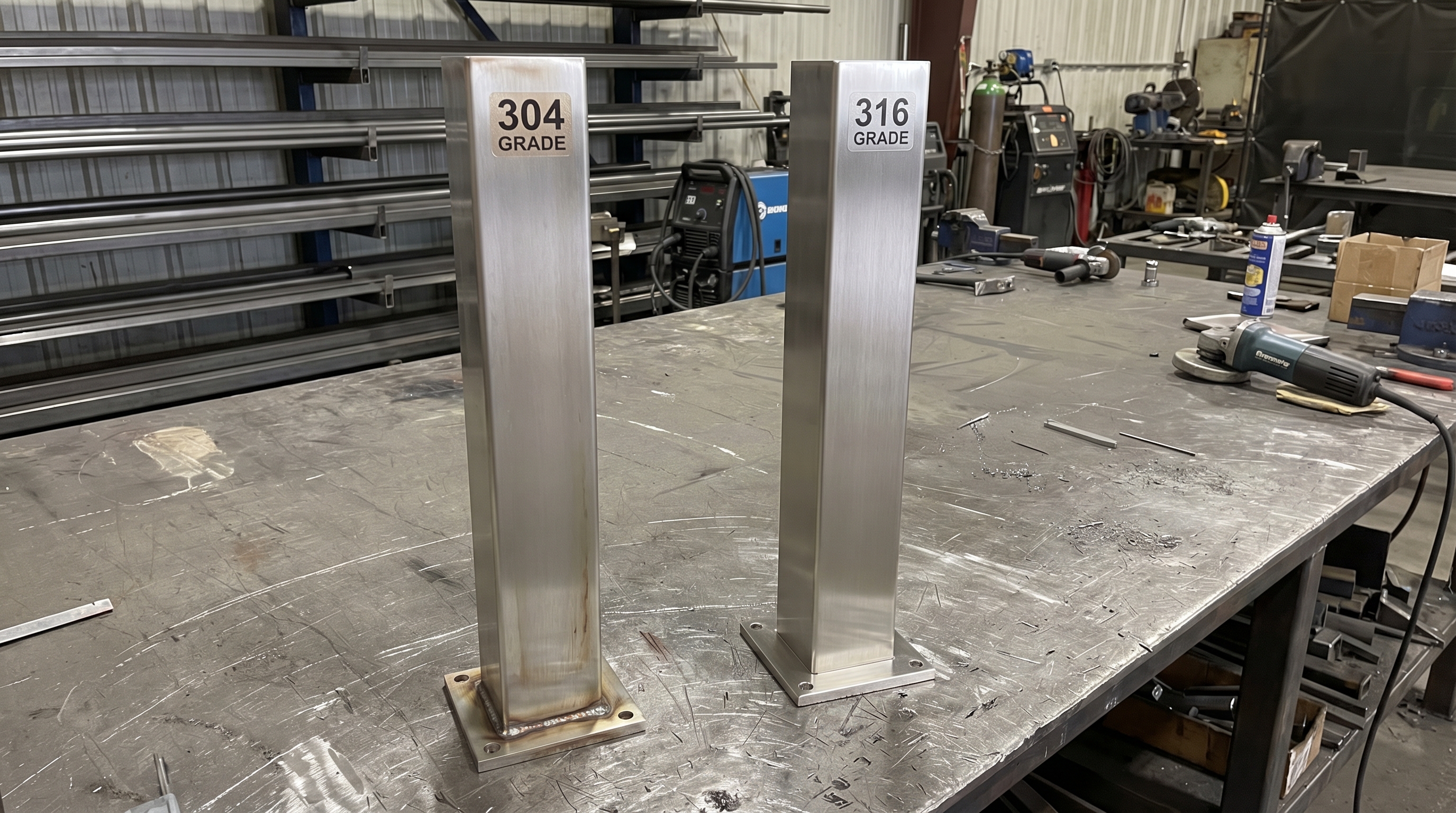
304 stainless (UNS S30400) contains 17.5 to 19.5% chromium and 8.0 to 10.5% nickel. The chromium forms a passive oxide layer on the surface that prevents corrosion in most environments. 304 is sometimes called “18-8 stainless” and it is the workhorse austenitic grade used across most general-purpose applications. For interior applications and sheltered exterior environments, it performs well and costs less than 316.
316 stainless (UNS S31600) contains 16.0 to 18.0% chromium, 10.0 to 14.0% nickel, and, the important part, 2.0 to 3.0% molybdenum. Molybdenum is what gives 316 its resistance to chloride-induced pitting and crevice corrosion. The International Molybdenum Association notes that, within the Pitting Resistance Equivalent Number formula (PREN = %Cr + 3.3 × %Mo + 16 × %N), molybdenum is roughly 3.3 times more effective than chromium at improving pitting resistance. Chloride ions are what make salt water and salt air corrosive to metals. Without molybdenum, 304 has limited defence against chloride attack. With it, 316 resists the same conditions that would pit and stain 304 within a few years.
The shorthand: 304 handles rain. 316 handles rain plus salt.
In Metro Vancouver, the rain part is obvious, Vancouver International Airport averages 1,189 mm of precipitation per year, with the wettest months (November, January, December) each receiving roughly 170 to 175 mm. But the salt part is what catches people. Vancouver is a coastal city. The Strait of Georgia, Burrard Inlet, English Bay, and the Fraser River estuary all contribute airborne chlorides. How much salt your railing sees depends on how close you are to the water, how exposed your site is to prevailing winds, and whether there is any shielding from terrain or buildings between your property and the salt source.
Where 304 works in Metro Vancouver
304 stainless is the right choice, and the more cost-effective one, for the majority of residential and commercial railing projects in the inland parts of Metro Vancouver. If your property is not on the waterfront or in the direct path of ocean wind, 304 will serve you for decades.
Most of Burnaby. Our shop is on Douglas Road and the majority of the Burnaby projects we handle spec 304 for stainless components. Burnaby is sheltered from direct salt air by the city of Vancouver itself and by the North Shore mountains. The Metrotown, Edmonds, Deer Lake, and Forest Hills areas are all well inland. The exception is the north-facing slope of Capitol Hill and Burnaby Mountain, where Burrard Inlet wind can carry salt uphill, on those sites we sometimes recommend 316 for the hardware even though the distance from the water looks safe on a map.
Coquitlam, Port Moody, New Westminster. All are far enough inland that 304 handles exterior exposure without issues. Port Moody is technically on Burrard Inlet at its eastern end, but the salt concentration that far up the inlet is much lower than at the open-ocean end in West Vancouver.
East Vancouver, Burnaby Heights, the Tri-Cities. Sheltered inland areas with standard rain exposure but minimal salt. 304 is the standard spec and lasts 25 to 40 years with basic maintenance.
Surrey, Langley, Richmond (inland). Well away from marine influence. 304 is more than adequate for any exterior railing application.
Interior residential applications everywhere. Inside the house, 304 is always sufficient regardless of the property’s proximity to salt water. Interior railings do not see rain, salt air, or UV exposure. A 304 stainless interior stair balustrade will last longer than the house it is installed in.
Where 316 is the right spec
316 is the correct choice when the railing will be exposed to salt air, salt spray, or any environment where chloride concentration is higher than typical inland Metro Vancouver rainfall delivers.
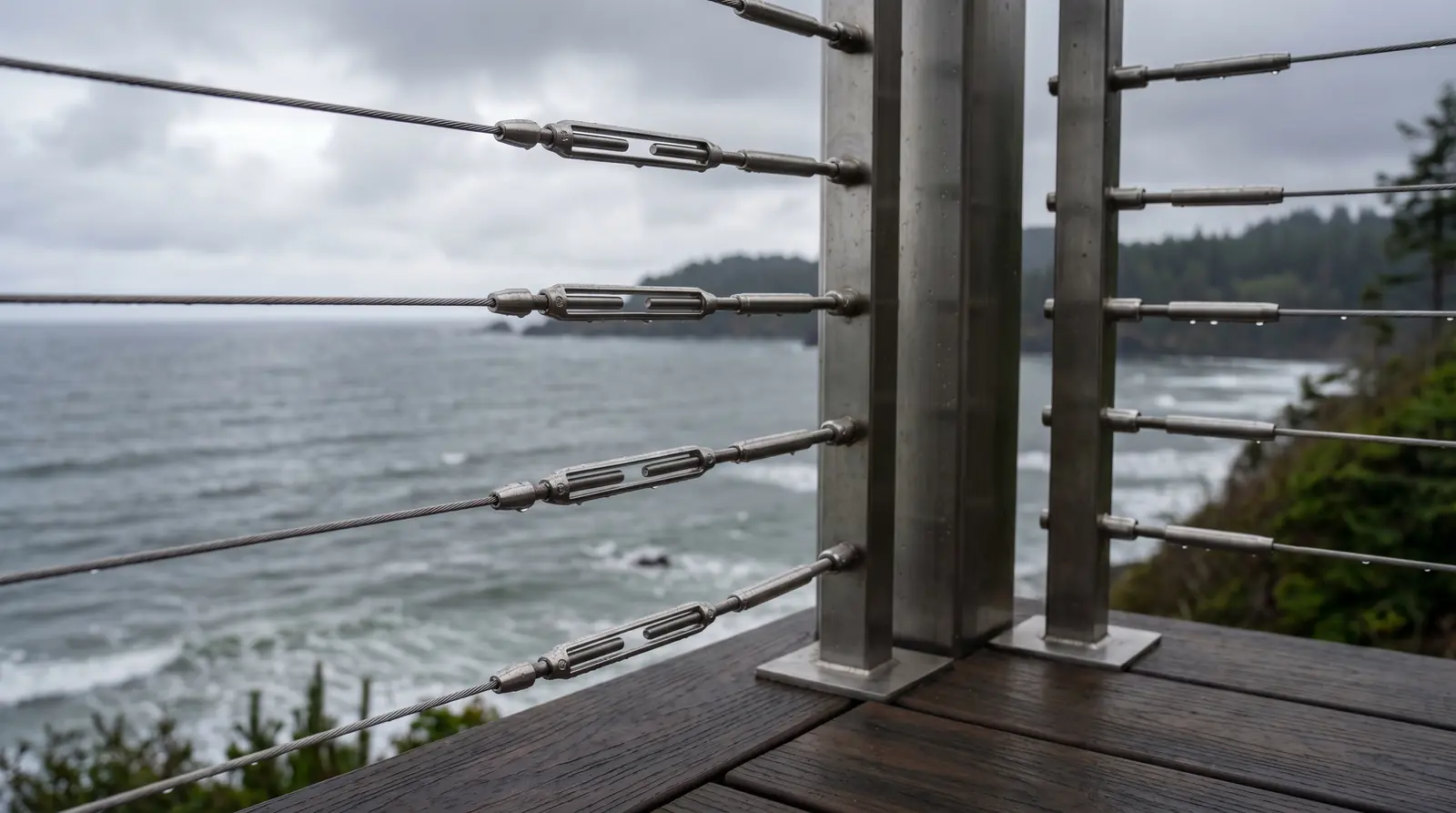
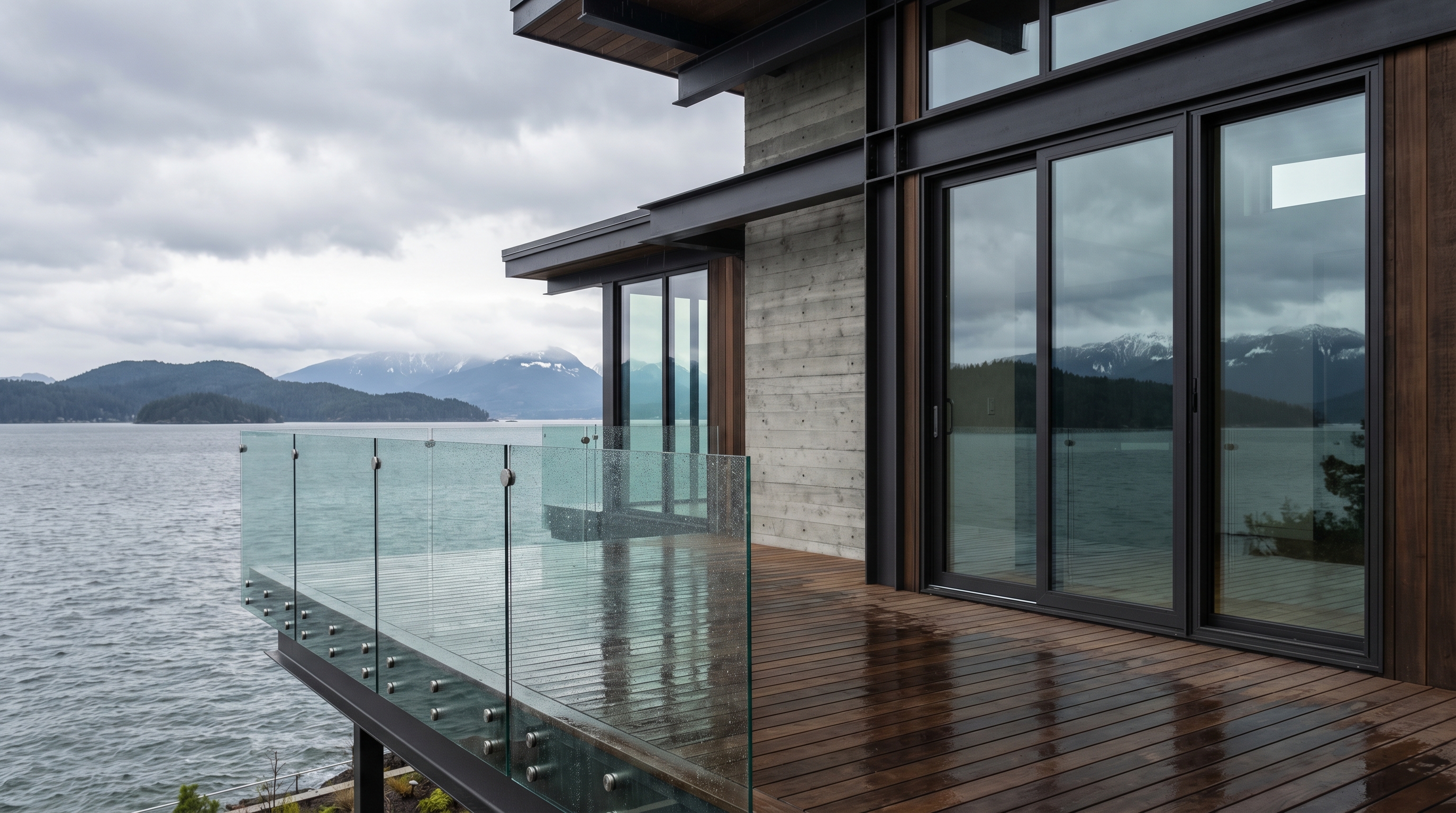
West Vancouver waterfront. From Ambleside to Horseshoe Bay, any property with a direct sightline to the open ocean or Burrard Inlet needs 316 stainless for exterior railing hardware. We have pulled 304 cable railing fittings off a Dundarave deck that were visibly pitted after four years. The same property with 316 hardware would still look new after a decade.
North Vancouver waterfront and Lower Lonsdale. The Lower Lonsdale shipyards area, Mosquito Creek, and the waterfront between the Seabus terminal and Capilano River all get direct Burrard Inlet exposure. 316 for any exterior railing in this zone.
Deep Cove and Dollarton. Protected from the open Strait by the Indian Arm topography, but still on the tidal water and still receiving enough salt to cause issues with 304 over a 10+ year period. We spec 316 on Deep Cove decks as a default.
Kitsilano Point, Coal Harbour, False Creek south shore. English Bay and False Creek are not open ocean, but they deliver enough salt air to make 316 the better long-term choice on exposed exterior railings. A Kits Point deck facing the water is in the same exposure class as a West Vancouver waterfront, the salt comes from the same Burrard Inlet system.
Richmond Steveston waterfront. Properties along the dyke trail and facing the south arm of the Fraser River or the Strait of Georgia get direct marine exposure. 316 for exterior metalwork on these sites.
Squamish and Whistler. Squamish is at the head of Howe Sound and gets ocean wind through the Sound, 316 is advisable on exposed exterior railings in Squamish. Whistler is far enough inland that salt air is not a factor; 304 is fine there.
The grey zone: properties that could go either way
Not every site fits cleanly into “inland 304” or “waterfront 316.” Several Metro Vancouver locations fall into a grey zone where the decision depends on specific site exposure rather than just distance from the water.
North Vancouver mid-slope. Properties between the waterfront and the Upper Levels Highway are partially sheltered but still receive some salt air from Burrard Inlet, especially on south-facing exposures. For these sites, we often recommend 316 for the most exposed components (end fittings, base plates, fasteners) and allow 304 for the structural posts if the client wants to manage cost. A fully 316 system is the conservative choice.
Kitsilano and Point Grey inland blocks. Two or three blocks back from the water, the salt concentration drops significantly. A Kits house on 4th Avenue is in a different exposure class than one on Point Grey Road. For the inland blocks, 304 with diligent annual cleaning is usually fine. For the waterfront blocks, 316.
West Vancouver upper properties. The British Properties and Sentinel Hill are 200 to 400 metres above sea level and several kilometres from the water, but they are exposed to the outflow winds from the ocean that carry salt uphill. On a wind-exposed site at elevation, we have seen 304 stain faster than expected. These are sites where a conversation about the specific exposure conditions is worth having before locking the spec.
Strata buildings in the West End. Downtown Vancouver high-rises that face English Bay or Coal Harbour get direct salt exposure on upper floors where the wind is stronger. Lower floors sheltered by surrounding buildings may be fine with 304. The strata spec should account for the worst-case exposure on the building, which is usually the top several floors on the ocean-facing side.
The cost difference: 304 vs 316
316 stainless carries a premium over 304 on raw material, which flows through to the installed cost. The fabrication labour is identical, welding, cutting, and finishing 316 takes the same shop hours as 304. What changes is the material line on the quote.
| System | 316 premium over 304 |
|---|---|
| Cable railing, stainless posts and cables | Moderate |
| Glass railing with stainless standoffs | Moderate |
| Stainless picket railing | Moderate |
| Stainless top rail only (on steel or aluminum posts) | Higher relative premium on this add-on item |
| Full stainless stair balustrade | Moderate |
Raw material cost is the driver. 316 stainless raw material costs meaningfully more than 304 depending on market conditions and the specific section (tube, plate, bar). The exact dollar premium on any project depends on the market at the time the steel is purchased, we quote current rates when the project is scoped.
On a waterfront home where the railing is protecting a view that sold the property, the 316 premium is a small percentage of the project budget. On a standard Burnaby or Coquitlam deck, that same premium may not be justified when 304 would last just as long in the sheltered environment. This is the cost-benefit call we help clients make based on the actual exposure at their site.
What goes wrong when 304 is used in a 316 environment
The failure mode is predictable and we see it regularly on railing replacement calls from West Vancouver and the North Shore.
Tea staining appears first. Brown or orange discoloration on the surface, typically starting at weld joints, base plates, and crevice points (anywhere two metal surfaces sit close together and can trap moisture). Tea staining is not structural corrosion, it is a cosmetic surface deposit, but it is the first visible sign that chlorides are attacking the metal. The British Stainless Steel Association notes that for atmospheric exposure in coastal regions, grade 316 is favoured precisely because 304 is more vulnerable to this type of chloride-driven surface attack. On 304 in a marine environment, tea staining can appear within 18 to 36 months.
Pitting follows. Small circular holes in the surface of the metal, typically 0.5 to 2 mm in diameter. Pitting is actual material loss and it is not reversible. Once a pit forms, it becomes a concentration cell for further corrosion and tends to deepen over time. On 304 stainless in direct West Vancouver waterfront exposure, we have seen pitting develop within 3 to 5 years.
Crevice corrosion at fasteners. This is the dangerous failure mode. Bolted connections, base plate joints, and cable end fittings create crevices where salt water can enter but not easily flush out. The chloride concentration builds up inside the crevice and accelerates corrosion. On a cable railing, a failed end fitting can release the cable under tension. On a post-mounted railing, a corroded base plate connection can allow the post to separate from the deck under load.
The timeline in Metro Vancouver. On a fully exposed West Vancouver waterfront deck with 304 stainless hardware, the typical timeline we see is: tea staining at 2 to 3 years, visible pitting at 4 to 6 years, structural concern at fastener connections by 8 to 12 years. The same system in 316 shows no visible degradation at the 10-year mark and remains structurally sound past 25 years.
That timeline difference is why the 316 premium pays for itself on any property with real salt exposure. Replacing a prematurely failed 304 system at 10 years costs more than the 316 premium would have been on the original install.
Specifying the right system: what to tell your fabricator
If you are specifying or purchasing stainless steel railings for a Metro Vancouver project, the information that determines the right grade is:
1. Site location and exposure. The specific address and the orientation of the railing relative to the ocean or inlet. A railing on the south side of a North Vancouver house facing away from the water may be fine in 304 even though the property is technically waterfront.
2. Shielding. Is the railing sheltered by the house, a wall, a canopy, or surrounding buildings? Sheltered exterior railings see less salt deposition than fully exposed ones. A West End strata balcony on the 4th floor sheltered by surrounding towers is different from an exposed penthouse terrace facing English Bay.
3. Owner’s maintenance commitment. Stainless steel is not no-maintenance. Both 304 and 316 benefit from regular cleaning in our climate. If the owner will realistically clean the railing quarterly and rinse it monthly in winter, 304 has a longer viable life in marginal environments. If the owner will install the railing and never touch it again (which is most owners), 316 is the safer bet in any location with even moderate salt exposure.
4. Budget context. On a smaller residential railing project, the 316 premium is a noticeable percentage of the total. On a larger project as part of a high-end home, the same premium is a smaller share of the overall budget. We help clients make that cost-benefit call based on the real exposure conditions at their site.
5. System consistency. If 316 is warranted for any component, it should be 316 for all components. Mixing 304 posts with 316 cables creates a system where the posts corrode first and the cables (the most visible part) are the only thing that survives. It also creates a galvanic interaction between the two grades at connection points, which can actually accelerate corrosion at the junction. Spec one grade and stick with it.
Finish matters too
The finish on stainless steel affects corrosion performance independent of the alloy grade. A rough finish has more microscopic surface area for salt to adhere to. A smooth finish sheds water and salt deposits more readily.
#4 brushed satin is the most popular finish on residential stainless railings in Metro Vancouver. The directional grain hides fingerprints and light scratches well, and it looks clean without being reflective. For inland 304 applications, it performs well. For coastal 316 applications, it is adequate but not optimal.
Mirror polish is the smoothest standard finish and performs best against corrosion because the polished surface has the fewest crevices for salt to accumulate in. It is also the most maintenance-intensive cosmetically, every fingerprint shows.
Electropolished is a chemically smoothed surface that removes the outermost layer of metal and creates a chromium-enriched passive layer. It is the best corrosion performer of any standard stainless finish and is the premium specification for 316 stainless in marine environments. An electropolished 316 railing on a West Vancouver waterfront deck is the most durable exterior railing system available. Electropolishing is an additional process step over standard brushed finish, and the added cost reflects the extra handling and chemical processing.
Bead-blasted matte is a non-directional textured finish that hides contact marks well. It has slightly more surface roughness than brushed, which means marginally more salt retention in exposed environments. Fine for inland 304 applications. For coastal exposure, brushed or electropolished is a better choice.
For detailed railing finish comparison and how different coatings perform in Vancouver’s climate, see our galvanizing vs powder coating for coastal Vancouver guide. For material-level comparison between stainless, mild steel, and aluminum, our steel vs aluminum railing analysis covers the broader decision.
Our recommendation by project type
Inland residential deck or stair railing (Burnaby, Coquitlam, New Westminster, Surrey, Langley): 304 stainless with #4 brushed finish. Annual cleaning with soap and water.
Waterfront or exposed coastal railing (West Vancouver, North Vancouver waterfront, Deep Cove, Kitsilano Point, Coal Harbour, Steveston): 316 stainless throughout, brushed or electropolished finish. Monthly freshwater rinse during wet season, quarterly cleaning.
Strata balcony replacement in a coastal exposure building: 316 stainless for all hardware, engineered to the building’s specific exposure conditions. Scope and pricing are handled as part of the building-wide project by the engineer and contractor team.
Interior stair balustrade anywhere in Metro Vancouver: 304 stainless with mirror or brushed finish. Wipe-down as needed, interior stainless is the lowest-maintenance railing system available.
Commercial mezzanine or public-area railing: spec based on exposure. Interior commercial spaces always 304. Exterior commercial in coastal zones always 316. Commercial guard load engineering and heavier post specs add to the per-foot cost over residential.
For the full Metro Vancouver railing cost picture across all materials, not just stainless, see our custom metal railing cost guide. For the glass vs cable decision on view-preserving systems, our glass vs cable railing comparison covers both with stainless hardware context.
If you are specifying a stainless railing and are unsure about the grade, send us the site address and photos. We can tell you what grade we would spec for that location based on the exposure conditions we have seen on similar sites across Metro Vancouver. The site visit is free for residential projects, and the 10 minutes it takes to confirm the right grade can save you a premature replacement down the road.
For the broader railing material reference and how stainless fits alongside galvanized steel, aluminum, and powder coat, see our custom railings materials and finishes guide within the custom railings hub.