Railing pricing in Metro Vancouver is all over the place. You can find a prefab aluminum panel kit at a building supply store for a fraction of the cost of a frameless glass system with stainless steel standoffs, but every configuration in between is quoted per project. Where your scope lands depends on a handful of decisions that get locked in early.
We fabricate and install custom railings from our shop in Burnaby, and the most common question we hear from homeowners, contractors, and architects is some version of “what should I budget?” This is the honest answer, broken down by material, style, and the factors that actually move the number.
Scope tiers for custom metal railings
Here are the configurations we fabricate across projects in Burnaby, Vancouver, North Vancouver, and Coquitlam. Every run is quoted per project including material, fabrication, finishing, and installation.
| Railing type | Tier | Best for |
|---|---|---|
| Aluminum (prefab) | Baseline | Budget deck and balcony guards |
| Aluminum (custom) | Baseline, mid | Modern homes, colour matching |
| Steel picket | Mid-range | Residential decks, stairs, balconies |
| Wrought iron / ornamental | Mid-range | Heritage homes, scrollwork details |
| Cable railing | Mid-range | North Shore and modern custom homes |
| Glass-and-metal (semi-frameless) | Mid-to-premium | Contemporary residential, strata |
| Glass-and-metal (frameless) | Premium | Waterfront, premium custom builds |
Tiers reflect straight-run residential applications. Stair-mounted railings, curved runs, and marine-grade finishes add 25 to 40% to these tiers.
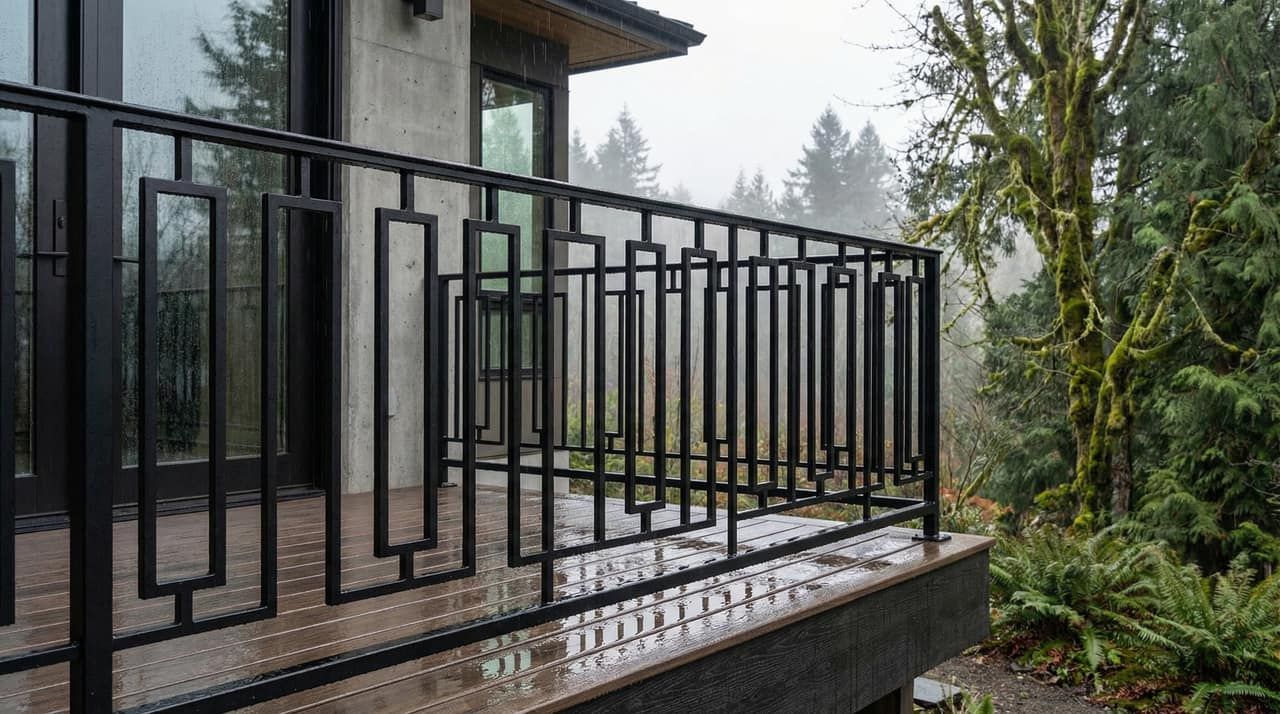
Steel picket railings (vertical bar infill, powder coated): the workhorse of residential railing. A straight run along a deck or balcony in a standard matte black finish sits at the baseline of this tier. Add curves, non-standard post spacing, or a custom colour and it climbs.
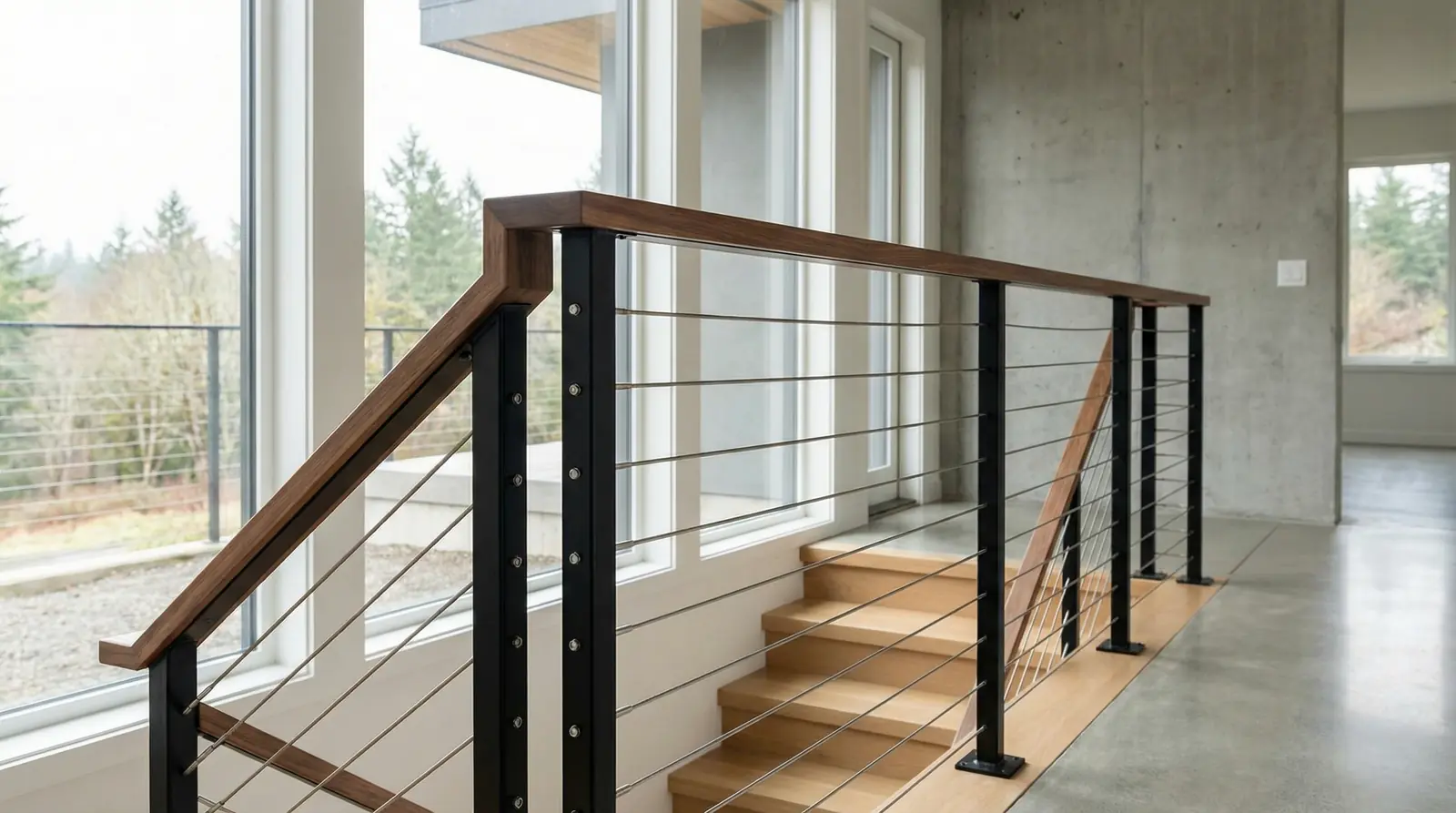
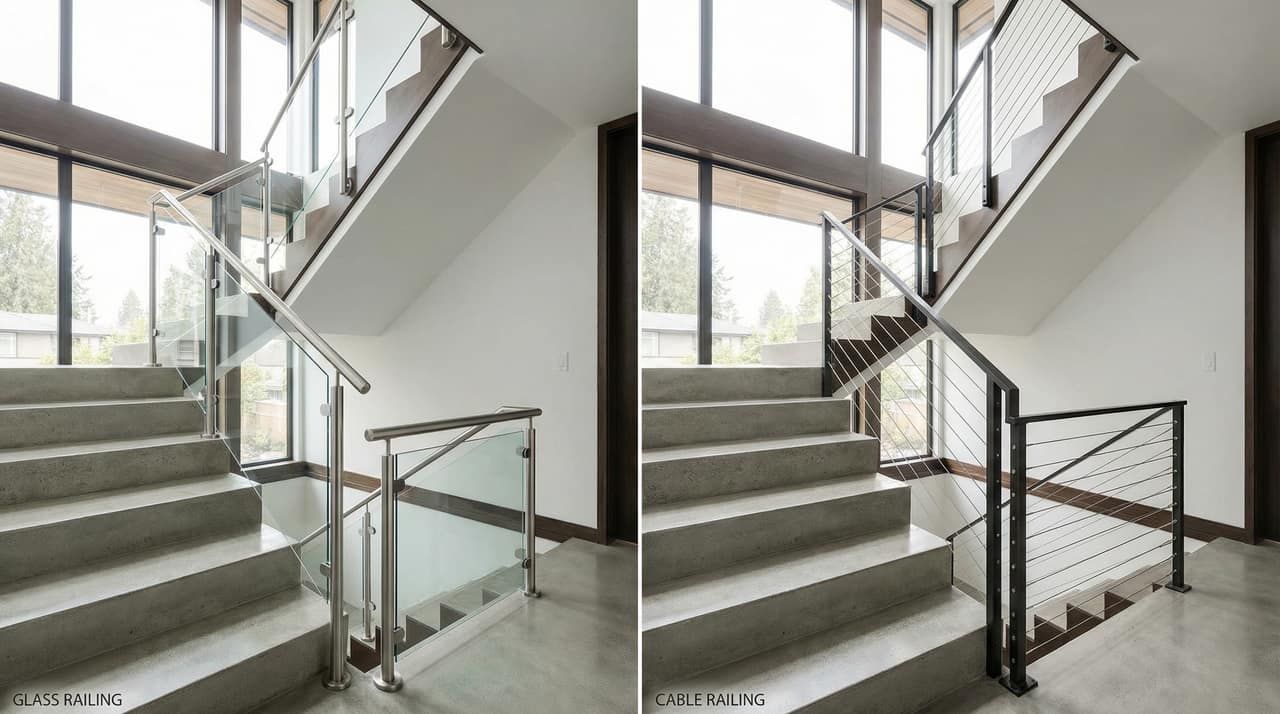
Cable railing systems (steel posts with stainless cable infill): popular on North Shore custom builds and newer Burnaby homes where architects want sightline preservation without going full glass. The cables themselves aren’t expensive, it’s the post fabrication and tensioning hardware that drive cost.
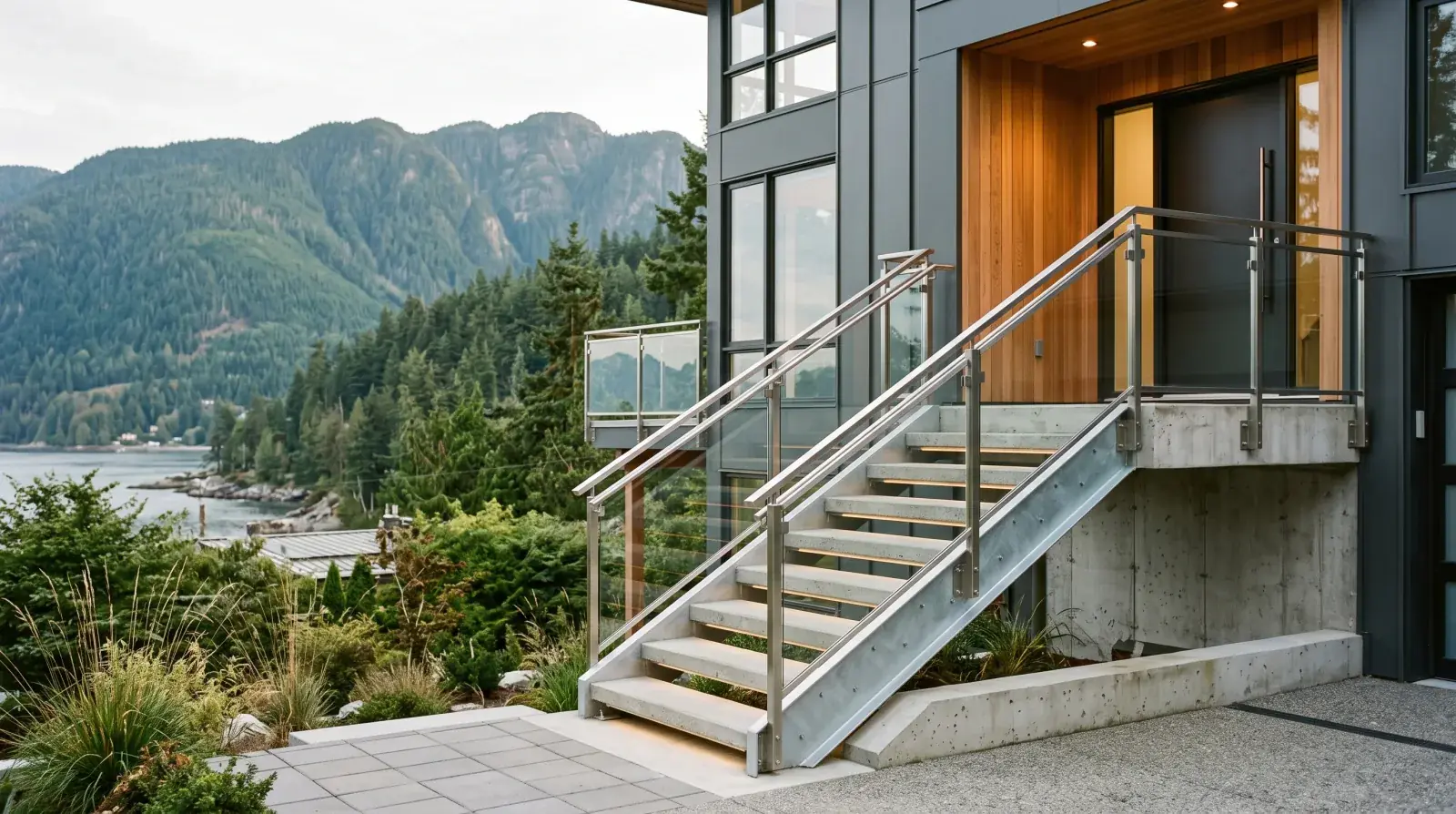
Glass-and-metal hybrid railings (steel or aluminum posts with tempered glass panels): frameless systems with standoff hardware sit at the top. Semi-frameless with aluminum channel at the base sit below. The glass itself is a significant line item, 12mm tempered panels for a guardrail application aren’t cheap, and curved glass carries a meaningful premium over flat panels.
Aluminum railings (prefabricated or custom): prefab aluminum is the budget-friendly option. It works well for deck railings and simple balcony guards. Custom aluminum, thicker profiles, welded connections, powder coat colour matching, sits above prefab.
Wrought iron / ornamental steel: ornamental railings with scrollwork, forged details, or heritage-style patterns take more shop hours. A straight section with simple twists is one thing; a curved balcony rail with custom rosettes is another scope entirely.
What actually drives the price up (and down)
The per-foot number is a starting point. Here’s what moves it.
Design complexity. A straight 20-foot deck railing with evenly spaced pickets is fast to fabricate. A staircase balustrade that follows a curved wall, transitions between floor levels, and meets a landing post at an odd angle, that’s a different job. In our experience, stair-mounted railings cost 25 to 40% more than level runs of the same style because every post height and angle changes.
Material grade. Mild steel is the default for most custom work. Stainless steel (304 or 316 grade) costs roughly 2 to 3x more in raw material and is harder to weld cleanly. We use 316 stainless on waterfront projects in West Vancouver and exterior applications where salt air or heavy rain exposure is constant. For interior residential work in East Vancouver or New Westminster, mild steel with a good powder coat is the better value.
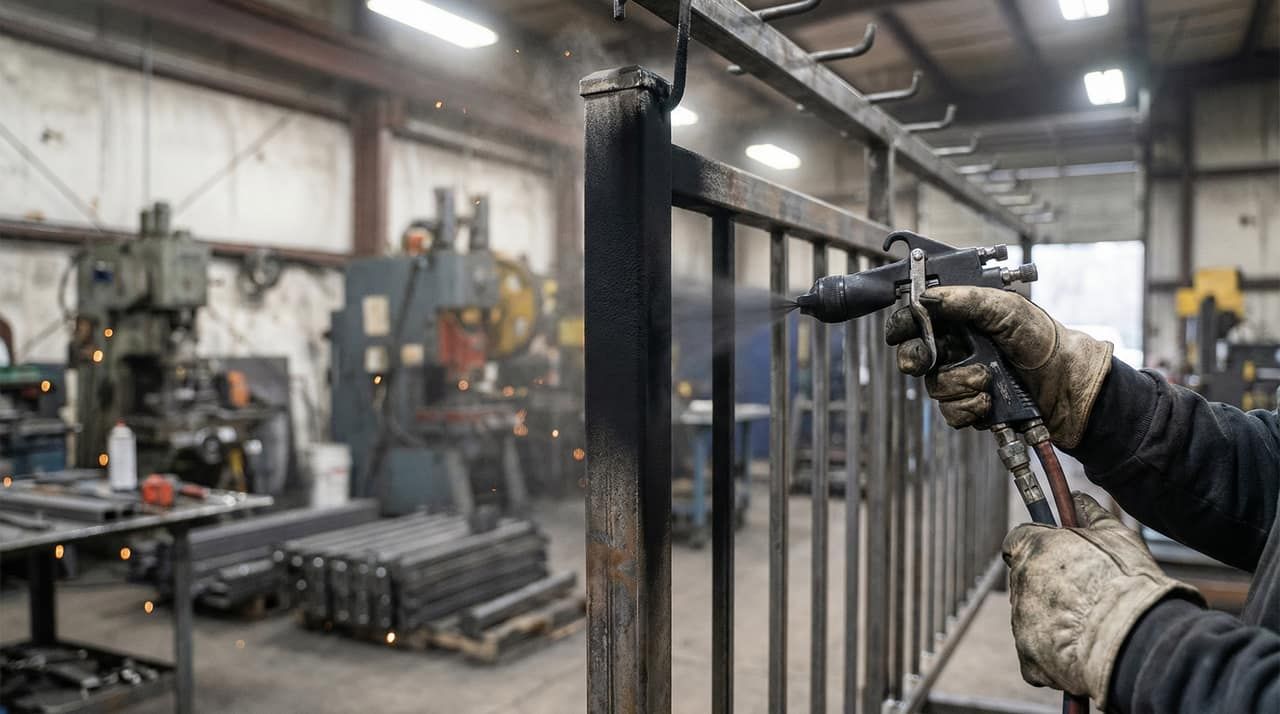
Finish and coating. A standard single-colour powder coat is the baseline finish cost. Hot-dip galvanizing for exterior durability adds more, and specialty finishes, metallic bronze, textured hammered coat, two-tone colour, add more still. In Vancouver’s climate, skipping proper coating on exterior steel is a false economy. We’ve seen railings on Coquitlam townhouse complexes start showing rust within 18 months because the original installer used a spray-can primer instead of proper shop-applied powder coat.
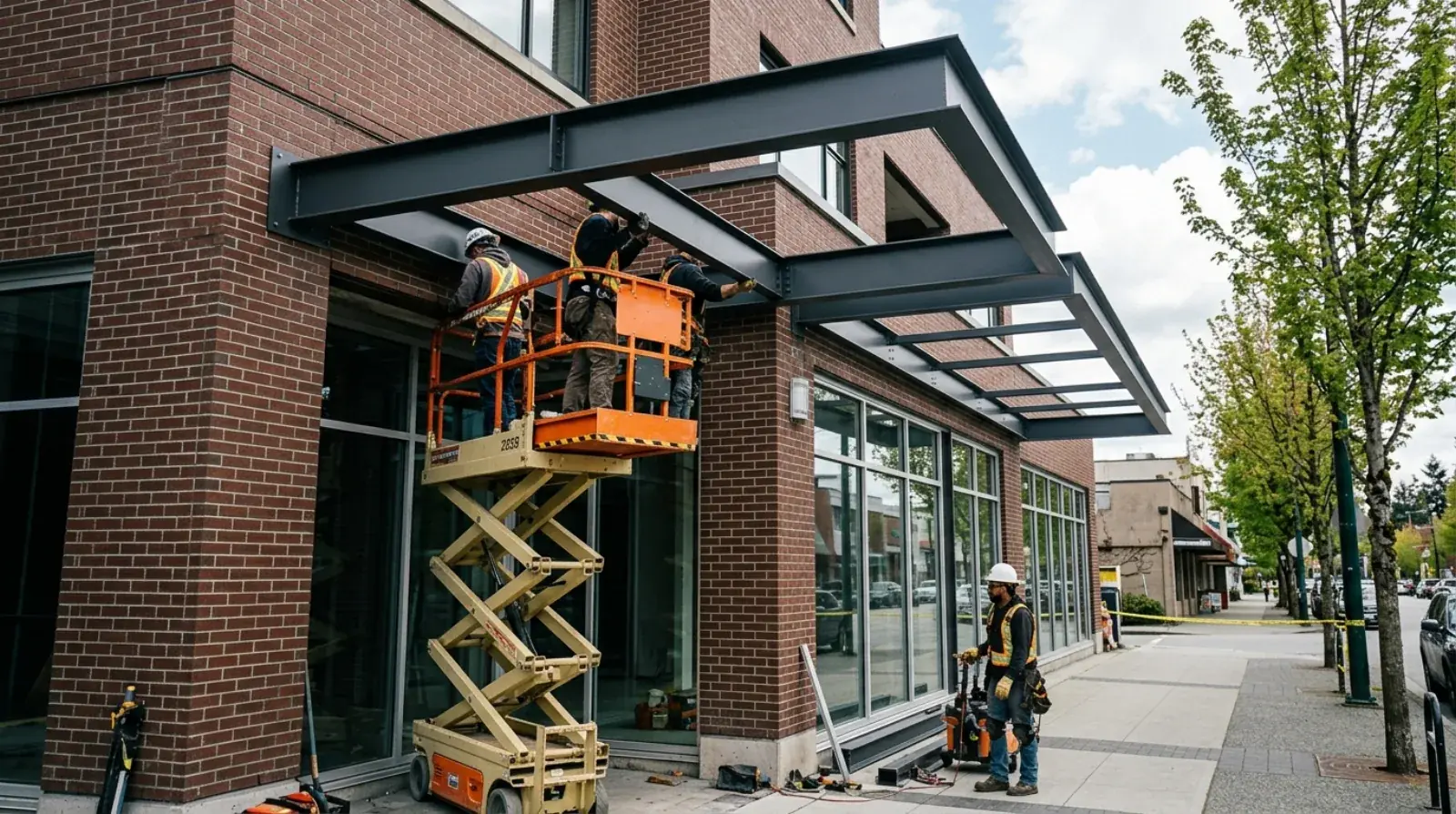
Site conditions. Mounting into concrete costs more than wood framing. Anchoring into a cantilevered concrete balcony slab on a 15th-floor condo is a different scope than bolting base plates into a treated wood deck. Access matters too, if the install crew needs a boom lift or has to work around other trades on a tight site, that’s reflected in the price.
Interior vs. exterior: the cost gap
Interior railings are almost always cheaper. The steel doesn’t need galvanizing. Mounting is usually into wood framing or a plywood-over-joist stair structure, which is faster. And the finish requirements are lighter, a standard interior powder coat holds up fine without the UV and moisture stress that exterior railings face.
Exterior railings in Metro Vancouver deal with rain for eight months of the year. That means hot-dip galvanizing before powder coating (or using aluminum or stainless), heavier base plate connections, and sometimes stainless hardware even on mild steel posts. Exterior applications carry a premium over the same design used indoors.
Deck railings on waterfront properties, we’ve done several on the North Shore, are the most demanding. Salt spray, wind load, and exposure mean every connection point needs to be overbuilt and every surface properly sealed.
How staircase railings differ from level runs
A straight railing along a deck or balcony is the simplest scope. Every post is the same height. Every infill panel (whether pickets, cable, or glass) is a rectangle. The shop drawings are straightforward.
Staircase railings are a different story. Post heights change at every tread. The top rail follows the stair pitch. Infill panels become parallelograms instead of rectangles, and if the staircase turns at a landing, those transition points need careful detailing. On a recent project in a New Westminster heritage home, the stair rail transitioned from a straight level run on the upper floor, down a curved staircase, and into a newel post at the entry, three different geometries in one continuous system.
That kind of work takes more time in shop drawing development, more careful fabrication, and more hours on site during installation. Staircase railing projects typically run 25 to 40% more per linear foot than equivalent level railings.
BC Building Code requirements that affect cost
The BC Building Code sets minimum standards that affect railing design and, by extension, cost. The main ones:
Guards are required on any surface more than 600mm (about 24 inches) above grade. The minimum height is 900mm (36 inches) for guards within a single dwelling unit where the drop is under 1.8m. Above 1.8m or in common areas (strata hallways, commercial spaces), the minimum jumps to 1,070mm (42 inches).
No opening in the guard can allow a 100mm sphere to pass through, that’s the child-safety rule that governs baluster spacing, cable spacing, and glass panel gaps.
Guards can’t have climbable elements between 100mm and 900mm above the floor. This is where some decorative designs run into trouble. Horizontal bars spaced like a ladder get flagged by inspectors. Horizontal cable railings are now permitted in BC for fall heights up to 4.2m, but they still need to meet the sphere test between cables.
These code requirements don’t add dramatic cost on their own, but they constrain design options. A homeowner in Port Moody who wants widely spaced horizontal bars for a modern look might need to rethink the design to pass inspection, and that redesign cycle costs time.
What a typical residential railing project looks like
Most of our residential railing work falls into a few common scopes:
A straight deck railing on a Burnaby rancher, 30 to 50 linear feet of aluminum or steel picket railing, standard height, powder coated black. Scope tier: baseline to mid-range.
An interior staircase railing in a new custom home, 25 to 40 linear feet of cable rail or glass-and-steel, including the stair sections and a landing transition. Scope tier: mid-range to premium depending on material and complexity.
A full exterior balustrade on a multi-level deck, 60 to 100+ linear feet with stairs, gates, and possibly mixed materials. Scope tier: premium to top-tier.
Commercial railing scopes, lobby guards, mezzanine rails, parkade barriers, vary too widely to generalize, but they tend to run higher per foot because of engineering stamp requirements, stricter code thresholds, and coordination with the GC’s schedule.
The timeline from quote to installation
For a typical residential project, here’s what the schedule looks like:
Site measure and quote: 1 to 2 weeks. We visit the site, take field measurements, and provide a detailed quote based on the design, material, and site conditions.
Shop drawings and approval: 1 to 2 weeks. Once the quote is accepted, we produce fabrication drawings for the client (and the architect, if there is one) to review. Changes at this stage are cheap. Changes after fabrication starts are not.
Fabrication: 2 to 4 weeks depending on the scope. Custom steel railings are cut, welded, ground, and finished in our Burnaby shop. C.W.B. certified welding to CSA W47.1 standards on every structural joint.
Finishing: 1 to 2 weeks. Powder coating or galvanizing happens during or immediately after fabrication, depending on the schedule.
Installation: 1 to 3 days for most residential scopes. Larger commercial installs can take a week or more.
Total lead time from signed quote to completed installation is typically 6 to 8 weeks. Rush timelines are sometimes possible, but they usually come with a premium.
How to get an accurate quote
The fastest way to get a realistic number is to bring us three things: a rough sketch or photo of what you want, the approximate length of railing needed, and whether it’s interior or exterior. If you’re working with an architect or designer, shop drawings or even a marked-up floor plan speeds everything up.
We quote based on actual site conditions, not generic per-foot rates pulled from a website. A 30-foot deck rail on flat ground is a different price than 30 feet of stair rail with two landings and a gate, even if the material is identical.
If you’re early in the planning stage and just need a ballpark, the ranges in this article will get you close. When you’re ready for a real number, request a quote or call our Burnaby shop directly, we’ll walk through the scope and give you a price you can plan around.