An automatic driveway gate is a moving machine that lives outside in the weather all year. In Burnaby, that means constant rain, damp air, and ground that shifts through the wet season. Over time, things wear, loosen, and corrode. The good news is that automatic gates fail in predictable ways, and most of those failures are fixable without replacing the whole system.
This post walks through the common problems we see on automated gates across Burnaby, Coquitlam, and North Vancouver, what a sensible maintenance routine looks like, and how to decide between a repair and a full operator replacement. If you are still planning a new gate rather than fixing an old one, our guide to driveway gate operators and automation covers the systems themselves in more detail.
The failures we see most often
Some problems come up again and again, season after season. Knowing them helps you describe the fault clearly when you call, and sometimes helps you fix a small issue yourself.
Sagging hinges and posts. A swing gate leaf is heavy, and every open and close puts load on the hinges. The pins wear. The post can lean, especially in the soft, wet ground we get in Burnaby through the rainy months. Once the leaf drops even a small amount, it scrapes the ground, strains the operator, and closes out of alignment. Resetting the post and replacing the hinge hardware brings the swing back to level.
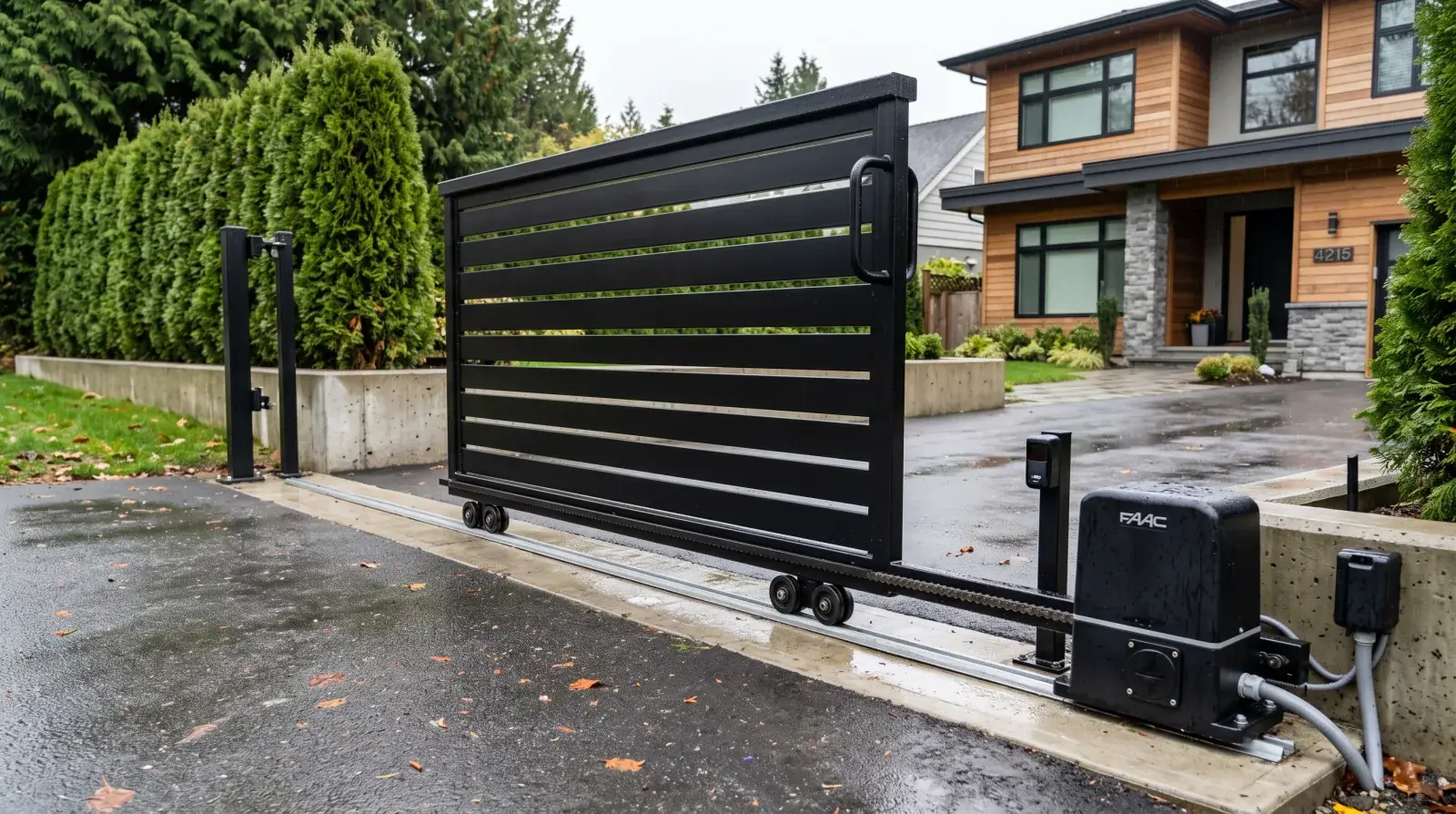
Worn rollers on sliding gates. A sliding gate rides on rollers along a track. Grit, rain, and daily use wear the wheels and the V-track. You hear it first: a grinding or squealing sound, or a gate that judders as it moves. Worn rollers force the operator to work harder, so replacing them early protects the more expensive parts.
Misaligned or dirty photo eyes. The photo eyes are the safety sensors that stop the gate from closing on a car or a person. They send a beam across the driveway. When that beam is broken, the gate reverses. In our climate, spider webs, wet leaves, and road grime block the eyes constantly, and a gate that bumps a sensor post knocks it out of alignment. This is the single most common “my gate is broken” call we get, and it is often a two-minute clean.
Dead battery backup. Most operators have a backup battery so the gate still works during a power cut. That battery has a limited life. When it dies, the gate can stop during any brief power blip, which people often mistake for a full electrical failure. Replacing the backup battery on a service schedule avoids the surprise.
Corroded wiring. This is the quiet one. The low-voltage wiring that runs to the sensors, keypads, and intercom sits in wet ground and damp junction boxes. On the coast, the connectors corrode. A corroded connection makes a gate behave in strange, intermittent ways: it works one day and not the next. Tracing and re-terminating the wiring fixes faults that look like an expensive board failure.
A seasonal maintenance routine that actually helps
Most gate problems are cheaper to prevent than to repair. A simple routine keeps a gate running and extends the life of the operator.
Through the year, keep the photo eyes clean. Wipe both lenses whenever you clean the car or clear the driveway. Keep the track clear on a sliding gate, because a single stone in the track can stop the gate or damage a roller. Listen to the gate every time it runs. New sounds, grinding, clunking, or hesitation are early warnings.
Once a year, and twice a year for gates near the Inlet or in heavy daily use, we do a full service. That covers lubricating hinges and rollers, checking and tightening every fastener, testing the safety reversal, checking the backup battery, inspecting the wiring and connectors for corrosion, and confirming the gate is still plumb and level. The damp coastal climate in Burnaby, Coquitlam, and North Vancouver corrodes and stiffens hardware faster than a dry inland climate, so the yearly visit matters more here than it would in the Interior.
While the operator is being serviced, it is also the right time to confirm the safety devices meet current standards. The UL 325 gate safety rules that took effect in January 2016 require two independent, monitored entrapment-protection devices at each pinch point, per the LiftMaster UL 325 guidance. If your gate predates those rules, a service visit is a good moment to bring it up to date.
When a repair is not enough
Not every problem is worth repairing. Sometimes the honest answer is to replace the operator, or the gate, or both. Here is how we think about it.
Repair makes sense when the operator is reasonably modern, replacement parts are still made, and only one thing has failed. A worn roller, a dead backup battery, a leaning post, or a corroded wire are all straightforward fixes on an otherwise sound gate.
Replacement makes sense when the control board is obsolete and parts are no longer available, when the motor is burned out, or when you are paying for repeated repairs inside a single year. At that point the money is better spent on a new operator that will run reliably and meet current safety rules. A gate that predates the 2016 UL 325 standard is often worth upgrading when the operator is replaced anyway, because the new install brings the entrapment protection up to code.
The gate structure itself is a separate question from the operator. Surface rust on a steel gate can be treated and repainted. Deep corrosion at a weld, a hinge, or the base of a post is structural, and that may mean fabricating a new section or a new gate. We always inspect the load-bearing points first, because that is where coastal corrosion does the damage that matters. We cover gate structure and materials in more depth in our Burnaby driveway gates guide.
What drives the cost of a gate repair
We never quote a price sight unseen, because gate repairs vary too much. A few things move the cost.
The type of gate matters. A sliding gate and a swing gate wear differently and use different hardware. The operator brand and age matter, because obsolete parts are harder and slower to source. The nature of the fault matters most of all: a photo-eye clean is minor, a control board swap is larger, and structural corrosion repair is a fabrication job. Access matters too, since a gate on a slope or a tight lot takes longer to work on safely.
If any part of the repair touches the incoming line-voltage power, an electrical permit is usually required. Burnaby and Vancouver run their own electrical inspection programs, so that permit goes through the city rather than Technical Safety BC, which handles homeowner electrical permits for most of the rest of the province. We coordinate that with a licensed electrician so the work is inspected and signed off.
The best way to get a real number is a site visit. We look at the gate, find the actual fault, and tell you plainly whether it is a repair or a replacement. To book that, request a quote and we will come out and assess it. A gate that is maintained well rarely strands you. A gate that is ignored eventually will.
Browse our driveway gates and entry systems, then request a quote and we will scope the gate, hardware, and install for your property.