Most people think of a driveway gate as a nice-looking barrier. It is also a moving machine with a motor, and it lives right where cars pull in and kids run out. That is exactly why there is a safety standard for it. On a recent gate we rebuilt in North Vancouver, the old operator had drifted out of alignment and started nudging the owner’s car on the way through. The gate looked fine. The safety system behind it had quietly stopped working.
UL 325 is the standard that governs powered gate operators across North America, and it applies to a single-family driveway gate in Vancouver or Burnaby just as much as it applies to a commercial gate. If you are planning an automated gate, or you already have one, this is the part worth understanding before you think about the styling.
What UL 325 actually covers
UL 325 sets the safety requirements for the operator, which is the motor and controller that moves the gate. It does not care whether your gate is steel slats, a solid panel, or a frame with mesh. It cares about what happens when the gate is moving and something gets in the way.
The core idea is entrapment protection. An automated gate has pinch points where a body, a limb, a pet, or a bumper can get caught. The standard requires the gate to detect that and reverse before it does harm. A gate that only stops when it physically jams into something is not meeting the standard, and it is not safe.
The four operator classes
UL 325 sorts gate operators into four classes based on where the gate is used. According to Automatic Gate Masters’ UL 325 breakdown, the classes are:
- Class I is residential, for one to four single-family units. A private driveway gate at a house in Vancouver or Coquitlam is Class I.
- Class II is commercial or multi-family with five or more units, such as an apartment complex, hotel, or office.
- Class III is industrial or limited access, like a warehouse yard or a construction site.
- Class IV is restricted, high-security access, such as a correctional or military facility.
The class matters because it changes which safety devices are required and how the operator is expected to behave. Most of the gates we build for homeowners are Class I, and most of the commercial jobs we do for property managers and general contractors are Class II.
The two-device entrapment rule
This is the part that trips up a lot of older gates. Since January 12, 2016, UL 325 requires two independent means of entrapment protection at each entrapment point. LiftMaster’s UL 325 guidance explains that this means the operator’s own inherent reversing system plus a monitored external device, such as a photo eye or an edge sensor. Only when they work together does the gate meet the standard.
Two words in there carry a lot of weight: independent and monitored.
Independent means the two devices cannot be the same kind. You cannot count one photo eye twice. You pair a different technology, so if one method misses, the other catches it.
Monitored means the operator constantly checks that the safety device is alive and working before it moves the gate. If a photo eye gets bumped out of alignment or a wire corrodes, which happens often in our wet coastal climate, a monitored system makes the gate refuse to run rather than run blind. That single feature is the difference between a gate that protects you and a gate that fails silently, like the one we found in North Vancouver.
Inherent protection versus external sensors
There are two layers to how a compliant gate senses trouble.
Inherent protection is built into the operator. It senses resistance in the motor. When the gate meets more force than expected, the operator reads it as an obstruction and reverses.
External sensors are the devices you can see on the gate:
- A photo eye is a non-contact sensor that shoots an infrared beam across the opening. Break the beam and the gate reverses. It catches a car or a person in the path before contact.
- A safety edge is a contact sensor that runs along the leading edge of the gate. The moment it touches anything, the gate reverses. It is the last line of defence for something the photo eye missed, like a low object or a pet.
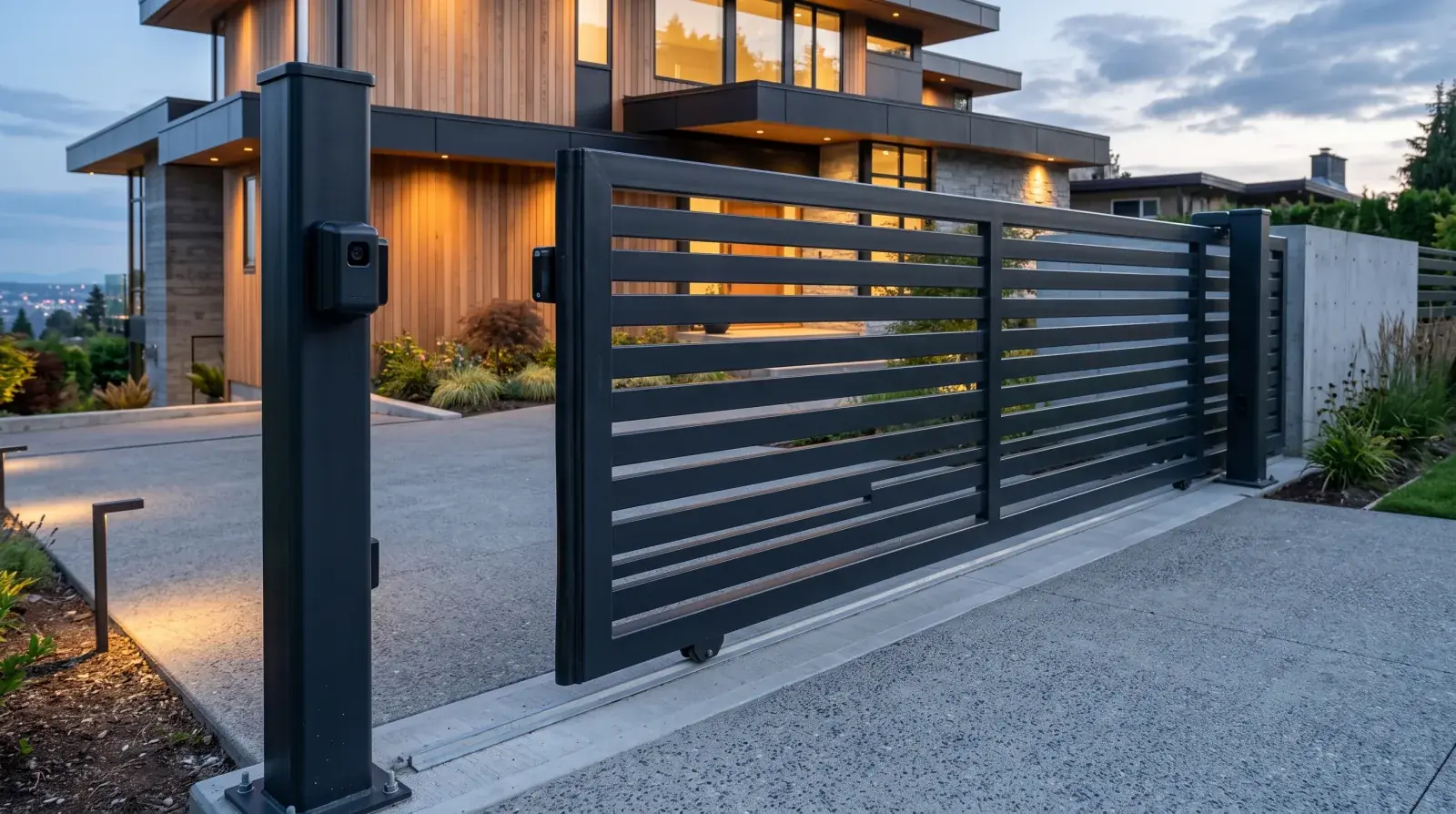
On a typical Metro Vancouver slide gate we protect the leading edge, the trailing edge, and the opening itself, because a slide gate has a pinch point where it retracts as well as where it closes. Swing gates have different trap points, usually between the gate and a wall or post, so we map them separately.
What this means for a real Vancouver gate
If you are buying a new automated gate, the safety system should be part of the design conversation from day one, not a box the installer ticks at the end. The operator class, the number of entrapment points, and the sensor layout all shape the fabrication. We detail the gate around the hardware so the photo eyes and edges have clean mounting points and protected wire runs, which matters when the gate lives outdoors through Vancouver winters.
If you already have a gate, it can often be brought up to standard. A modern monitored operator with added photo eyes and a safety edge is frequently enough. Older non-monitored operators sometimes have to be replaced, because the monitoring has to live inside the operator itself and cannot be bolted on afterward. We look at what you have before recommending a full swap. Our gate automation and operators guide walks through the operator side in more detail, and our UL 325 safety overview covers the code specifics.
Permits and inspection in Vancouver and Burnaby
A hardwired gate motor is electrical work, and electrical work in British Columbia needs a permit and an inspection. For most of the province that runs through Technical Safety BC, which also lets a qualified homeowner pull an electrical permit for their own principal residence. There is an important local catch: the City of Vancouver, the City of Burnaby, and the City of Victoria run their own electrical inspection rather than Technical Safety BC. So the permit path for a gate in Vancouver is different from the path for a gate in Surrey or Langley.
We sort this out before the trench for the power run is dug, because retrofitting conduit and pull boxes after the concrete is poured is expensive and avoidable. Our Vancouver gate permits guide covers the building and electrical side, and for the mechanical decision between a sliding and a swinging gate, our post on swing versus slide driveway gates is a good next read.
How we build gates to the standard
For us, UL 325 is not paperwork. It changes how the steel is detailed. We choose the operator class for the property, map every entrapment point on the specific gate geometry, and lay out monitored photo eyes and a safety edge that suit a gate that will sit outdoors for decades. Then we protect the wiring, because a sensor is only as reliable as the cable feeding it, and coastal moisture is patient.
The result is a gate that looks like a clean piece of modern steel and behaves like a machine that respects the people around it. If you are planning an automated gate anywhere from Vancouver to Coquitlam, request a quote and we will scope the class, the sensors, and the permit path with you before a single piece of steel is cut.