A gate answers one question: who stays out. Access control answers a harder one: how do the right people get in, easily, at all the different times they show up? Your kids come home from school, a delivery arrives at noon, the cleaner comes on Thursdays, and a guest pulls up on Saturday night. A good entrance handles all of them without you running to the door or handing out keys. That is what access control is for, and on the automated steel gates we build across Metro Vancouver, it is part of the design from the first sketch.
The pieces of a home gate access system
There is no single right setup, because different people need different ways in. The common building blocks are:
- A video intercom or call box, so a visitor can reach you and you can see and admit them.
- A keypad, which opens the gate with a code, handy for service providers.
- Remote fobs, the press-button remotes your family keeps in the car.
- RFID tags or cards, which a reader detects when they are close.
- A smartphone app, which lets you open the gate, view the camera, and grant temporary access from anywhere.
- A vehicle exit loop, a wire loop in the driveway that opens the gate automatically as you drive out.
Most homeowners we work with combine several. Family gets fobs or the app, the keypad handles the cleaner and trades, the intercom covers guests and deliveries, and the exit loop means nobody stops on the way out. The mechanics of the gate itself, the operator and drive, are covered in our guide to gate operators and automation; here the focus is on who gets through.
The video intercom is the centrepiece
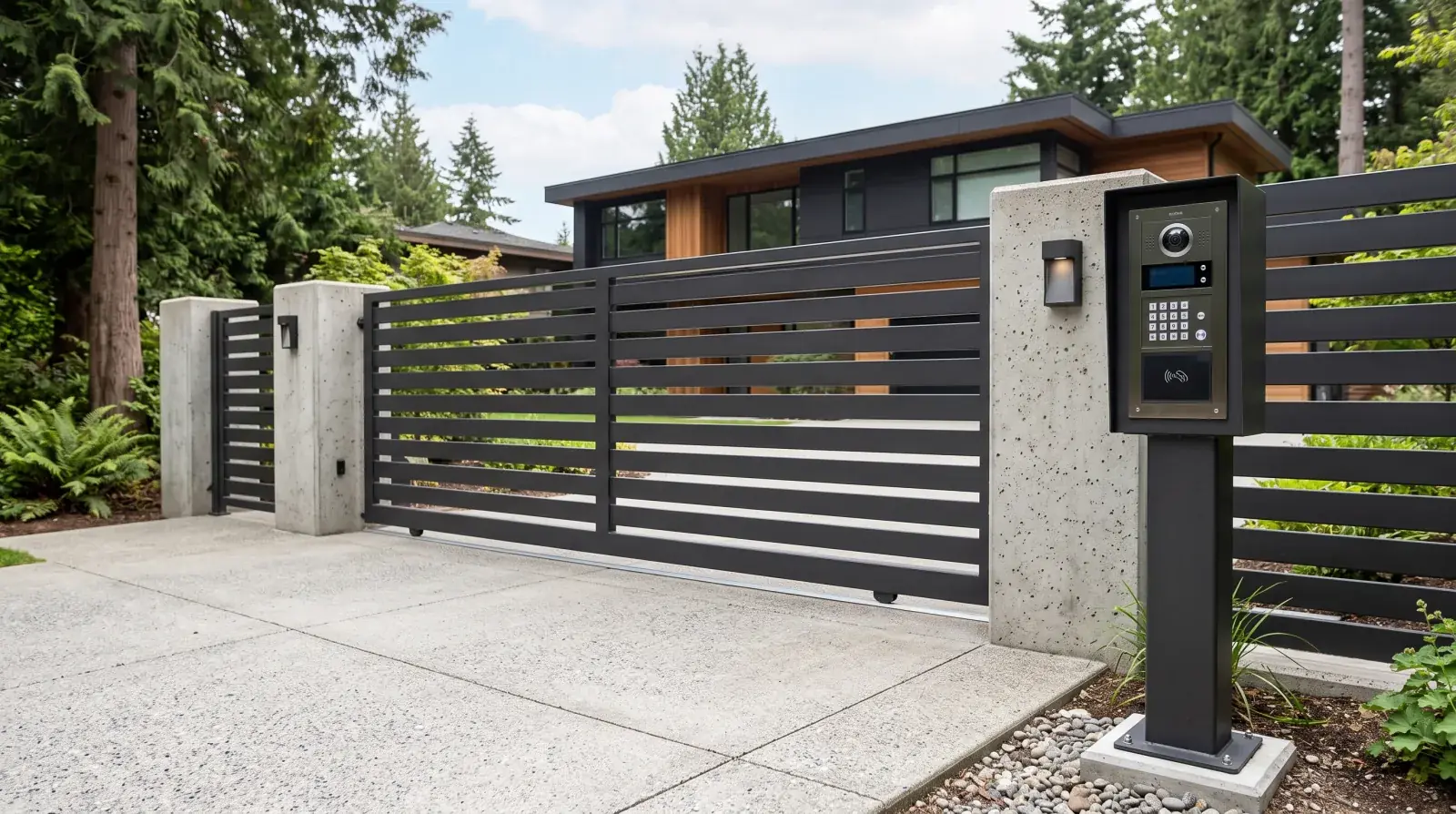
For most homes, the video intercom does the heavy lifting. A visitor presses the call button, and instead of ringing only a screen inside the house, a modern system rings your phone. You see who is there, talk to them, and release the gate, whether you are home in West Vancouver or across town. That single capability is why the intercom is usually the first thing we plan, because it changes daily life: deliveries get into the courtyard, guests get buzzed in, and you are never tied to being home to manage the gate.
App-based control extends this further. You can grant a one-time code to a contractor, watch the camera, and open the gate remotely, all without a physical key changing hands. For busy households, that convenience is the whole point.
Why the wiring decides everything
Here is the part that separates a clean install from a messy one. Intercoms, readers, and cameras all need power and a data connection run out to the gate. That is real work, and it is far easier to do well when the gate is being built.
When we fabricate the gate, we build the access hardware into it: a steel pedestal at driver’s-window height, or the call box integrated into a gate post or masonry pier, with the wiring hidden inside the steel and protected against our coastal moisture. Compare that to the common retrofit, a plastic box bolted to a post with wires stapled down the side, and the difference is obvious the moment a visitor walks up. We treat the mount as part of the fabrication, which is what makes the technology look like it grew out of the gate rather than being stuck on afterward.
The conduit for power and data should go in before the driveway concrete is poured. Trenching after the fact is expensive and avoidable, the same logic we apply to the operator’s power run.
Power, backups, and our weather
Access control is only as reliable as its power. The gate operator’s battery backup keeps the gate cycling during an outage, and when the access devices share that backed-up supply, the intercom and readers keep working too. On the storm-prone North Shore, we plan backup power for the whole system, not just the motor, so a winter outage does not lock you out of your own driveway. A manual gate release is always there as a final fallback.
Whether to go hardwired or wireless depends on the site. Hardwired intercoms and readers are the most reliable and are well worth the conduit when the gate is new. Wireless and cellular systems earn their place on retrofits and on gates far from the house. We recommend based on distance, site conditions, and whether the driveway is still open for trenching.
Permits: the Vancouver and Burnaby difference
Because access control involves power and low-voltage wiring at the gate, the electrical portion needs a permit and inspection. As with gate operators, that runs through the City of Vancouver or the City of Burnaby in those cities, and through Technical Safety BC across most of the rest of the province. We sort the permit path early so the low-voltage and electrical work is coordinated rather than improvised.
Every automated gate also has to meet the UL 325 safety standard, and access control does not change that, the entrapment protection still applies. Our post on UL 325 gate safety covers what the standard requires.
One system, designed together
The gate, the operator, the safety sensors, and the access control are not four separate purchases. They are one system, and they work best when they are designed together. When they are, the entrance is effortless and quietly secure: you drive up and it opens, a guest buzzes and you let them in from your phone, a delivery lands in the courtyard, and the whole thing still looks like one clean piece of steel. If you want the smaller walk-through gate handled the same way, our post on pedestrian and side gates covers those.
If you are planning an automated entrance with intercom and access control anywhere from Vancouver to West Vancouver, request a quote and we will scope the access hardware, the wiring, and the permits alongside the gate itself.