On most modern custom homes in Metro Vancouver with a view worth keeping, the railing decision comes down to two options: glass or cable. Both preserve the sightline in a way that steel picket or wrought iron simply cannot. Both look at home on contemporary architecture. And both are technical systems that need to be spec’d properly for Vancouver’s weather and BC’s code requirements.
We install both at our Burnaby shop. This is a straightforward comparison of where each one wins, where each falls short, and what the real cost and maintenance picture looks like in 2026, not from a manufacturer brochure but from what we see in the field across the North Shore, West Vancouver, and newer custom builds across Metro Vancouver.
The basic difference
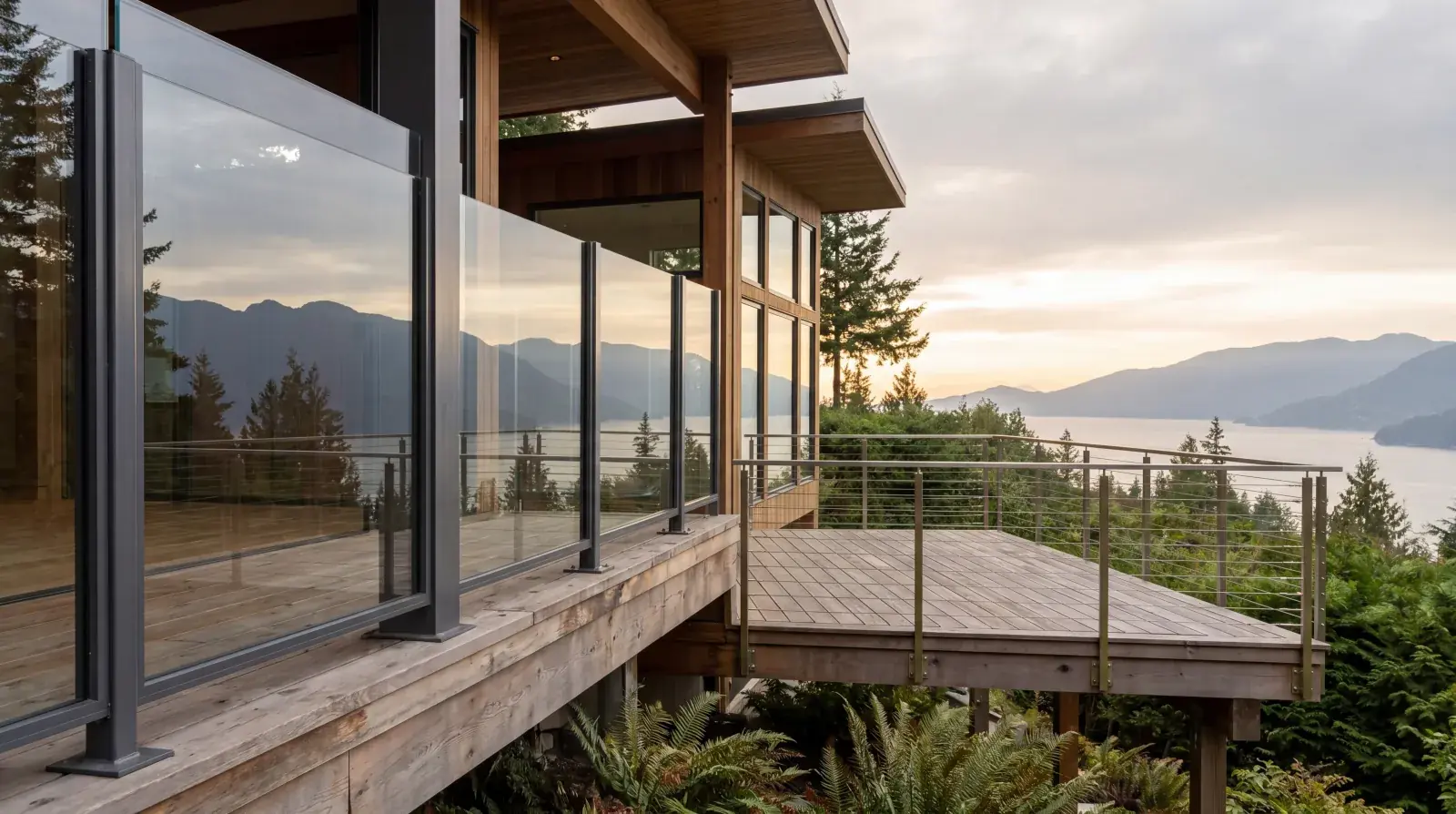
A glass railing is a series of tempered (and usually laminated) glass panels held in place by either base shoe channels, top rails, or point-fixed standoffs. The glass itself carries the guard load. Metal components are structural supports and trim, they are not the guard.
A cable railing uses horizontal stainless steel cables stretched between steel or aluminum posts, typically at 75 to 95 mm vertical spacing. The cables under tension are the guard infill. The posts are the structural members, they take the tensioning loads and the lateral guard loads from BC Building Code.
That difference shapes everything else, cost, maintenance, view, structural demands, and where each one works best.
Cost: real 2026 numbers from our shop
Here is what we are quoting in Metro Vancouver in 2026 for both systems, fully installed:
| Railing system | Cost per linear foot | Typical 40-ft deck total |
|---|---|---|
| Cable railing, steel posts, powder coat, 316 stainless cables | Baseline | Quoted per project |
| Semi-frameless glass, aluminum base channel, painted frame | Baseline, mid | Quoted per project |
| Semi-frameless glass, steel posts with top rail + glass infill | Mid-range | Quoted per project |
| Frameless glass, point-fixed standoffs on steel posts | Premium | Quoted per project |
| Frameless glass, structural glass, 316 stainless hardware | Top-tier | Quoted per project |
The ranges overlap more than people expect. A high-end cable system on steel posts with hardwood top cap can push into the low end of the glass range. And a budget-friendly semi-frameless glass system with aluminum base channel can come in close to a premium cable install.
The practical rule of thumb: cable is meaningfully cheaper than glass on the same run; mid-range glass sits above cable; true frameless structural glass sits at the premium end. For context on the full range of materials, see our custom metal railing guide.
The view question
This is where most people start the decision, and it is worth being precise about what each system actually looks like through a window.
Frameless glass is the cleanest visual. Properly fabricated with clear tempered-laminated glass, high-transmission PVB interlayer, and minimum visible hardware, a frameless glass railing is nearly invisible from 10 feet back. On a North Shore view lot with Burrard Inlet in the background, the difference between glass and anything else is dramatic.
Semi-frameless glass with an aluminum base channel has a small visible strip at the deck line. From most viewing angles, the strip disappears into the deck structure and the glass still reads as nearly invisible. This is the most common glass railing in Metro Vancouver custom homes, it balances cost and appearance well.
Cable railing has visible horizontal lines, typically 10 to 12 cables on a 36-inch guardrail. From 20 feet back, those cables become nearly invisible. From 3 feet back, they are clearly there but still transparent enough to see through. Cable gives you a sightline that is dramatically better than picket or glass with heavy frames, but it is not the pure visual clearance of frameless glass.
The view test that matters: stand where you actually sit on the deck or in the living room, and look at the railing from that angle. Cable disappears into a busy background (trees, water, city lights). It is more visible against a plain sky. Frameless glass is cleaner in either case.
Cost of ownership: maintenance and cleaning
Glass and cable have very different maintenance profiles, and this matters more than most people realize when they make the initial choice.
Glass requires regular cleaning. Tempered glass shows every water spot, every fingerprint, and every salt deposit. In Metro Vancouver’s wet climate, an exterior glass railing on a view lot needs cleaning at minimum monthly during dry months and every 1 to 2 weeks during the rainy season. North Shore waterfront glass often gets cleaned weekly because ocean spray deposits build up fast. Skip the cleaning and you end up with glass that looks permanently smudged, not because of damage but because calcium deposits etch the surface over time if left in contact with rainwater.
Professional glass railing cleaning is billed per visit by the cleaner, depending on access and length. DIY cleaning with a squeegee and deionized water works fine if you are diligent about it.
Cable requires periodic tensioning. A new cable railing settles for the first 6 to 12 months and the tension needs to be checked at least twice in that period. After the initial settling, tension checks every 2 to 3 years keep the system tight. A loose cable fails the BC Code 100 mm sphere test and becomes a liability, so this is not optional maintenance.
Professional cable tensioning is billed per visit depending on post count. The turnbuckles at cable ends are the mechanism, a trained installer can check and re-tension an entire 60-foot deck run in about an hour.
Both need corrosion management. Glass standoffs and cable end fittings are the corrosion points in both systems. 316 stainless hardware is the standard for anything exposed to salt air on the North Shore, West Vancouver waterfront, and Deep Cove. 304 stainless is fine for sheltered applications like an East Vancouver backyard deck. Aluminum fittings and frames are acceptable for inland projects but can pit over 15+ years in direct salt exposure.
Over a 20-year ownership period, glass maintenance (cleaning only) costs more than cable maintenance (tensioning and occasional cable replacement if one fails). Glass is higher on routine cleaning but lower on mechanical service.
Where glass wins
Glass is the right choice on projects where the railing has to be as close to invisible as possible, where the budget can absorb the premium, and where the owner is willing to clean it.
Waterfront and view lots. On a West Vancouver or Deep Cove property where the entire reason to buy the home is the view, frameless glass is the only railing that truly gets out of the way. Cable is close but not identical, and the visual difference matters when the view is the primary asset.
Formal contemporary architecture. Frameless glass on a modernist concrete-and-steel home reads as part of the architectural vocabulary. Cable can read as slightly more casual in contrast. On high-end modern builds where every element is intentional, glass is often the better match.
Strata balconies. Strata buildings in Burnaby, Coquitlam, and downtown Vancouver almost always spec glass for balcony guards. The strata approval process is set up for glass systems, the tempered-laminated spec is standardized, and the appearance is consistent across units. Cable is rare on strata balcony replacements.
Wind-exposed decks. Glass panels block wind and make an exposed deck more usable. Cable lets wind pass through, which is sometimes what you want (less sail load on the structure) but often is not (a windy deck is less comfortable). On an exposed corner deck on a North Shore ridge, glass improves the usability of the space.
Where cable wins
Cable is the better choice when budget matters, when the architectural style is more casual or modern-farmhouse, when maintenance is a concern, or when the owner wants a railing that stays out of the view without the cost and upkeep of glass.
Mid-range custom homes. On a custom home in Burnaby, Coquitlam, or the West End where the railing budget is a meaningful but not top-tier line item, cable gets you most of the view preservation at a fraction of the cost of comparable glass. The savings can fund upgrades elsewhere in the project.
Modern farmhouse and casual modern. Cable rails look at home on modern farmhouse, West Coast contemporary, and transitional designs where the aesthetic is warm rather than strictly minimalist. Frameless glass can read as too formal in those contexts.
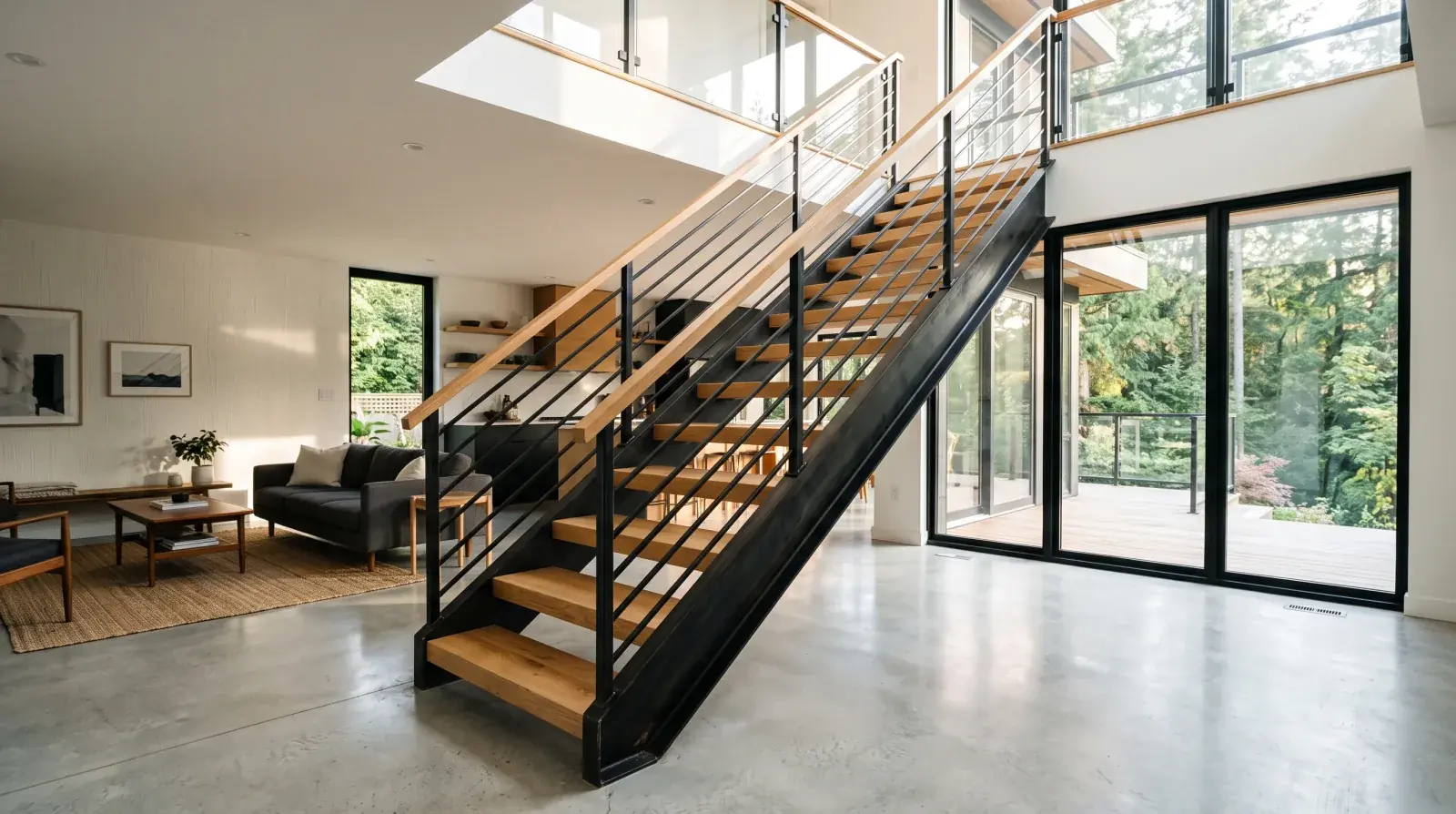
Staircase balustrades. Cable on a staircase is one of our most frequently built configurations. The angled cables match the stair slope cleanly, and the result is a stair that feels open and modern without the detailing complexity of raked glass panels. Glass stair balustrades are possible but significantly more expensive because each panel has to be templated and cut for the specific stringer geometry.
Owners who do not want to clean glass. This is the underrated reason to pick cable. Some people clean glass railings and love them. Some people try to keep up with the cleaning for a year, give up, and live with spotted glass for a decade. If you know yourself and you know cleaning is not going to happen, cable is a more forgiving choice.
Exterior applications with weather exposure. Cable can handle constant rain and salt air with minimal visible degradation, the 316 stainless cables just look slightly weathered over time, which reads as intentional. Glass in the same conditions needs more attention to look presentable.
Structural and code considerations
Both systems meet BC Building Code guard requirements when properly designed, but the engineering details differ.
Guard height. 900 mm minimum within a single residential dwelling where the drop is under 1,800 mm, 1,070 mm above that or in common areas. Both glass and cable can be built to these heights.
Opening size. No opening can pass a 100 mm sphere. For glass, this is automatic, the panel is a solid surface. For cable, the cable spacing must be 95 mm or less, and the cables must be tensioned enough to resist a child pushing between them. We spec 75 mm cable spacing as our default so there is margin for a small amount of tension loss between maintenance visits.
Lateral load. BC Code requires 0.75 kN/m applied laterally at the top of the guard, plus 1.5 kN concentrated load. Cable railing posts take these loads in bending, they need to be engineered with the correct post size and spacing to resist both the cable tension and the guard load. Glass railings handle loads through the panel and base channel or standoffs.
Engineering stamp. Commercial and multi-family glass railings typically require an engineer’s stamp. Residential systems over a certain height or spanning conditions often also need engineering. Cable systems generally need engineering for the post design and tension calculations. Engineering fees are billed separately by the structural engineer.
For more on BC Building Code railing requirements, see our BC Building Code railing requirements guide.
Installation complexity
Glass installation is a two-person lift for most panels, 12mm tempered-laminated glass is heavy, fragile in transit, and has to be set into brackets or standoffs without edge contact with the metal. A typical 40-foot glass deck install takes 1 to 2 days once the posts and base channel are in place. Rushing is how panels crack.
Cable installation involves setting posts first, then pulling cable runs through each post, then tensioning from the end turnbuckles. A 40-foot cable install is typically a single day for one installer. The fiddly part is getting the tension consistent across all cable runs, each one needs to be firm enough to pass the sphere test without over-tensioning the end posts.
Both systems benefit from engineered shop drawings that specify exact post placement, hardware locations, and tension specs.
Our recommendation by project type
Modern view home on the North Shore or West Vancouver: frameless glass. The view justifies the premium and the owner usually expects and accepts the cleaning commitment.
Custom build on Burnaby Mountain, Buckingham Heights, or Deep Cove: semi-frameless glass or premium cable. Both work well visually. Cable is more forgiving on maintenance, glass is slightly cleaner visually.
Mid-range custom or upgraded renovation: cable railing. Best cost-to-sightline ratio, straightforward maintenance.
Staircase balustrade in a modern home: cable. The angled cables look clean, cost is reasonable, and it is easier to fabricate than a raked glass system. Staircase cable runs carry a premium over deck runs because of stair complexity.
Strata building balcony replacement: tempered laminated glass in aluminum base channel. Standard strata-approved spec, consistent across units.
Waterfront property with heavy salt exposure: either works, but use 316 stainless hardware without exception. Glass standoffs and cable end fittings should be 316. Budget a 10 to 15% premium over inland equivalent pricing.
What to send us for a quote
Whether you are leaning glass or cable, the details that actually shape the quote are the same:
- Total linear footage and the layout (straight run, L-shape, with stair transitions, etc.)
- Railing height required (900 mm or 1,070 mm)
- Deck or floor surface the posts will mount to (concrete, wood framing, engineered floor)
- Site exposure (sheltered, mixed, direct wind/salt/rain)
- Handrail preference, wood cap, steel top rail, or no top rail (glass only)
- Design inspiration photos if you have a specific look in mind
From there we can quote both options side by side and walk through the trade-offs for your specific site. Request a quote or contact the shop to start the conversation. For context on the full range of railing options, see our guide to custom railings in Vancouver.
For the full system-by-system reference, see our custom railings hub, the glass railings guide, and the cable railings guide.