If your Kelowna lot sits on a hillside that backs onto pine and grassland, you already know the August feeling, checking the smoke on the ridge, watching the wind. The Okanagan’s wildfire interface is real, and it changes how you should think about the exterior of a home. Every material out there is either something a fire can use or something it can’t.
Steel can’t. That’s the whole point of this post.
What “wildfire interface” actually asks of a material
The wildland-urban interface is where built homes meet the surrounding forest and grass. On Kelowna’s hillside margins, Upper Mission, Wilden, Clifton, Crawford Estates, that line runs right through people’s backyards. Fire in those zones doesn’t usually arrive as a wall of flame; it arrives as embers, carried ahead on the wind, landing on and around the house looking for something to catch.
FireSmart BC’s guidance for home construction is built around denying those embers fuel: non-combustible roofing, ember-resistant vents, and non-combustible exterior materials in the zone closest to the home. Railings, gates, and fences are part of that zone, and they’re often overlooked because people think of them as accessories rather than as fuel.
Where steel earns its place
A wood fence that runs up to the side of the house is, in fire terms, a fuse. It gives a ground fire a continuous combustible path straight to the structure. A timber gate at the driveway is the same idea at the entrance. Composite isn’t the answer either, most composite decking and fencing will burn.
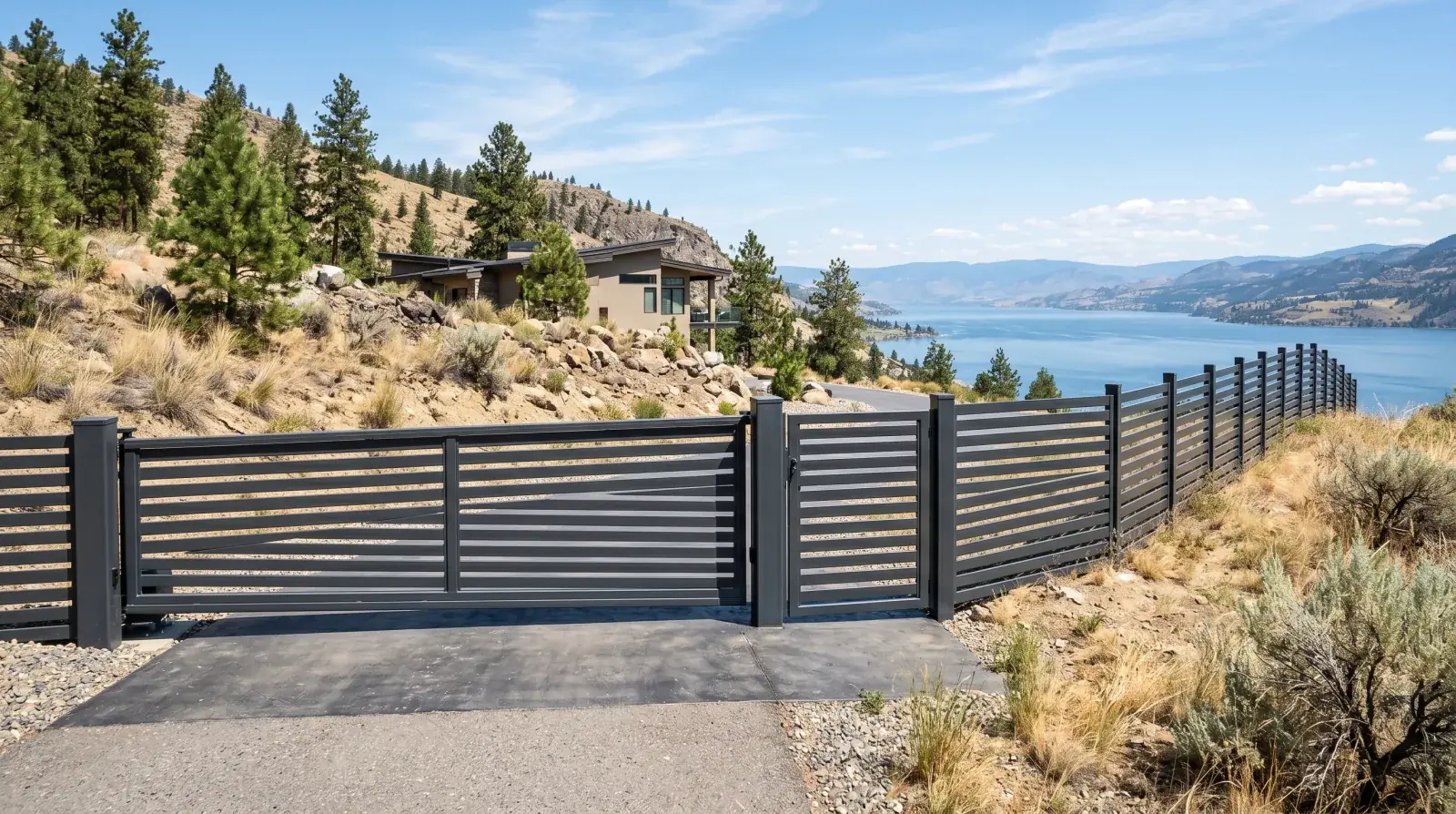
Steel breaks the path. A steel fence along the property line, a steel driveway gate, and steel deck railings put non-combustible material exactly where the fuel-to-structure connection would otherwise be. You don’t have to rebuild the whole property in steel to get the benefit, replacing the attached fence run and the gate is often the highest-value move on its own.
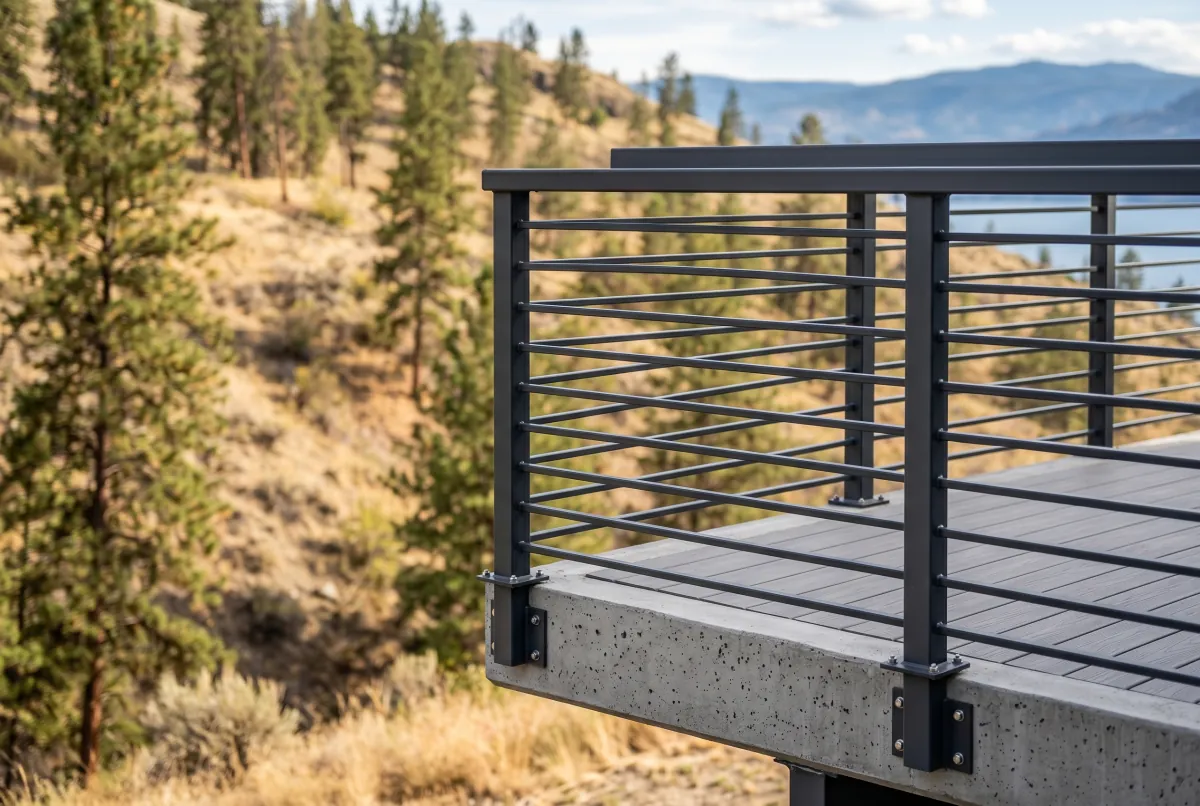
And steel doesn’t force an aesthetic compromise. The horizontal-slat gates and clean deck rails that suit a modern Okanagan home are exactly what we build, non-combustible and contemporary at the same time. The fire performance is a property of the material, not a look you have to live with.
Steel is one layer, not the whole plan
Worth being straight about this: steel railings, gates, and fences are not a fireproofing system on their own. FireSmart is a layered approach, the roof, the vents, the siding, the deck surface, and the vegetation in the first few metres around the home all matter, and a non-combustible gate doesn’t make up for a cedar-shake roof. What steel does is handle the parts of that picture it touches, and handle them completely.
For Okanagan sun, we finish exterior steel with a duplex system: hot-dip galvanizing where it meets grade, then a UV-stable powder topcoat that resists the fade the strong valley light causes. Non-combustible and built for the climate.
What FireSmart actually says about fencing and railings
FireSmart BC’s home construction guidance divides the area around a home into zones based on distance from the structure. Zone 1, the first 1.5 metres immediately around the foundation, is where ember ignition is most likely, and the guidance calls for non-combustible materials throughout that zone. Zone 2 extends to 10 metres from the home, and the guidance calls for reduced combustibles.
Fencing and railings that sit in Zone 1 or that connect to the structure are specifically flagged. A combustible fence attached to the house moves fire from the yard to the structure along a continuous fuel path. A cedar deck railing on a wildfire-interface property sits in Zone 1 and meets both ember ignition and direct flame exposure standards worse than steel.
The implication is straightforward: any railing or fence that physically connects to the house, or that sits within 1.5 metres of the foundation, is a candidate for replacement with non-combustible material. Not every fence on the property, necessarily, but the section that connects to the home and the gate that marks the driveway approach are the ones with the clearest fire-performance argument.
The specific products that work on interface lots
The steel applications that matter most on a Kelowna wildfire-interface property are the ones positioned to break the combustible fuel path:
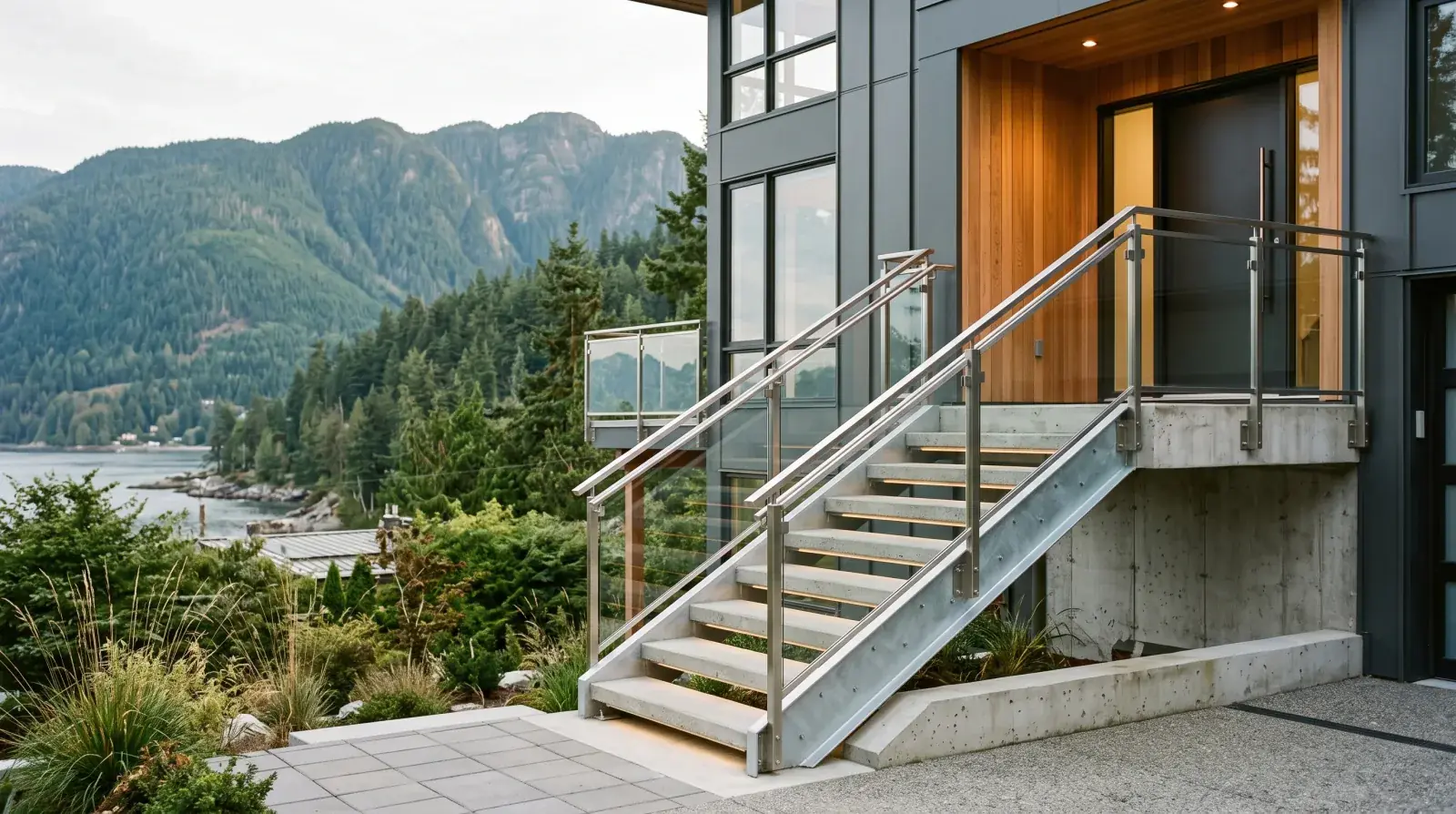
Deck and balcony guardrails, Okanagan view homes almost always have decks, and decks that face a hillside slope are directly in the path of uphill ember travel. A steel-and-glass guardrail, or a horizontal-slat steel rail, replaces combustible wood or composite at exactly the zone that matters. It also holds up to the UV exposure without the surface degradation that wood and composite see after a decade of Thompson valley sun.
The driveway gate, A timber driveway gate at the entrance of a property on the wildfire interface is a large combustible structure within close range of the house. A steel driveway gate, swing or slide, automated or manual, removes that fuel source. Modern horizontal-slat or open-frame steel gates are architecturally consistent with the contemporary homes common in Upper Mission and Wilden; this is not a fire-performance compromise that forces an industrial look.
The fence section attached to the home, The most cost-effective move on many interface properties is not replacing all the fencing, but replacing the run that attaches directly to the house with steel. The structural posts, the infill, and the gate that connects to the home can all be replaced in steel while leaving the rest of the fencing in wood if budget or preference calls for it.
Steel privacy screens and patio enclosures, Properties in Crawford Estates and South Mission often include covered patios and screen walls. Steel-frame privacy screens, laser-cut steel panels, or expanded metal infill are non-combustible alternatives to wood or composite screen structures in those positions.
Finishing for the Okanagan climate
The finishing question matters separately from the non-combustibility question. Steel is non-combustible regardless of what’s on the surface, but a finish that fails in Kelowna’s climate is a maintenance problem and an aesthetic one.
On coastal BC properties, the main threat to steel finishes is salt air corrosion. In Kelowna that threat is minimal. What the Okanagan climate does instead is work on finishes with UV and heat. A powder coat that performs well under Vancouver cloud can chalk, fade, and lose adhesion in a few seasons of strong Okanagan sun, particularly in darker colours.
The spec we use for Kelowna exterior steel: hot-dip galvanizing on posts and anything that contacts grade or concrete, then a UV-stable exterior-grade powder topcoat over that. The galvanizing handles the slow moisture exposure at grade even in a dry climate; the UV-stable topcoat holds colour and adhesion under the valley sun. On long railing runs we also design expansion into the connections, steel grows and contracts with temperature swings, and Kelowna’s summer-to-night temperature differential on an exposed deck is large enough to stress a rigidly fixed long run if expansion isn’t accounted for.
The design conversation on an interface lot
One thing that surprises people when they start replacing combustible materials with steel: the design result often improves. Wood fencing and composite railing have an inherent look, one that reads as ordinary residential landscaping in many contexts. Steel done well looks intentional. The horizontal-slat gate patterns, the thin-profile cable-and-steel deck guards, the clean welded steel privacy screens, these are the same products architects specify on premium Okanagan homes because they suit the view and the landscape, not just because of any fire consideration.
When we talk through a Kelowna interface project, the conversation usually moves through three stages. First: which elements need to change from a fire-performance standpoint, based on the lot’s position in the Wildfire Development Permit Area zones. Second: what product would perform well in the Okanagan climate, which means UV-stable finishes, duplex coating at grade, and thermal expansion designed into long runs. Third: what looks right for the property, which is a design conversation about the house style, the site topography, and how the metalwork reads from the approach and from the view deck.
The three stages reinforce each other. A steel gate that breaks the fuel path to the structure, holds its finish for fifteen years in Okanagan sun, and looks like it belongs on a contemporary hillside home, that’s the outcome. None of those goals compromise the others.
Building or rebuilding on a Kelowna interface lot
If you’re on one of the hillside-interface lots, it’s worth looking at your railings, your gate, and the fence section attached to the house as a fire question, not just a design one. We fabricate at our C.W.B. certified Burnaby shop and install across the Okanagan, the same way we delivered the Interior Health stairs at Kelowna General Hospital.
Start by checking your parcel against the City of Kelowna’s wildfire hazard mapping, properties in the Wildfire Development Permit Area carry specific requirements that may affect what finishes, materials, and structural details you need to include. Know which zone you’re in before you spec any exterior material.
If you want to talk through a Kelowna project, the metal fencing and driveway gate options are the places most interface homeowners start. The deck railing question is usually right behind them.