Everything a coastal fabricator knows about protecting steel is built around two enemies: salt and rain. Move three and a half hours up the Coquihalla to Kamloops and both mostly disappear. The Thompson valley is semi-arid, Kamloops averages roughly 547 mm of precipitation a year, less than half of what Vancouver gets, and the summers are hot, dry, and brutally sunny.
That single change rewrites the railing spec. The question on the coast is “how do I stop this from rusting?” In Kamloops it’s “how do I stop the sun from wrecking the finish, and how do I let the steel move when it bakes?” Different problem, different answers.
Salt isn’t the threat here, the sun is
On a North Shore or Richmond waterfront railing, we reach for 316 stainless and duplex finishes because salt-driven corrosion is relentless. None of that applies on a Sahali bench or a Sun Rivers view lot. There’s no salt. Corrosion is slow. Spending a client’s money on marine-grade alloy in Kamloops is spending it on the wrong problem.
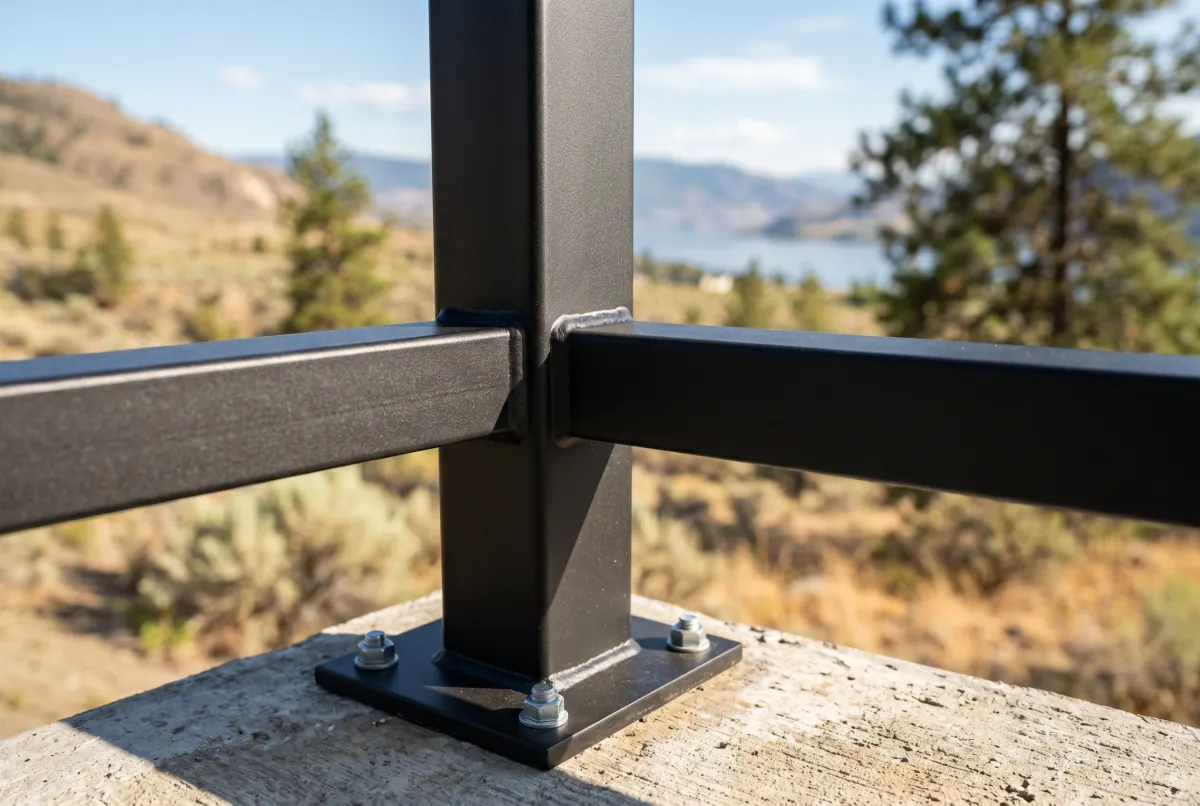
What does fail in Kamloops is the finish. A powder coat that holds its colour under Vancouver cloud will chalk and lighten under direct Thompson valley sun, and it shows up first on the darker colours people love on modern homes. Matte black is the most-requested railing colour we fabricate, and matte black is exactly the colour that punishes a weak topcoat.
So the spec shifts. We use exterior-grade, UV-stable powder topcoats rated for high-sun exposure. On steel that meets a concrete deck or touches grade, where moisture can sit even in a dry climate, we’ll still galvanize underneath the powder. But the headline decision in Kamloops is the topcoat, and it’s the one most out-of-town fabricators get wrong by shipping a coastal spec inland.
Heat moves steel, and a long rail will tell you about it
Here’s the one that surprises homeowners. Steel expands when it heats up. In Kamloops, a deck rail can go from a cool morning to a surface temperature well above air temperature under afternoon sun, then drop again overnight. The daily swing is bigger than anything a coastal rail sees.
On a short balcony guard it doesn’t matter. On a long, continuous exterior run, say a 12-metre deck rail facing the valley, that expansion adds up to real movement. If every post is rigidly fixed and the rail has nowhere to go, the steel fights itself. You hear it (creaking on hot afternoons), then you see it (stressed powder at the joints), and eventually a weld can crack.
The fix is boring and effective: design expansion into the run. Slip joints, considered post fixity, and breaking very long runs into engineered segments. It’s the kind of detail that never shows up in a photo but is the difference between a rail that’s quiet in twenty years and one that isn’t.
Choosing the right steel alloy for Kamloops
On a coastal Metro Vancouver site, we regularly specify 316 stainless for exterior applications, particularly anything within a kilometre of salt water, in West Vancouver, Richmond, or the North Shore waterfront. The molybdenum content in 316 stainless resists the chloride pitting that salt air drives into 304 and mild steel over time.
In Kamloops, that calculus doesn’t apply. The city sits in a semi-arid interior valley with no salt exposure. Kamloops averages around 300 to 400 mm of precipitation annually, roughly a quarter of what Metro Vancouver receives. The corrosion mechanisms that drive marine-grade specification are largely absent.
What that means in practice: standard powder-coated mild steel performs well on most Kamloops exterior railings. For applications where a polished or brushed metal look is wanted without paint, 304 stainless is the right alloy, not 316. The price difference between 304 and 316 is real, and on a Kamloops project, that money is better spent on a quality UV-stable topcoat than on an alloy grade solving for a problem that doesn’t exist.
Where you do still want hot-dip galvanizing in Kamloops: posts that sit in concrete footings, base plates at grade, and any section of railing that will have standing water around it seasonally. Even in a dry climate, moisture sits in footings. Galvanizing before powder coat, the duplex system, is the right call at grade contact regardless of location.
What colour does under Thompson valley sun
This is the practical question most homeowners don’t ask until it’s too late. Dark powder coat colours, matte black and deep charcoal are the most common requests on contemporary Okanagan homes, are exactly the colours that show UV degradation fastest. Fade appears as a lightening of the colour toward grey or brown; chalking is the powdery surface breakdown that follows.
The failure timeline depends on topcoat quality. A cheap powder coat, or one formulated for indoor or low-UV environments, can start showing colour change within two to three summers of direct Thompson valley sun. A properly specified UV-stable exterior-grade topcoat holds colour for ten or more years under the same exposure.
The questions to ask your fabricator: What is the specific powder coat product? Is it rated for exterior exposure? What is the UV resistance specification? A shop that can’t answer those questions is likely shipping a coastal spec inland and hoping.
We apply exterior-grade, UV-stable powder topcoats on all Kamloops and Okanagan work. On dark colours, we also specify the coating thickness on the drawings, a thinner coat of any product degrades faster. This is not a detail that shows up in photographs or in a sales conversation, but it is the difference between a railing that looks the same in fifteen years and one that needs recoating in five.
Substrate prep, the step that decides how long the finish lasts
A UV-stable topcoat applied over poorly prepared steel will fail earlier than a standard topcoat applied correctly. The finish is only as durable as the bond between the coating and the substrate.
For Kamloops exterior railings, we use one of two prep approaches depending on the application:
Abrasive blast plus phosphate wash, for standard exterior mild steel railings. Blast removes mill scale, rust, and surface contamination; phosphate conversion creates a chemically reactive surface that bonds strongly with the powder. This is the baseline for any exterior railing that will see sun, moisture, and thermal cycling.
Galvanize plus powder topcoat (duplex), for posts at grade, base plates in concrete, or any application where moisture contact is expected. The galvanizing acts as the primary corrosion barrier; the powder coat above it provides colour, UV resistance, and a second moisture seal. A duplex system on a Kamloops post set in a concrete footing will outlast a powder-only approach by decades.
A fabricator who blasts and coats without a primer or conversion coat step is cutting the prep short. It saves twenty minutes per piece in the shop and shows up as coating adhesion failure in three to five years, typically at welds, at edges, and at the stress points that move most with thermal cycling.
Glass railings in Kamloops, the detail that changes
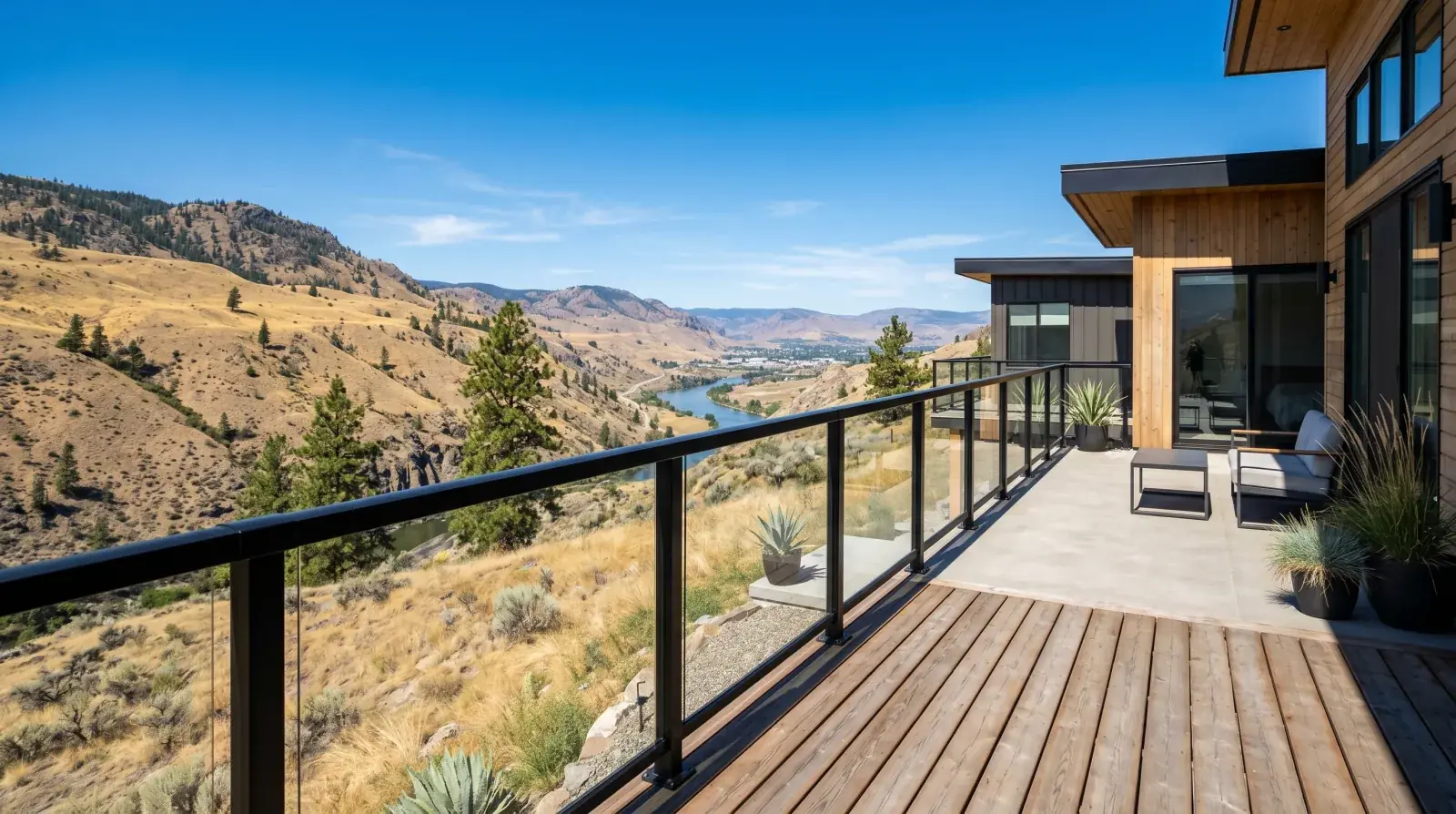
Glass-and-steel railing systems are common on the view decks that make Kamloops hillside properties worthwhile. Frameless and semi-frameless glass guards work well in the Interior climate, with a few details that differ from a coastal installation.
The hardware matters. Standard stainless standoff hardware, used on frameless glass systems to pin the panels, is 316 stainless in coastal applications to resist salt air. In Kamloops, 304 stainless performs equally well at lower cost. The glass itself doesn’t change; tempered or laminated tempered glass to CSA A440 is the spec regardless of climate. What changes is the structural post sizing, because a long glass railing run on a Kamloops deck is subject to more dramatic thermal cycling than the same railing on a West Vancouver site, and the posts and base plates need to be designed to accommodate that movement without transmitting stress into the glass panels.
On framed glass systems, where the glass sits in a steel channel or tube frame, we also pay attention to the seal between the frame and the glass edge. A sealant that stays flexible in heat holds the panel without cracking the glass edge; a rigid sealant can put point loads on the glass as the frame moves. This is a small detail that has a real consequence on a deck that hits 40°C in July and drops to 10°C overnight.
What this means if you’re building in the Thompson valley
If you’re putting a railing on a deck in Aberdeen, Juniper Ridge, or out toward Barnhartvale, the brief is straightforward once you stop thinking like the coast. Standard powder-coated steel or 304 stainless is plenty of corrosion protection. Put the budget into a UV-stable topcoat and proper substrate prep. And on any long exterior run, make sure whoever’s fabricating it is detailing for thermal movement, not just welding it solid and hoping.
We fabricate at our C.W.B. certified shop in Burnaby and install across Kamloops as a planned trip, the same way we delivered the Interior Health stairs at Royal Inland Hospital. If you’re weighing finishes for a Kamloops project, or you want the longer version on railing materials, our materials and finishes guide goes deeper on the trade-offs.
The valley view is the whole reason for a glass or thin-line steel rail up there. Spec it for the sun, not for salt that isn’t coming, and it’ll still look right when the view hasn’t changed a bit.