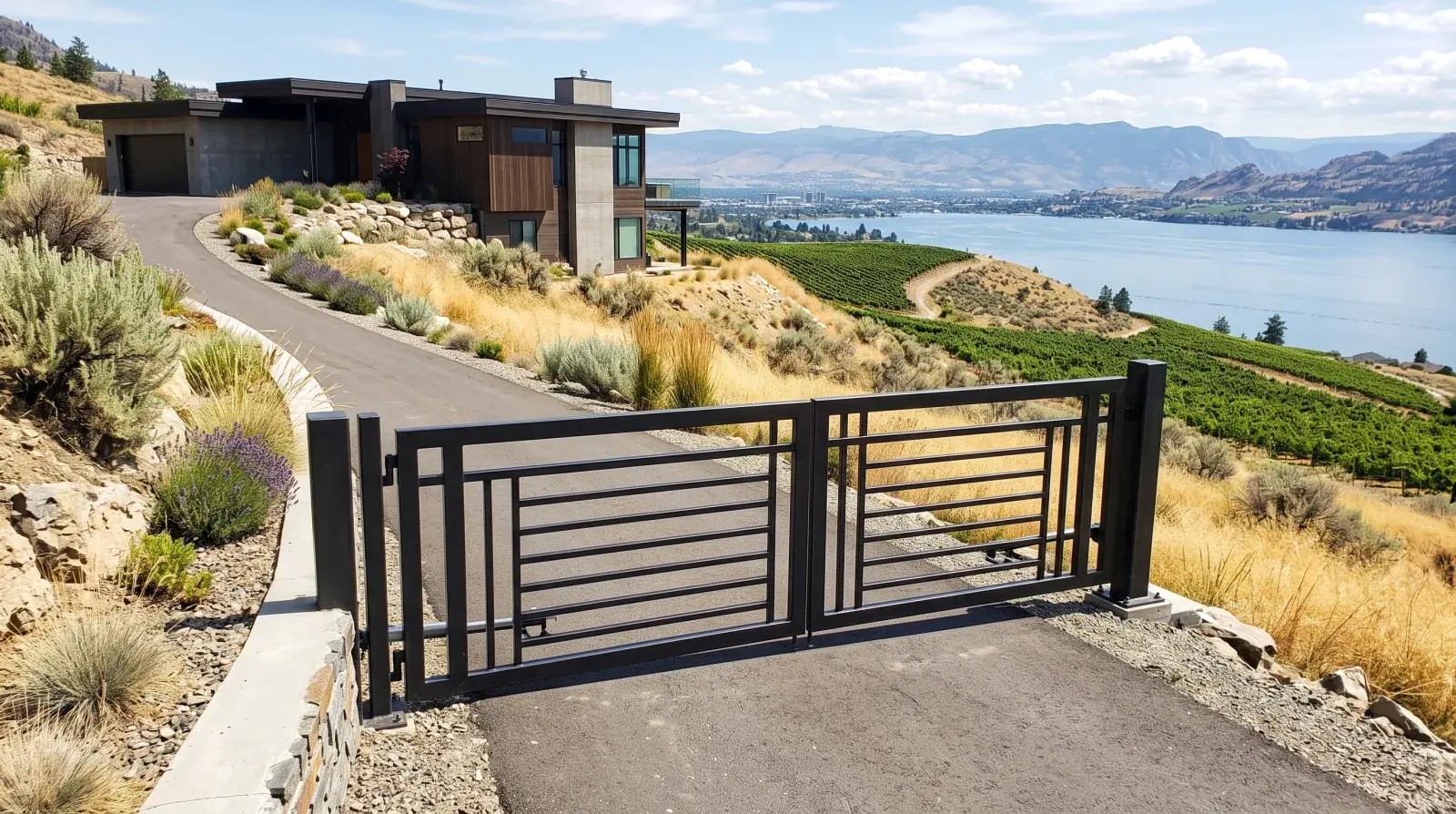
Coquitlam driveways come with two complications that change the design conversation, long approaches and real slope. Burke Mountain, Westwood Plateau, and Eagle Ridge sit on a serious grade, and the homes up there often have driveways that climb 6 to 12% from the street to the garage. Drop a standard swing-gate design on that geometry and you get a gate that scrapes asphalt at the bottom of its arc, or sits awkwardly high to clear the slope. Neither looks good and one of them does not work.
This post walks through the design choices that actually matter for a custom driveway gate on a Coquitlam property, slide versus swing, single versus double leaf, automation, finish for the climate, and the City of Coquitlam permit process. The fabrication itself is the same regardless of where in Metro Vancouver the gate is going; the up-front decisions are what differ.
For the broader gate-design conversation across Metro Vancouver, our custom driveway gates Vancouver, swing vs slide post covers the basics. This one is for the project on a Coquitlam lot where slope, approach length, and local conditions push the design decisions in specific directions.
What slope does to the design
The biggest single thing slope changes is whether a swing gate works at all. A swing gate has to clear the ground through its full arc, from the closed position to perpendicular to the driveway. On a flat lot, that is straightforward; the gate rides on its hinges with maybe 25 to 50 mm of clearance to the driveway surface. On a downhill driveway, the same gate would dig into the asphalt as it swings open, so the bottom of the gate has to be raised to clear the lowest point of the arc. That gap below the gate often ends up at 200 to 300 mm, which looks wrong and lets in animals and debris.
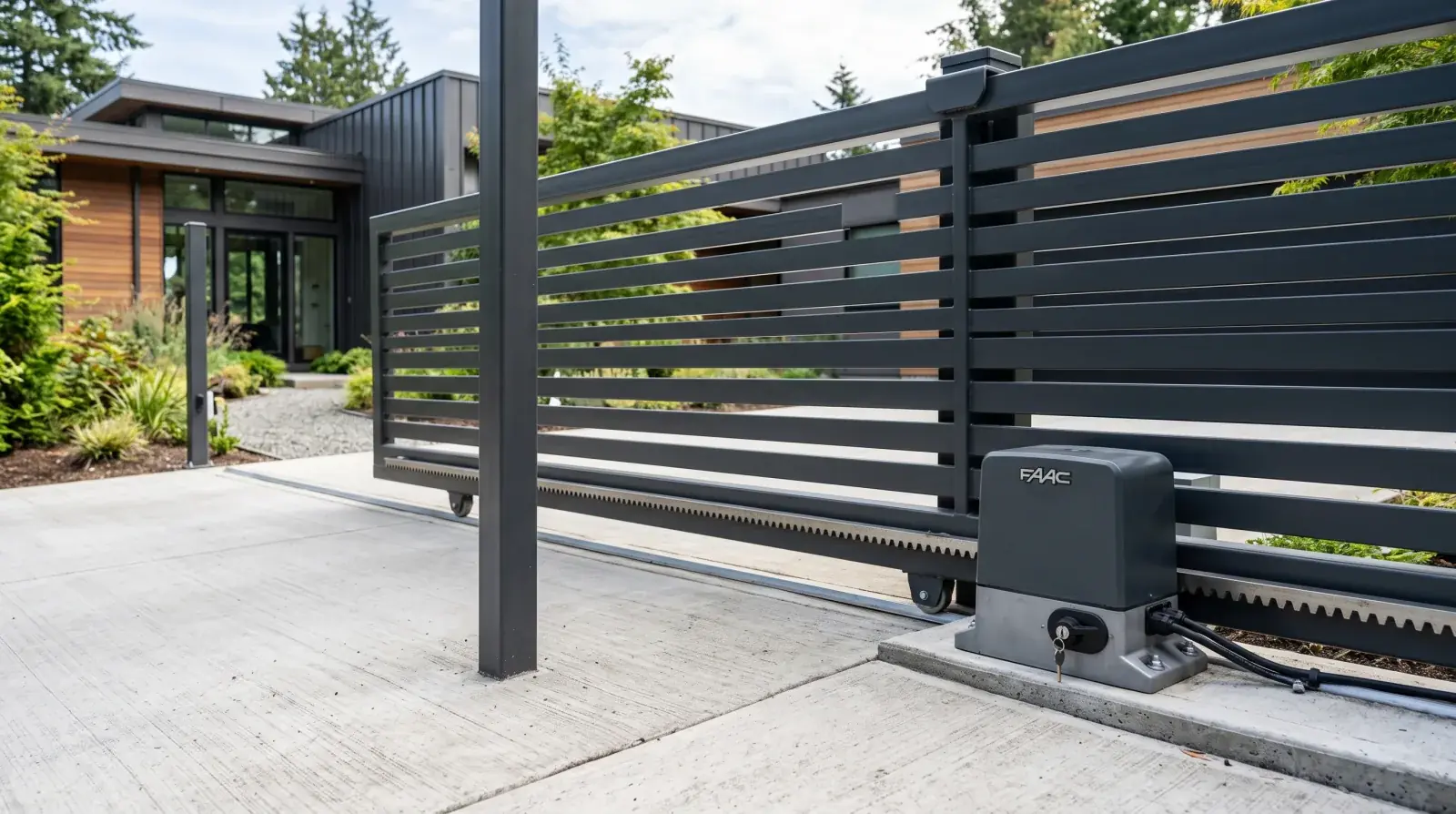
The fixes are well known. Cantilever-mounted swing gates have a sloped bottom rail that follows the driveway grade. Bi-folding swing gates fold against themselves so the swing arc is shorter and the clearance issue shrinks. And slide gates eliminate the problem entirely, the gate moves laterally, parallel to the property line, and never sweeps over the driveway. On steep Westwood Plateau driveways, slide gates are usually the cleanest answer.
The trade-off with slide gates is the receiver post and track. A slide gate needs a clear run alongside the driveway equal to its opening width, a 12-foot opening needs at least 12 feet of fence line for the gate to slide into. On tight properties where there is no room for the slide pocket, swing gates win even on slope, with the clearance issue solved through cantilever or bi-fold detailing.
How approach length changes automation
The other thing Coquitlam driveways often share is length. A 100-foot approach from the street to the garage is normal in Burke Mountain. That distance changes the automation conversation in three ways.
First, the gate operator needs to be sized for daily-use cycles plus deliveries. A residential class operator rated for 30 to 50 cycles per day is fine on a low-use property; on a long driveway where the gate is opened multiple times a day for residents, deliveries, and trades, a heavy-duty residential or light-commercial operator is the right call. The cost difference is meaningful but the operator survives 10+ years instead of 4 to 6.
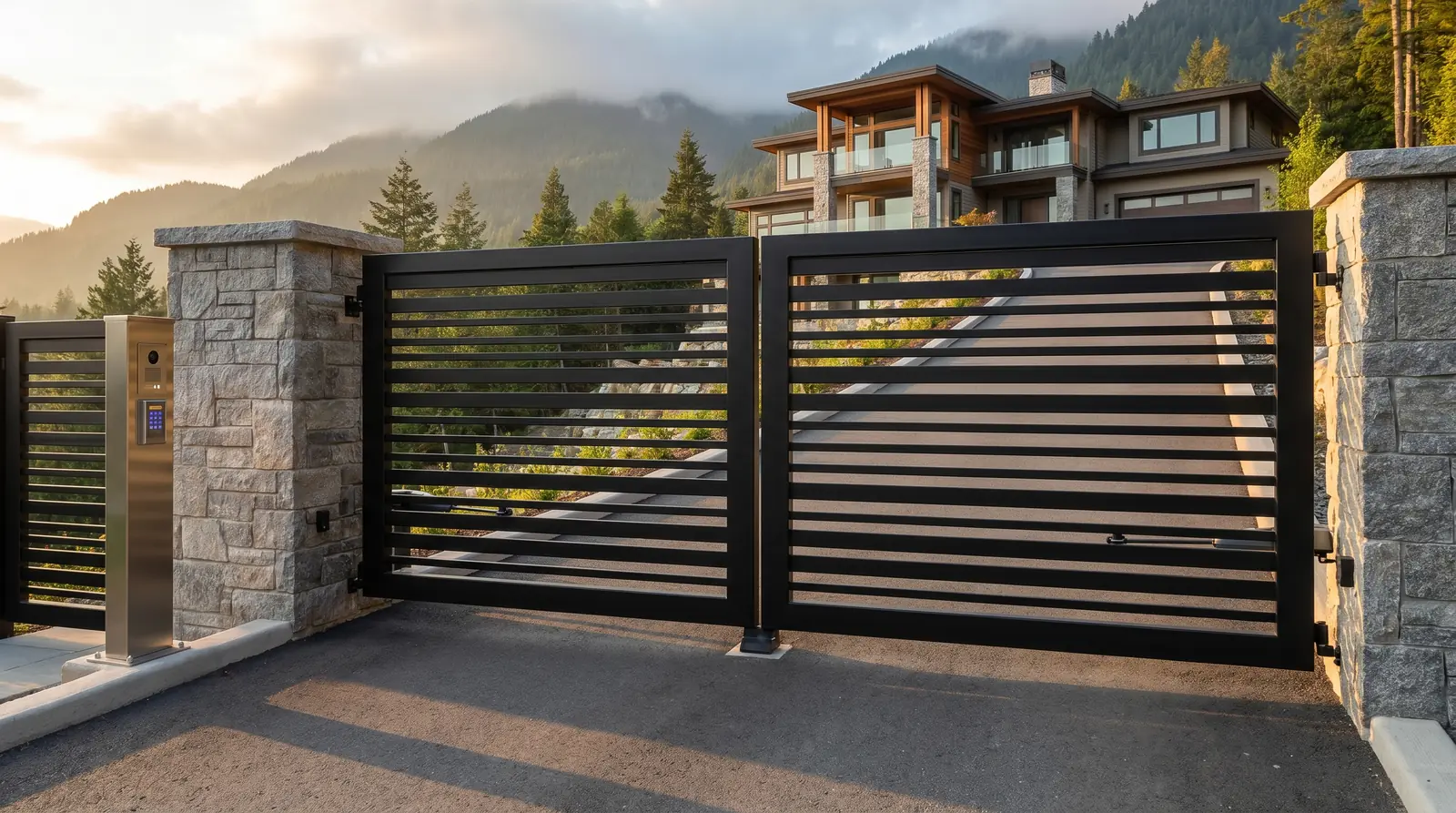
Second, the intercom and access control matter more. On a short driveway, a visitor at the gate can usually get the homeowner’s attention by horn or by being visible from the house. On a 100-foot approach behind landscaping, the gate is out of sight and out of earshot, so a quality intercom or video-call system is functionally necessary. We integrate these during the gate fabrication so the wiring and conduit are clean.
Third, the gate operator needs reliable power. On long driveways the operator panel is far from the house service, so a dedicated underground conduit run from the panel to the gate is part of the project scope. The electrical trade handles the run; we coordinate the conduit termination at the operator pad during gate install.
Permit and bylaw considerations in Coquitlam
The City of Coquitlam regulates fence and gate construction through its Building Bylaw. Most residential fence and gate projects under 1.8 m do not require a building permit, but height limits, setback requirements, and corner-lot sight-line rules vary. Anything over 1.8 m, anything in a designated heritage area, or anything that involves a strata-managed property triggers additional review.
Practical advice from working through Coquitlam projects regularly: confirm directly with the Building Permits Division (604-927-3441) before fabrication begins. Permit volume in Coquitlam has increased significantly with provincial housing legislation changes, and review timelines have stretched. Building the permit timeline into the project schedule from the start avoids the common situation where the gate is fabricated and ready to install but the City sign-off hasn’t come through.
For commercial properties and strata managed sites, the process is more involved, strata council approval, possibly architectural-control-committee sign-off in newer developments, and engineering review for taller or longer gates. Allow an extra 4 to 8 weeks for the approval process on these projects.
Finish for the Coquitlam climate
Coquitlam gets the same wet Pacific climate as the rest of Metro Vancouver, but the higher elevations on Burke Mountain and Westwood Plateau add freeze, thaw cycles in winter that lower-elevation neighbourhoods rarely see. A gate that sits on a Burnaby flat lot at 50 m elevation faces less corrosion stress than the same gate at 350 m on Burke Mountain.
For any exterior gate in Coquitlam, the finish spec is straightforward: hot-dip galvanized to ASTM A123 over the entire fabricated assembly, then powder coat or wet paint for colour. The galvanizing is the actual corrosion protection; the powder coat is the colour and weather resistance for the finish. This duplex system has demonstrated multi-decade service life on Pacific coast applications and is the conservative spec for any gate the owner expects to outlast a coat of paint by 20+ years.
Powder coat alone over bare steel will start showing rust at edges, weld terminations, and any small chip within five to ten years in Coquitlam’s climate. We do not recommend it on exterior gates regardless of how nice the showroom photo looks.
Automation hardware specifics
For automated driveway gates in Coquitlam, the operator class is the first decision. Three common categories:
- Residential Class I, for single-family homes with low cycle counts (under 50 per day), no public access. Quieter, smaller, more affordable. Suits most Coquitlam single-family residential projects.
- Residential Class II, for single-family homes with higher cycle counts or long driveways. Beefier, faster, longer service life.
- Commercial Class III, for strata, commercial, and high-cycle properties. Required by code on commercial gates in BC. Heavier-duty motor, higher rating, more expensive but multi-decade service life.
Within each class, slide gate operators and swing gate operators are different products. Slide gate operators include a chain or rack-and-pinion drive; swing gate operators are typically articulated arm or underground hydraulic. The choice depends on the gate type, the speed required, and the appearance the owner wants, articulated arms are visible; underground hydraulic operators are hidden.
Access control hardware, keypads, intercoms, vehicle loop sensors, and remote/smartphone systems, gets specified after the gate operator is chosen. Intercom-and-camera systems are the most common pairing for residential properties. Vehicle loop sensors (a wire embedded in the asphalt that detects a car’s exit) prevent the gate from closing on a vehicle and are required by the BC Building Code on automated gates.
Common Coquitlam project types
The work splits roughly into three buckets across our Coquitlam projects.
Single-family residential driveway gates
By far the most common, homes on Burke Mountain, Westwood Plateau, Eagle Ridge, and Riverview Heights commissioning a custom steel gate to match an existing fence or replace a previous installation. Typical scope: 8 to 14 ft single-leaf swing or 12 to 20 ft double-leaf swing, automated, integrated with intercom and keypad, finished in matte black powder coat over hot-dip galvanizing.
Strata townhouse and condo entry gates
Less common but a different conversation. Strata-managed properties usually require council approval, a more durable operator class, and a higher cycle rating. The gate also needs to integrate with the property’s broader access control system, fobs, transponders, or app-based access for residents and a separate visitor flow.
Commercial and small-industrial driveway gates
Coquitlam’s commercial and light-industrial corridor, particularly along United Boulevard and the Cape Horn industrial area, uses driveway gates for after-hours security on small commercial yards, contractor lots, and storage facilities. These are typically slide gates because the run is along a fence line, sized for the largest vehicle that needs access (often 20 ft for trucks), with commercial-class operators and durable finishes. Less aesthetic, more about function, and the engineering is more focused on impact resistance.
For pricing and a site visit on a specific Coquitlam driveway gate project, request a quote, slope, approach length, gate width, automation requirements, and finish all need to be confirmed before any meaningful number can be put on the project.
Related driveway gate guides by city
- Driveway gates in Burnaby, our home city, and where most of our flat-lot residential gate work is concentrated
- Driveway gates in Vancouver, tight lots, heritage streets, and the City of Vancouver permit process
- Driveway gates in Langley, acreage and rural lots, slide gates on long fence lines