City of Vancouver lots are tighter than almost any other Metro Vancouver municipality. The standard 33-foot frontage lot common in East Vancouver and parts of the West Side leaves very little room for a driveway gate to swing without intruding on the sidewalk or the neighbour’s setback. Add a heritage designation in Shaughnessy or the West End, a tight setback in Mount Pleasant, or a Vancouver Special with the driveway running flush to the property line, and you get a permit and design conversation that is meaningfully different from working in Burnaby or Coquitlam.
This post covers what holds up on a Vancouver driveway gate project, the lot conditions that drive the design, the City permit process, and the gate styles that survive the climate and the daily-use cycle. The broader cross-Metro design conversation is in our swing-vs-slide guide; this one is for the project actually inside the City of Vancouver.
What a tight Vancouver lot does to the design
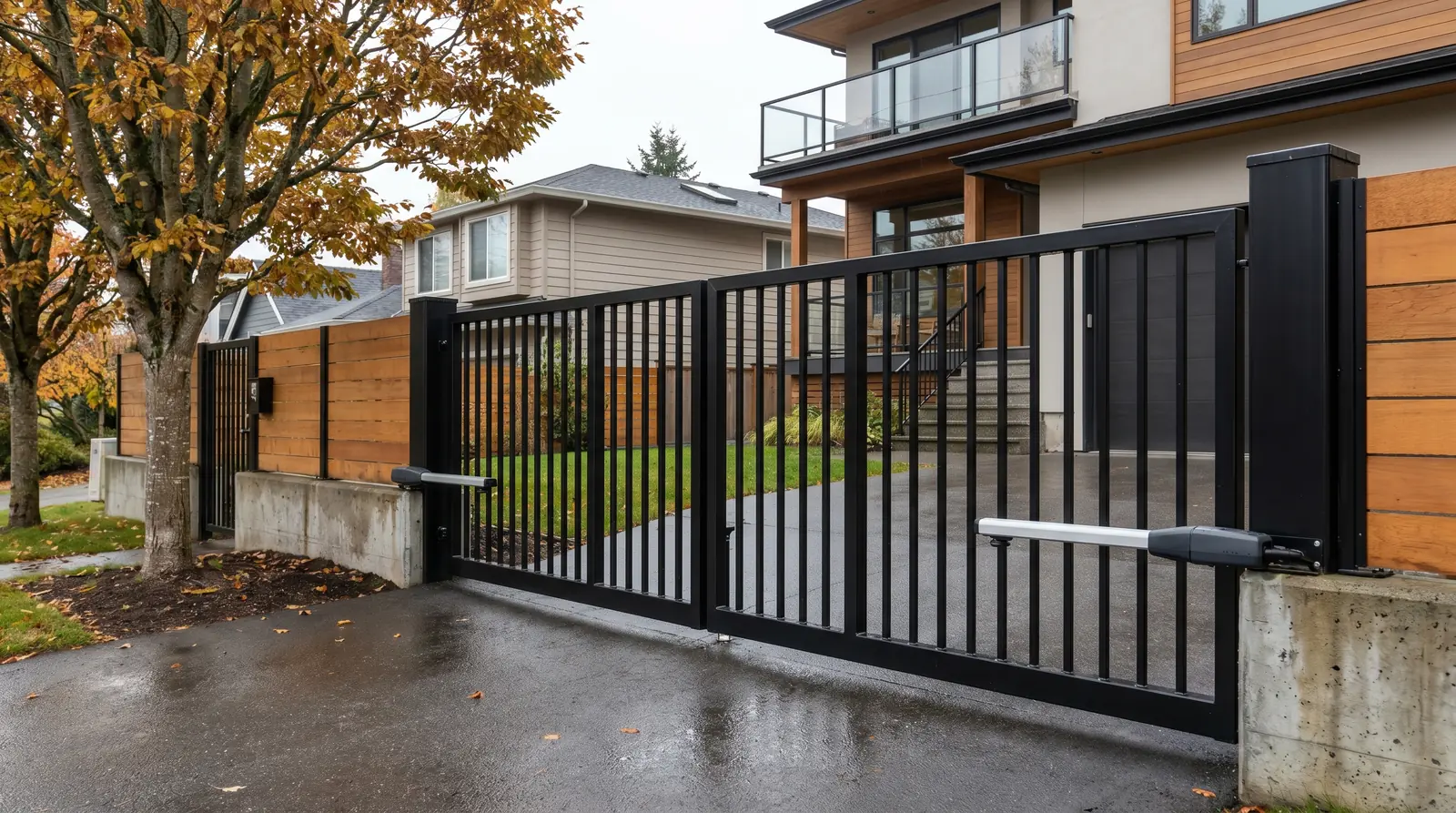
A swing gate sweeps through an arc equal to its leaf length. On a 12-foot single-leaf swing, that is a 12-foot arc, and the gate has to be free to clear that arc without hitting the property line, the neighbouring fence, the City sidewalk, or any vehicle parked on the driveway. On a tight 33-foot lot with the driveway running 9 to 10 feet wide, there is often not enough room for a standard swing.
Two design moves solve this on most tight Vancouver lots:
Bi-folding swing gates. The gate folds against itself at a midpoint hinge, so the swing arc is halved. A 12-foot effective opening fits into a 6-foot swing arc. The fabrication is more involved (twice the hinges, twice the bearing surfaces, more careful detailing of the fold), but the operator hardware is similar to a single-leaf swing. We fabricate a meaningful number of bi-folding gates for West Side projects in Kitsilano, Dunbar, and parts of Point Grey for exactly this reason.
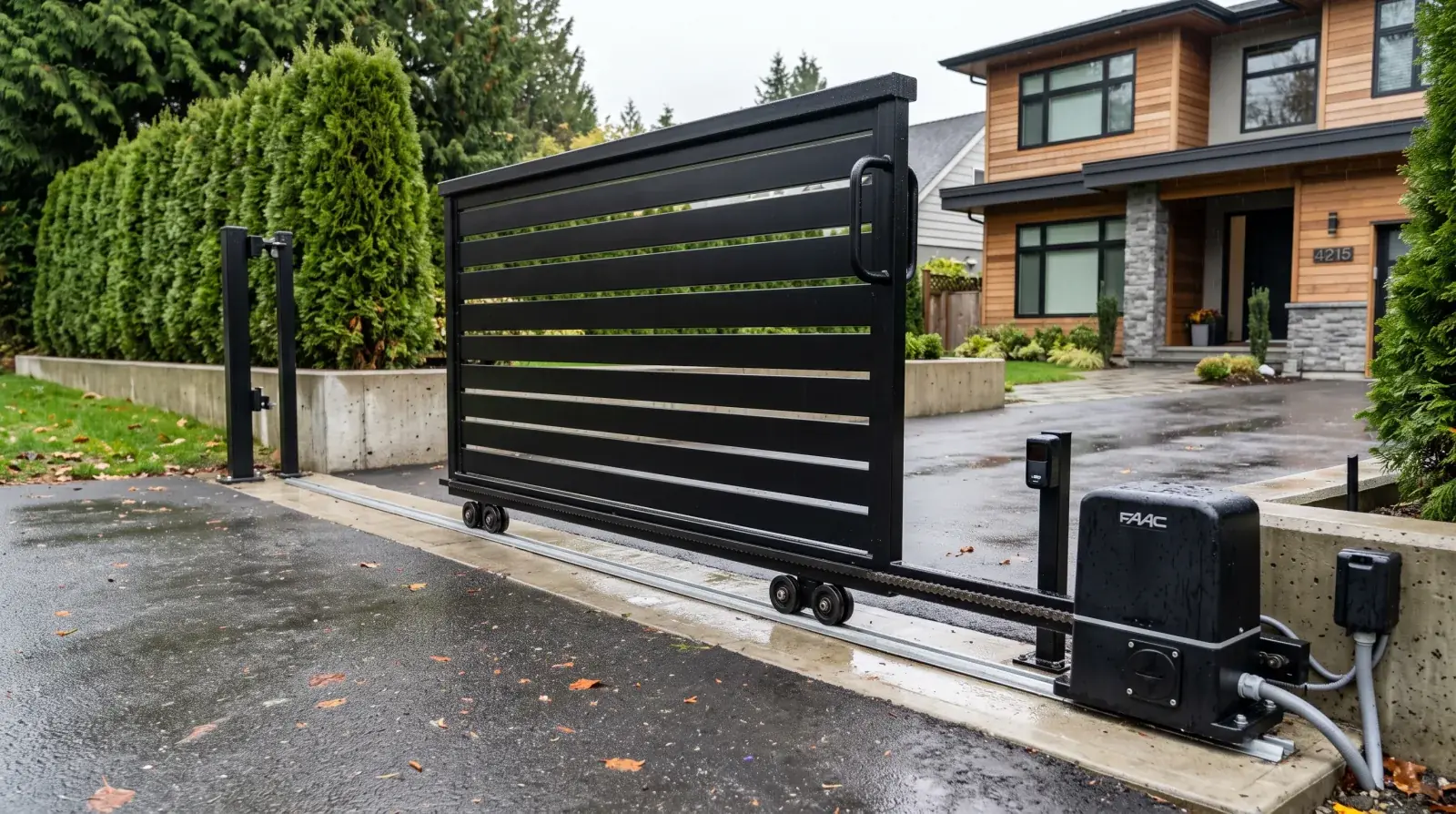
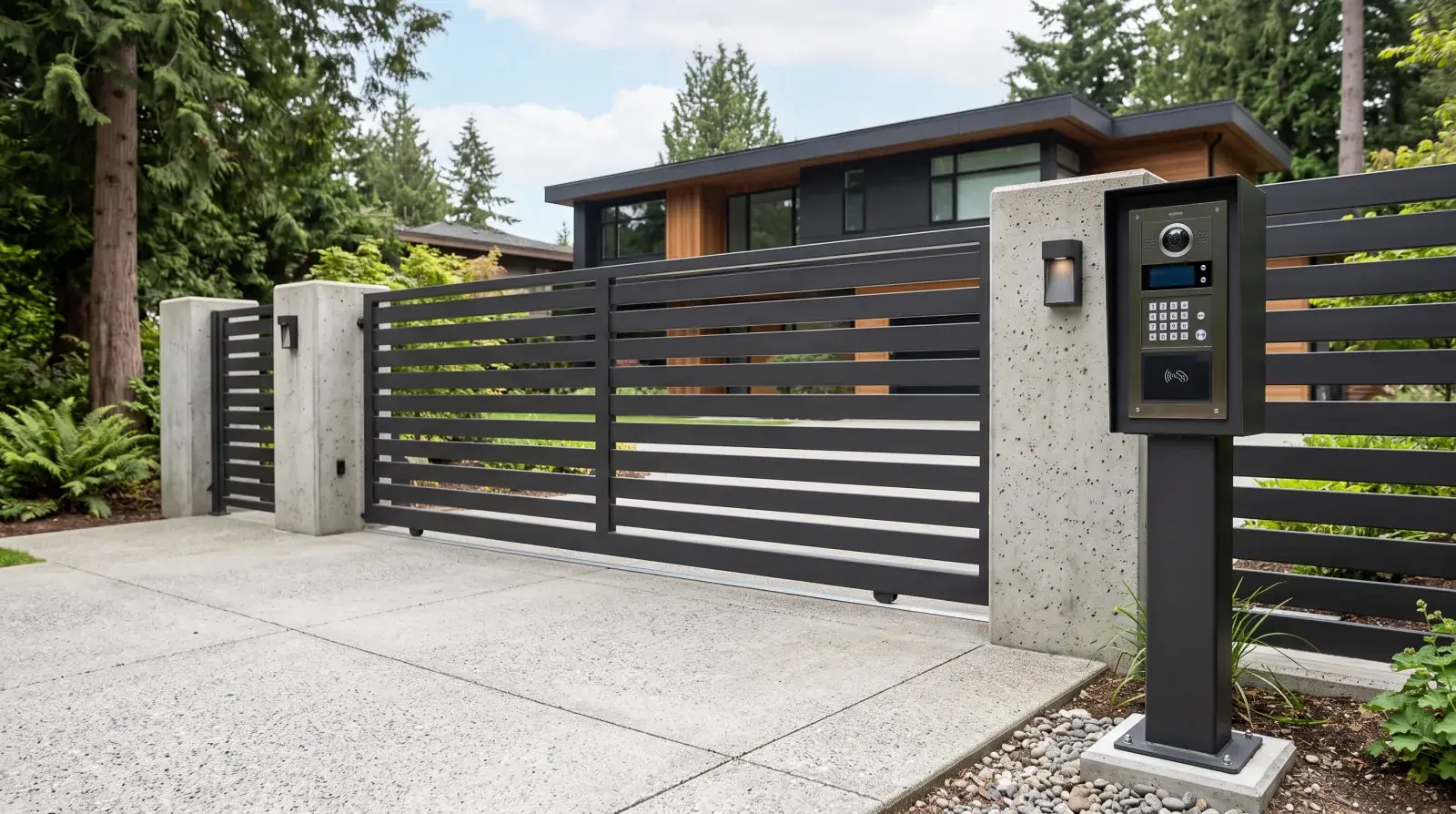
Slide gates. Lateral travel parallel to the property line, no swing arc at all. Slide gates need a clear run of fence equal to the gate’s opening width, a 12-foot opening needs 12 feet of fence line for the slide pocket. On a deep narrow lot this is feasible if the fence runs back along the side property line. On a corner lot or a lot with the side fence already at maximum length, slide gates become impossible.
A small number of Vancouver projects use vertical lift gates, the gate lifts straight up like a garage door, but these are uncommon outside of commercial and high-end estate work because the operator hardware is more specialized and the visual is often unwanted.
Vancouver permit and bylaw process
The City of Vancouver has the most complex permit process of any Metro Vancouver municipality, partly because of the high volume and partly because of the layered bylaws (zoning, building code, heritage, zoning by-law overlays, view corridor protection in some areas). All gate work eventually goes through the City’s development and building services.
Common triggers for permit requirements:
- Gates over 1.8 m total height. Most residential gates fit under this, but security-oriented designs sometimes do not.
- Setback intrusions. Vancouver’s zoning by-law strictly enforces front, side, and rear yard setbacks. A gate’s hinge post and any pillars must respect setback lines.
- Heritage-designated properties. First Shaughnessy, the West End, and a number of individually designated homes in Mount Pleasant, Kitsilano, and Strathcona require Heritage Alteration Permits for any visible exterior change. Like-for-like restoration of an original gate is faster than new gate installation; heritage planning generally prefers restoration over reproduction over modern replacement.
- Corner lot sight triangles. The City protects driver sight lines at intersections; gate placement on corner lots has to leave the sight triangle clear of obstruction above a defined height.
- View corridor protection. A small number of streets have protected view corridors that limit the height and visual mass of any installation in the foreground.
Practical timeline: budget 2 to 4 weeks for City permit review on a standard residential gate, more on heritage or commercial sites. Building this into the project schedule from day one means the gate is ready to install when the permit comes through, not waiting in the shop.
Vancouver-specific design considerations by neighbourhood
The work coming through our shop from Vancouver projects splits roughly by neighbourhood, and each has its own pattern.
First Shaughnessy and the West End
Heritage-designated homes built between 1907 and 1925, with original wrought-iron fences and gates from glasgow forges and east coast foundries. New driveway gate work on these properties is rare; most of the work is restoration of existing gates, hand-forged matching elements, and finish duplication. The full restoration workflow is in our Heritage ironwork restoration in Vancouver’s Shaughnessy & West End post.
West Side custom homes (Point Grey, Dunbar, Kerrisdale, Kitsilano)
Larger lots than the East Side, contemporary or transitional new build architecture, and homeowners willing to spend on architectural metalwork. The dominant design language is matte-black powder-coated steel with horizontal slat or vertical picket infill. Bi-folding gates are common because the lots, while larger, often have driveway constraints that rule out standard swings.
East Side residential and Vancouver Specials
Tighter 33-foot lots, smaller setbacks, more density. Vancouver Special homes built between 1965 and 1985 often have the driveway running directly into the basement entry without a usable garage; the driveway gate, if installed, sits at the property line and is small (often 8 ft single-leaf swing). New East Side custom homes follow the West Side modern aesthetic but at smaller scale.
Cambie Corridor and Marpole townhouse infill
High-density redevelopment areas with stratified ownership. Driveway gates here are usually communal, one gate serving multiple townhouses or condo units. Strata council approval, architectural-control-committee design standards, and commercial-class operators apply. The gate is more durable than a single-family residential gate because it cycles many more times per day.
South Vancouver commercial corridors
Marine Drive, Kingsway, and Knight Street commercial properties have driveway gates for after-hours security on yards, contractor lots, and storage facilities. Slide gates dominate, sized for the largest vehicle that needs access (often 20 ft for trucks), with commercial-class operators and durable finishes. Less aesthetic, more functional.
What holds up in the Vancouver climate
The corrosion environment in the City of Vancouver is broadly the same as the rest of Metro Vancouver, high rainfall, salt-and-grit blowback in winter, cool temperatures with relatively rare freeze, thaw cycles below the 200 m elevation. The exception is properties near the water, Kitsilano, English Bay, parts of Point Grey, and the Marpole waterfront. Airborne salt accelerates corrosion on these projects significantly, and the finish spec needs to reflect it.
Standard exterior gate finish for any Vancouver project: hot-dip galvanizing under powder coat or wet paint. For waterfront properties, we sometimes specify stainless steel hinges and hardware in place of galvanized, the small extra cost is justified because the hardware sees the worst of the salt exposure.
The mistake we see on a meaningful number of replaced gates: installers who treat Vancouver as a typical Pacific climate and use only powder coat on bare steel, betting on the fact that the gate will not see active marine spray. Within five to ten years the rust shows through at every weld and chip, and the gate has to be stripped, galvanized, and re-coated.
Automation considerations on Vancouver projects
Automation is the standard expectation on most Vancouver custom driveway gate projects, residential and commercial. Three considerations specific to working in Vancouver:
Operator location and weather protection. On a tight lot, the operator pad is often very close to the gate and exposed. Standard residential operators are weather-rated, but proximity to a busy street with road spray suggests adding a small protective enclosure or specifying a higher-IP-rated operator class.
Power supply. Vancouver’s grid is reliable but the run from the home’s electrical panel to the gate operator is often short on tight lots. Coordination with the electrical trade matters, the conduit needs to be the right gauge and routed to avoid damage from landscaping work.
Access control on shared lanes. A meaningful number of Vancouver properties have rear-access driveways from shared lanes. Gates on shared lanes can be subject to easement conditions, lane access agreements, and other constraints that do not apply on a standard front-yard driveway. Confirm easement and access arrangements before designing the gate.
For a quote on a specific City of Vancouver driveway gate project, request a quote, every Vancouver lot has its own dimensions, slope, setback conditions, and (on some properties) heritage or zoning constraints. Pricing only makes sense after a site visit confirms what the lot will actually accommodate.