Langley driveways are different from anywhere else we install gates in Metro Vancouver. Properties run larger, half-acre to multi-acre lots are common, full hobby farms and equestrian operations are normal, and the geometry of the front entry is shaped by long approaches and rural fence lines. The gate that suits a tight 33-foot Vancouver lot does not work on a Langley acreage, and the reverse is also true.
This post walks through what Langley properties change about the gate design conversation, slide versus swing on long fence lines, sizing for trailers and equipment, the Township of Langley permit process, and the inland-climate finish that holds up. The fabrication itself is the same as anywhere else; the up-front decisions are what differ.
For the broader cross-Metro design discussion, our swing-vs-slide guide is the primary reference. This post is for the Langley project where rural conditions, larger lot scale, or agricultural use change the design from the standard residential template.
Why slide gates dominate Langley work
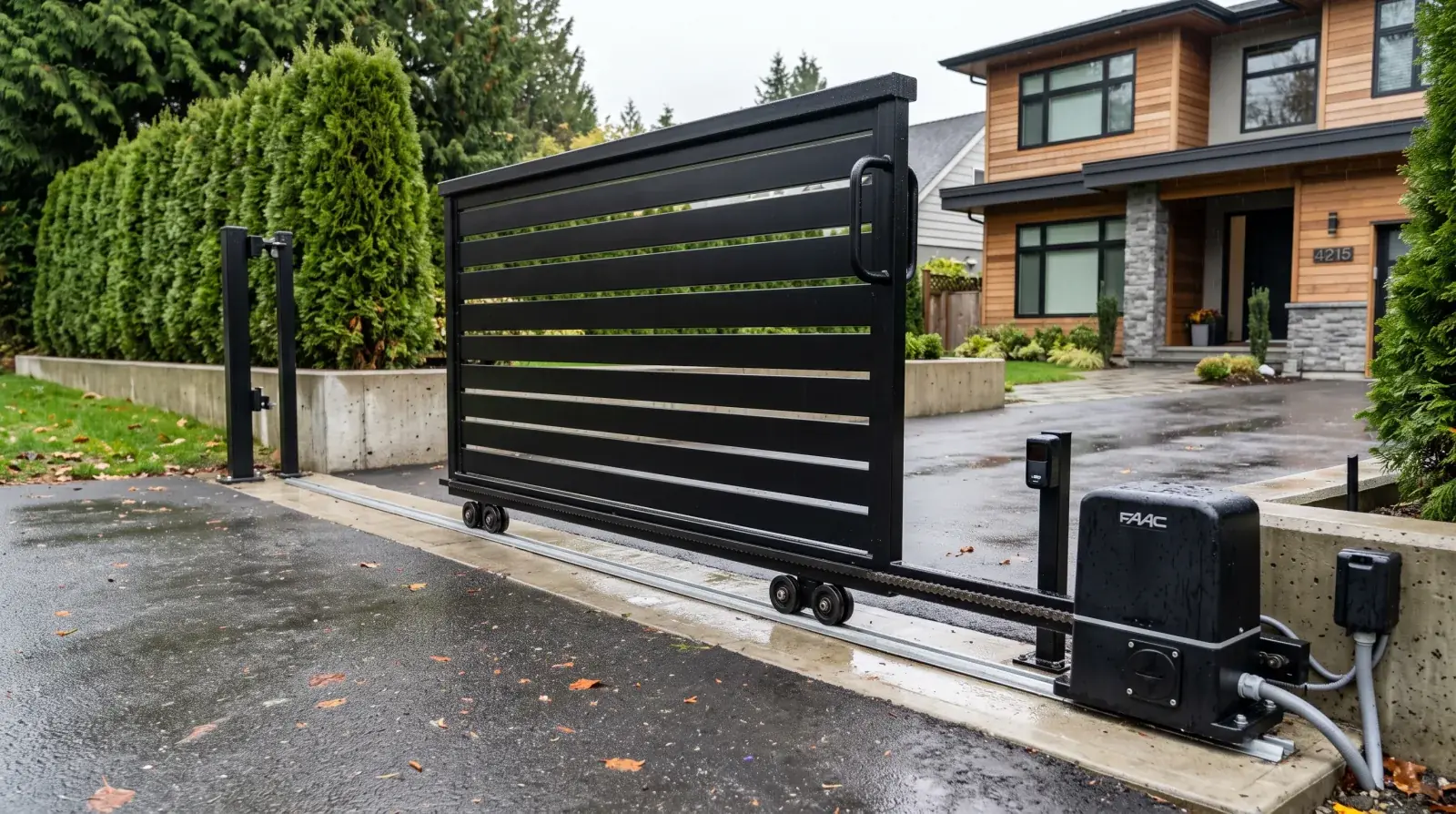
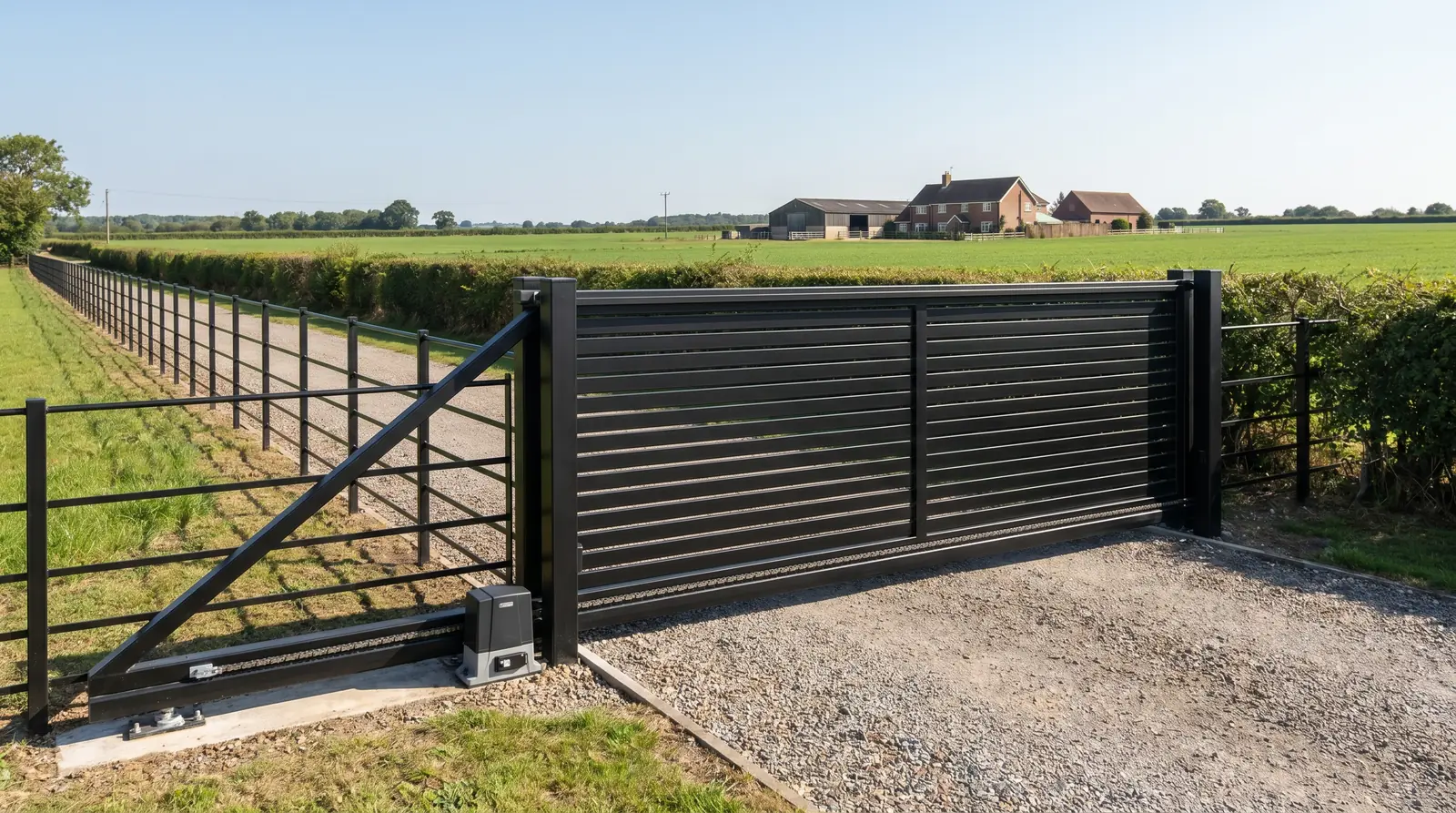
A slide gate moves laterally, parallel to the property line, riding on a track or cantilevered over a guide post. The gate needs a clear run of fence line equal to its opening width, a 20-foot opening needs 20 feet of fence for the slide pocket. On urban lots, that is rarely available. On Langley acreages, the fence line typically continues for hundreds of feet in both directions from the gate, so the slide pocket is no constraint.
Three reasons slide gates win on most Langley properties:
Span efficiency. Single-leaf slide gates routinely cover 16 to 25 foot openings, well beyond what swing gates can manage. On a hobby farm where the gate has to clear a horse trailer or equipment truck, that span matters.
Geometry tolerance. Long rural driveways often slope away from the road, kink slightly off the property line, or transition between gravel and pavement at the gate. Swing gates require a clean swing arc; slide gates only need a level track or guide rail at the gate height.
Cycle durability. Slide gate operators (chain or rack-and-pinion drive) handle high cycle counts well. On an active agricultural operation with tractors, feed trucks, and farm vehicles moving through several times a day, a properly spec’d slide gate can run for 15+ years before major service.
The trade-off is the receiver post and track infrastructure. A cantilever slide gate avoids the in-ground track but needs heavier guide posts and a longer overhang. A v-track slide gate has the smoothest operation but requires the in-ground track to be perfectly level. We size both for the specific gate weight and span on every Langley project.
Township of Langley vs City of Langley
Two distinct municipalities cover the area people refer to as “Langley.” The Township of Langley is the larger, primarily rural and suburban municipality covering Walnut Grove, Willoughby Heights, Murrayville, Brookswood, Aldergrove, Fort Langley, and the agricultural belt. The City of Langley is a smaller, denser municipality at the centre of the area, focused around the Langley Centre and the 200th Street commercial corridor.
The two have different bylaws, permit processes, and zoning regulations. Township work goes through the Township building permits service; City of Langley work goes through its own permit office. Gate projects in either jurisdiction need to confirm which municipality the property is in, the boundary is not always obvious from the address.
A specific Langley constraint worth flagging: properties in the Agricultural Land Reserve (ALR) have additional rules about structures, setbacks, and the character of road-frontage installations. ALR rules are provincial, administered through the Agricultural Land Commission, and apply across BC. On gate projects, ALR rules rarely prevent installation but sometimes constrain the design, particularly for non-farm-use structures.
Sizing for the largest vehicle
The single most common spec mistake we see on Langley gates is opening width sized for the family vehicles rather than the largest vehicle that will actually use the gate. A homeowner with a half-ton pickup and a horse trailer needs a 14- to 16-foot opening to handle the trailered turn. A hobby farm with a tractor and equipment trailer needs 18 to 22 ft. A working agricultural operation with feed trucks and large equipment may need 25 ft or more.
The cost difference between a 12-ft gate and a 20-ft gate is meaningful but rarely deal-breaking. The cost difference between installing the right size from day one and replacing an undersized gate after the homeowner can’t get equipment through is significant. We measure the actual swing radius required for the largest expected vehicle on every Langley project before committing to gate width.
For combined gates, a driveway gate plus an integrated pedestrian gate or man-door for property staff, both can be designed as a single assembly with consistent finish and detailing. This is common on equestrian properties where the same gate handles vehicle traffic during the day and walking traffic for stable staff.
Inland-climate finish
Langley sits inland from the marine influence that affects Kitsilano, West Vancouver, and the North Shore. Less direct salt exposure means the corrosion environment is slightly less aggressive than coastal Metro Vancouver. But the rain, the freeze, thaw cycles in winter, and the seasonal fog all still drive the same finish requirements as the rest of the lower mainland.
Standard exterior gate finish for Langley work: hot-dip galvanizing per the American Galvanizers Association’s standard process under a powder coat or wet paint top coat. The duplex system has demonstrated multi-decade service life on similar Pacific Northwest applications.
For agricultural and equestrian properties specifically, two finish considerations:
Manure and feed exposure. Gates near barns, paddocks, or feed storage areas see more aggressive chemical exposure than residential gates. Manure is acidic; feed dust accumulates in joints. The galvanized layer underneath the powder coat is what protects against this, if the top coat fails, the galvanizing keeps the steel intact for years until the gate is repainted.
Touch-up planning. Rural gates take more knocks than residential ones, equipment hits, gate posts get backed into, animals lean on the panels. Specifying powder coat in a colour that matches a readily available touch-up paint makes long-term maintenance easier. Matte black is the easiest match; custom colours sometimes leave a homeowner with no good touch-up option a few years later.
Automation considerations on long driveways
The other thing Langley properties share with the steeper Coquitlam neighbourhoods is long approach driveways. Many Langley acreage homes sit 100 to 300 feet back from the road, with the gate at the property line and the home well out of sight.
That distance changes three things about gate automation:
Operator class. A long-driveway property sees more delivery, contractor, and service traffic than a short-driveway home, and the operator needs to handle the cycle count. Residential Class II or light commercial operators are the right call. Class I residential operators are undersized for active acreages.
Power supply. A 200- or 300-foot run from the house electrical panel to the gate operator requires sized conduit, voltage drop calculations, and proper grounding. The electrical trade handles this, but coordination during gate fabrication ensures the conduit termination at the operator pad lines up with the operator location. We work this out with the electrician during the planning phase.
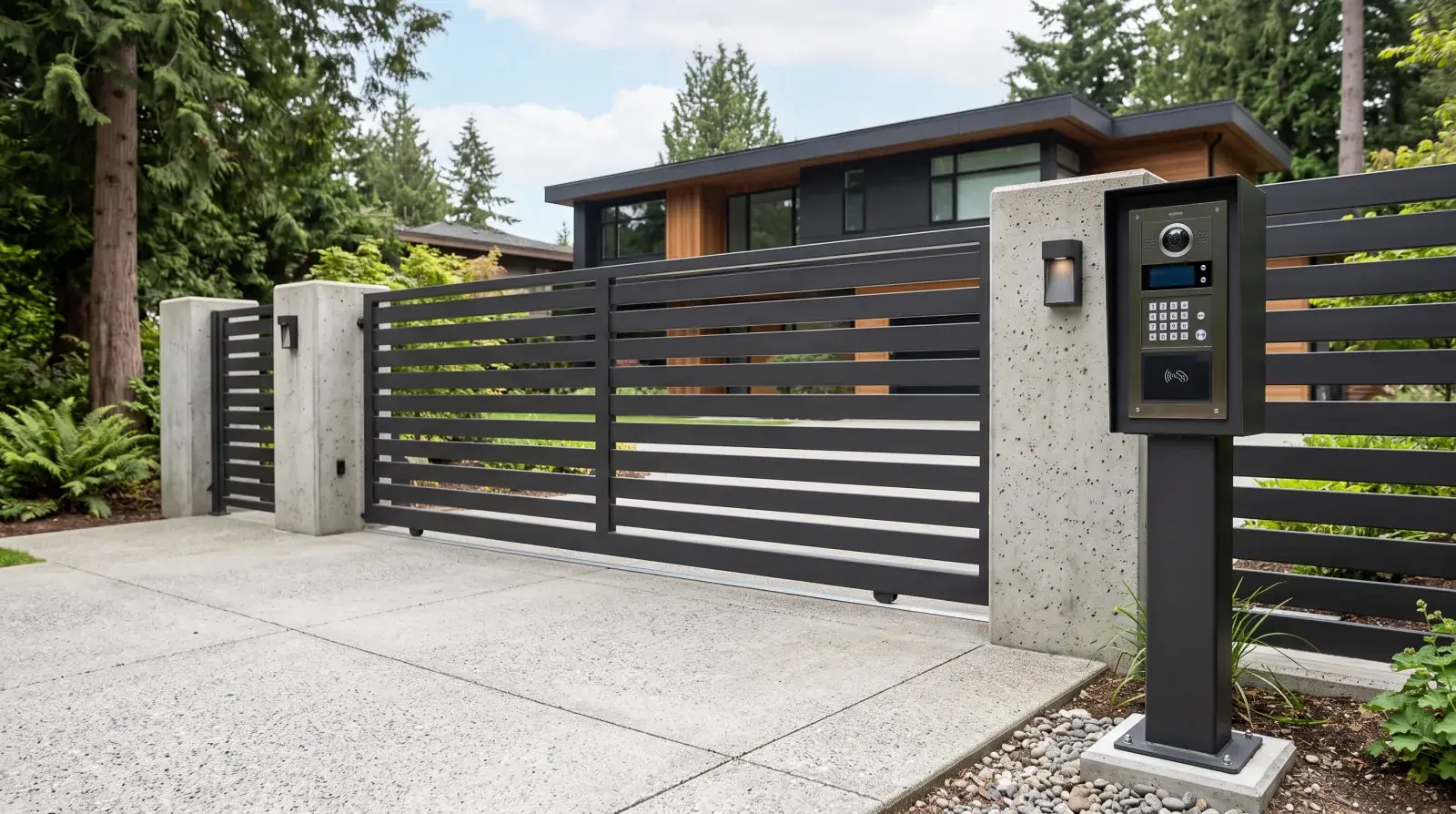
Communication. Cellular-based intercom and access control work better than long Wi-Fi runs on rural acreages where Wi-Fi coverage often does not reach the gate. Most current gate access control systems support cellular or hybrid configurations.
Common Langley project types
The work splits across three buckets:
Hobby farm and acreage homes
By far the most common, a 1- to 5-acre property with a single-family home, sometimes a barn or detached shop, and a long driveway from the road. Standard scope: 16- to 20-foot slide gate, automated, integrated with intercom and keypad, finished in matte black powder coat over hot-dip galvanizing. Often paired with a separate pedestrian gate for foot traffic.
Equestrian and agricultural commercial operations
Larger scale, higher cycle counts, often need to integrate with farm operations and security. 18- to 25-foot slide gates, commercial-class operators, more durable finishes, and sometimes integrated camera and alarm systems. Aesthetics matter but function dominates the design conversation.
Suburban Langley residential
Walnut Grove, Willoughby Heights, and Murrayville have substantial suburban subdivisions where lots are smaller and gate design follows a more standard residential pattern. 8- to 14-foot swing or bi-folding gates, automated, with picket or slat infill. Lower-spec than the acreage work but still custom fabricated rather than off-the-shelf.
For a quote on a specific Langley driveway gate project, request a quote, slope, approach length, vehicle requirements, automation needs, and finish all need confirmation before any meaningful number can be put on the project.