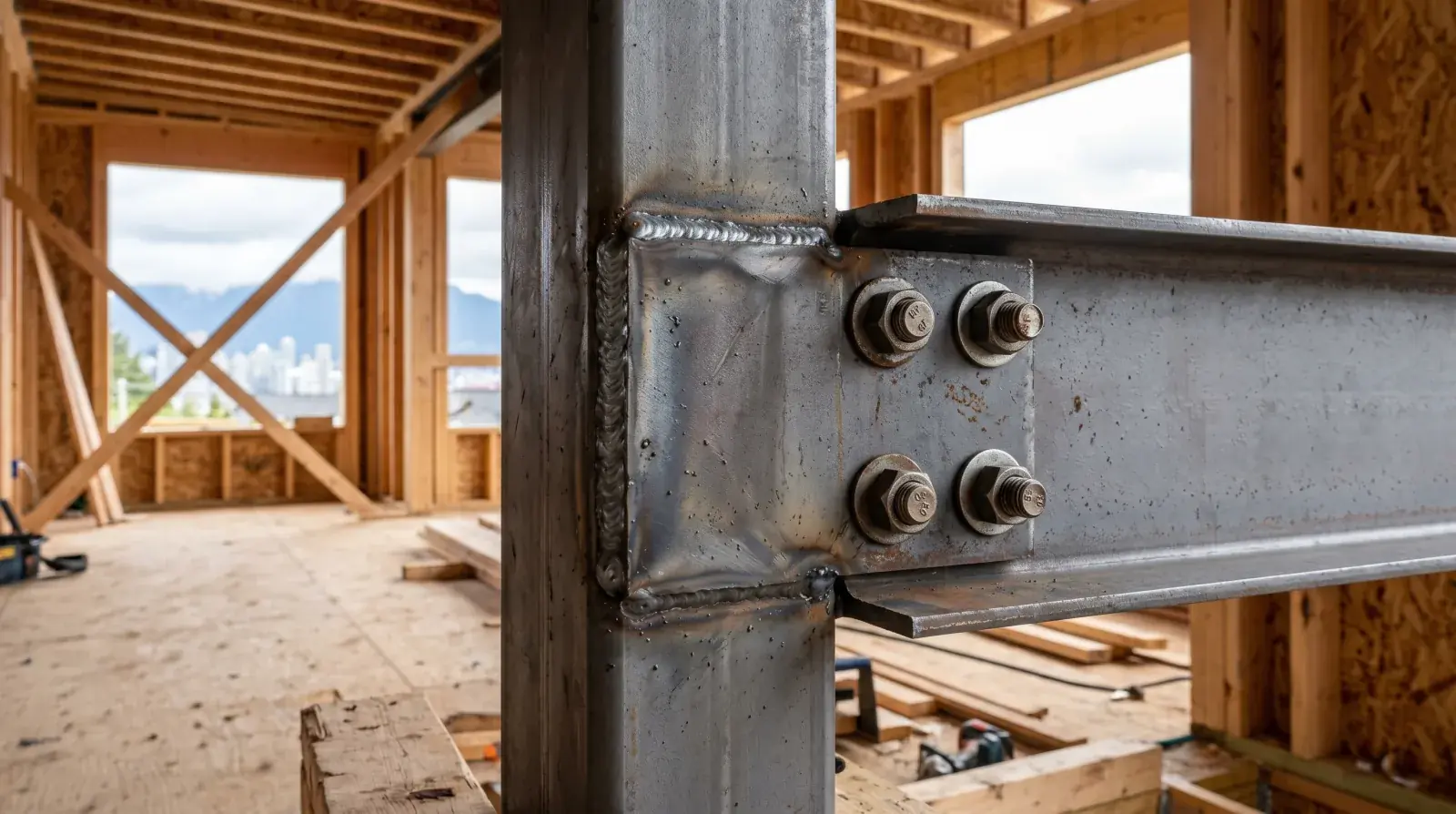
On a residential steel frame, everyone looks at the beam. How deep is it, how long is the span, will it carry the floor above. Fair enough, the beam does the headline work. But ask any structural engineer where a steel frame actually succeeds or fails, and the answer is the connection. A perfect beam with a poorly executed joint is a problem. A modest beam with a correctly designed and built connection is sound.
So when a steel package lands on a Vancouver build, a beam carrying a removed load-bearing wall, a column picking up a point load, a moment frame resisting earthquake forces, the welded-versus-bolted question is one of the first real decisions. Here’s how it gets made.
Two ways to join steel, both engineered to the same loads
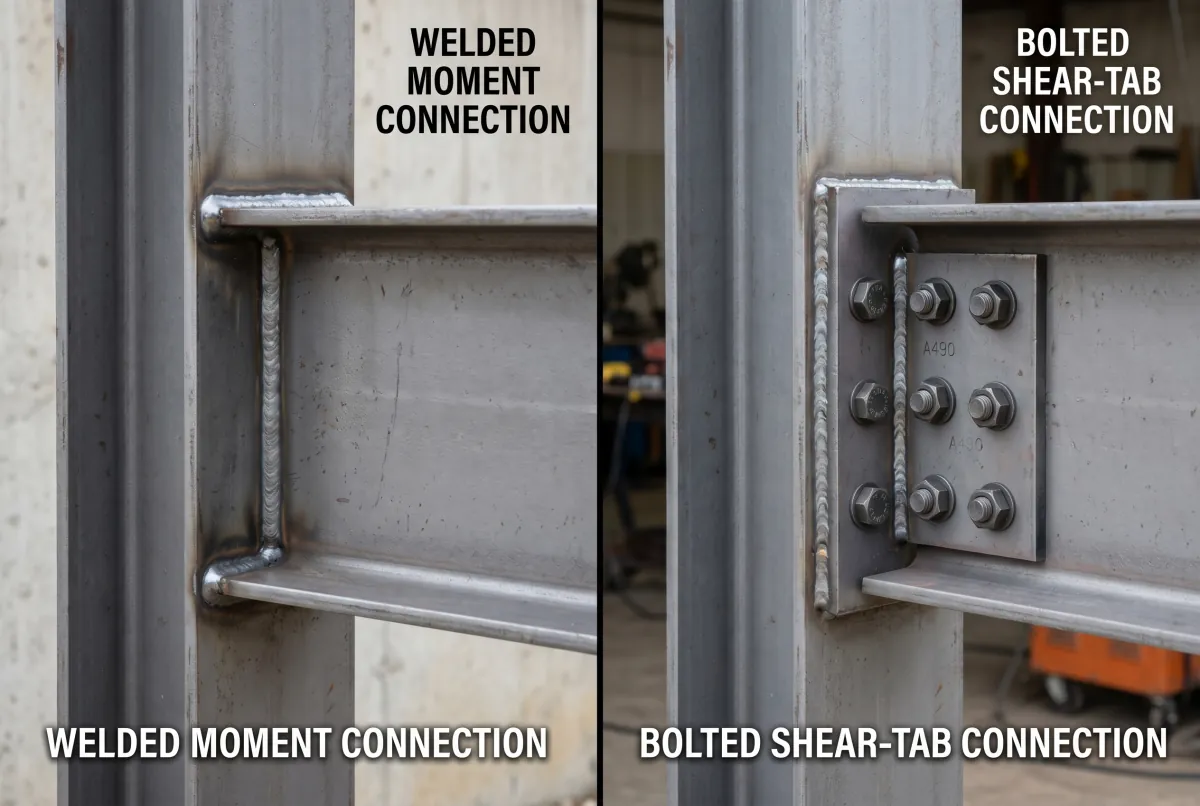
A welded connection fuses members together with weld metal. Done right, it’s a continuous, rigid joint. A bolted connection joins members with high-strength bolts through plates or angles, assembled mechanically.
The instinct is to ask which is stronger. It’s the wrong question. Both are designed by the structural engineer to carry the specified loads with the code-required safety factor. Neither is inherently stronger, they behave differently. A welded moment connection is rigid and transfers bending. A bolted shear connection allows a degree of rotation. The engineer picks the type based on how the frame is meant to act under load, not on a vague notion of strength.
Shop weld, field bolt, the default for good reason
Here’s the pattern we use on most Vancouver homes: weld in the shop, bolt in the field.
Welding is precision work that wants a controlled environment. In our Burnaby shop, the steel is clean and dry, the welder is in position, and every weld can be inspected before the piece ever leaves the building. That’s the right place to make a critical weld.
Field welding fights everything. There’s weather, and in this climate, rain is a constant threat to a field weld. There’s position, with welders working overhead or out of position on a live site. There’s access, and there’s the difficulty of inspecting and protecting a field weld on a busy job. None of that is impossible, but it all degrades quality control compared to the shop.
Bolting, by contrast, is fast, works in most conditions, and is straightforward to inspect on site, the inspector checks the bolt grade, the installation, and the tensioning. So the smart move is to shop-weld assemblies, a beam to its baseplate, a column build-up, and then field-bolt those assemblies together. The slow, precise work happens where it should, and the site work stays quick.
”Won’t the bolts loosen?”
This is the most common homeowner worry, and the answer is no, not when they’re installed right. High-strength structural bolts in a residential frame are tensioned to a specified value so the joint clamps tight and behaves exactly as the engineer designed. A pretensioned or slip-critical connection, properly torqued and inspected, is a permanent joint. It doesn’t back off the way a loose hardware-store bolt might. The reliability comes from following the specified tensioning method and verifying it, which is part of the inspection regime.
Seismic design changes the conversation
We’re in an earthquake zone, and that’s not abstract. The BC Building Code’s seismic requirements shape whether a connection needs to be rigid, ductile, or able to dissipate energy when the ground moves. A connection that’s fine for gravity load alone might need very different detailing once seismic demand is in the picture, sometimes a specific welded moment connection, sometimes a carefully designed bolted assembly that can flex and absorb energy.
This is squarely the structural engineer’s domain. On a Metro Vancouver home, the engineer’s connection design already accounts for the region’s seismic demand, and our job is to fabricate those details exactly as drawn. When a connection detail looks unusual, extra stiffeners, a specific weld sequence, oversized plates, there’s usually a seismic reason, and we don’t second-guess the seal.
Why this lands on your schedule
Connection choice is one of the quiet factors that determines how fast steel goes up. A frame designed around shop-welded, field-bolted assemblies installs quickly because the field crew is bolting, not waiting for weld conditions and weld inspection. A frame that requires extensive field welding is at the mercy of the weather and the inspection schedule, and that can stall a North Vancouver or West Vancouver framing crew that’s ready to keep moving.
We flag this at the shop-drawing stage. When we detail a residential steel package, the connections are drawn to the engineer’s design, and we sequence the work so the welding happens in the shop and the site gets clean, fast, bolted joints. The result is a frame that’s built right and goes up on time.
Inspection: it’s not optional
Both connection types get inspected, and the regimes differ. Structural welds are checked visually and, for critical welds, by non-destructive testing, ultrasonic or magnetic particle methods that find flaws below the surface. That’s why the welding has to be done by a C.W.B.-certified shop working to CSA standards; the certification is what lets the inspector and engineer trust the welds. Bolted connections are inspected for the right bolt grade, correct installation, and proper tensioning.
If you’re planning a build with structural steel in it, a renovation that pulls a wall, an addition, a new custom home in Burnaby or on the North Shore, the connections deserve as much attention as the beams. Send us your structural drawings and we’ll detail the connections, fabricate to the engineer’s design, and give you the inspection records the permit needs.