Aluminum and glass railings are a common request on newer Langley decks, and it is easy to see why. You get an open view through the glass, a frame that does not rust, and a clean modern look that suits the homes going up across Langley and Surrey. But there are real choices inside that request. How the glass sits in the aluminum, how the system handles wind on an open lot, and whether framed or frameless is the right approach all change the result.
This post explains how aluminum-framed glass railings are built, what to expect on views, wind, and cleaning, and how framed compares to frameless when the frame is aluminum. If your interest is glass specifically, our glass railings in Langley guide goes deeper on the glass side, and our aluminum railings guide covers the metal in more detail.
How the glass sits in the aluminum
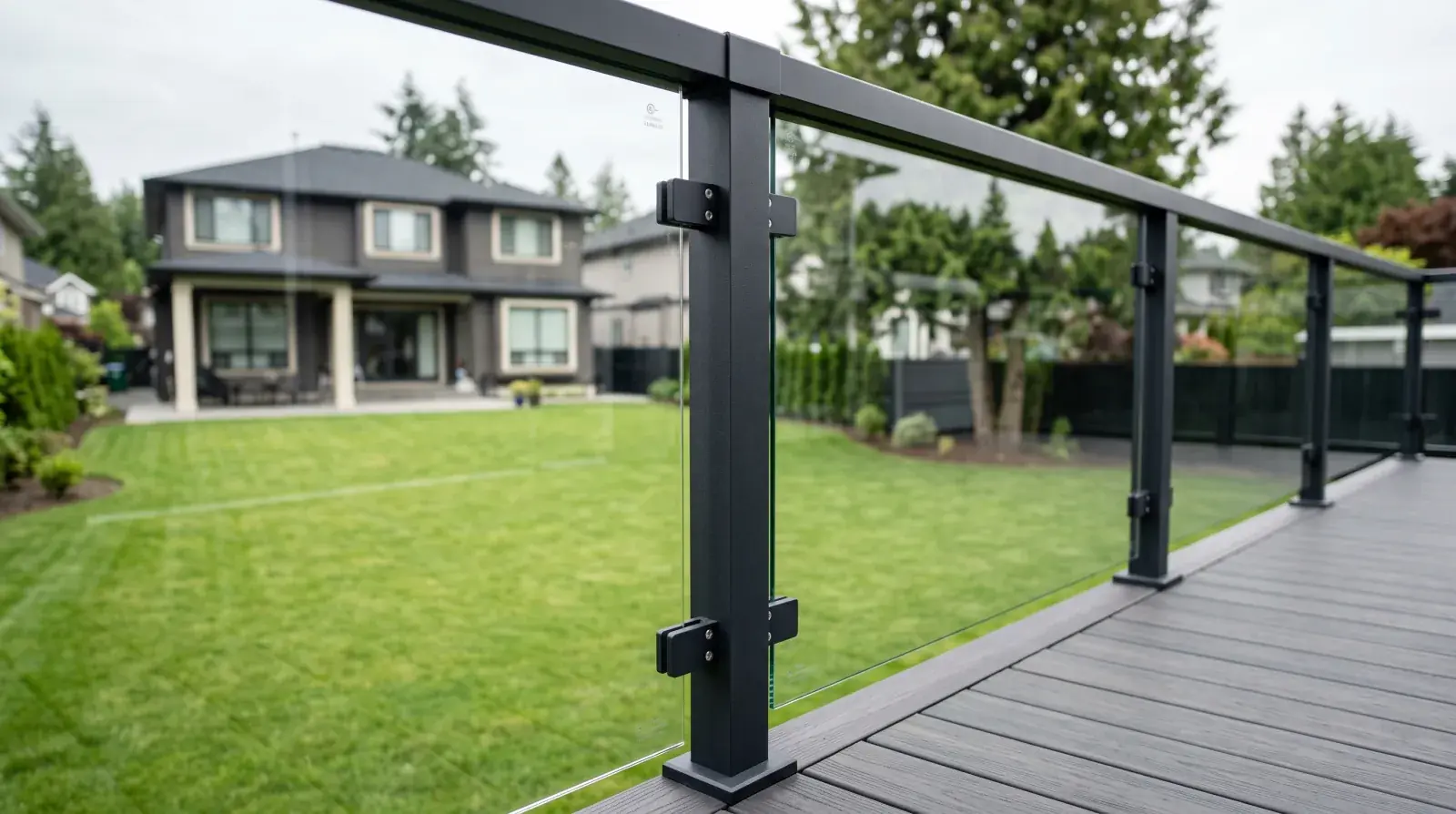
The simplest way to picture an aluminum and glass railing is a frame with the middle filled in. The aluminum is the structure. Powder-coated aluminum posts anchor to the deck, and an aluminum top rail runs across the top. Between the posts, tempered glass panels fill the space, held either in channels that grip the top and bottom edges of the glass or in clamps that grip the sides.
The aluminum does the load-bearing work, and the glass provides the guard surface and the clear view. That division of labour is why the system works so well on a residential deck. Aluminum is strong, light, and rust-free, which makes it a good frame material for a Langley deck exposed to rain. Glass is the infill that keeps the sightline open. The frame carries the loads that the code requires, and the glass fills the gap without blocking the view.
Because aluminum does not rust, the frame needs almost no upkeep beyond an occasional wash. That is a real advantage over a steel frame on an exterior deck, where rust is a constant maintenance job near any moisture.
Views, wind, and the Langley lot
The reason most people want glass is the view. On a Langley or Surrey deck that looks over a yard, a field, or a greenbelt, clear tempered glass keeps almost the entire sightline open. The slim aluminum posts break up the view far less than solid pickets would, so from a chair on the deck you mostly see through the railing, not at it. If keeping the view is the priority, glass infill delivers it better than any picket design.
Wind is the factor people forget. A glass panel is solid, so it catches wind like a sail. On a sheltered deck that is not a big deal. On an open Langley lot with wind moving across the fields, the load on the railing goes up, and the design has to account for it. The aluminum posts, the glass thickness, and the way the glass is held all get sized for the exposure. A railing designed for a calm courtyard is not the same as one designed for an open, windy lot, and building the wrong one leads to trouble later.
This is where an aluminum frame helps. The frame shares the wind load through the posts and top rail, so the system is more forgiving than a frameless design that carries everything through the base. On an exposed Langley or Surrey site, that shared load is a practical advantage.
Cleaning: the trade-off you accept
Glass railings look their best when they are clean, and they do not stay clean on their own. Glass shows rain spots, dust, pollen, and fingerprints in a way that pickets never do. Through Langley’s rainy season, that means regular washing if you want the view to stay crisp. This is the honest trade-off of the glass look, and it applies to any glass railing, framed or frameless.
The aluminum frame is the easy part. It needs little more than an occasional wash to clear grime, and there is no rust to fight. So the upkeep on an aluminum and glass railing is really about the glass, not the metal. Many Langley homeowners decide the open sightline is worth the cleaning. Some decide pickets are the better fit for how they actually live. Both are reasonable, and it is worth being honest with yourself about how much glass cleaning you will really do before you choose.
Framed versus frameless in aluminum
When people say “frameless glass railing,” they mean a railing where each glass panel has no visible frame around it. The glass is held by a strong base clamp or a channel at the bottom, and it stands on its own with no posts or top rail. It gives the cleanest, most minimal look, and it is the one that photographs best.
Framed glass is the other approach. The glass sits inside an aluminum perimeter with posts and a top rail, and the frame carries the load while the glass fills the gap. It is more forgiving, usually more economical, and easier to build for a windy or exposed site because the load is shared through the frame rather than carried by the base alone.
In aluminum, framed glass is the more common choice, and on most residential Langley decks it is the one we recommend. You still get the open view, but in a system that suits an exposed lot and costs less to build than frameless. Frameless is a strong choice when the look is the priority and the budget and site suit it, but it is not automatically the better railing. Whichever you choose, the railing has to meet the BC Building Code: the right guard height, the loads it must carry, and the correct safety glass type and thickness for a guard. A registered engineer seals the design where the Langley inspector or the project requires it.
If you are weighing framed against frameless, or glass against aluminum pickets for your deck, request a quote and we will look at your lot, your view, and your exposure and tell you plainly which system fits your Langley or Surrey home.
Explore our custom railings work, then request a quote and we will size the guard, handrail, and finish to your home across Metro Vancouver.