Aluminum gets sold hard for exterior railings in Metro Vancouver, often as the obvious answer because “it doesn’t rust.” That is true, and on the right project aluminum is genuinely the better material. But it is not the right answer everywhere, and the marine-grade marketing language obscures real trade-offs that show up after install.
This post separates where aluminum wins from where steel still wins, walks through the alloy and finish choices that matter, and explains the code and engineering implications. For the head-to-head with steel, our steel vs aluminum railings comparison is the better starting point. This post is for the project where aluminum is on the table and you need to know what spec actually delivers.
Where aluminum wins outright
Three application types make aluminum the clear answer over steel.
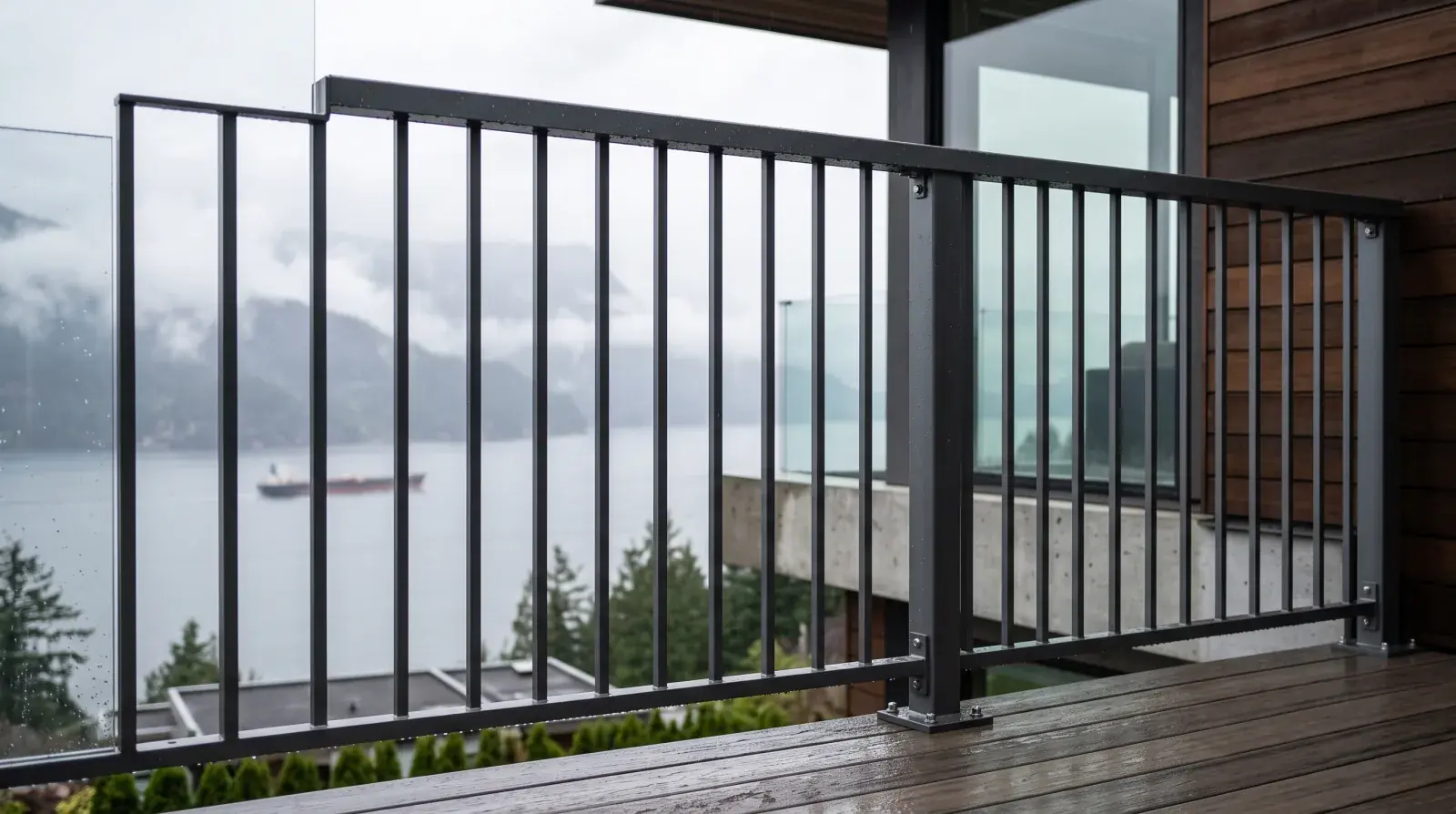
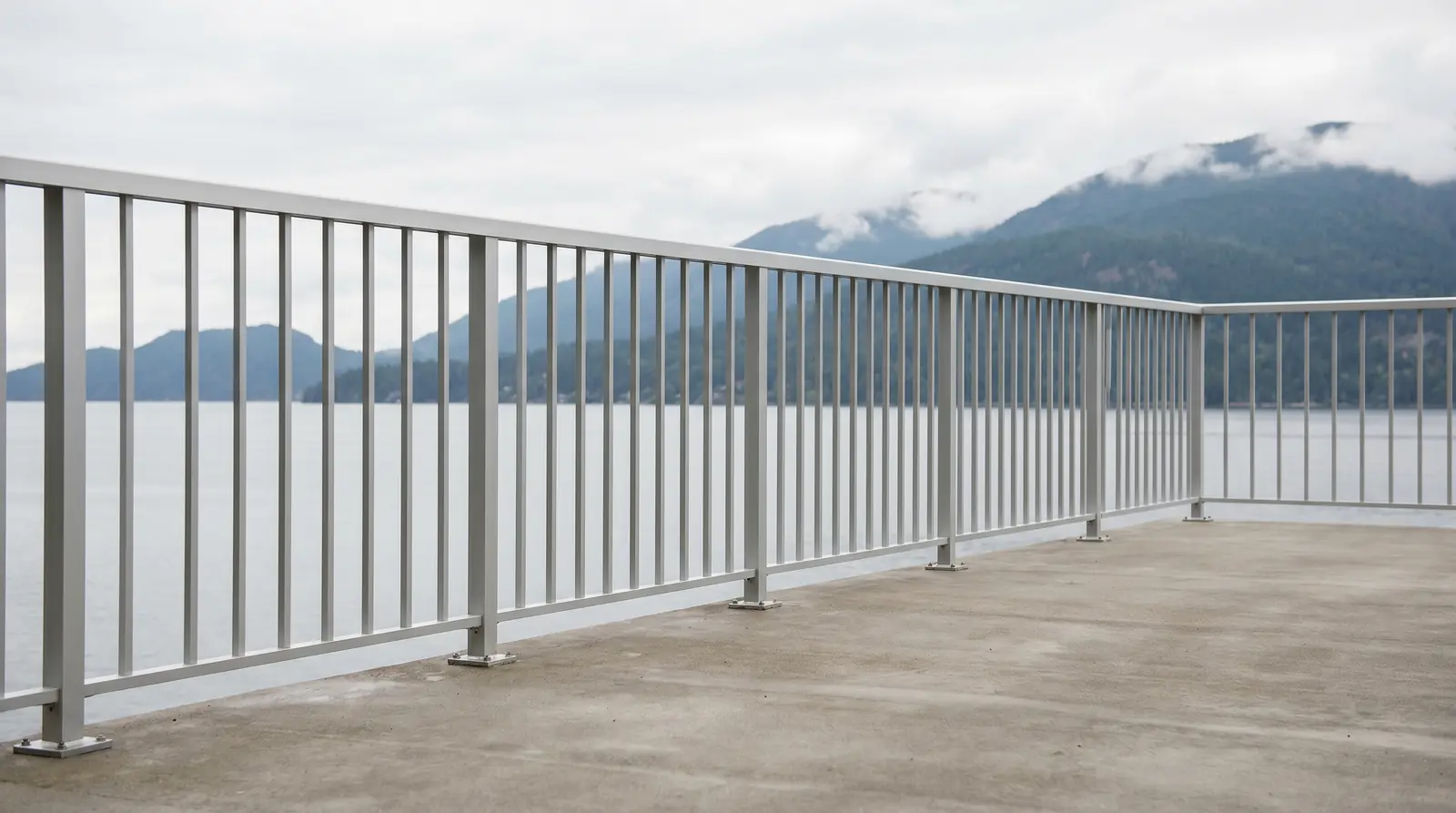
Direct marine exposure. Properties within sight of salt water, Kitsilano, Point Grey, English Bay, the West Vancouver waterfront, Marpole, and the Squamish waterfront, face airborne salt that accelerates steel corrosion even with hot-dip galvanizing under powder coat. Aluminum does not corrode in salt; the natural oxide layer is the protection. On waterfront homes, an aluminum railing will look the same in 20 years as it does on install day. A steel railing in the same exposure will need refinishing.
Rooftop and high-load-sensitive installations. Aluminum weighs roughly one-third of steel for the same volume. On rooftop decks, where structural capacity for railing weight is sometimes a concern, aluminum’s lower mass changes the engineering equation. Multi-storey commercial projects with extensive rooftop balconies benefit from aluminum on the same basis.
Long-life residential exterior railings where maintenance is the deciding factor. Some homeowners do not want to think about railing maintenance ever again. Aluminum delivers that, clean it occasionally, no refinishing, no rust touch-up. Steel requires more attention over a 25-year horizon, even with the duplex (galvanized + powder coat) finish.
Where steel still wins
Three places where steel remains the better answer despite aluminum’s corrosion advantage.
Structural railings. When the railing also functions as a structural element, supporting a stair stringer, carrying a roof, or doubling as a supporting column, steel’s higher stiffness and weld strength dominate. Aluminum can do structural work but the section sizes have to be larger and the welding requires specialized skill. Mild steel is what residential and commercial structural fabrication runs on.
The look of steel. Some designs want the visual weight, the matte black depth, or the welded-joint character of mild steel. Aluminum can be powder-coated black, but up close the surface texture and the joint detailing read differently. On a contemporary build where the architect has specified blackened steel for the railings, aluminum is not a substitute.
Field-modifiable applications. Steel can be cut, welded, drilled, and modified on site by a competent welder with standard equipment. Aluminum field modification requires aluminum-specific welding gear and procedures, which most general contractors do not have. On commercial projects with last-minute coordination changes, the ease of steel field-modification is a real advantage.
Alloy and section choice
The 6xxx series of aluminum alloys, magnesium and silicon, dominate architectural railing fabrication. Two grades cover almost all the work:
6063-T6 is the workhorse. Most extruded aluminum railing sections, top rails, posts, picket profiles, are 6063-T6. It has good strength, excellent extrudability (which is why railing profiles can have complex shapes), and excellent corrosion resistance. Standard residential and most commercial railings are 6063-T6.
6061-T6 is slightly stronger, used where structural loads demand it. Posts on long-span railings or commercial guards with heavy load requirements sometimes step up to 6061-T6. The cost difference is small but the alloy is harder to extrude into complex profiles, so 6061-T6 is more common in plate, bar, and tube form than as a railing profile.
Marketing language sometimes refers to “marine-grade aluminum”, the term usually means a 5xxx or 6xxx series alloy with appropriate corrosion resistance. Both 6063-T6 and 6061-T6 are suitable for Metro Vancouver marine applications. The 5xxx series alloys (used in boats and structural marine applications) are not commonly used in architectural railings.
Anodizing vs powder coat
Two finishes dominate aluminum railing work, with different trade-offs.
Anodizing electrochemically forms a dense oxide layer on the aluminum surface. The layer is integral to the metal, it cannot peel or chip the way a coating can. Anodized aluminum is available in clear (silver-grey natural appearance) and a small range of standard colours (bronze, black, champagne). Anodizing holds up exceptionally well under UV and lasts 30+ years on exterior installations without intervention.
Powder coating applies a polyester or polyurethane coating electrostatically and cures it with heat. Wider colour range than anodizing, almost any colour is available. Slightly less durable under direct UV and over a 25-year horizon may need touch-up. Touchable, paint-like surface.
For exterior Metro Vancouver applications, anodized aluminum is the conservative choice when the colour palette permits. Powder coat is fine when the colour matters more than the marginal durability difference, which is often the case on residential designs where matching the home’s trim is the priority.
Code and structural design
The 2024 BC Building Code applies to aluminum railings without modification. Minimum guard height, picket spacing, handrail graspability, and load requirements are identical to steel railings. The difference is in the structural sizing, aluminum’s lower stiffness (about one-third of steel’s modulus of elasticity) means sections need to be larger or post spacing tighter to meet the same deflection limits.
A typical 1,070 mm aluminum guard with 6063-T6 vertical pickets at 100 mm centres and 2” × 2” hollow posts spaced at 1,500 mm meets code on standard residential decks. On longer post spans (1,800 to 2,400 mm) or higher load applications (commercial guards rated for higher live loads), the post and top rail sections step up.
Engineering for aluminum railings follows the same load assumptions as steel, typically 0.75 kN/m horizontal load applied at the top rail for residential guards, increasing for commercial occupancies. A registered P.Eng. seals the structural design where required.
Welded vs mechanically fastened systems
Aluminum railings come in two construction types:
Welded aluminum is fabricated as a continuous structure with TIG (GTAW) welds joining the posts, rails, and infill into one piece. Looks identical to welded steel from a distance, clean joints, continuous lines. Requires aluminum-specific welding equipment and a CWB-certified shop with aluminum procedures (CSA W47.2). Higher labour cost, better look, longer life.
Mechanically fastened aluminum uses cast or extruded fittings to join posts, rails, and pickets without welding. The joints are visible as fittings, caps on posts, brackets at corners, sleeves where pickets meet top rail. Faster to fabricate and install, lower cost, slightly less clean visually. Most stock aluminum railing systems are mechanically fastened.
Custom commercial and high-end residential work typically goes welded; standard production residential balcony railings on multi-unit Burnaby and Coquitlam developments often go mechanically fastened. The choice depends on budget, visual standard, and project type.
When to recommend aluminum vs steel on a Vancouver project
The simple decision tree we use on a typical site visit:
- Within 200 m of salt water → aluminum is the strong default.
- Rooftop or weight-sensitive structure → aluminum.
- Owner does not want to maintain → aluminum (anodized).
- Design language requires the look of steel → steel with duplex finish.
- Structural-grade application → steel.
- Interior railing → steel (no corrosion concern, lower cost on custom work).
- Standard exterior on inland Burnaby, Coquitlam, or Vancouver lot → either works; choose on aesthetic preference and budget.
For a quote on a specific aluminum railing project, whether welded or mechanically fastened, anodized or powder coated, residential or commercial, request a quote. Section sizing, finish choice, and engineering all need to be confirmed for the specific application before any meaningful number can be put on the project.