In a commercial or public building, the handrail is one of the hardest-working pieces of metal in the place. People grab it, lean on it, and touch it thousands of times a day. It has to stay solid, stay clean, and meet a strict code, year after year. That is why stainless steel is the standard for commercial handrails across Vancouver and Burnaby. This post covers what makes stainless the right choice, how to pick the grade and finish, and what to know about code and durability in high-traffic spaces.
Why stainless steel is the commercial standard
Stainless steel earns its place in commercial buildings for a few plain reasons.
It is tough. A commercial handrail takes constant use, and stainless handles that without denting or wearing out. It resists corrosion, so it does not rust the way coated mild steel can once the coating chips. It cleans easily, which matters when janitorial staff wipe it down daily. And it keeps a clean, professional look for decades without repainting.
Put those together and you get a handrail that a building owner can install once and largely forget about, aside from routine cleaning. In a Vancouver lobby, office stairwell, hospital corridor, or public building, that long, low-maintenance life is exactly what owners want. Painted steel might cost less upfront, but it chips and needs recoating over the years. Stainless holds its finish, which is why you see brushed stainless handrails in so many commercial spaces.
Choosing the grade: 304 versus 316
Not all stainless is the same, and picking the right grade matters.
The two common grades for handrails are 304 and 316. The practical difference is corrosion resistance. 316 contains molybdenum, which helps it resist salt and chloride far better than 304.
For most indoor Vancouver commercial spaces, 304 stainless is the right choice. The interior is dry and climate-controlled, so 304 performs well and costs less. 316 stainless is the grade for exterior handrails, coastal buildings near the water, and wet areas like pool decks, where salt or moisture would eventually stain 304. Choosing the wrong grade for the location is a common and avoidable mistake. Our post on 304 vs 316 stainless railing in Vancouver lays out exactly where each grade belongs so you can spec the right one.
The brushed finish and why it wins in high traffic
Finish choice matters as much as grade in a busy building.
The most common commercial handrail finish is a brushed satin finish, often called #4. It has a fine directional grain across the surface. That grain is not just for looks. It hides fingerprints and small scratches far better than a mirror polish does.
Think about a mirror-polished rail in a busy Vancouver lobby. Every fingerprint shows. Every scuff catches the light. No matter how often it is cleaned, it never quite looks clean. A brushed finish solves that. Its grain breaks up reflections and disguises the marks of daily use, so the rail keeps looking sharp with far less effort. For high-traffic commercial work, brushed satin is almost always the right call.
Glass, standoffs, and modern systems
Many modern commercial handrails are part of a larger system that includes glass.
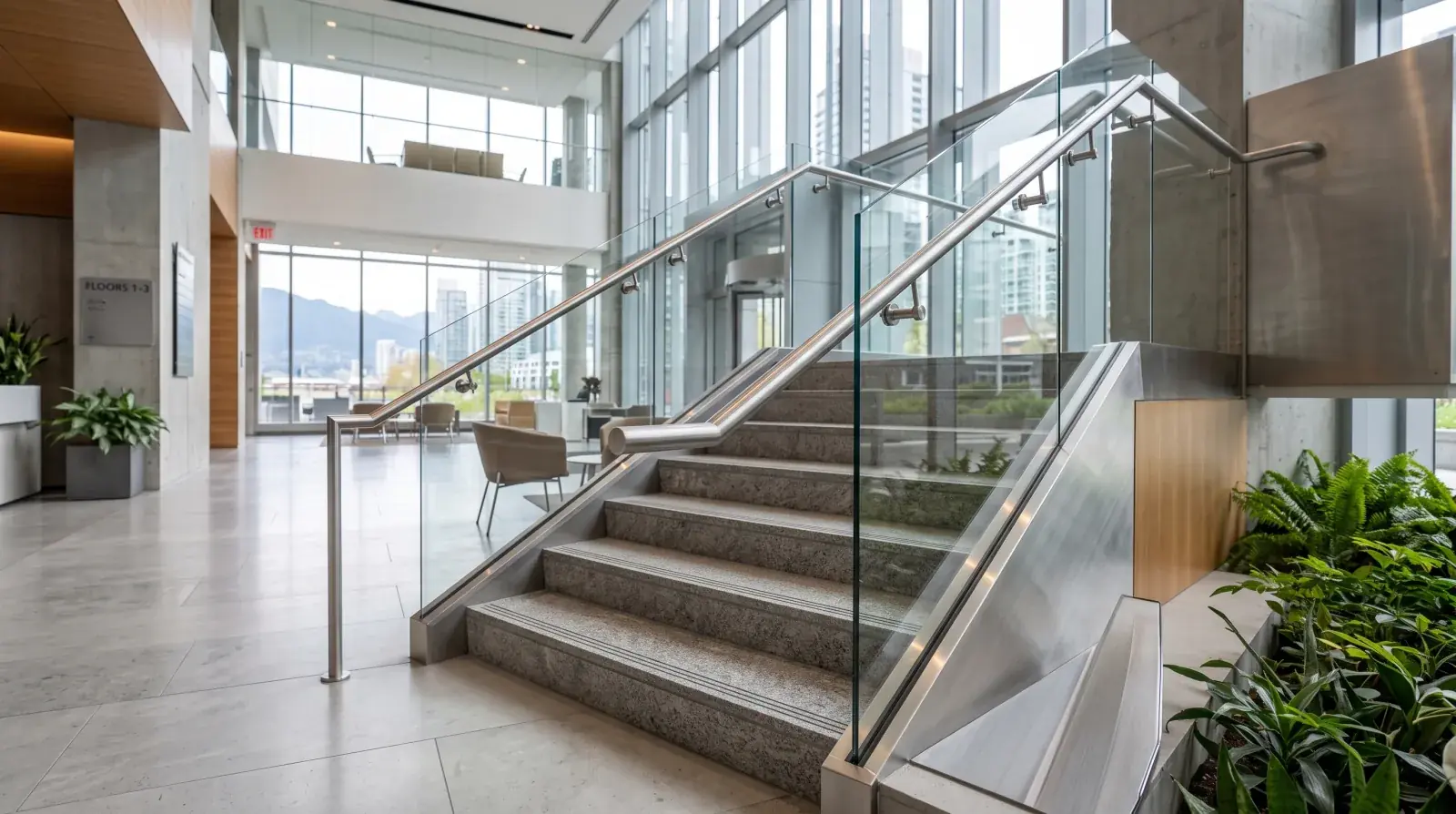
In a contemporary Vancouver lobby, you often see a glass balustrade with a slim stainless handrail running along the top. The glass panels are held by stainless standoffs, which are fittings that hold the glass a short distance off a wall or a stair edge so it appears to float. These standoffs carry the load from the glass into the building structure, so they have to be sized, spaced, and installed correctly.
This is where the difference between a handrail and a guard matters. A handrail is the graspable rail you hold. A guard is the barrier that stops a fall at an edge, like a mezzanine or a balcony. Many systems combine both: the glass and standoffs form the guard, and the stainless rail on top is the handrail. The BC Building Code has separate requirements for each, so both parts have to be right. Our work on steel balustrades for commercial lobbies in Vancouver shows how these glass and stainless systems come together in signature spaces.
The stainless handrail diameter matters more than people expect on these systems. The code sets rules for a graspable shape, which means the rail has to be a size a hand can actually close around. A rail that is too fat fails the grip requirement and fails inspection. On commercial work in Vancouver and Burnaby, we size the round or oval rail to meet that requirement while still matching the look the designer wants. The mounting brackets and returns at the ends of the run are part of the same detailing, and they are exactly the spots where a poorly built rail comes loose over time.
Fabrication and install in a working building
There is a practical side to commercial handrail work that shapes how the job runs.
Most commercial buildings are either occupied or on a tight construction schedule, so the install has to be planned around that. We build the handrail system in our Burnaby shop from approved shop drawings, so the bulk of the welding and finishing is done before we ever arrive on site. That keeps the on-site work short and clean, which matters in a lobby that has to stay open or a stairwell other trades are using.
Field measurements come first. In a commercial building, the stairs and landings are rarely exactly what the drawings show, so we measure the real conditions before fabrication. Stainless is unforgiving of a bad fit because you cannot easily grind and repaint it the way you can with coated steel. Measuring accurately up front is what lets the finished rail drop in and line up on the first try.
Welds on visible stainless also need care. A commercial handrail is looked at closely every day, so the welds are ground and blended to match the brushed finish rather than left rough. Done right, the joints nearly disappear and the rail reads as one continuous piece. That level of finishing is part of what separates a professional commercial rail from a patched-together one.
Code, durability, and getting it built right
Commercial handrails are not a place to improvise, because they are governed by code and used by the public.
Handrails and guards in Vancouver commercial buildings must meet the BC Building Code, which sets rules for height, the graspable shape of the handrail, continuity along stairs and ramps, and resistance to load. Public buildings also carry accessibility requirements. Getting height or continuity wrong can fail inspection and, worse, fail the people using it. This is why commercial handrail work belongs with a fabricator who knows the code and works with engineering, not a general handyman.
The payoff for doing it right is durability. A properly built and installed interior stainless handrail in a Vancouver commercial building lasts for decades with only routine cleaning. It does not rust indoors, it resists wear, and it never needs the repainting a coated steel rail would. That long life is a big part of the value.
We handle full commercial railing packages, not just the handrail itself: guards, handrails, glass balustrades, standoffs, and the connections that tie everything into the structure. Our post on commercial railing contractor work in Vancouver covers how we take a project from shop drawings through to install for offices, lobbies, and public buildings across Vancouver and Burnaby.
If you are planning or renovating a commercial or public building and need handrails that will hold up, send us your drawings. We will help you pick the right grade and finish, detail it to code, and build a system that still looks sharp long after the ribbon is cut.
Explore our commercial and industrial metalwork, then request a quote and we will plan the scope, schedule, and install with your team.