Most of the failed garden structures I get asked to replace in Vancouver have the same story behind them. Someone built a cedar trellis or arbor, planted a wisteria or a grape vine at the base, and a decade later the plant is magnificent and the thing holding it up is rotting at the ground and leaning. The planting won. The wood never had a chance against constant rain, the load of a mature vine, and the years.
Steel changes the whole equation. A garden structure built in steel can carry far more weight with much slimmer members, which means it disappears behind the growth instead of competing with it. And built and finished correctly, it stays sound long after a wood version would have been torn out and burned. That’s the case for steel in a garden, and the rest of this is how it gets done properly on the coast.
Why steel beats cedar in a wet climate
Cedar is the default for garden woodwork around here for good reason, it’s local, it smells nice, and it weathers to a soft grey. But it’s a consumable. In our climate it checks, it greys, and it rots wherever water sits: at ground contact, at every joint, and around every fastener. Western red cedar is naturally rot-resistant, not rot-proof, and a structure in constant wet exposure gives up its surface to decay over time.
The bigger problem is load. A mature wisteria is heavy, and in a windstorm it becomes a sail. To hold that in wood, the posts and beams have to be thick, and thick wood members are exactly what you don’t want in a garden, because they pull your eye away from the planting. Steel inverts that. A piece of hollow structural section (HSS) the width of two fingers can carry what a chunky cedar post does, so the frame reads as a thin dark line and then vanishes once the vine fills in.
There’s a coordination angle too. On a lot of the projects we do, the trellis or screen is one element in a larger landscape package a landscape architect or designer has drawn, and steel lets the structure match the slim, modern lines they’re after instead of forcing a bulky timber compromise into the design.
Designing for the plant, not the empty frame
The single most common mistake is sizing a garden structure for how it looks on installation day. An empty steel arbor looks almost too delicate. Then three seasons in, a heavy climber is loaded onto it, a December windstorm rolls through, and a structure sized for “looks nice empty” starts to flex.
We size it the other way around. Tell us what’s going on it, wisteria, climbing hydrangea, grape, kiwi, clematis, and roughly how big you expect it to get, and we design the members, the connections, and the footings for that mature load plus the wind it’ll catch. The wire or mesh that the plant actually grabs onto gets detailed too, because a stainless tension cable grid reads very differently from a welded steel lattice, and the plant behaves differently on each.
Heavier vines change the spec meaningfully. Wisteria in particular has wrist-thick old wood and real mass, and the difference between a trellis that holds it for thirty years and one that slowly bows is decided at the design stage, before any steel gets cut.
Weathering steel versus galvanized and powder-coat
This is the decision that defines the whole look of the piece, and it’s worth slowing down on.
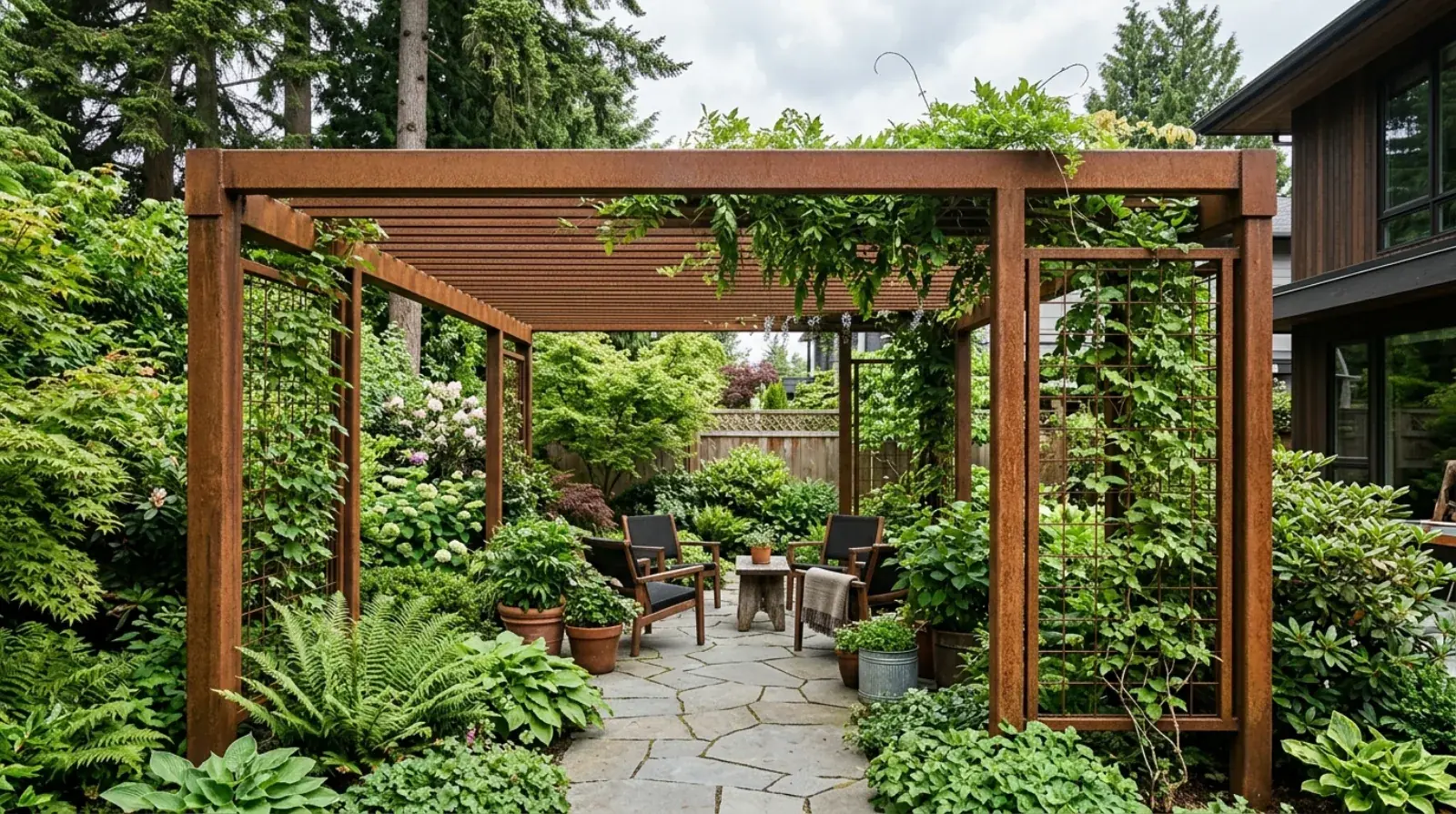
Weathering steel, most people say Corten, which is actually a trademark, is an alloy that forms a stable, tightly-adhering rust layer when exposed to wet-and-dry cycles. That patina protects the steel underneath, so the piece is meant to be left bare and never painted. The colour is a warm orange-brown that mellows to a deep mahogany over years. It suits a natural, planted garden beautifully, and it never needs a maintenance coat. We cover where it does and doesn’t work on the coast in more depth in our piece on weathering steel for Vancouver exteriors.
Galvanized-then-powder-coated steel is the other path. The steel is hot-dip galvanized for a zinc corrosion barrier, then powder-coated for colour and ultraviolet resistance. You get a clean, controlled finish, usually matte black in a modern garden, that stays that colour and shrugs off the rain. It’s the right call when the structure sits against pale stucco, a glass wall, or light stone, or when the client simply wants a crisp architectural line rather than a rust aesthetic.
Both finishes hold up to Vancouver rain. They commit you to different looks, and that’s the real choice.
The rust runoff nobody warns you about
One practical thing on weathering steel that catches people out: for the first year or two, before the patina fully stabilizes, it sheds iron-coloured runoff. Put a bare weathering-steel screen directly above a pale limestone patio or a white stucco wall and you’ll get rust streaking that’s hard to remove. It’s not a defect, it’s how the patina forms, but it has to be designed around. We detail drip edges, keep the runoff off vulnerable surfaces, or steer the client to powder-coat where the surroundings won’t tolerate the staining.
Footings and anchoring into the garden
A garden structure lives in soil, weather, and root systems, and how it’s anchored decides whether it stays plumb. There’s no single right answer, it scales with the size of the piece and the load.
A light privacy screen or a low trellis can sit on surface base plates lagged into an existing concrete patio or an existing footing. Once you go taller, or the structure has to hold a heavy vine and catch wind, it needs proper concrete footings poured below the frost line, with the steel tied in by anchor bolts or posts embedded in the pour. Vancouver’s frost depth is modest compared to the BC Interior, but footings still need to get below seasonal movement and resist the overturning force a loaded, wind-loaded structure puts on them. Skip that and a beautiful arbor slowly tips over its first few winters.
Soil matters here. A lot of Metro Vancouver gardens sit on clay or fill that holds water and moves, and the footing design has to account for what’s actually under the lawn, not just what the structure weighs.
Tying trellises into fences and privacy screens
A trellis rarely lives in isolation. More often than not the homeowner wants privacy from a neighbour and a place to grow plants in the same run, and that’s where designing the whole thing as one steel assembly pays off. A single frame can hold a climbing plant on the garden side and carry a laser-cut steel privacy panel on the other, so the screening and the trellis share posts, share footings, and share a finish.
The same logic extends to overhead structures. If the garden plan also calls for shade, the trellis can integrate with a steel pergola or shade structure so the vertical growing structure and the overhead frame read as one designed piece rather than a collection of separate purchases. Doing it as one fabrication package keeps the steel grades, the connection details, and the finish consistent across everything.
The clean line versus the rust patina
In the end most garden conversations come back to the aesthetic, because both finishes are durable and both can be engineered to hold the load. So the question becomes how you want the steel to read in the space.
Weathering steel gives you warmth and a material that feels like it belongs in a planted, organic setting, it ages, it changes, and it’s forgiving of a wild, naturalistic garden. Powder-coated black gives you precision and intent: a crisp dark frame that signals “this was designed,” which suits a modern, architectural garden with hard landscaping and clean planting beds. Neither is more correct. They’re two different statements, and the smart move is to pick based on what’s around the piece and how the rest of the garden is styled.
What matters more than either is that the structure was sized for the plant it’ll carry, anchored for the soil and the wind, and finished for the coast. Get those right and the steel becomes the quiet part, the planting is what people see.
If you’re planning a trellis, arbor, garden screen, or a combined screen-and-trellis run for a Vancouver garden, send us the dimensions, the planting you have in mind, and whether you’re after the bare-rust look or a clean finish. Request a quote and we’ll spec it for the load and the climate.