Privacy is getting harder to come by in Metro Vancouver. As lots get subdivided, laneway houses go in, and three-storey infill rises next to a one-storey bungalow, the backyard that used to be private suddenly has a neighbour’s deck looking straight into it. The old answer was a taller fence. The problem with a taller fence is that it’s a wall, it darkens the yard, feels heavy, and often runs into height rules.
A laser-cut steel screen solves the same problem differently. It blocks the sightline you want gone while staying visually light, passing some sun and air, and looking like a designed object rather than a barrier. It’s become one of the most-requested pieces of architectural metalwork we do for East Vancouver and Burnaby homeowners.
How a screen buys back privacy without a wall
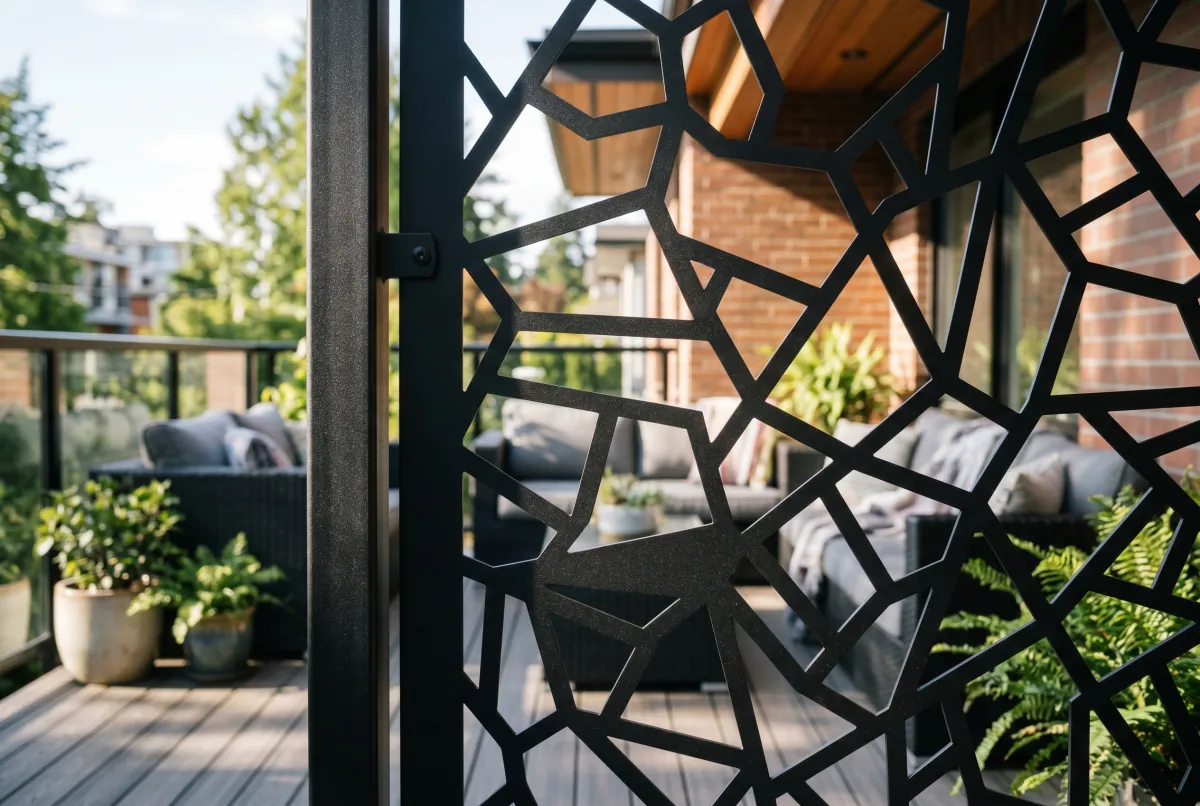
The trick is that privacy works on angles. A neighbour standing on their deck sees your patio along a specific sightline. A screen with a cut pattern blocks that angled view, the solid portions of the pattern line up to interrupt the sightline, while from inside your own space, looking more straight-on, the screen reads as open and you still get light through the cutouts.
That’s why pattern density matters and why an off-the-shelf panel is a compromise. A screen facing a neighbour’s second-floor window needs to be denser than one you’re using purely to throw a bit of shade over a seating area. When we design a custom screen, we tune the openness of the pattern to the actual sightlines you want to block, and we position the panel where it does the most work.
The pattern is yours
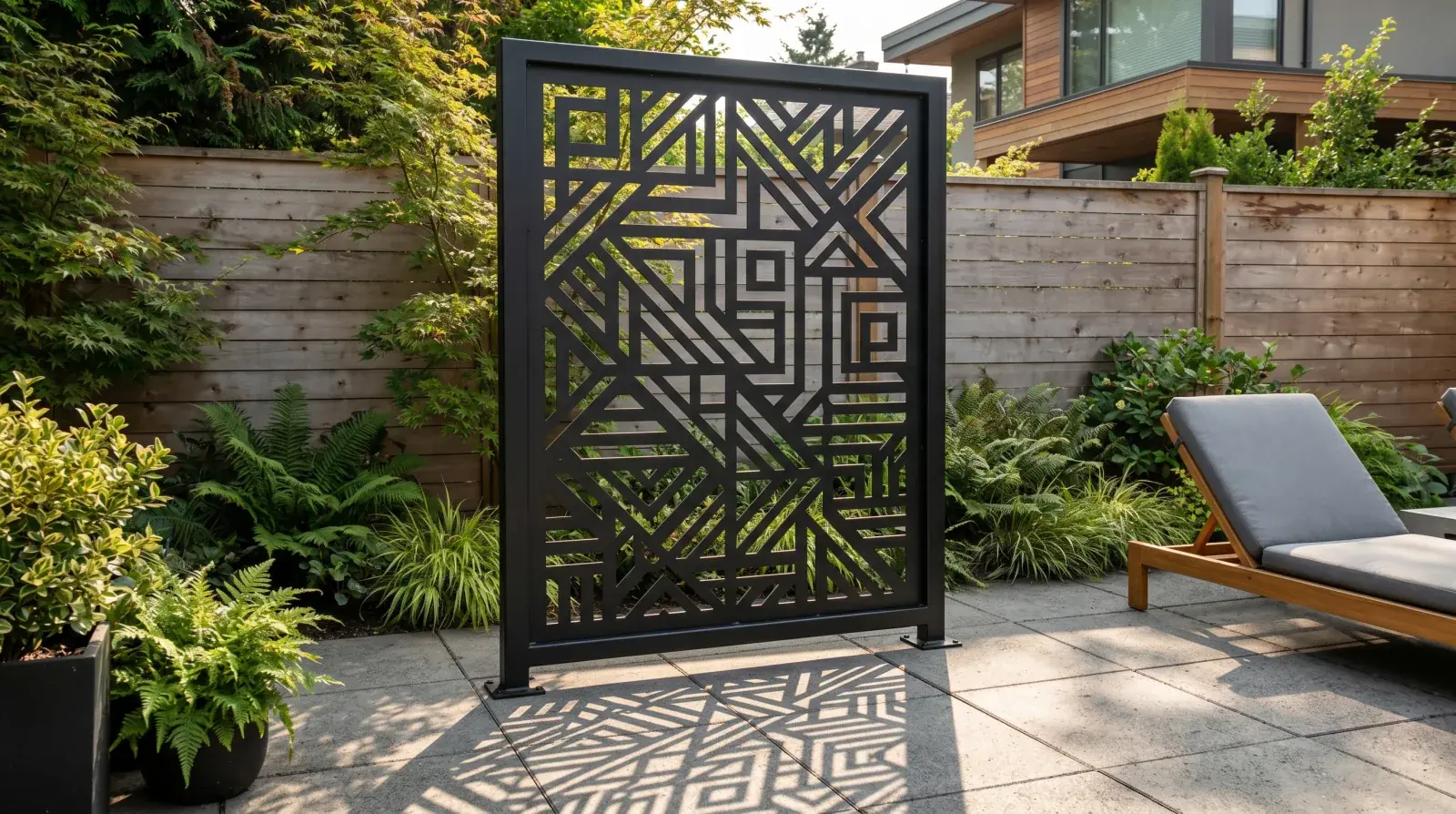
This is the real reason to choose laser-cut steel over a prefab lattice. The cutter follows whatever pattern we draw. We’ve done crisp geometric grids, organic motifs that echo West Coast plant forms, gradients that get denser toward the bottom for ground-level privacy and open up overhead for light, and patterns drawn to match the lines of a particular home. The cut is clean and the detail is fine, so the finished screen looks intentional, not generic.
Laser is the right process for most of these because it gives the cleanest edge and the finest detail on the thinner steel used for screens. For thicker panels or bolder patterns we’ll sometimes use waterjet (no heat distortion) or plasma (fast and economical). The process follows the design and the steel thickness, not the other way around.
Finishing it for the rain
A steel screen lives outdoors in one of the wettest cities in the country, so the finish is not where you cut corners. For most yards we powder-coat the steel, an electrostatically applied, heat-cured finish that stands up to rain and UV far better than ordinary paint. Matte black is the most-requested colour because it disappears against greenery and reads modern, but powder coat comes in any colour.
For sites with harsher exposure, closer to the water, or fully exposed to driving rain, we hot-dip galvanize the steel before coating, or step up to a more corrosion-resistant material. It’s the same logic we apply across our work: the finish has to match the environment. Raw or thinly painted steel will rust in this climate, and a rusted screen is a callback nobody wants.
Mounting it so it stays put
A large screen panel is, aerodynamically, a sail. In a Pacific Northwest windstorm, the wind load on a freestanding screen can be significant, and the mounting has to handle it. Depending on the site, we mount screens to posts set in properly sized footings, bolt them to a deck structure, or fix them to an existing wall or railing.
For freestanding screens we engineer the footings for the wind load on that specific panel size, a tall, dense screen in an exposed North Vancouver yard needs more substantial footings than a small shade panel tucked beside a house. Getting this wrong is how a beautiful screen ends up leaning after the first big blow.
Permits, fences, and double-duty screens
Before fabrication, it’s worth a call to your municipality. A screen that functions as a fence falls under local fence-height rules, and a taller or structural installation can require a permit. The thresholds differ between the City of Vancouver, Burnaby, Coquitlam, and the other municipalities we serve, so confirm what you’re allowed before we build to a height you can’t keep.
One more design question comes up often: can the screen also be a railing? If a screen runs along the open edge of a raised deck, it might need to do double duty as a guard, which means meeting the BC Building Code’s guard height, infill spacing, and load requirements. That’s doable, but it has to be designed to those rules from the start. A screen built purely for privacy has far more design freedom than one that also has to stop someone from falling. If you want one element to do both jobs, tell us up front and we’ll design to the guard requirements from the first sketch.
A good privacy screen is one of those upgrades that changes how a Vancouver backyard feels to use, it turns an overlooked patio back into a private one without boxing it in. Send us your dimensions and a sense of the pattern you’re after, and we’ll design and build a screen that fits the site, the climate, and the rules.