
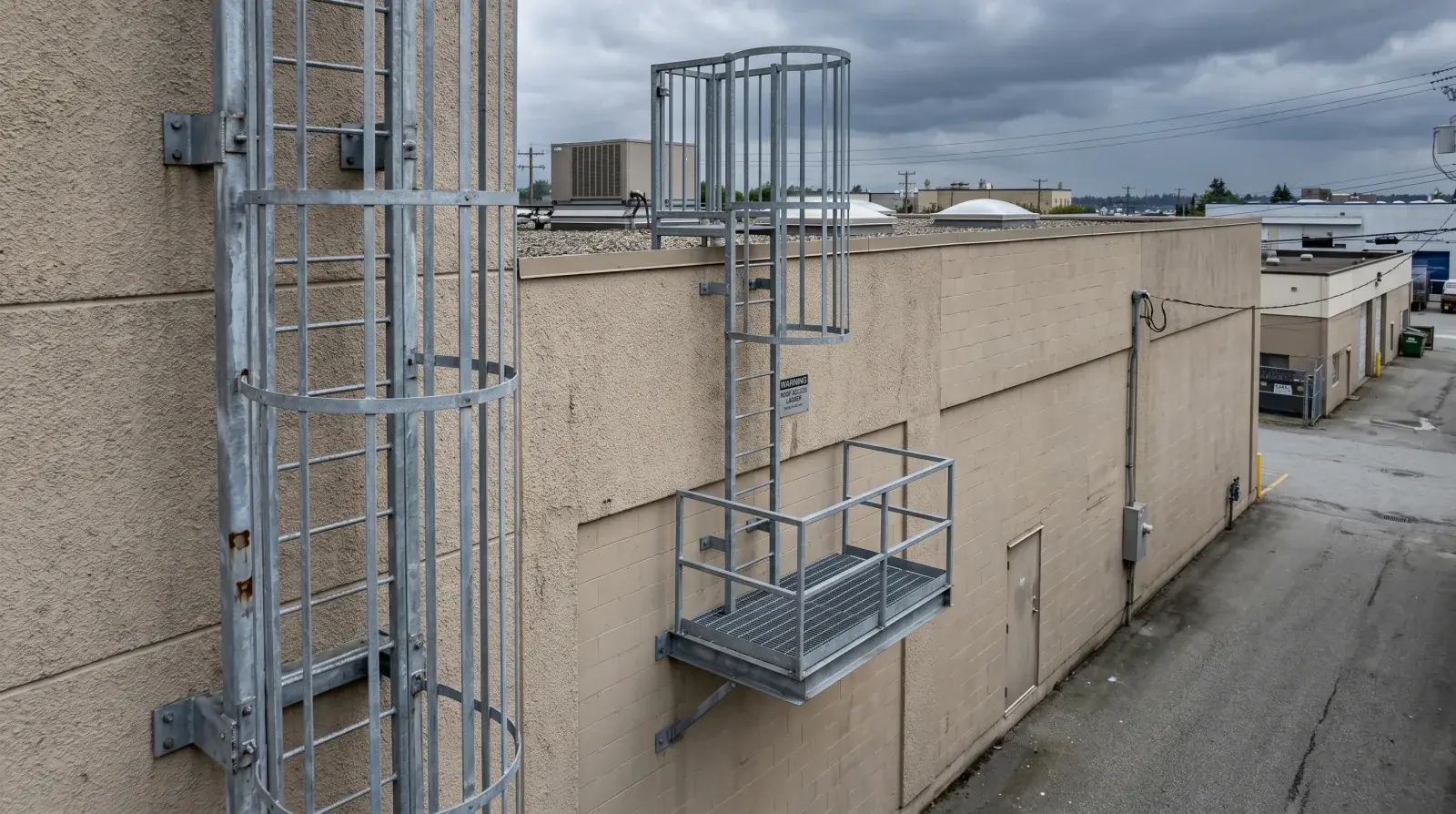
Galvanized steel roof-access ladder with safety cage and platform on a Burnaby commercial building

Article

Roof Access Ladders & Platforms: WorkSafeBC Rules for BC Buildings

Steel roof-access ladders, cages, and platforms for Burnaby and Vancouver commercial buildings, what WorkSafeBC fall protection rules require and how they're built.

This is the steel nobody photographs for the brochure. There’s no glossy hero shot of a roof-access ladder. But every commercial building in Metro Vancouver has rooftop equipment, HVAC units, mechanical, electrical, and that equipment needs servicing, which means people climbing up to it. The moment a worker goes up there, WorkSafeBC’s fall-protection rules apply, and the building owner’s obligation to provide safe access becomes very real.

So while roof access isn’t glamorous, getting it wrong is expensive, in safety violations, in liability, and in maintenance contractors who refuse to go up an unsafe ladder. Here’s what the rules actually require and how the steel gets built to meet them.

The 3-metre line

The number that governs almost everything in this space is three metres. WorkSafeBC’s OHS Regulation requires a fall protection system where a worker could fall 3 metres (about 10 feet) or more, and also where a shorter fall carries a greater injury risk than landing on a flat surface. That threshold is what triggers the need for guards, anchors, cages, and engineered access on a Burnaby or Vancouver rooftop.

Once you’re over that line, and a roof on a single-storey commercial building usually is, the access and the rooftop work areas have to be designed around keeping the worker from falling. That’s the whole game.

Looking up a galvanized steel fixed roof-access ladder with safety cage hoops on a Burnaby commercial building

Ladders, cages, and the shift in thinking

The classic image is a fixed vertical ladder with a circular safety cage. Cages were the standard answer for tall fixed ladders for decades, and you’ll see them on commercial buildings all over Burnaby and Coquitlam.

The thinking has been shifting, though. Current fall-protection practice increasingly favours ladder safety systems, a climbing attachment that travels with the worker on a rail or cable, over cages alone, because a cage doesn’t actually arrest a fall; it just contains it. The right solution for a given building depends on the height, the standard the ladder is built to, and an honest assessment of the fall risk. We don’t default to “always a cage” or “always a rail system.” We design the access to meet the applicable standard and WorkSafeBC’s requirements for that specific building and that specific climb.

Ships ladders and platforms for routine access

For equipment that needs regular servicing, a vertical ladder isn’t always the best tool. A ships ladder, a steep stair with treads and a handrail, climbed facing forward, is far easier and safer to use repeatedly than a vertical ladder you climb facing the rungs. We specify ships ladders a lot for routine rooftop access where a maintenance tech is going up weekly, not once a year.

And once you’re on the roof, getting to the equipment safely matters too. Where a worker could fall 3 metres or more reaching a rooftop HVAC unit, that path needs a guard or another fall-protection system. We fabricate equipment platforms, walkways, and crossovers with compliant guardrails so staff can reach the equipment without stepping near an unprotected edge or clambering over a parapet. The guard has to meet the height and load requirements for the application, the same engineering discipline we bring to any commercial guard or railing.

Built to a standard, sealed where required

WorkSafeBC requires ladders and work platforms to meet the applicable CSA or other recognized standard in effect when they were made, or, where no standard applies, to be designed by a professional engineer. That’s not a suggestion. When we fabricate a roof-access ladder or platform, it’s built to the relevant standard, and where the situation calls for it, to an engineer’s sealed design, with the documentation a building inspector or safety officer will ask for.

As a C.W.B.-certified shop, the welding behind that steel is done to CSA standards, which is part of what makes the access trustworthy when someone’s life depends on it.

Galvanizing is the default finish

A roof-access ladder lives outdoors in the rain, year-round, on a Vancouver or North Vancouver building. So it gets hot-dip galvanized almost every time. The zinc coating from hot-dip galvanizing is the workhorse that keeps the steel from rusting for decades in this climate, far more durable than paint on a component that’s constantly wet and rarely maintained. Where appearance matters, we can powder-coat over the galvanizing, but the galvanizing does the protective work.

Retrofitting older buildings

A lot of our roof-access work is retrofit. Older commercial buildings around Metro Vancouver frequently have access that doesn’t meet current requirements, a ladder with no fall protection, a sketchy parapet step-over, or no real access at all. When a building changes hands, or a maintenance contractor flags the access as unsafe, the owner needs it brought up to standard.

We assess the height, the access point, and the rooftop layout, then design and fabricate access that meets current WorkSafeBC requirements and mounts to the existing structure, whether that’s an exterior fixed ladder, a ships ladder, a roof-hatch ladder for interior access out of the weather, or a platform system. Older buildings are where the biggest gaps usually are.

The responsibility piece is worth naming. Under the regulation, the employer of the workers doing the work has to ensure fall protection is used, but the building owner has every reason to provide compliant permanent access so that every contractor who shows up isn’t left improvising on an unsafe roof. Permanent engineered access protects the workers, the contractors, and the owner all at once.

If your Burnaby, Vancouver, or Coquitlam building has rooftop equipment and the access is missing, aging, or non-compliant, it’s worth fixing before a safety officer or a refusing contractor forces the issue. Tell us about your building and your rooftop access needs and we’ll design and build access that meets the rules.
Related topics

  • roof access ladder WorkSafeBC
  • steel ladder cage fall protection BC
  • commercial roof platform Burnaby
  • WorkSafeBC ladder requirements Vancouver
  • steel roof access fabrication commercial

FAQ

Related questions

These FAQs are included only where the article topic naturally supports them.

When does WorkSafeBC require fall protection for roof work in BC?

WorkSafeBC's OHS Regulation requires a fall protection system where a worker could fall 3 metres (about 10 feet) or more, or from a lesser height where the fall involves a greater risk of injury than landing on a flat surface. That threshold drives the design of roof-access ladders, platforms, and the guards and anchors around rooftop equipment on Metro Vancouver buildings.

Does a roof-access ladder need a safety cage?

Fixed ladders that rise a significant height have historically used safety cages, though current fall-protection thinking increasingly favours ladder safety systems with a climbing attachment over cages alone. The right solution depends on the height, the standard the equipment is built to, and an assessment of the fall risk. We design roof-access ladders to meet the applicable standard and WorkSafeBC's fall-protection requirements for the specific building.

What's the difference between a ships ladder and a regular fixed ladder?

A ships ladder is a steep stair, somewhere between a vertical ladder and a normal stair, with treads and a handrail, climbed facing forward. A fixed vertical ladder is climbed facing the rungs. Ships ladders are easier and safer to use repeatedly and are often specified for routine rooftop access to equipment, while vertical ladders suit occasional access where space is tight.

Do rooftop platforms and walkways need guardrails in BC?

Where workers access rooftop equipment and could fall 3 metres or more, guardrails or another fall-protection system are required under WorkSafeBC's regulation. Steel walkways, equipment platforms, and crossovers are commonly fabricated with compliant guards so maintenance staff can reach HVAC units and other equipment safely. The guard has to meet the height and load requirements for the application.

Why do commercial buildings in Burnaby need engineered roof access?

Because rooftop HVAC, mechanical, and electrical equipment needs regular maintenance, and the workers servicing it are covered by WorkSafeBC's fall-protection rules. A Burnaby or Coquitlam commercial building has to provide safe access, a compliant ladder, platform, or stair, or the building owner and maintenance contractors are exposed to safety violations and liability. Engineered steel access is how that obligation gets met.

What standard are fixed steel ladders built to?

WorkSafeBC requires ladders and work platforms to meet the applicable CSA or other recognized standard in effect when they were manufactured, or to be designed by a professional engineer where no standard applies. We fabricate roof-access ladders and platforms to the relevant standards and, where required, to an engineer's design, with the documentation the building inspector and safety officer expect.

How is a roof-access ladder finished to last in Vancouver's climate?

Almost always hot-dip galvanized. A roof-access ladder is exposed to rain year-round on a Vancouver or North Vancouver building, and hot-dip galvanizing gives the zinc coating that keeps it from rusting for decades. Powder coating over galvanizing is an option where appearance matters, but the galvanizing is the workhorse protection.

Can you add roof access to an existing commercial building?

Yes, retrofitting compliant roof access to an existing building is common work for us. We assess the height, the access point, and the rooftop layout, then design and fabricate a ladder, platform, or ships ladder that meets the current WorkSafeBC requirements and mounts to the existing structure. Older buildings often have non-compliant or missing access that needs upgrading.

What's the difference between a fixed ladder and a roof hatch ladder?

A roof hatch ladder provides interior access up through a hatch in the roof deck, while an exterior fixed ladder climbs the outside of the building. Hatch access keeps the climb out of the weather and is often preferred for routine maintenance, but it requires a hatch and interior space. The choice depends on the building layout and how often the roof is accessed.

Who is responsible for fall protection on a building's roof?

Under WorkSafeBC's regulation, the employer of the workers doing the work is responsible for ensuring fall protection is used, but the building owner has a strong interest in providing compliant permanent access so every contractor who comes up isn't improvising. Permanent engineered access, a compliant ladder, platform, or anchor system, protects everyone and reduces the owner's liability.

Does Jeff and Simon design and build roof-access steel for Metro Vancouver?

Yes. We design and fabricate roof-access ladders, ships ladders, equipment platforms, crossovers, and guardrails for commercial buildings across Burnaby, Vancouver, Coquitlam, and the North Shore, built to the applicable standards and WorkSafeBC's fall-protection requirements. [Request a quote](/request-a-quote/) with your building details and rooftop access needs.

Related reading

More fabrication topics from Jeff and Simon

Related articles from our blog on metalwork, fabrication, and project planning.

Get in touch

Need help applying this to a real project?

Use the article as background, then send the actual fabrication scope, municipality, drawings, or dimensions so Jeff and Simon can review the next step.