A glass railing does one job that no other guard can match. It stops a fall while letting the view through almost untouched. On a Vancouver deck facing the water, or a West Vancouver home built into the slope above the ocean, that open sightline is often the whole reason the railing exists. The question is not usually whether to use glass. It is which glass system to use.
There are two families. Frameless, where the glass carries the load through a base shoe channel or standoff discs, and framed, where the glass sits between posts with a top rail. Both are made from tempered or laminated glass and slim steel or stainless hardware. They look similar in a listing photo. In person, and on the invoice, they behave very differently. Here is how we think about the choice when a client in Metro Vancouver asks us to build one.
How each system holds the glass
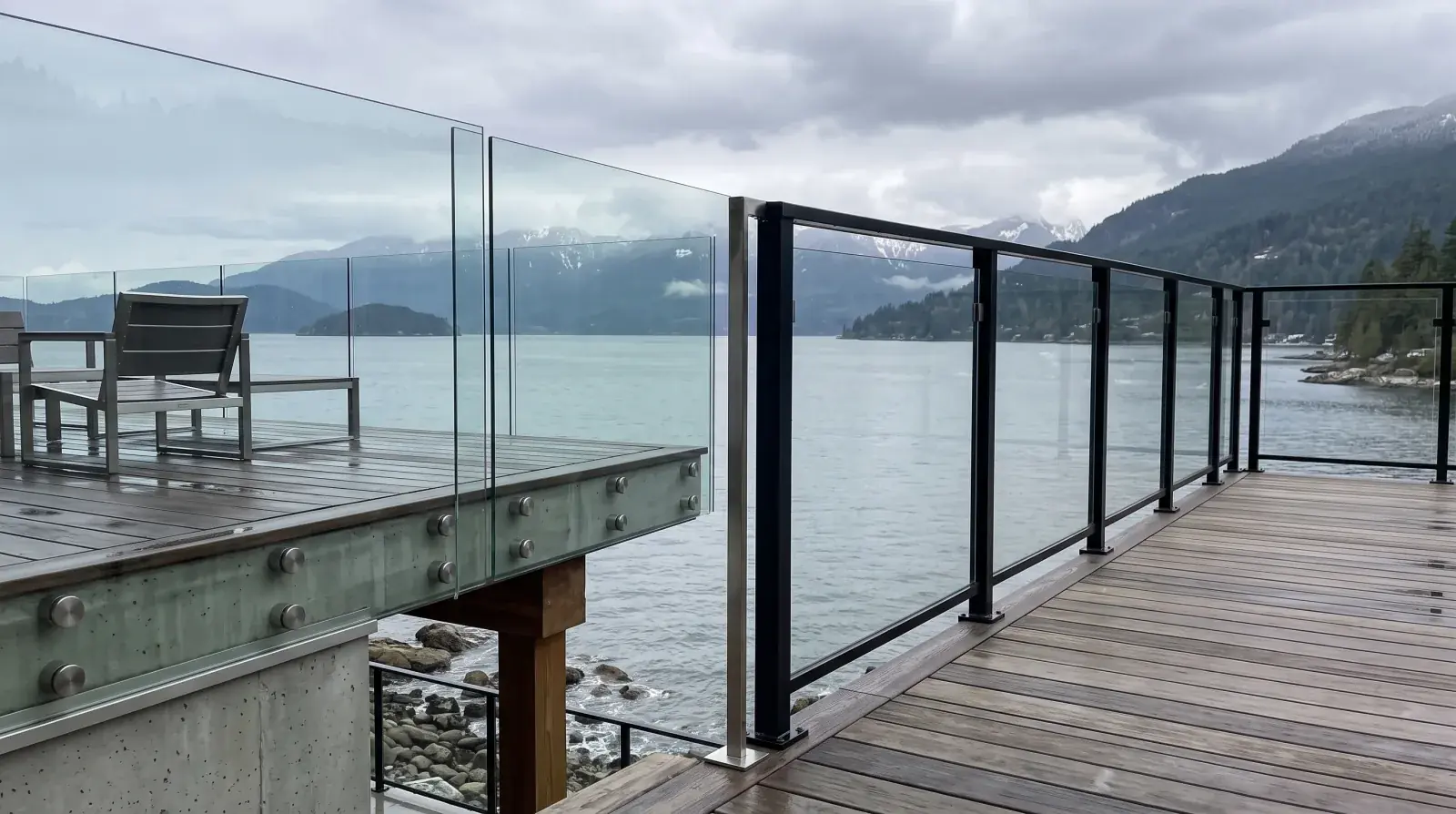
A framed glass railing works the way most people picture a railing. Slim vertical posts stand at regular spacing, the glass panels sit between them, and a top rail ties everything together. The posts do the structural work. They carry the horizontal load that a person leaning on the guard applies, so the glass panels themselves can be thinner. This is the more forgiving system to build and often the more affordable one.
A frameless glass railing removes the posts. There are two common ways to do it. The first is a base shoe, a continuous steel or aluminum channel bolted to the deck or the slab that grips the bottom edge of each glass panel. The second is a standoff system, where stainless discs bolt through pre-drilled holes in the glass and hold it off a steel fascia or a slab edge. In both cases the glass is the structure. That is why frameless panels are usually thicker, and why the hardware and anchoring have to be sized carefully. Our post on the steel guardrail glass standoff detail shows how we build that standoff connection so it carries the load and still looks clean.
The practical difference is visible from a few metres away. A framed guard has verticals marching along the run. A frameless guard is a single sheet of glass with nothing breaking it. On a view deck, that difference is the whole point.
The view: what actually breaks the sightline
If the reason for glass is the water, the mountains, or the city skyline, frameless gives you the most of it. Standing at a frameless rail on a West Vancouver deck, the only thing between you and Howe Sound is the glass, and clean glass almost disappears. There are no posts to count, no top rail cutting across the horizon if you choose to run it cap-free.
Framed still opens the view a great deal compared to a solid guard or a picket rail. But the eye notices the posts. On a long straight run they read as a rhythm across the view. Some clients like that structure and the visual weight it adds near a modern steel-and-concrete home. Others find it distracting when the point was to make the guard disappear.
There is a middle path we build often. Use frameless glass on the primary view side of the deck, and switch to a framed or even a steel picket guard on the side sections where the view does not matter. It saves cost and keeps the clean look where it counts. If you are still deciding between glass and other open guards, our glass versus cable railing comparison lays out how each option treats the sightline.
Cost drivers, not fixed prices
We do not publish a set price for glass railings, because two decks that look the same on a plan can cost very differently to build. What we can do is tell you what moves the number, so you can plan your budget with your designer.
The biggest driver is which system you choose. Frameless usually costs more than framed for the same run. The glass is thicker because it carries the load, the base shoe or standoff hardware is a bigger structural component, and the anchoring into the deck or slab has to be engineered to hold everything. A framed system spreads the load across the posts, so the glass is thinner and the hardware is lighter.
Other things that change the price include the total length of the run, the fall height (a rail on a second-storey deck faces different load requirements than one at grade), the number of corners and stair transitions, and the glass type. Laminated glass costs more than plain tempered but stays in place if it ever breaks, which matters on a high deck. Coastal hardware grade also affects the number. When you are ready, request a quote with your deck dimensions and we will price the actual layout rather than a guess.
Cleaning and coastal durability
Glass looks effortless and then the first winter of salt spray arrives. Neither system is maintenance-free on the coast, and it helps to know what you are signing up for.
Framed systems have more parts. Every post base, every clamp, and every joint is a place where salt, grit, and water collect. That means more surfaces to wipe down, and more spots where the wrong hardware can start to streak with surface rust. Frameless has fewer parts, but a base shoe channel sits at the bottom of the glass and can trap water and dirt if it is not detailed to drain. Standoff discs need attention around each fixing point.
The single most important decision for a coastal railing is hardware grade. In Vancouver, and especially on exposed West Vancouver waterfront, we specify marine-grade stainless (316) for standoffs, clamps, base shoe fasteners, and any exposed steel. We also detail the base shoe so water drains away instead of pooling against the metal. Regular stainless can look fine in the shop and show rust streaks within a couple of salty winters. Getting the grade right at the design stage is far cheaper than replacing corroded hardware later. For steel components behind the glass, our custom railings service covers the finishes we use to survive coastal exposure.
So which one should you build?
If the view is everything and the budget has room, frameless is usually the answer. It gives the cleanest sightline, and with the right marine-grade hardware it holds up on the coast. If you want an open view but the budget is tighter, or you like the look of visible posts near a modern home, framed is a strong choice and easier on the wallet. Many of our Vancouver and West Vancouver projects end up mixing the two, frameless where the view lives and framed where it does not.
Whichever you choose, the guard still has to satisfy the code. The height, the load test, and the 100 mm sphere rule all apply to glass just as they do to pickets. Start there, pick the system for the view you want, then let the fall height and the salt air decide the final spec.
Explore our custom railings work, then request a quote and we will size the guard, handrail, and finish to your home across Metro Vancouver.