Burnaby has more custom metal fabrication happening inside its boundaries than most people realize. Between the high-rise towers going up in Metrotown and Brentwood, the laneway houses squeezing into Burnaby Heights, the strata guardrail replacement cycles rolling through 1980s condo buildings, and the institutional work at BCIT and Burnaby Hospital, the demand is steady and the variety is real.
This guide covers what custom metal fabrication actually looks like in Burnaby in 2026: how it works, what it costs, what the city requires, and what separates a shop worth hiring from one that’ll leave you chasing warranty issues two years later. It’s written from the perspective of a fabricator operating a Burnaby shop on Douglas Road, not a content agency pulling numbers off a national average.
What “custom” really means here
The phrase “custom metal fabrication” gets used loosely. On our side of the business, custom means three specific things:
- Built to project-specific dimensions. Nothing stock. Every part is measured, drawn, cut, and welded for the job it’s going into.
- Engineered where it needs to be engineered. Structural members get stamped drawings. Guardrails get load calcs. Nothing gets waved through on guesswork.
- Finished for its environment. A rooftop railing in Burnaby Heights gets a different finish spec than an interior handrail in a Metrotown condo. The fabricator should know why.
If a shop is quoting you “custom” work but showing you a catalog of pre-welded components to mix and match, that’s modular assembly, useful and cheaper, but not the same thing. Real custom fabrication starts with a blank CAD file and your project’s measurements.
Who’s buying custom fabrication in Burnaby
Four client types drive most of our Burnaby work, and they each approach the process a little differently:
Homeowners renovating in Burnaby Heights, Capitol Hill, Deer Lake, or Buckingham Heights. Usually railings, staircases, or entry gates. The conversation starts with photos and a rough budget, and the process moves fast once the design is locked.
Architects and designers on new custom homes and renovations. These projects come in with drawings already developed, our job is to translate the designer’s intent into something that actually fabricates and installs cleanly, and to flag anything that won’t meet BC Building Code before it gets built.
General contractors running multi-trade jobs. GCs want a fabrication partner who shows up on schedule, turns RFIs around quickly, and doesn’t become the reason the drywaller can’t start. Coordination is half the job on commercial and multi-family work.
Strata councils and property managers doing guardrail replacements on 1980s and 1990s high-rises. A lot of Metrotown, Edmonds, and Lougheed towers are cycling through balcony railing upgrades right now, driven by aging original systems, updated code requirements, and strata depreciation reports. These projects are coordination-heavy: access by floor, resident notification, phased installs to minimize disruption.
The six-step fabrication process
Every custom project at our Burnaby shop moves through the same sequence, regardless of size:
1. Site visit and scope
20 to 45 minutes on a residential job, longer on commercial. Measurements, photos, access conditions. A Metrotown tower install has completely different logistics than a detached home in Burnaby Heights, elevator reservation windows, parkade clearance, union site rules. All of that gets captured on the first visit.
2. Shop drawings
Residential projects get a CAD drawing for client approval. Commercial projects get a submittal package, dimensioned elevations, sections, weld symbols, hardware schedules, finish specifications. On structural work, a BC-licensed structural engineer reviews and stamps the connections. This is also where most mistakes get caught, it’s a lot cheaper to fix a dimension in CAD than to re-cut 20 feet of plate.
3. Material ordering
Steel grades matter. Structural work is typically 350W or A500 tube. Stainless for coastal and food-service applications is 316, not 304, the extra molybdenum holds up to salt air. Aluminum for lightweight architectural work, wrought iron for ornamental and hand-forged pieces. A Burnaby fabricator with good supplier relationships can shave days off a tight schedule because they know which local mills and service centres actually have what’s on the drawing in stock.
4. Cutting, forming, welding
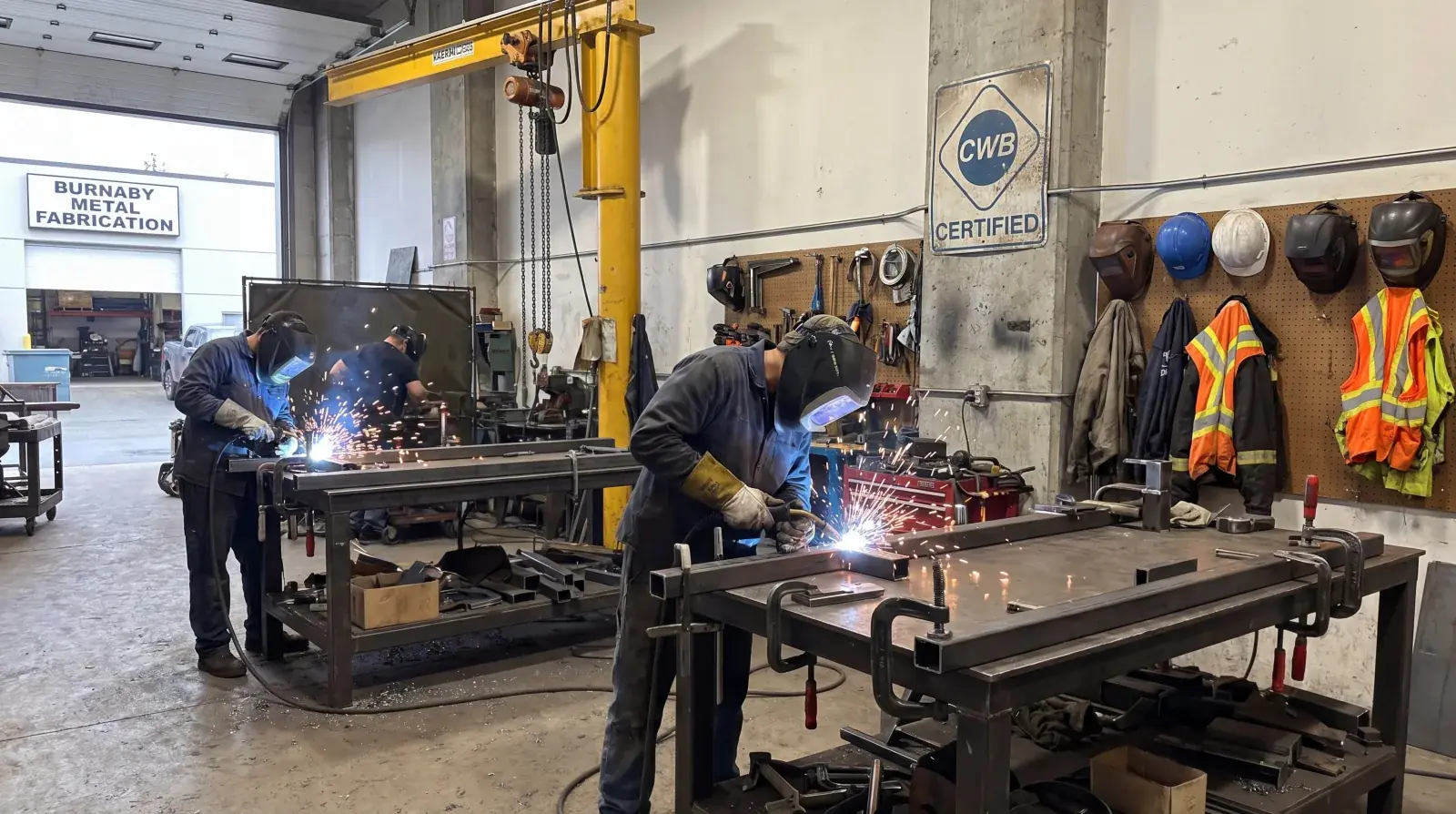
The actual fabrication. Plate and tube get cut, plasma, band saw, or laser depending on geometry. Stringers and handrails get jigged on flat tables. Welds are laid to CSA W47.1 standards and visually inspected before the piece moves on. This is where C.W.B. certification pays off: the procedures are qualified, the welders are tested, and the quality doesn’t depend on one person being in a good mood that day.
5. Finishing
Vancouver’s wet climate is hard on unprotected steel. Burnaby gets 1,100+ mm of rain a year, and exterior railings in particular take a beating. The finishing options break down like this:
- Powder coating, durable, colour-matchable, good for interior work and protected exterior. Baseline finish on most custom railings.
- Hot-dip galvanizing, molten zinc coating that protects steel for 30+ years in exposed conditions. Required on most exterior structural work.
- Duplex system, hot-dip galvanizing with powder coating applied over top. The belt-and-suspenders option for exposed railings and gates. Costs more but handles 15+ years of coastal weather with almost no maintenance.
- Stainless polish, #4 brushed or mirror, depending on the architect’s spec.
- Architectural bronze or blackened steel, for high-end interior work where the finish is the feature.
6. Install and final QC
Install day is where shop precision meets site reality. Our crews handle the full install on most residential and commercial jobs, core drilling into concrete, anchor placement, coordination with other trades. Final QC checks guard heights against BC Building Code (1,070 mm minimum on most applications), the 100 mm sphere test on infill, and any touch-ups from install. Close-out on strata and commercial jobs includes as-built drawings and material certificates.
What drives the price in Burnaby
Every quote depends on scope, materials, finish, and site conditions. Rather than publish ranges that go stale or mislead, material prices move, designs vary widely, and two “60 ft railings” can quote very differently, here is how we tier the custom fabrication work we do in Burnaby:
| Scope | Tier breakdown |
|---|---|
| Steel cable railing | Baseline to mid-range depending on length, post spacing, and finish |
| Glass-and-metal railing | Mid-range to premium depending on frame style and glass spec |
| Wrought iron railing | Baseline (simple straight runs) through heritage (hand-forged) |
| Mono stringer staircase | Mid-range to premium depending on span and tread material |
| Floating staircase | Premium to top-tier depending on engineering and finish |
| Double stringer staircase | Baseline to mid-range |
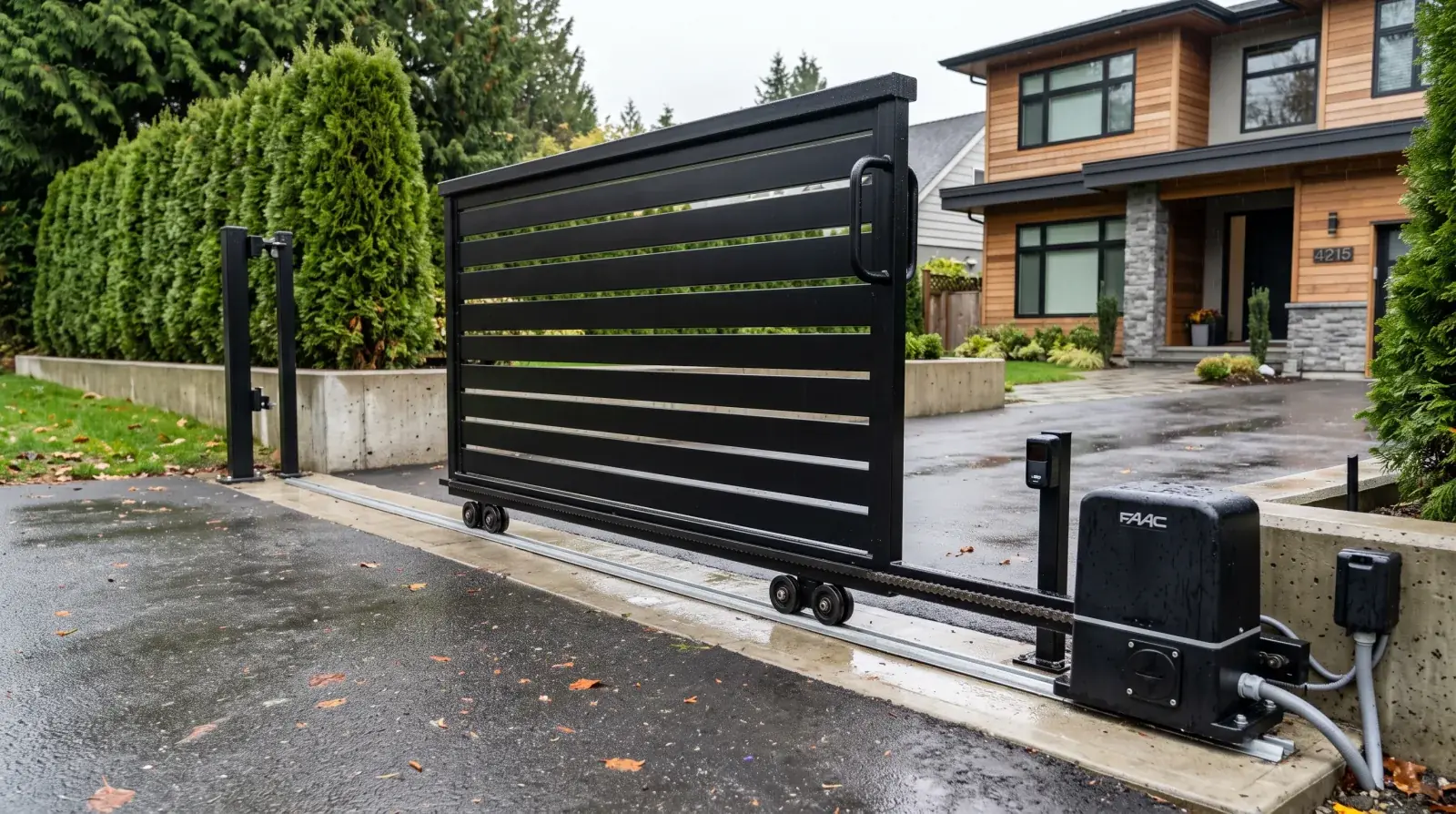
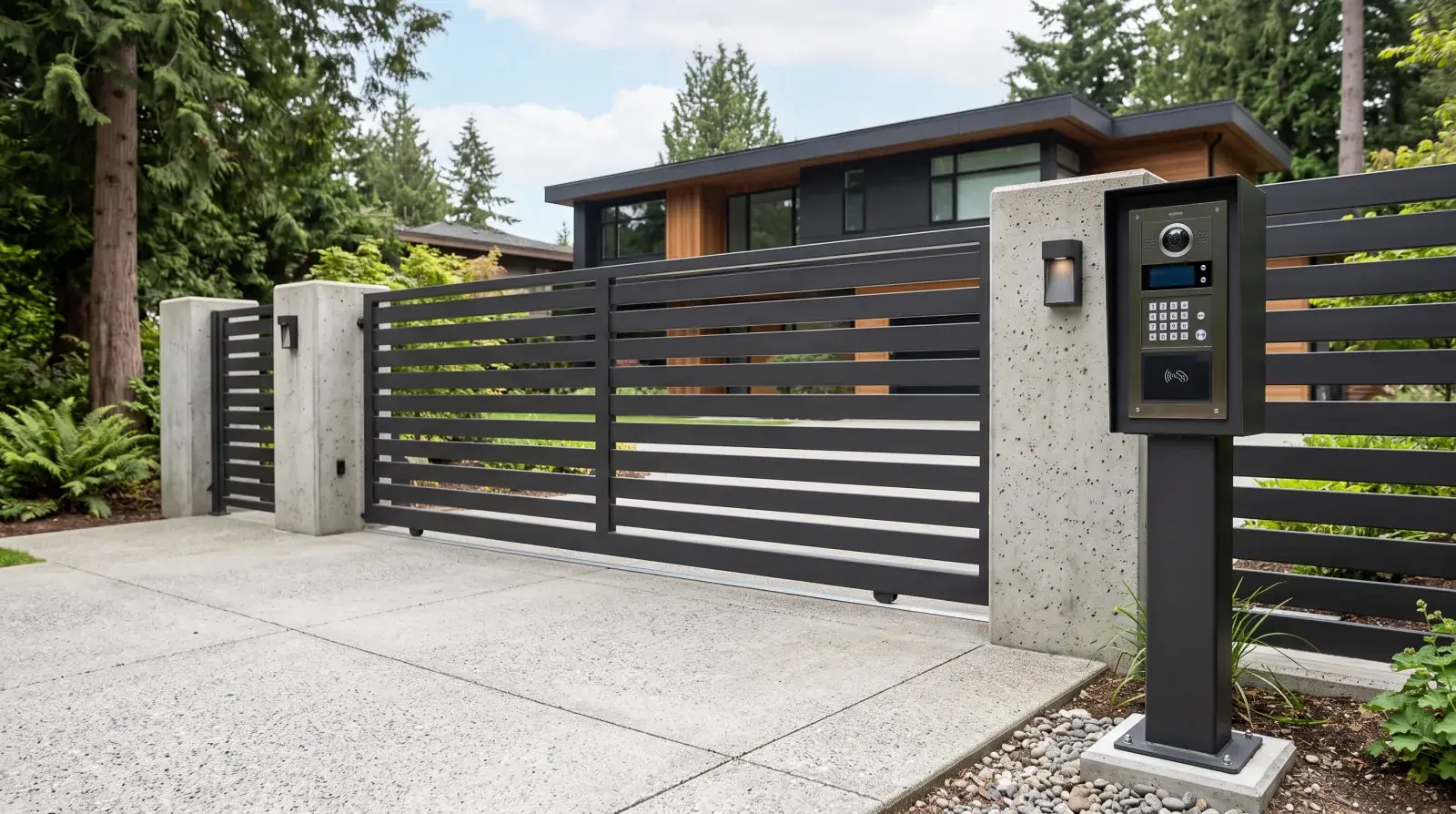
| Driveway gate (swing) | Mid-range; automation and length push higher |
| Driveway gate (slide, automated) | Premium; rail, gear, and automation complexity matter most |
| Residential structural steel package | Scoped from the engineer’s drawings, members, connections, coordination |
| Steel entry canopy | Mid-range; span and anchoring drive the labour line |
Commercial misc. metals and structural steel packages are bid per project based on tonnage, complexity, and site conditions. For a real number on your scope, request a quote with drawings or photos, we respond in a few business days for residential, and inside tender windows for commercial.
The biggest pricing variables aren’t the obvious ones. Material is only part of a typical fabrication quote. The rest is design time, shop labour, finishing, delivery, and install, which is why two shops can quote very differently on the same drawings.
What Burnaby specifically requires
The City of Burnaby’s building department treats metalwork the same way most BC municipalities do, with a few local quirks worth knowing.
Permits. New staircases, structural modifications, and guardrail replacements that involve new mounting or load paths all require a building permit. Cosmetic replacements on an existing structural frame sometimes qualify for exemption, for example, swapping wood pickets for steel on an existing wood guard that stays in place. The Burnaby building department is reachable and generally quick to confirm whether your specific scope needs a permit. Ask before you buy materials.
Engineered drawings. Any structural steel, beams, columns, moment connections, cantilevered stairs, needs stamped drawings from a BC-licensed structural engineer. That’s a BC Building Code requirement, not a Burnaby-specific one, but it’s where a lot of residential projects get stuck. The fabricator should be able to coordinate with the engineer directly rather than making you run messages between trades.
Seismic design. BC sits in a seismic zone, and all structural connections need to account for earthquake loading. That affects bolt specifications, weld details, and member sizing in ways that aren’t obvious to shops from outside the province. If you hire a fabricator from Alberta or the Prairies, ask whether they’ve done seismic work in BC before.
C.W.B. certification. Canadian Welding Bureau certification under CSA W47.1 is the baseline for any structural welding in BC. The Burnaby building inspector will look for it on structural scope. It’s also the quality signal that separates a fabricator who’s investing in their process from a welder with a truck and a couple of machines.
How to evaluate a Burnaby fabrication shop
A few specific questions cut through the marketing copy faster than anything else:
“Can I see your C.W.B. certificate?” Current certificates have an expiry date and are procedure-specific. A real certified shop will hand it over without hesitation.
“Will I see shop drawings before you start cutting?” The answer should be yes, always. If a shop wants to fabricate off field measurements without producing drawings, that’s a warranty problem waiting to happen.
“Who handles install?” In-house install crews know the fabrication and can fix issues on the spot. Subcontracted install is fine on big commercial jobs but usually a red flag on residential work, it typically means the shop is buying components from elsewhere and just assembling on site.
“What’s your warranty on welds and finishes?” A serious shop offers a written warranty. Powder coat warranties are typically 5-10 years, galvanizing 20-30 years, structural welds for the life of the building.
“Can I visit your shop?” Any fabricator with nothing to hide will say yes. A shop visit tells you more about quality in 10 minutes than an hour of back-and-forth on email. Our shop is at 2544 Douglas Rd #106, walk-ins welcome during business hours, and we’d rather have you see the work in progress than take our word for it.
Why being Burnaby-based actually matters
A lot of Metro Vancouver shops will bid work in Burnaby. Being in Burnaby changes the math in a few specific ways:
- Site visits don’t burn a half-day. Twenty minutes from Douglas Road to most Burnaby projects. That means we actually do the site visits that matter, instead of trying to quote from photos.
- Material pickups stay local. Our steel suppliers are all within 15 minutes, we can respond to a dimension change or material substitution the same day.
- Install mobilization is cheap. No cross-city fuel, no drive-time premium buried in the quote. On a smaller residential job, that’s a noticeable difference versus a shop trucking in from further out.
- Knowledge of Burnaby’s building stock. The strata buildings in Metrotown behave differently than the ones in Edmonds. The character homes in Burnaby Heights have different framing than the ones in Deer Lake. Local experience shows up in the details.
None of this means a Vancouver or Coquitlam shop can’t do good Burnaby work. It means the logistics math is just better when the shop is already here.
Next steps
If you’re planning a project in Burnaby, residential, commercial, or institutional, the fastest path to a real quote is a short phone call or a few photos and dimensions sent through the quote form. We’ll tell you whether it’s a good fit, what the timeline looks like, and what order of magnitude the budget should be in before anyone commits to anything.
For a broader view of the Metro Vancouver market, the complete guide to custom metal fabrication in Vancouver covers material selection, finishing options, and certification in more depth. For Burnaby-specific project types, the Burnaby service area page has more detail on the neighbourhoods and project categories we work in most often.
And if you want to see finished work before you reach out, the project gallery has photos from Burnaby and across the Lower Mainland, including institutional and commercial installations that show the full range of what custom fabrication looks like when it’s done right.
For Burnaby commercial and industrial projects specifically, our steel buildings in Burnaby guide walks through the differences between pre-engineered metal buildings and custom structural steel fabrication, useful if you’re still deciding which approach fits your scope.