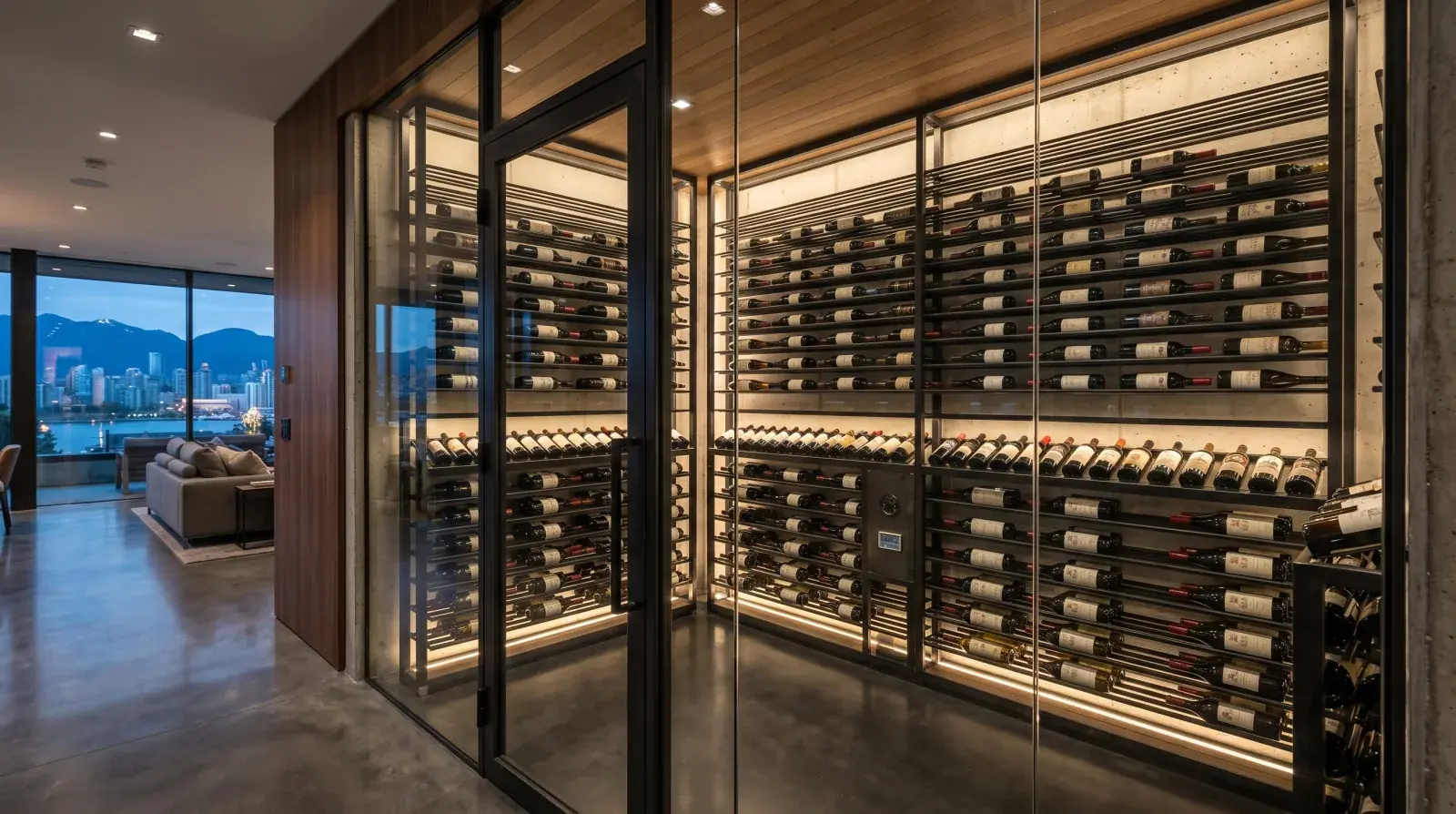
Custom wine cellars have become a recurring scope in high-end Vancouver custom residential. Some are back-of-house storage rooms with serious racking and quiet utility. More often now they’re feature rooms, glass-walled cellars visible from the dining room or living area, with custom blackened steel racking, integrated lighting, and the kind of architectural presence that makes the cellar the centrepiece of the room it adjoins.
These rooms are more technically demanding than they appear in photos. The fabrication, the glass, the climate system, and the architecture have to be coordinated as one design. Each trade on its own is solvable; coordinating all of them is the actual project.
What the cellar metalwork actually includes
A custom steel wine cellar typically involves several metalwork elements:
- Bottle racking, the structural racks holding the bottles. Custom sized and configured for the collection.
- Glass enclosure framing, the steel framing supporting the glass walls of the cellar, if it’s a glass-walled design.
- Door framing, usually a custom steel-framed glass door integrated with the enclosure.
- Service or tasting elements, a counter, a service shelf, or integrated display lighting.
- Architectural trim, base details, transitions to wall finishes, integrated lighting reveals.
The racking is the bulk of the fabrication. The glass framing is what makes the cellar read as a designed enclosure rather than a closet. The service elements are project-specific.
Racks: structural and dimensional
Bottle racks carry concentrated weight. A standard 750 ml bottle weighs around 1.2 kg full. A rack holding 500 bottles carries 600 kg of bottle weight, plus the rack’s own weight. For larger collections, the load is correspondingly more substantial.
The rack design has to handle this load over decades without sag, racking, or fastener loosening. Critical dimensions:
- Cubby size, standard for 750 ml bottles (typically around 90-100 mm diameter cylindrical or equivalent), with dedicated zones for magnums (1.5 L) and larger formats if the collection includes them
- Rack depth, sized to hold the bottle securely, neck-out, with no risk of forward fall
- Spacing between rack rows, clearance for the bottle plus visual hand access
- Total rack height and footprint, sized to the room
Material choice is typically steel, solid steel tube, plate, or rod, for the structural strength and the architectural language. Wood racks are an alternative but read differently and have their own structural considerations.
The bottle should sit at a slight downward angle so the wine touches the cork (keeping the cork moist, which prevents oxidation). A horizontal rack with a 1 to 2 degree downward tilt to the neck is the standard configuration.
Glass enclosure: temperature differential
A glass-walled cellar has glass separating the cellar environment (cool and humid) from the adjacent interior (warmer and drier). The temperature differential, typically 5 to 10 degrees, and the humidity differential mean condensation is a real risk on the warm side of the glass.
Two design responses:
Insulated glass units (IGU), double or triple-pane glass with a sealed air or gas space between the panes. The insulation reduces the temperature gradient across the glass, dropping the warm-side surface temperature closer to room ambient and reducing condensation risk.
Climate control on both sides, minimizing the differential through careful HVAC design so condensation doesn’t form. This is part of the HVAC sizing conversation.
For a glass-walled cellar in a Vancouver custom home, we coordinate with the glazier and the HVAC contractor on this decision. Most modern installations use IGU glass plus careful climate control as a combined response.
Climate control: not our scope, but coordinated
The cellar climate system, refrigeration, humidification, and air circulation, is HVAC scope, not metalwork. A small dedicated cellar refrigeration unit and humidifier sized for the cellar volume maintain the controlled environment.
What the metalwork has to do for the HVAC scope:
- Provide a tight envelope so the controlled climate stays in the cellar and the ambient stays out
- Penetrate the envelope cleanly for any HVAC ductwork, electrical, and lighting
- Accommodate the equipment locations specified by the HVAC contractor
We coordinate with the HVAC contractor during design so the steel and glass envelope works with the climate equipment. A cellar that loses control of its environment is a failed cellar regardless of how beautiful the metalwork is.
Lighting: low heat, careful detail
Integrated cellar lighting is standard, LEDs in the racking, ambient light from above, accent lighting on a feature bottle wall. The lighting has to be low-heat because heat input affects the cellar’s climate load, and the heat generated by lighting fixtures in the cellar comes out of the refrigeration system’s capacity.
LED is the only practical lighting technology for cellars, heat output is minimal compared to incandescent or halogen, and the colour temperature can be selected for the architectural intent. Warm white (around 2700 to 3000K) reads as appropriate for a cellar; cooler temperatures feel wrong in the space.
The wiring penetrations through the cellar envelope have to be sealed so they don’t compromise the climate system. We coordinate with the electrician on the wiring routing during design.
Door: usually glass, sometimes solid
The cellar door is typically a glass-and-steel-framed door matching the enclosure design. The door has to:
- Seal tightly against the frame to maintain the climate envelope
- Have a heavy-duty hinge and closer because the door includes the weight of the glass and the frame
- Lock if the owner wants restricted access (collectors often do)
For some cellars, particularly back-of-house storage rooms rather than feature rooms, a solid door is appropriate. The choice is design-driven.
Sizing the cellar to the collection
The rack layout is sized to the owner’s collection, both current and projected. A typical conversation includes:
- Current number of bottles
- Expected collection growth (modest, moderate, ambitious)
- Format mix (mostly 750 ml? magnums? large formats?)
- Daily-drink versus special-occasion ratio
- Future-proofing for case purchases
A cellar that’s too small constrains the collection. A cellar that’s wildly oversized is wasted space and wasted refrigeration. The right size balances current needs with realistic projection.
We’ve fabricated cellars from a few hundred bottle capacity to several thousand. The complexity scales with size, but the design conversation is the same.
Coordinating with the rest of the home
A custom wine cellar is usually part of a broader custom home design where multiple architectural metalwork elements coordinate. The cellar metalwork, the racking finish, the glass framing detail, the door, should coordinate with the home’s other custom metalwork: exposed structural beams, railings, fireplace surrounds, and other architectural features.
We work directly with the project architect or interior designer on the design language. The cellar isn’t its own design moment unrelated to the rest of the house, it’s one element in a coherent architectural language across the home.
Lead time and trade sequencing
A typical custom cellar runs eight to twelve weeks from design lock to installed cellar. The racking is custom fabricated in our Burnaby shop; the glass is custom cut and tempered; the install has to coordinate with the HVAC, the electrical, and the surrounding finish trades.
Trade sequencing on a typical install:
- Framing and rough HVAC penetrations
- Refrigeration equipment installation
- Cellar wall finishes (cellar interior surfaces)
- Glass enclosure and steel framing
- Racking installation
- Lighting and finish electrical
- Door installation and final commissioning
Coordinating this sequence is part of what makes the cellar project succeed. We participate in the construction schedule from the design phase so the install lands at the right point.
If you’re at the design stage of a Vancouver custom home where a wine cellar is part of the program, bring us the architectural intent and the collection size and we’ll coordinate the metalwork, the glass, and the climate system from the start.