
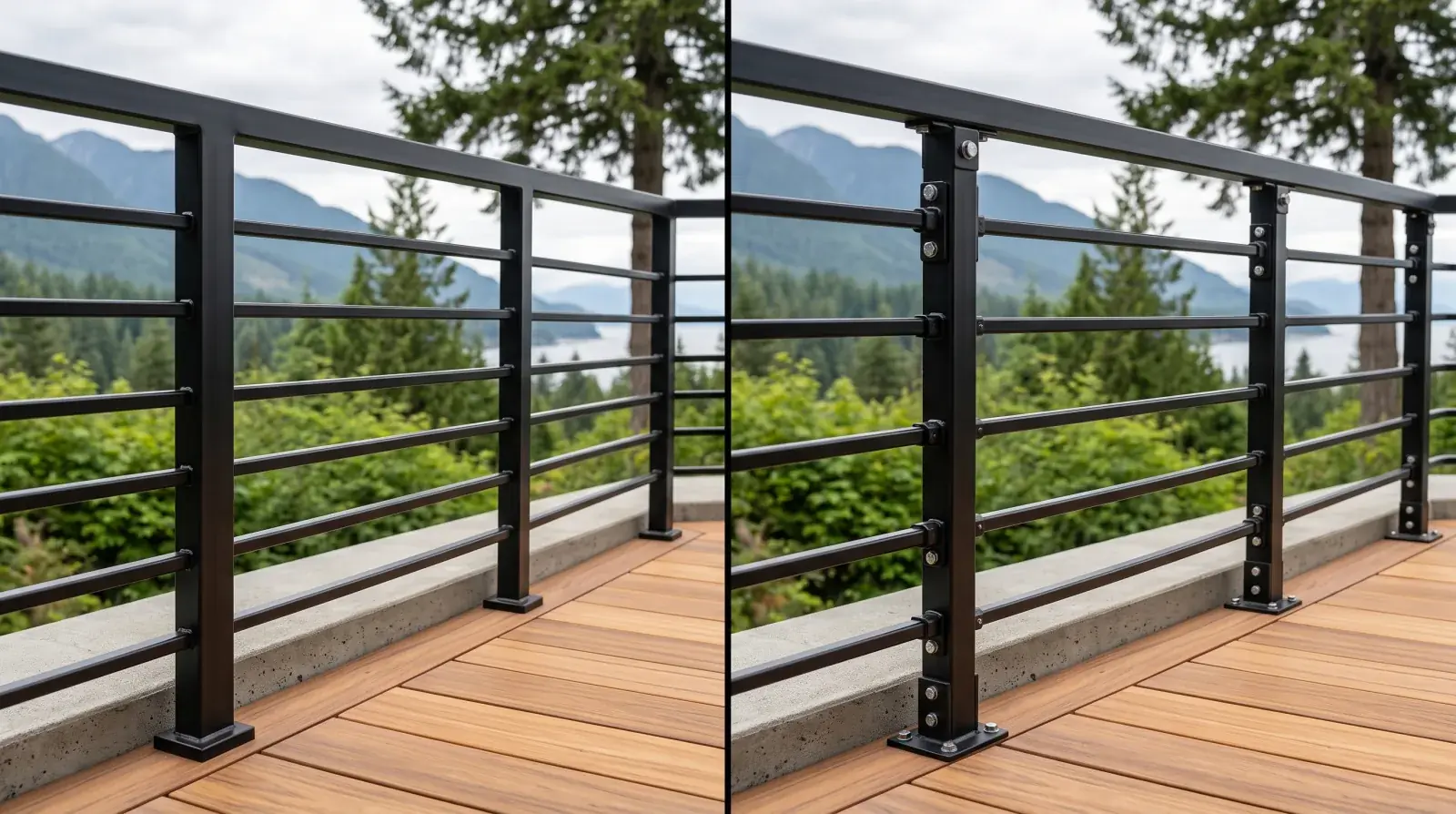
Side by side comparison of a fully welded matte black steel railing and a bolted modular kit railing on a modern Vancouver deck

Article

Welded custom railings vs modular kit systems in Vancouver

Welded vs modular railing systems for Vancouver and Burnaby: strength, fit, finish, code, and longevity. A fabricator on when each choice makes sense.

When it is time for a new railing, owners face a basic choice. Buy a modular kit railing that bolts together from standard parts, or have a shop build a fully welded custom railing designed for your space. Both put a guard on your deck or stair, but they are different products with different strengths, and the right pick depends on the job.

This is a fabricator’s guide to welded custom railings versus off-the-shelf modular kit systems. We compare strength, fit, finish, code, and longevity, and we lay out when each one is the sensible choice for a home in Vancouver or Burnaby.

What each system actually is

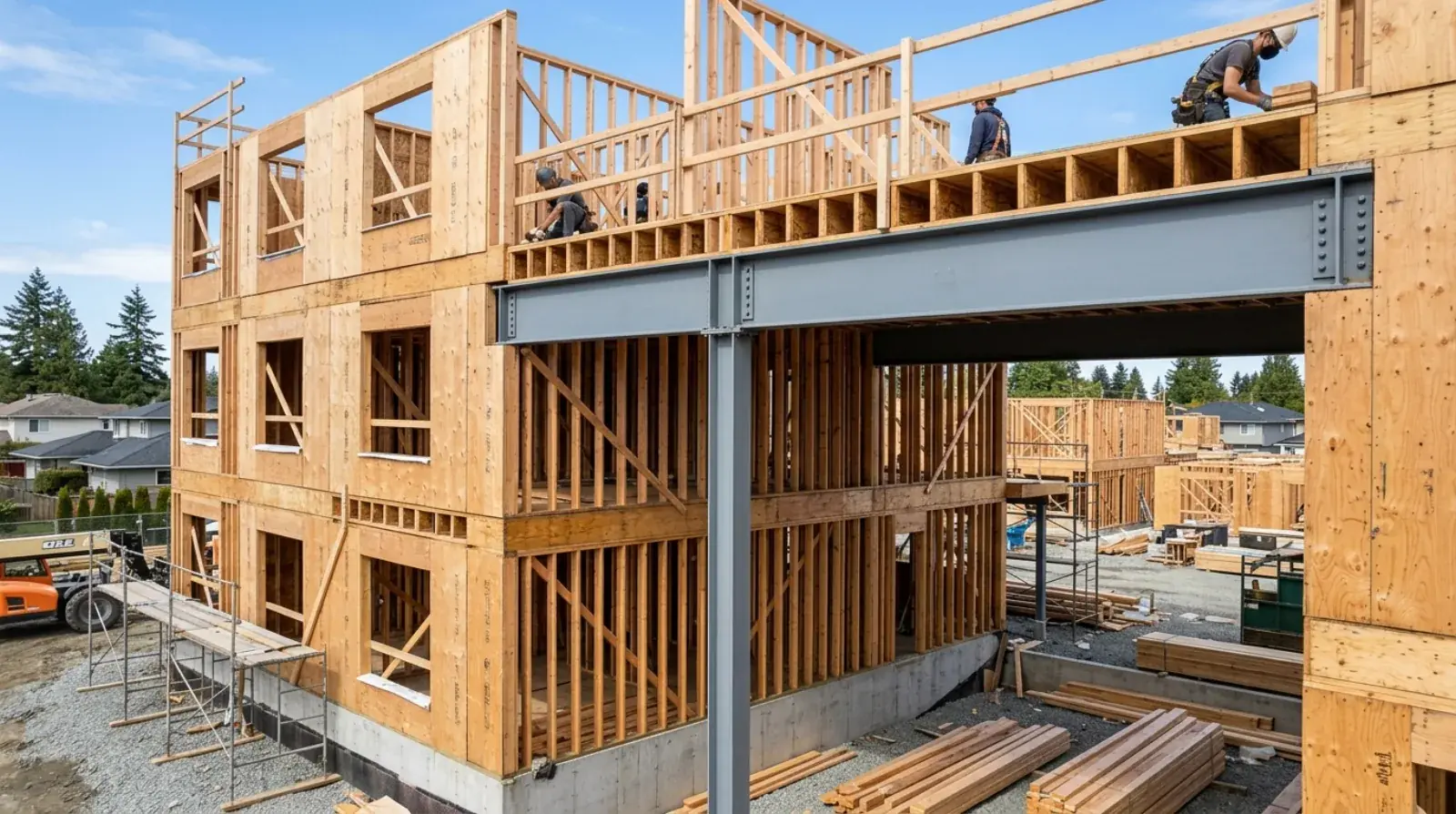
A welded railing is fabricated as one assembly. The posts, rails, and infill are joined by welds and finished together, so the railing arrives as a solid piece built to your exact measurements. On a large run we build it in shop-sized welded sections and bolt those together at planned points on site, but each section is fused steel.

A modular or kit railing is a set of standard parts. Posts, rails, and connectors come in fixed sizes, and they bolt together on the deck with mechanical brackets. You are assembling a catalogue product rather than getting one built for your space. That difference in how the two are made drives every comparison below.

We build welded custom railings, and our shop is CWB certified to CSA W47.1, the welding standard for structural steel in Canada. For a guard that has to hold a person’s weight, that welding certification is the baseline you should look for. Our full approach is laid out in our guide to custom railings in Vancouver.

Strength and the connection question

A guard railing has one critical job, to stop a person from falling. That makes the joints the most important part. In a welded railing, the joints are fused steel with no play. The post and rail become one piece, and there is nothing to work loose.

In a modular railing, the connections are mechanical. Bolts and brackets hold the parts together, and over years of use and weather, bolted joints can loosen. A loose guard is a safety problem. This is the same reason welded connections are preferred over bolted ones in many structural situations, which we cover in our post on welded vs bolted steel connections. For an exposed deck or stair in Vancouver, we build welded so the structure stays rigid for the life of the house.

Fit and finish

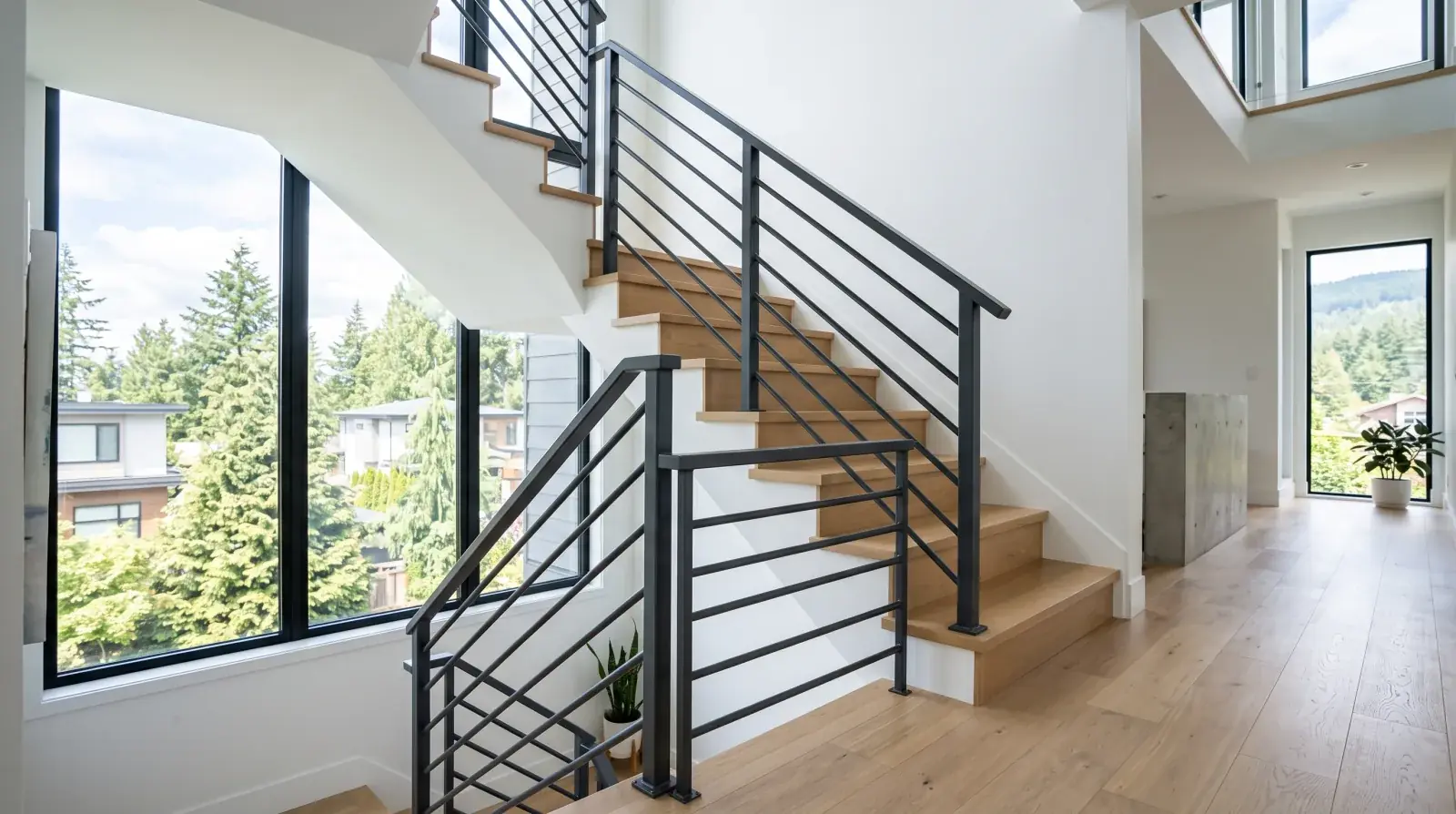
Fit is where welded railings pull ahead the most. Because we fabricate to your exact conditions, a welded railing matches the precise angle of a stair or the curve of a deck. Modular kits come in fixed pieces and standard angles, so they struggle on slopes and curves, and you often end up with a compromise fit and visible gaps.

Finish follows fit. A welded railing has clean, continuous lines with no visible brackets or bolt heads, so it reads as one solid piece. That matters when the railing is a design feature on a modern home. Kit railings show their connectors, which can look busy up close. On the varied deck and stair shapes in Vancouver and Burnaby homes, the welded look is usually what owners are after. We finish welded railings by hot-dip galvanizing for outdoor jobs, then powder coating in any colour, commonly matte black.

Code and longevity

Any railing has to meet the BC building code, which sets rules for guard height, load resistance, and opening size. A welded custom railing is designed to your exact conditions, so we build compliance in from the start. Some kits are tested and rated to meet code, but you have to confirm the specific product suits your height, load, and application. Always check the rating against your permit before you buy.

Longevity comes down to joints. A welded railing that is galvanized and powder coated has fewer joints for water to attack and no bolts to loosen, so it lasts longest in wet Vancouver and Burnaby weather. A kit railing has many mechanical connections, and each one is a spot where water can get in and corrosion can start. Over decades, fewer joints means fewer failure points.

When each choice makes sense

There is a place for both. A rated modular kit can make sense on a simple, standard-size deck where the budget is tight and the look does not matter, such as a rental back deck or a run out of sight. If the deck is straight, the heights are standard, and speed matters most, a good kit can do the job.

For almost everything else, welded is the better long-term call. Anything visible, any stair, any slope or curve, any waterfront or exposed site, and any guard where strength and clean lines matter, points to a welded custom railing. A welded railing costs more up front, and the trade is a tighter fit, a cleaner look, more strength, and a longer life.

If you are choosing a railing for a home in Vancouver or Burnaby, we can help you weigh it. See our custom railings work, then reach out for a real quote. Every railing depends on the run, the site, and the finish, so we price each one to your project rather than a catalogue number.

Explore our custom railings work, then request a quote and we will size the guard, handrail, and finish to your home across Metro Vancouver.
FAQ

Related questions

These FAQs are included only where the article topic naturally supports them.

What is the difference between a welded railing and a modular kit railing?

A welded railing is fabricated as one piece, with the posts, rails, and infill joined by welds and finished as a single assembly. A modular or kit railing comes as separate parts that bolt together on site with mechanical connectors. Welded railings are custom-built for your space, while kits are standard sizes assembled from a catalogue. We build welded custom railings for homes across Vancouver and Burnaby.

Which is stronger, a welded or a modular railing?

A fully welded railing is generally stronger because the joints are fused steel with no play. Bolted modular connections can loosen over time and rely on the brackets holding tight. For a guard that has to stop a person from falling, that solid connection matters. On exposed decks and stairs in Vancouver we build welded railings so the structure stays rigid for the life of the house.

Do modular railing kits meet the BC building code?

Some kits are tested and rated to meet code, but you have to check the specific product and confirm it suits your application, height, and load. The code sets rules for guard height, load resistance, and opening size that any railing must meet. A welded custom railing is designed to your exact conditions, so compliance is built in. Always confirm the rating against your permit in Vancouver or Burnaby.

Does a welded railing look better than a kit?

Most people think so. A welded railing has clean continuous lines with no visible brackets or bolt heads, so it reads as one solid piece. Kit railings show their mechanical connectors, which can look busy. For a modern Vancouver home where the railing is a design feature, the welded look is usually what owners want. We can also blacken or powder coat the finished welded railing in any colour.

When does a modular kit railing make sense?

A kit can make sense on a simple, standard-size deck where budget is tight and the look is not a priority, such as a rental or a back deck out of sight. If the run is straight, the heights are standard, and speed matters more than a custom fit, a rated kit can work. For anything visible, sloped, or non-standard in Vancouver or Burnaby, welded is usually the better long-term choice.

Which lasts longer outdoors in Vancouver's climate?

A welded railing that is hot-dip galvanized and powder coated lasts longest because there are fewer joints for water to attack and no bolts to loosen. Kit railings have many mechanical connections, and each one is a spot where water can get in and corrosion can start. In wet Vancouver and Burnaby, fewer joints means fewer failure points over the decades.

Can you fit a welded railing to a sloped stair or a curved deck?

Yes, and this is where welded really wins. We fabricate each railing to the exact angle of a stair or the curve of a deck, so the fit is tight and the lines are clean. Modular kits struggle with slopes and curves because they come in fixed pieces. On the varied deck and stair shapes we see in Vancouver and Burnaby homes, a welded railing solves the fit problem.

Do I need a permit to replace a railing?

A like-for-like railing replacement sometimes does not need a permit, but changes to structure, height, or a guard on a raised deck often do. For any electrical work tied to the job, such as deck lighting, Technical Safety BC handles homeowner permits at https://www.technicalsafetybc.ca/apply-for/permits/homeowner-permits. Always confirm the requirement with your city in Vancouver or Burnaby before starting.

Is a welded railing more expensive than a kit?

A welded custom railing usually costs more up front than a basic kit because it is designed and built for your space rather than pulled off a shelf. The trade is a better fit, a cleaner look, more strength, and longer life. We do not quote prices online because every railing depends on the run, the site, and the finish. Reach out and we will give you a real quote for your Vancouver or Burnaby project.

Can a welded railing be installed in sections?

Yes. We fabricate a welded railing in shop-sized sections that are welded as units, then bolt those sections together on site at planned connection points. That gives the strength and clean look of welded work while still allowing delivery and install on a real deck. On tight Vancouver lots this sectioned approach is how we get a large welded railing into place.

Related reading

More fabrication topics from Jeff and Simon

Related articles from our blog on metalwork, fabrication, and project planning.

Get in touch

Need help applying this to a real project?

Use the article as background, then send the actual fabrication scope, municipality, drawings, or dimensions so Jeff and Simon can review the next step.