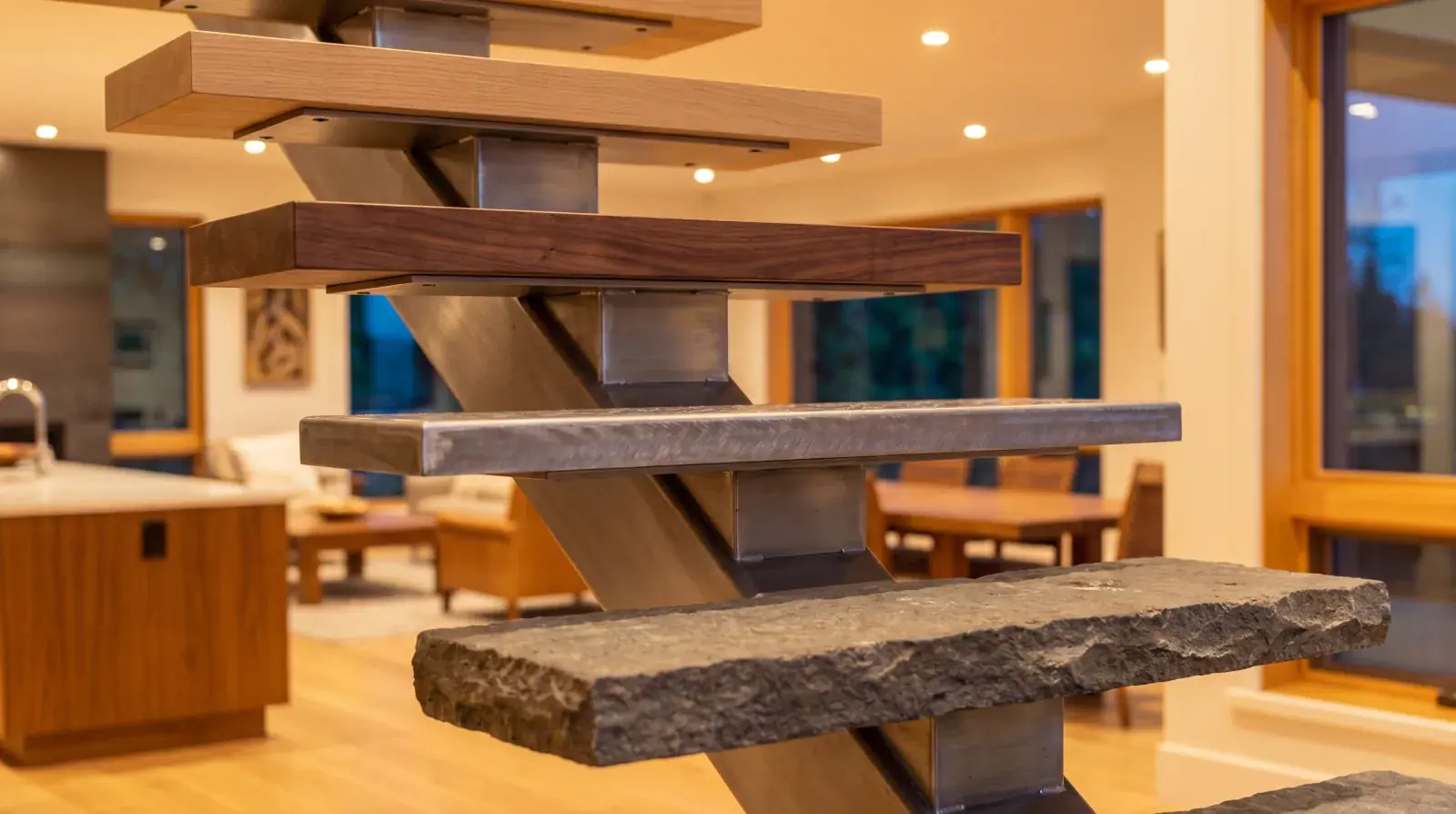
The steel part of a mono stringer staircase is the engineering story. The treads are the part everyone actually looks at, touches, walks on, and forms an opinion about. Tread choice also happens to be the single biggest cost variable after the overall stair configuration.
This is a straight fabricator’s take on the tread materials we actually use, how they behave over time, and what each one costs relative to the others.
White oak, the baseline choice
White oak (Quercus alba) is the default residential tread material across Metro Vancouver for good reasons. Janka hardness around 1360, hard enough to resist dents from shoes, chair legs, and the occasional dropped item. Grain takes stain evenly, which matters because most stair projects involve matching the treads to existing flooring. Supply is steady from local millwork shops across the Lower Mainland.
We typically spec white oak treads at 40 mm solid or 50 to 60 mm engineered-over-steel for the bigger mono stringers. Finishes are hardwax oil (Rubio Monocoat or Osmo) in a matte or low-sheen. Polyurethane is the runner-up, more durable initially but harder to spot-repair.
Stain options run from near-white “bleached” finishes through mid-tone natural to dark walnut-colour stains. We have fabricated white oak treads for custom homes in Kitsilano, Point Grey, and Burnaby where the architect wanted the tread to match wide-plank flooring. The visual continuity from floor into stair reads cleanly because the species is the same.
Tier: Baseline. This is what most mono stringer quotes are built around.
Walnut, the premium upgrade
Black walnut (Juglans nigra) is softer than oak, Janka hardness around 1010, but the colour depth is unmatched. Natural walnut is a rich chocolate brown with purple undertones and pronounced grain variation. In contemporary interiors with matte black powder-coated steel, walnut treads give a warmth that oak needs stain to achieve.
The softness is a real consideration. Walnut dents under high-heel impact more than oak does, and it shows wear faster in high-traffic entry stairs. For a family home with kids, pets, and heavy daily use, we have a direct conversation with the client about that trade-off. For a primary residence in West Vancouver or a penthouse condo where traffic is lighter and visual quality is the priority, walnut is the right call.
Tier: Mid-range step up from oak. Expect a meaningful premium on tread supply alone, plus a small labour addition because walnut fabrication demands more care.
Maple, the Scandinavian option
Hard maple (Acer saccharum) is harder than oak (Janka around 1450), lighter in colour, and more uniform in grain. It works in Scandinavian, minimalist, or coastal interiors where the design brief is low contrast and bright. We have used maple on several East Vancouver laneway projects where the ceiling height was low and the stair needed to read as light.
The challenge with maple is finish compatibility. Maple absorbs stain unevenly, the grain can look blotchy unless the installer uses a conditioner or gel stain. Most maple treads end up finished clear, which keeps the colour very pale. If a client wants a warmer tone, white oak is easier to work with.
Tier: Baseline to mid-range, similar pricing to oak with a small premium for the tighter finishing tolerance.
Engineered hardwood over steel, the thick-tread answer
For treads thicker than 60 mm, solid wood becomes a problem. Solid oak or walnut at 75 to 80 mm thickness will cup, check, or crack as it acclimates to heated interior air. Moisture moves through the board unevenly and there is nothing to restrain it.
Our solution, and the standard approach from higher-end custom builders, is to build a steel subframe and have the millwork shop laminate engineered hardwood skins over the top and edges. The subframe is usually a 10 mm plate with a perimeter frame in flat bar, welded and ground smooth. The hardwood veneer is real wood in the same species as the architect’s floor choice, applied in a matched grain pattern so the tread reads as solid.
This detail is standard on floating cantilevered stairs with 75 mm treads and works just as well on mono stringers where the visual intent is a thick, substantial step. Weight stays reasonable (steel is heavier than wood for the subframe, but the wood skin is thin), movement is eliminated, and the tread can be made to a precise geometric profile that solid wood cannot hold.
Tier: Mid-range to premium depending on species and edge detail.
Glass treads, the dramatic choice
Laminated safety glass treads turn a staircase into a sculptural object. The light that passes through a glass-tread stair changes the feel of an entire room. They are also the most expensive tread option by a meaningful margin and the most demanding to detail correctly.
Code requirements are specific. BC Building Code requires a concentrated live load of 1.5 kN on any point of a tread. BC Building Code reference - https://www2.gov.bc.ca/gov/content/industry/construction-industry/building-codes-standards/bc-codes. For a glass tread that means laminated construction, typically three layers of 12 mm tempered glass with a structural SentryGlas interlayer, sized by a glazing engineer for the span and bracket spacing.
Slip resistance is the other code requirement. A smooth glass tread fails. We specify either an acid-etched surface, a sandblasted pattern, or a ceramic frit applied to the top ply. All three maintain the transparency while providing enough grip.
Brackets matter with glass. A steel bracket with sharp edges against the glass creates stress concentrations that can lead to breakage. We detail glass-tread brackets with a compressible polymer gasket between the steel and the glass, bolted through oversized holes with shoulder bushings so the glass can move minutely with temperature changes.
Tier: Top-tier. Glass treads are a significant upgrade over hardwood and are quoted per project because fabrication and engineering vary.
Steel plate treads, the industrial move
Steel plate treads are the most cost-effective option and the most honest detail on a mono stringer. Same material as the stringer, welded directly to the tread brackets, finished in the same powder coat. The stair reads as a single assembly rather than a frame with treads applied.
We use 10 mm plate as a baseline, or 12 mm for spans greater than 900 mm. Anti-slip finish is required, either diamond plate (classic industrial look), a welded-on grating insert, or an epoxy-based anti-slip coating over smooth plate. Diamond plate is the most common because it meets slip resistance requirements without a separate coating step.
The big consideration with steel treads is noise and temperature. Footfall on uninsulated plate transmits clearly through the structure and into the floor framing below. We fix this with a neoprene gasket between the plate and the bracket, and sometimes a rubber isolation underlayment on the bracket itself. Steel treads also feel cold, a real consideration in a family home with early-morning bare feet, less of a concern in a commercial lobby or loft-style condo.
Tier: Baseline in terms of material cost, but the shop labour to grind, finish, and weld plate treads cleanly adds back some of what is saved on tread supply.
Stone, granite, quartz, limestone
Stone treads are possible on mono stringer stairs but need engineering attention. A solid 50 mm granite tread at 300 mm deep x 1100 mm wide weighs roughly 50 kg. Multiply by 14 treads and the dead load on the stringer jumps significantly. The engineer has to size the beam accordingly, and the tread brackets need a larger bearing area to distribute the load without stress concentrations.
We most often build stone tread stairs with engineered quartz, more dimensionally stable than natural granite, available in a consistent colour palette, and easier to source in the large formats that mono stringer treads require. Honed granite is the second choice for projects with a specific aesthetic brief.
Tread thickness on stone is usually 40 mm to keep weight manageable. The edge profile is where budget shows, a simple eased edge is baseline, a custom mitred edge or a bullnose profile adds meaningful fabrication time.
Stone treads work best in foyers, commercial entrances, or premium residential projects where the weight and cost are justified by the visual permanence. They are not the right choice for a secondary stair or a lightly used application.
Tier: Premium to top-tier.
Concrete, precast or cast-in-place
Concrete treads give a brutalist or industrial look that pairs well with exposed steel and board-form concrete walls. We have used precast concrete treads (supplied by a local precaster with a steel reinforcement cage) on a couple of West Coast modern projects. Cast-in-place is less common because the forming work on an installed stringer is complicated.
Weight is significant, a precast concrete tread runs 60 to 100 kg depending on size and density. Like stone, this affects stringer sizing. The tread surface can be polished, acid-etched, or left with the form face showing, and each finish has different maintenance expectations.
Concrete is cold underfoot and tends to pick up staining. It is a committed aesthetic choice rather than a neutral one.
Tier: Premium.
How to actually decide
Start with the architecture. If the floor the stair lands on is wide-plank white oak, the baseline answer is white oak treads in the same species. If the floor is polished concrete or large-format tile, steel plate, stone, or engineered hardwood over steel all become more interesting. If the stair is in a heritage character home renovation, the species and finish should nod to the era without pretending to be original.
Budget shapes the second decision. Oak and steel plate are the most cost-effective. Walnut, engineered hardwood over steel, and maple sit at the mid-range. Glass, stone, and concrete are premium choices.
Code and structure shape the third decision. Heavier treads push the stringer heavier and the engineering more involved. Glass and stone both need glazing-engineer or stone-engineer sign-off in addition to the structural engineer’s stamp. See the mono stringer engineering guide for how load assumptions propagate through the design.
Lifestyle shapes the fourth. Walnut dents. Glass shows every speck of dust. Stone is unforgiving when a dropped glass hits it. Steel plate rings underfoot. Oak absorbs almost anything you throw at it and still looks good a decade later.
If you want a candid recommendation for your specific project, request a quote with the floor plan and a photo of the adjacent flooring. We will tell you what actually works, and what we would build in our own homes.