A commercial security fence has a job that a backyard fence never faces. It has to slow down a person who arrived with tools and a plan. That changes everything about how it is built. The steel is heavier, the design removes footholds, the openings are protected, and the whole line is finished to survive years of Metro Vancouver rain. We fabricate and install steel security fencing from our Burnaby shop for commercial and industrial sites across Vancouver, Burnaby, and Surrey, and the first conversation is always about the real threat, not the look.
A perimeter has to resist three different attacks: climbing over, cutting through, and ramming with a vehicle. No single fence detail answers all three, so the design starts by deciding which one is the biggest risk on your site. This post walks through the main steel fence types, how anti-climb and cut resistance actually work, why the gate and the bollards matter as much as the fence, and how galvanizing keeps the whole thing standing in our climate.
Palisade and welded mesh: the two workhorses
Two steel fence types cover most commercial jobs, and they solve the problem differently.
Palisade fencing uses vertical steel pales fixed to horizontal rails behind them. The pales are hard to climb because there is little to grip, and they are hard to cut quickly because each one is a solid section. The tops are usually pointed or splayed so getting over the top is difficult and unpleasant. Palisade blocks the view more than mesh, which suits a site that wants to look closed off and keep what is inside out of sight.
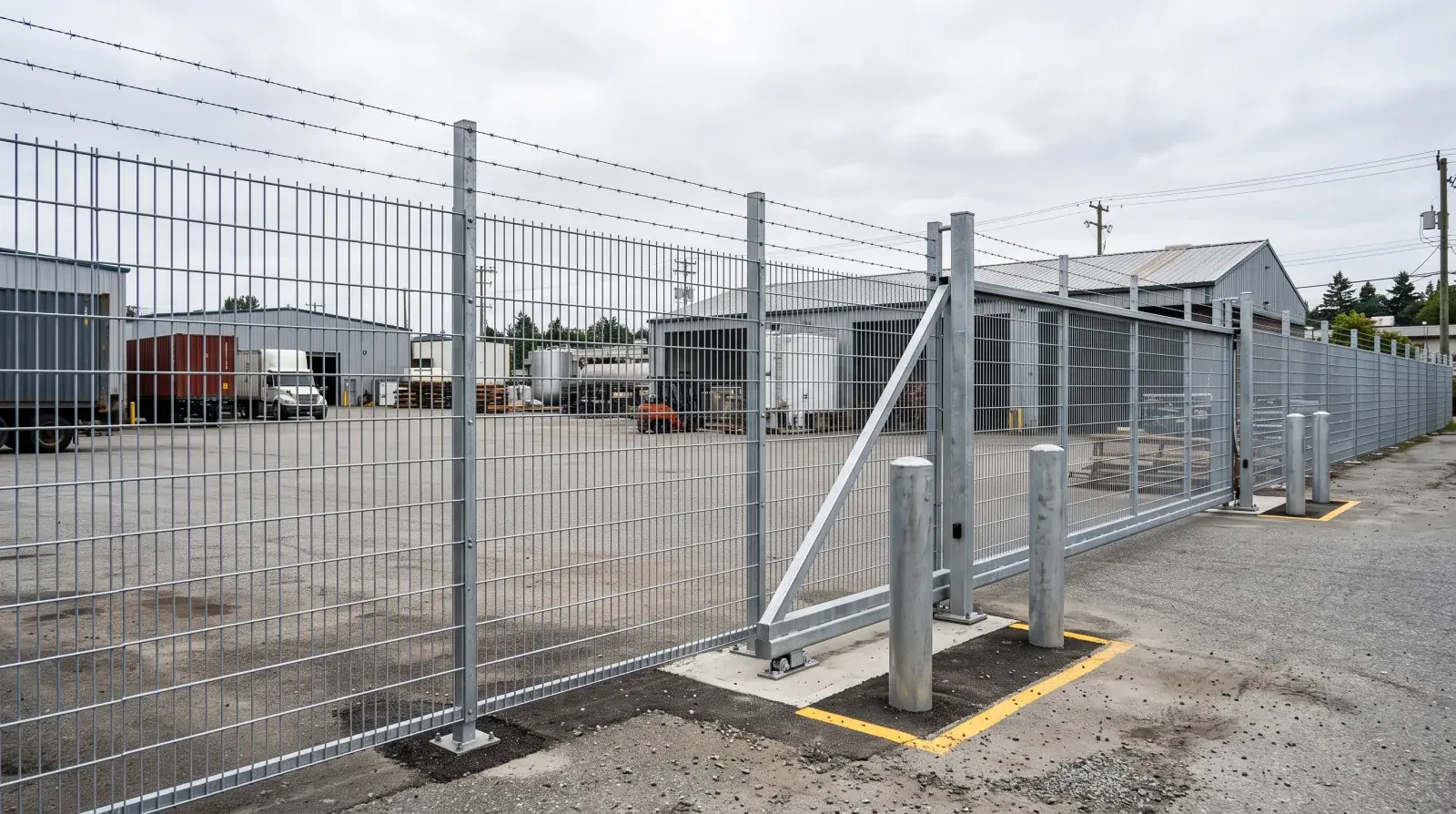
Welded mesh fencing uses steel wires welded into a tight grid, then framed into panels. The strength comes from the aperture, the size of each opening in the mesh. A tight aperture means fingers and toes cannot get a grip to climb, and bolt cutters cannot easily fit around a wire to cut it. Welded mesh also gives clear visibility straight through the grid, which helps security cameras and guards watch the perimeter. For a Surrey distribution yard that wanted its cameras to see the whole fence line, welded mesh was the right call. For a site that wanted a more solid, closed look, palisade made more sense.
Chain-link still exists on plenty of commercial sites, and it has its place for basic boundary marking. But it is easy to cut and easy to peel back, so it is not a security fence in the real sense. When theft or intrusion is the concern, palisade or heavy welded mesh is where we start.
How anti-climb and cut resistance actually work
Anti-climb is not one feature. It is a set of design choices that together leave nothing to grab and nothing to stand on. Tall panels raise the top out of easy reach. A tight mesh aperture removes the toe and finger holds that a person needs to climb. Keeping the horizontal rails on the secure side, or removing them from the climbable face entirely, takes away the ladder rungs that an ordinary fence accidentally provides. A raised, pointed, or rolled top makes going over the top slow and awkward.
On a Burnaby industrial site we combined a tight welded mesh with a raised anti-climb top detail so there was genuinely nothing to grip and nothing to step on. The point is that a determined climber is looking for exactly those footholds, so a good design removes them on purpose.
Cut resistance comes from the steel section and the aperture. Thicker wires and pales take longer to cut, and a tight mesh leaves no room to fit a cutting tool around a member. The longer an intruder has to stand at the fence working on it, the more likely they are to be seen or to give up. That is the whole logic of a security perimeter. It does not have to be impossible to breach. It has to be slow and obvious enough that the attempt fails.
The gate and the bollards: the points that get attacked
Here is the mistake that undoes a strong fence. A fence is only as secure as its weakest opening, and the gate is almost always the weakest point. A heavy mesh line with a flimsy gate is a heavy mesh line with a door in it. We build the gate frame from the same steel as the fence panels, so the gate is not a soft spot. Sliding gates suit wide vehicle entrances where there is room to one side for the gate to travel, and swing gates suit narrower openings. Either way we can prepare the gate for automation and access control so entry is managed, not left open.
The other exposed point is anywhere a vehicle could ram through, especially the entrance and any street frontage. A fence panel does not stop a truck. Steel bollards do. We set bollards in concrete at the gate opening and along vulnerable frontage so the perimeter has hard protection at the points most likely to be attacked. Our guide to commercial bollards covers how bollards and fencing work together as one system rather than two separate jobs. Getting the fence, the gate, and the bollards designed together is what turns a barrier into a real perimeter.
Galvanizing: surviving the Vancouver climate
A security fence is a long-term investment, and in our wet climate rust is the slow attack that never stops. This is why hot-dip galvanizing is the standard for every commercial steel fence we build. The steel panels, posts, and gate frames are dipped in molten zinc, which coats the metal inside and out and protects it from rust for decades in Metro Vancouver’s weather. A painted fence chips and rusts at the scratches. A galvanized fence resists corrosion across its whole surface.
Many sites want a colour rather than the raw silver-grey of fresh galvanizing, usually black or dark grey for a clean industrial look. We handle that with a two-step finish. Hot-dip galvanize first for the corrosion protection, then apply a powder-coat colour on top for the appearance. The galvanizing does the durability work underneath and the powder coat gives the site the look it wants. This combination holds up well through the rainy Vancouver and Burnaby winters.
Getting the height and the permit right
Height matters because a taller fence is harder to climb, but you cannot simply build as tall as you like. Municipalities set maximum fence heights, setbacks from the property line, and sometimes limits on the fence type, and the rules differ between Vancouver, Burnaby, and Surrey. A design that ignores the local bylaw is a design that gets stopped. We confirm the height limit and the requirements for your specific address before finalizing the fence so it is both effective and permitted. The permit process is separate from the fabrication, and we can advise on what your municipality needs.
Steel security fencing is part of our commercial and industrial metalwork service. We assess the site, recommend the fence type based on the real threat, build the matching gate, integrate bollards at the openings, and galvanize everything for our climate. If you have a yard, a lot, or a facility to protect anywhere across Vancouver, Burnaby, or Surrey, request a quote and we will scope the perimeter with you.
See our commercial and industrial metalwork, then request a quote and we will scope the fabrication and install for your Metro Vancouver project.