Steel bollards are one of the unsexy parts of commercial property metalwork. Easy to get wrong, easy to overlook in design, and easy to specify based on what they look like rather than what they have to do. The conversation gets more focused after the first vehicle incursion at a storefront or after an insurer asks for documented impact protection on a renewal.
For Vancouver commercial properties, retail, hospitality, multifamily, parkade entries, gas stations, daycares, the right bollard for a given location is a specific answer to a specific protective requirement. Generic bollards from a catalogue don’t usually map to the actual risk.
Decorative versus security: the foundational distinction
The bollards that look identical on the street are often completely different products structurally. A decorative bollard defines or marks an area but isn’t engineered to resist meaningful vehicle impact. A security bollard is engineered to stop a vehicle at a specified speed and is rated to a recognized standard.
The visible steel post is a small part of what makes a security bollard work. The structural design of the bollard itself, heavier wall thickness, internal reinforcement, sometimes filled with concrete, and the foundation underneath do the actual work. A security bollard is largely below grade.
A decorative bollard set in a decorative-grade foundation will not stop a vehicle. If the protective intent is real, the bollard has to be engineered for it, and the foundation has to match. There’s no middle ground that looks the same but costs less.
Crash ratings: when they matter
Security bollard performance is documented by impact ratings, typically referenced to standards like ASTM F2656 (US), IWA 14 (international), or PAS 68 (UK). The ratings describe what vehicle weight at what speed the bollard line will stop, and how far behind the bollard the vehicle will travel after impact.
For most Vancouver commercial applications, the relevant question isn’t a specific test number but whether the bollard line is designed to stop a vehicle at all. A property doing rigorous risk assessment, a government building, a critical infrastructure site, a major retail flagship, may specify a particular rating. A typical commercial property doing general perimeter protection wants engineered security bollards without needing to specify a particular rating number.
The risk assessment for the property, what’s behind the bollards, what consequence an incursion would cause, what street the property faces, determines whether real security is needed. A storefront on a busy arterial with vehicle traffic running past has different risk than a quiet side-street boutique. The bollard specification should reflect the actual exposure.
Fixed, removable, retractable: matching to access needs
Fixed bollards are permanently installed. They never move. Use these where vehicle access through the bollard line is never needed.
Removable bollards can be lifted out by an authorized person, usually with a key, for occasional access. They sit in a sleeve set in the concrete foundation and are stored when not in place. Use these where occasional service access is needed but daily traffic is not.
Retractable bollards lower into the ground mechanically. The mechanism can be:
- Manual, a person pumps a hydraulic mechanism to lower the bollard
- Semi-automatic, manually unlocked but spring-assisted to operate
- Automatic hydraulic, fully powered, often controlled by access cards or remote
- Pneumatic, similar to hydraulic but air-powered
Retractable bollards are the most expensive of the three categories because of the mechanism and the more substantial below-grade infrastructure. They’re worth the cost when controlled vehicle access through the line is a regular daily requirement, secure deliveries, emergency vehicle access, valet operations.
We’ve installed all three on Vancouver commercial properties. The right choice depends entirely on how often the bollard line needs to open and to whom.
Foundation: the part nobody wants to talk about
For any structural bollard installation, the foundation is doing the work. A typical security bollard foundation is substantial, depth and reinforcement designed by the structural engineer to resist the impact load and transfer it into the surrounding ground.
The foundation is also the part that’s hardest to do later. Excavating, pouring, and reinforcing happens before any visible bollard work. If the bollard installation is being retrofit into an existing property, the foundation work, including potential interference with existing utilities, paving, or other below-grade infrastructure, is the unknown that drives schedule and cost.
Decorative bollards have smaller foundations because the structural demand is lower. A decorative bollard pulled out by a small vehicle impact doesn’t fail in any meaningful sense, it’s not supposed to resist real load.
Finish: durability in our climate
For outdoor commercial bollards in Metro Vancouver, two finish paths work for long service:
Hot-dip galvanized steel with a powder coat is durable and finish-flexible. The galvanizing protects the steel for decades, the powder coat carries the colour, and the system holds up through Vancouver’s wet weather. Matte black is the most common architectural choice, but any RAL colour is available.
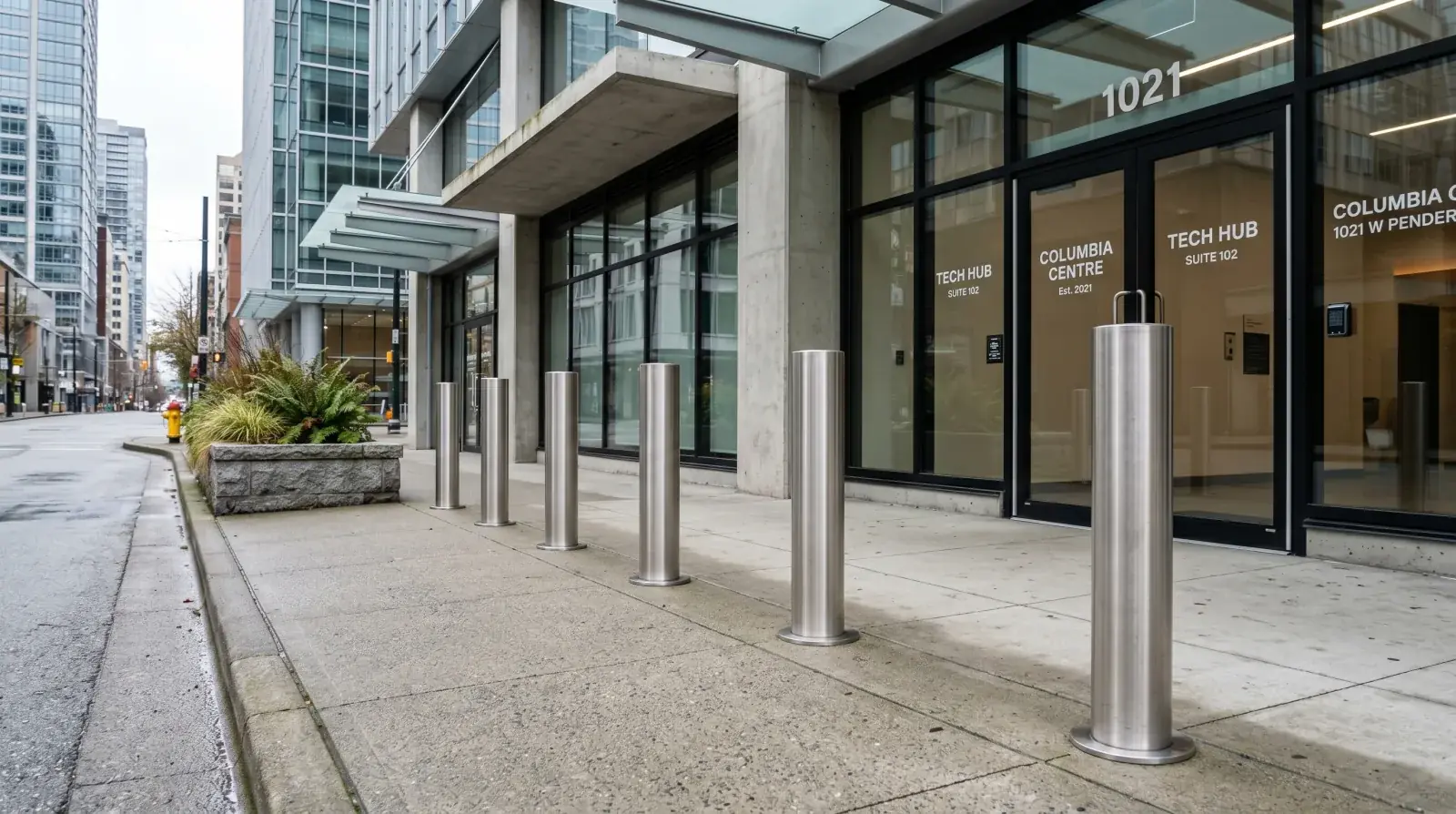
Stainless steel, typically 316 for coastal applications, is more expensive but truly maintenance-free in the long term. The bollard never needs repainting. Stainless reads architecturally crisp and works well for high-end installations.
Bare painted steel without galvanizing underneath is the least durable option for outdoor use in our climate. The paint chips with even minor impact, water gets behind, and the bollard rusts visibly within a few years. Maintenance and repainting become a recurring scope.
Bollards as architecture
A bollard installation doesn’t have to look like a row of generic posts. Custom shapes, integrated lighting, custom caps, and coordinated colour can make a bollard line read as a deliberate architectural element rather than an obvious add-on.
For high-end Vancouver commercial properties, hotels, hospitality, flagship retail, we’ve fabricated custom bollard designs that integrate with the building’s architecture: matched stainless to other building hardware, custom-fabricated caps with integrated downlighting, sculptural geometries that read as designed objects. The protective function is still there; the bollards just don’t look like protective infrastructure.
This is the same conversation as custom commercial railings and other commercial architectural metalwork, the protective and the architectural can coexist when the design intent is clear from the start.
Coordination with the rest of the property
Bollards are usually one element in a larger property protection or perimeter design. Coordinating with:
- Landscaping and planters, bollards can integrate with planter walls
- Lighting, integrated downlights or accent lighting on the bollards themselves
- Signage and wayfinding, bollard placement affects pedestrian flow
- Other steel work on the property, fencing, gates, rooftop railings, structural canopies
A property design that addresses bollards as one element in the broader perimeter and entrance composition reads more deliberate than a property that adds bollards later as an afterthought.
When to engage engineering
Real security bollards always need structural engineering. The bollard itself, the foundation, and the connection between them are designed by the structural engineer for the impact load. We fabricate and install to the engineer’s design.
Decorative bollards often don’t need separate engineering, the load case is minimal, and standard fabrication practice covers the installation. But anything claiming to provide vehicle impact protection should be engineered.
If you’re scoping bollards on a Vancouver commercial property, new construction or retrofit, tell us what you’re protecting and from what, and we’ll detail the right solution. The right bollard for a quiet plaza is different from the right bollard for a high-traffic storefront, and the spec should reflect the actual risk.