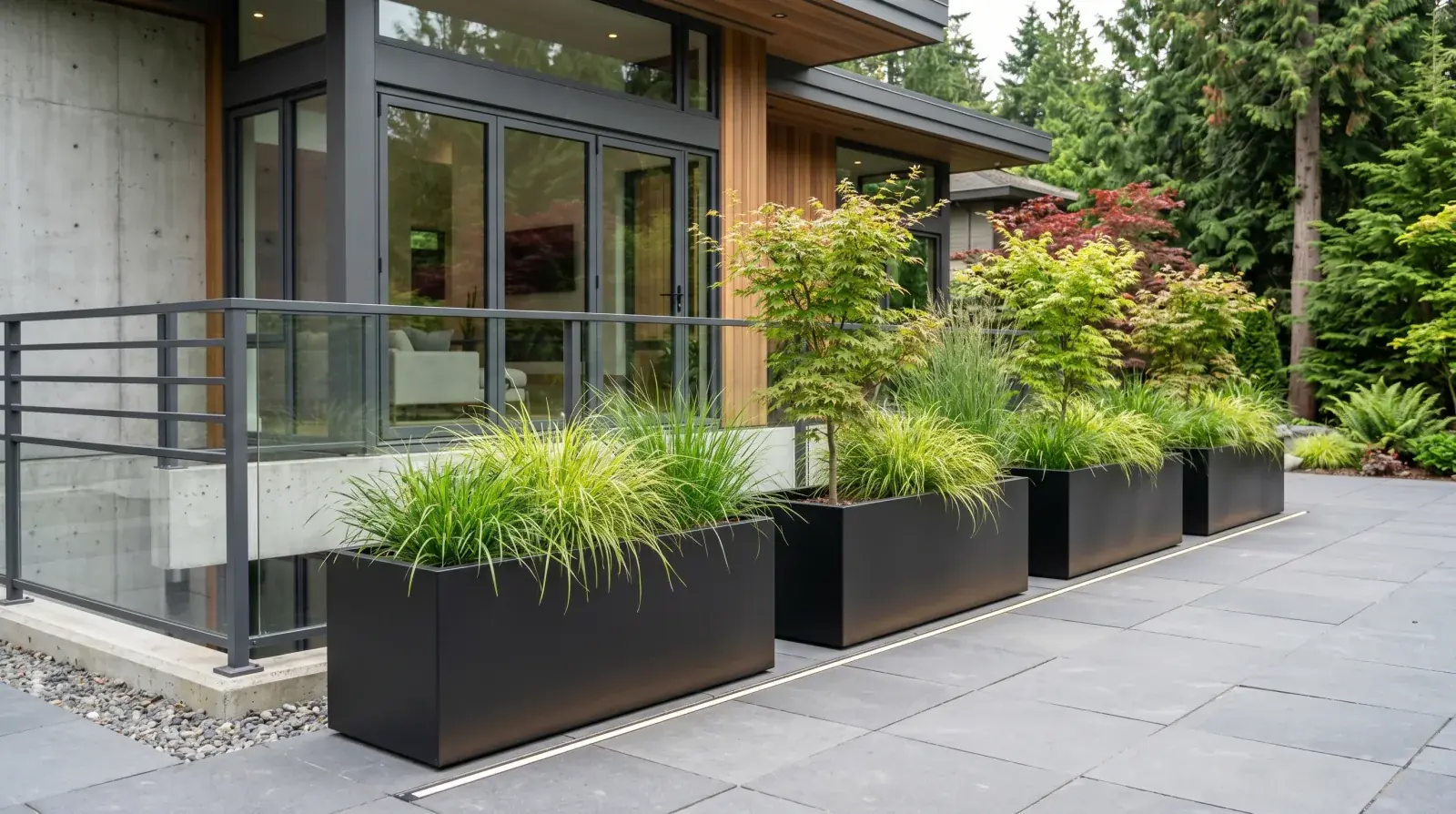
A custom steel planter looks like a simple object on the drawing. Four sides, a bottom, some drainage. The reason custom planters from a real shop cost what they do isn’t the visible part, it’s the part nobody sees once the soil goes in.
Done well, a steel planter lasts decades in a Vancouver landscape and ages into the design. Done poorly, it rusts from the inside out, drains badly, and gets replaced in five years. The difference is in detailing the soil side, the drainage, and the corrosion path, all of which happen at the shop, not on site.
Material choice up front
Three main material paths for an outdoor planter in Metro Vancouver:
Hot-dip galvanized steel is the workhorse. The galvanizing protects the steel for decades, and the planter can be powder-coated to any colour for finish flexibility. The galvanizing happens after fabrication, the whole planter is dipped in molten zinc, so coverage reaches every welded edge and corner. This is our default for most custom planters because it’s durable, finish-flexible, and proven in our climate.
Weathering steel (Corten) delivers the warm rust patina that’s everywhere in West Coast modern landscapes right now. The aesthetic is real and the maintenance is genuinely low. The catch is that Corten has real coastal limits, the patina doesn’t stabilize in constantly wet conditions, and the rust runoff stains surfaces below. For a sheltered, well-drained planter that gets sun and air, Corten works. For an exposed coastal site or directly over light-coloured paving, it’s the wrong material.
Stainless steel is the most durable and the most expensive. For a high-end installation, particularly indoor or covered settings, stainless reads cleanly and never patinas. We use 316 for any outdoor application to handle Metro Vancouver’s coastal chloride exposure.
The choice depends on the look, the exposure, and the budget, and there’s no single right answer.
The soil side is where planters actually fail
The detail nobody talks about and that determines lifespan: what’s on the soil contact face of the steel.
Bare structural steel in constant contact with wet soil corrodes continuously. The exterior of the planter can be perfectly galvanized and powder-coated, the visible finish can stay beautiful for years, and meanwhile the soil-side wall is dissolving. The first warning is often a rust streak appearing through the powder coat from inside. By that point the structural wall is already compromised.
The fix is to isolate the soil from the steel. We line the soil contact face on every custom planter, typically with a heavy-duty pond liner or a coated interior, depending on the planter size and intended use. The liner extends up the walls past the soil line and laps over the top edge so soil and water can’t track behind it. The drainage holes are detailed so water exits through the liner and doesn’t pool against the steel.
This adds modest cost to the fabrication and is invisible in the finished product. It’s also the single biggest factor in whether the planter lasts 30 years or 5.
Drainage: non-negotiable
A planter without drainage in Vancouver’s climate fills with water during the rainy season, drowns the plant, and traps moisture against every surface inside the planter. The drainage detail is one of the first things we design on a custom planter.
The options:
- Bottom drainage: holes through the base of the planter, sized to drain freely, set above a layer of gravel to prevent soil migration into the holes.
- Side drainage: holes at the bottom of the side walls, typically at the back of a planter that sits against a wall, draining away from the visible face.
- Sub-drain integration: on rooftop or hardscape installations, the planter drainage ties into the deck or patio drainage system so the water has somewhere to go.
The size and spacing of the drainage holes depends on the planter footprint. We undersize the holes only if there’s a specific reason, and we never skip them. A planter without drainage is a planter on a timer.
Corner detailing separates custom from kit
A kit steel planter has visible bolted or mechanical corner connections. A custom shop planter has welded corners that are ground and finished so the planter reads as a single folded form. On a long planter run, this difference is the single most visible mark of custom fabrication.
The welding has to be clean, typically TIG on smaller architectural pieces, MIG on larger structural planters with the welds ground flush, and the corners have to be square and consistent. On a modern installation where the planter is part of the architectural language, this finish quality matters as much as on a stair or rail.
For planters in any finish, galvanized, painted, or stainless, the welds get prepped so they disappear in the final finish. A weld bead showing through the powder coat is the giveaway that the shop wasn’t doing architectural-grade work.
Sizing, weight, and structural support
Steel planters scale up to whatever the installation can support. The structural design has to account for the soil weight, wet soil runs roughly 1,500 to 1,800 kg per cubic metre, which adds up fast on a larger planter.
A planter 2 metres long, 0.5 metre wide, and 0.5 metre deep, moderate size for a residential installation, holds half a cubic metre of soil and runs around 900 kg of soil weight alone, plus the steel weight, plus any retained water during heavy rain. That’s a meaningful load on a deck or balcony.
For ground installations, a properly compacted gravel base usually handles the load with no engineering required. For rooftop or balcony installations, the point load has to be checked against the building’s structural drawings. We coordinate with the project engineer on any rooftop or strata installation to confirm the load is acceptable.
Strata and multifamily applications
Steel planters on strata patios, rooftops, and common areas have to clear the strata council and respect the building’s structural and envelope conditions. We’ve fabricated planter sets for strata buildings across Metro Vancouver and worked with property managers and councils to satisfy the documentation requirements.
The conversations usually centre on:
- Structural load and point load distribution
- Drainage and where the water goes (especially on roofs and decks)
- Visual coordination with the building’s existing aesthetic
- Long-term maintenance responsibility
A planter installation that addresses these up front clears strata approval faster than one that presents the planters as a fait accompli.
Coordinating with the landscape design
The planter itself is one element in a larger landscape composition. For most custom installations we work with the project’s landscape architect or designer, who establishes the planter dimensions, locations, and material expectations as part of the broader plan. Our role is fabrication: turning the landscape architect’s intent into a planter that survives the climate and reads as the designer drew it.
For homeowners working without a designer, we can detail and fabricate from a brief, dimensions, location, finish preference, plant list, but we’re a fabrication shop, not a landscape design firm. We’ll handle the metalwork; the planting and irrigation are someone else’s scope.
If you’re scoping a Vancouver landscape installation that involves custom steel planters, send us the design intent and we’ll quote on the actual sizes and finish. The visible parts of the planter are what you see in the catalogue. The hidden parts, the liner, the drainage, the corner welds, are what you’re really paying for.