A steel stair stringer rarely fails where you’d expect to look. The treads can be solid, the handrail tight, the paint mostly intact up top, and the stringer can still be on its way out. Where it goes is the base, down at the concrete or the landing, where rain has been pooling against the steel for years. That’s the first thing I check on any exterior stair assessment in Vancouver, and it’s the spot most owners never see until something moves.
Exterior steel stairs take a beating here. Apartment common stairs, fire-escape stairs, deck stairs on a North Shore custom build, all of them sit out in the rain ten months a year, and a lot of them were coated once, decades ago, and never touched since. The question I get asked most is whether a stair can be repaired or has to be replaced. The honest answer is that it depends entirely on how much sound steel is left, and you can’t tell that from the surface.
How steel stringers actually fail
Three things kill exterior stringers, and corrosion at the base is by far the most common.
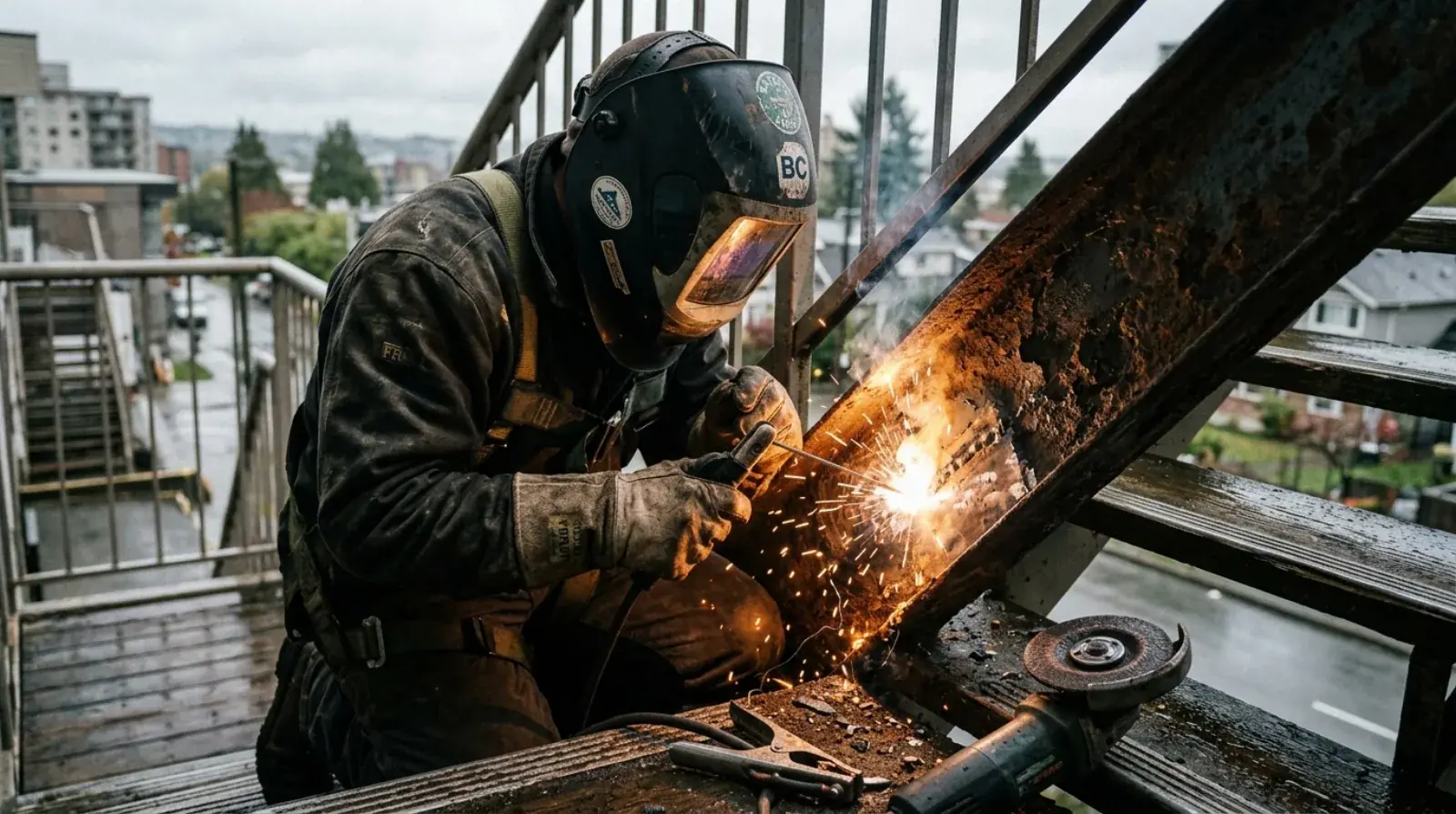
A stringer is usually a steel channel, an HSS section, or a plate beam, anchored at the bottom to concrete or a steel landing. Water runs down the stair, collects at that connection, and sits there. If the coating has failed anywhere in that zone, and after fifteen or twenty years it usually has, the bare steel starts to rust. Rust expands, lifts the surrounding coating, and lets in more water. The section loses wall thickness from the most heavily loaded part of the beam first. By the time you see flaking and scale, the steel underneath may have lost a real fraction of its thickness.
The second failure is weld cracking. Tread brackets, landing connections, and splice welds carry cyclic load every time someone walks the stair. A weld that wasn’t sound to begin with, or one that’s been corroding at its edges, can crack. A single hairline crack at one bracket isn’t a collapse, but it’s a warning that the connection is working loose.
The third is deflection from overload or fatigue. A stair built light, or one that’s been carrying more than it was designed for, starts to sag. You feel it as bounce underfoot. Once a steel beam has yielded and taken a permanent set, it doesn’t spring back, and that’s a structural problem, not a cosmetic one.
Why the coast makes it worse
None of this is unique to Vancouver, but our conditions speed it up. The wet coastal climate keeps exterior steel damp for most of the year, so there’s always moisture available to drive corrosion. Environment and Climate Change Canada records show Vancouver gets well over 1,400 mm of rain a year on average, and that water finds every flat surface and unsealed pocket on a stair.
Near the water it’s worse again. Properties in West Vancouver, along Ambleside, out in Deep Cove, they get chloride in the air off the ocean, and salt accelerates rust on steel. A coating system that would last on an inland stair in Coquitlam can give out years sooner on a waterfront stair. And in a cold snap, freeze-thaw cycling pries at any coating that’s already cracked and opens a path for more water. I covered the corrosion-protection side of this in detail in galvanizing versus powder coating for coastal Vancouver, and the same logic that protects new steel is what fails on neglected old steel.
Repair or replace: how I decide
This is the call everyone wants made, and it comes down to one question: how much sound, full-thickness steel is left in the load-carrying parts of the stringer?
Repair is the right answer when the damage is localized. A cracked weld at a single tread bracket, surface rust that hasn’t eaten into the section, one corroded connection on an otherwise solid beam, those get cut out, re-welded, and re-coated. The main beam still has its strength; you’re fixing a detail.
Replacement is the right answer when the load path itself is compromised. If the base of the stringer has thinned along its length, if the load-bearing flange has measurable section loss, if the beam has visibly deflected, patching won’t restore it. Welding a plate over rusted-through steel doesn’t give you back a sound member, it hides the problem and traps moisture behind the patch. I’d rather replace a stringer than send someone out on one I don’t trust. The cost of a repair versus a replacement is driven by how much steel has to come out, the access to the stair, the finish system, and how much engineering review the scope needs, which is the same set of variables that drives any exterior steel job.
When you need an engineer
For a single cracked weld on a private deck stair, a qualified fabricator’s inspection is usually enough to scope the fix. But the moment the stair’s structural capacity is genuinely in question, you need a structural engineer.
That means visible deflection, section loss in the main beam, a stair on a building over 40 years old, or any common stair serving an apartment or commercial property where the public uses it. A registered professional engineer (P.Eng. under Engineers and Geoscientists BC) assesses the remaining capacity and issues a sealed report. That sealed assessment is what the property owner, the strata council, and the fabricator all rely on, and it’s what an insurer will want to see if anything ever goes wrong. We work with structural engineers on exactly this kind of assessment, and we’d rather involve one early than guess at a load path.
Surface prep and re-coating, where repairs go wrong
A weld repair is only as durable as the coating that goes over it, and this is where a lot of well-intentioned repairs fail within a couple of years.
After the welding is done, the repaired area has to come back to bare, sound steel. That means grinding or abrasive blasting away every bit of rust scale, old paint, and weld slag in the repair zone, not just wire-brushing the loose stuff and painting over it. Welds get dressed smooth so a coating can sit on them evenly instead of bridging over a rough bead and leaving a void. Then the steel gets primed and topcoated before flash rust forms, which in our humidity can start within hours of blasting.
For exterior stairs, the durable finish is hot-dip galvanizing where the repaired piece can be removed and sent to the galvanizer, per the zinc-coating standard CSA G164. Where the part has to be coated in place, the best you can do is a high-zinc cold-galvanizing compound followed by a quality topcoat. Plain paint over a field weld is the least durable option, and it almost always fails first right at the repair. If you’ve ever seen a repainted stair rusting through again two years later, poor prep and a paint-only finish are usually why.
The strata and landlord angle
If you manage a strata or own a rental, the stairs are your responsibility, and a deteriorating exterior stair is a liability you can measure.
A strata corporation has to maintain common-property stairs, and a landlord has to keep the stairs serving a rental safe. Both are required to keep a means of egress operable. The exposure isn’t just the repair bill, it’s what happens if someone is hurt on a stair that was visibly failing and never assessed. Documented neglect can affect an insurance claim, and “we didn’t know” is a hard position to defend when the rust was there to see. This is the same maintenance duty that applies to exterior steel balconies on strata buildings, and the fix is the same: get the steel looked at on a schedule, keep dated records, and act on what the inspection finds.
The practical move is an annual look at the base of every exterior stair, because that’s where the failure starts and that’s where it’s cheapest to catch. A small repair caught early beats a full replacement and an incident report.
If you’ve got an exterior steel stair that’s showing rust at the base, a handrail that’s started to move, or any flex underfoot, get it assessed before the season turns wet again. Our Burnaby shop handles assessment, repair, and replacement across Metro Vancouver, and we build new exterior stairs the right way when replacement is the answer, see our work on custom steel stairs for Metro Vancouver. When you’re ready, request a quote and we’ll come look at the steel.