Most people hiring a custom metal fabricator in Metro Vancouver have never done it before. They have a staircase to replace, a railing system to design, a gate to fabricate, or structural steel that needs to be built and installed. They get a few quotes, pick the one that looks reasonable, and hope for the best.
This guide is for doing it more deliberately. Here is what actually matters when evaluating a custom fabrication shop in this region, what to look at, what to ask, and what to walk away from.
Start with the work, not the price
Before you talk to a single fabricator, get clear on your scope. At minimum you need:
- What you want fabricated, staircase, railing, gate, structural steel, something else
- The material, steel, aluminum, stainless, a combination
- The finish, powder coat colour, galvanized, raw/oiled, stainless brushed
- The location, indoors, outdoors, coastal exposure
- Whether you need engineering, any structural element (stair stringer, structural beam, commercial guardrail) needs engineer-sealed drawings in BC
- Rough dimensions, even approximate measurements help a fabricator give a meaningful first estimate
The more specific you are, the more comparable the quotes you get back will be. Vague scopes produce vague quotes that don’t compare well.
The one certification that actually matters
For any steel fabrication work in BC that carries structural load, staircases, structural steel, commercial guardrails, canopies, the shop must hold C.W.B. (Canadian Welding Bureau) certification to CSA W47.1. This is the standard referenced by the National Building Code and the BC Building Code for structural welding.
What CWB certification actually means:
- Every welder in the shop has passed qualification tests for the specific processes and joint types they work on
- Written welding procedure specifications (WPS) are documented and approved for each process the shop uses
- A qualified welding supervisor is responsible for ensuring procedures are followed
- Steel and filler metals are traceable to mill certifications
- The shop is audited annually by the CWB
When a structural engineer seals drawings for your project, they are relying on the assumption that the welds will be made by a qualified welder using a qualified procedure. CWB certification is the proof.
How to verify: Ask for the shop’s CWB certificate number and check it yourself at cwbgroup.org. The directory shows current certification status, scope, and standards covered. A legitimate shop will hand over the certificate number without hesitation. If they are slow about it or redirect the question, walk away.
For decorative or non-structural work, ornamental gates, furniture, artwork, CWB certification is not legally required. But a shop that runs certified structural welding tends to bring the same discipline to everything they fabricate.
Visit the shop before you sign anything
A 30-minute shop visit tells you more than any quote document. What you are looking for:
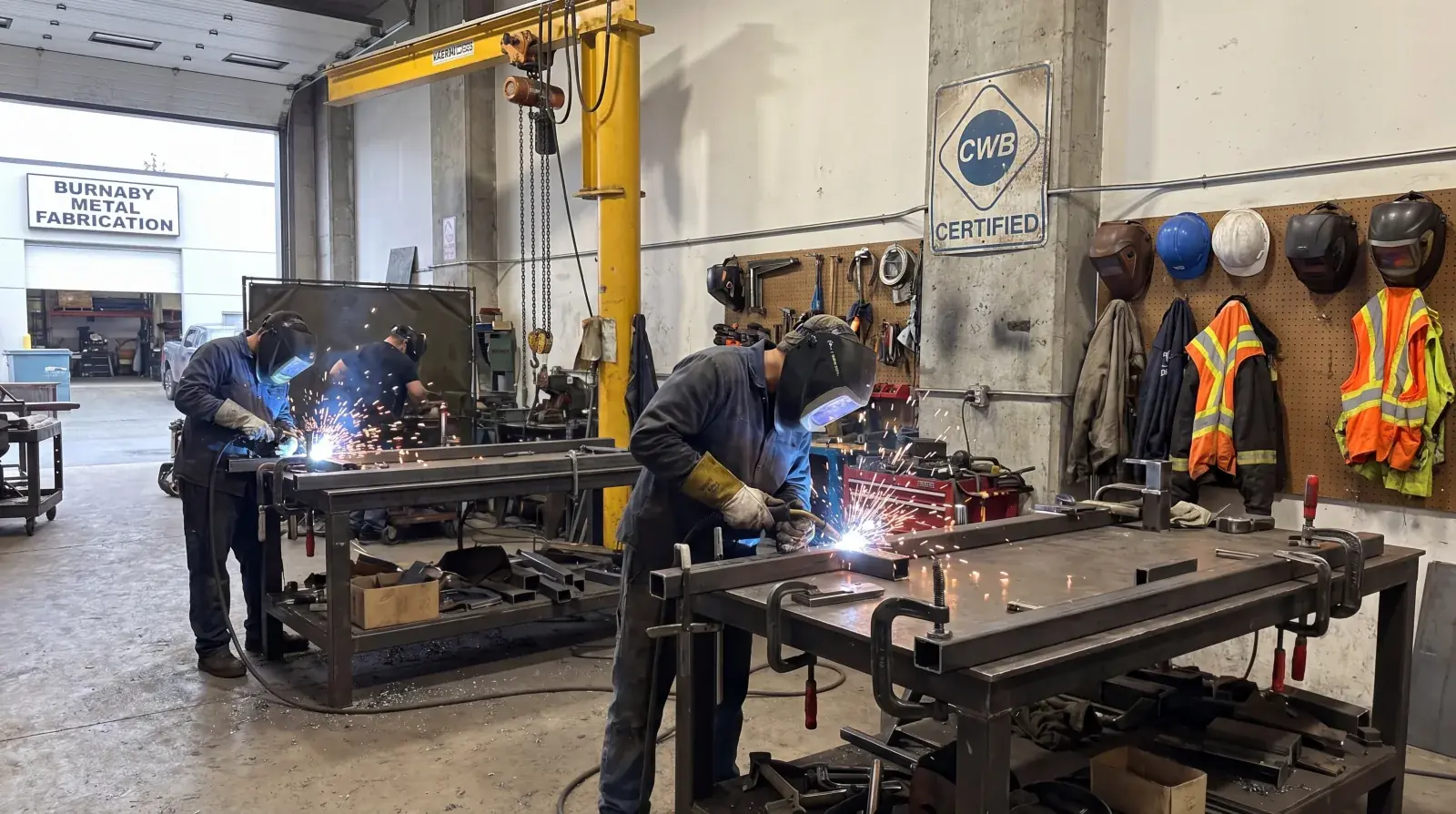
Signs of a real, working shop:
- Active welding work in progress
- Racks of structural steel in recognizable sizes (flat bar, angle, tube, channel)
- Shop drawings on a bench or monitor, real fabricators work from drawings
- Finished or in-progress pieces that match the scope they described
- C.W.B. certification signage
Signs you should keep looking:
- No evidence of current work, an empty shop with a few tools is not a fabrication operation
- Can’t show you recent similar work to what you need
- Foreman or owner can’t explain how they’d approach your specific project
- Deflecting on the shop visit (“we’ll come to your site instead”)
The visit also tells you something about communication culture. A shop that is organized, can explain their process, and answers questions directly is likely to communicate the same way throughout your project.
How to read a quote
Get at least two quotes for any project over $10,000. When comparing them, look for:
What should be itemized separately:
- Materials (steel, aluminum, hardware, glass if applicable)
- Shop drawings (sometimes included, sometimes separate)
- Finish (powder coat, galvanizing, or both)
- Installation (is it included, or quoted separately?)
- Engineering and sealed drawings (if required, who arranges it, who pays?)
- Building permits (if required, who applies, who pays?)
A quote that is 25 to 35% cheaper than the others is probably excluding something. The most common omissions: engineering, permits, installation, and structural repairs discovered during the work.
Deposit and payment schedule: Standard Metro Vancouver custom fabrication practice is 40 to 50% deposit on contract signing, with progress payments at material procurement and shop drawing approval, and the final 10 to 20% on installation completion. A request for 80 to 100% upfront is a significant red flag. A deposit of less than 30% may mean the shop is using your project to fund materials for another.
The questions worth asking
On credentials:
- What is your CWB certificate number? (verify it yourself)
- Are you in good standing with WorkSafeBC? (ask for a clearance letter on the project)
- What general liability coverage do you carry?
On the specific project:
- Have you done similar work recently? Can I see photos or speak to the client?
- Do you handle shop drawings in-house, or outsource them?
- What happens if you take a site measurement and it’s off, who pays for the revision?
- Who installs, your own crew, or a subcontractor?
On timeline and cost:
- What is the current lead time for a project like mine?
- What would push the cost higher from the estimate you’ve given?
- Are engineering and permits included in the quote?
- What is the payment schedule?
On the practical stuff:
- What access does installation require on my site? (parking, clear path, ceiling height for staircases)
- Do I need to be present for installation?
- What do I need to have ready before install day?
What the quote should include
A complete custom fabrication quote should clearly state:
- Project description, what is being fabricated, in what material and finish
- Dimensions, at least approximate, or a note that final dimensions are subject to site measure
- Deliverables, shop drawings, fabrication, finishing, delivery, installation
- Engineering, whether it is included, excluded, or coordinated separately
- Lead time, time to shop drawings, time to fabrication start, time to installation
- Payment schedule, deposit percentage, milestones, final payment trigger
- Warranty, what is covered, for how long, under what conditions
- What happens if scope changes, how change orders are handled
If a quote is a number on a piece of paper without those components, ask for clarification in writing before signing.
Fabrication and installation: keep it with one shop
When you split fabrication and installation between two parties, any misfit or quality problem becomes a finger-pointing exercise. The fabricator says it was fabricated to spec; the installer says the spec was wrong. You are left in the middle.
When one shop fabricates and installs with their own crews:
- The fabricator knows the site conditions first-hand (they measured it)
- If something doesn’t fit, they fix it without argument
- If something fails inspection, they own it
Ask directly: do you install with your own crews, or do you hand the fabricated pieces to a third party?
A note on timeline realism
The most common frustration in custom metal fabrication is the homeowner who didn’t factor in lead time. Custom fabrication in Metro Vancouver is made-to-order work, there is no inventory. Timeline from signed contract to installed work runs 6 to 10 weeks for most residential projects in normal shop conditions.
If you have a hard deadline, a strata meeting, a building inspection, a move-in date, communicate it at the start, not after the quote is signed. Most shops can work to a deadline if they know it upfront. Almost none can compress a 10-week process into 3 weeks after the fact.
The checklist
Before signing with any custom metal fabricator in Metro Vancouver:
- C.W.B. certification verified at cwbgroup.org (for structural work)
- WorkSafeBC clearance confirmed
- General liability insurance confirmed
- Shop visited in person
- Recent similar work seen (photos or site visit)
- At least two comparable quotes received
- Quote is itemized (materials, shop drawings, finish, installation, engineering, permits)
- Deposit schedule is 40 to 50% (not 80 to 100% upfront)
- Installation is by the shop’s own crews (or subcontracting is disclosed)
- Timeline is confirmed in writing with lead time to installation
- Change order process is documented in the contract
If you can check all of these, you have done the due diligence. The rest is craftsmanship, and for that, you need to see the work.
Jeff and Simon Ironworks is a C.W.B. certified custom metal fabrication shop in Burnaby, BC serving Metro Vancouver since 2007. We handle stairs, railings, gates, structural steel, and custom ironwork, design, shop drawings, fabrication, and installation with our own crews.
Request a quote, or read our guide on what to ask before hiring a fabricator for more on the vetting process.