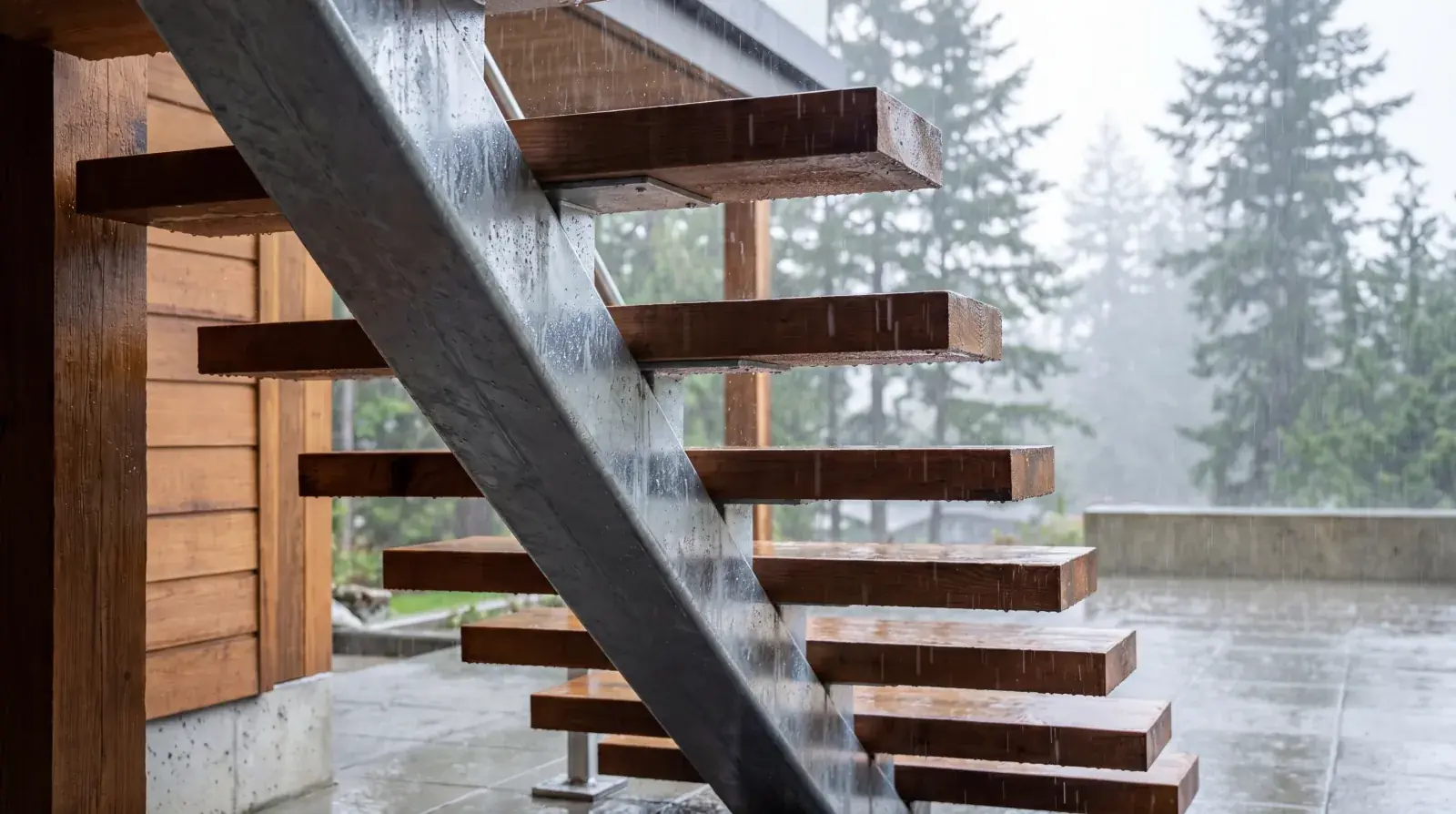
Vancouver steel outside is a different material problem than Vancouver steel inside. Rain, salt spray, UV, freeze-thaw, pollen, moss, the exterior environment is corrosive, and any exterior mono stringer staircase has to be specified with that in mind from day one.
This is a fabricator’s guide to what actually works. Hot-dip galvanizing, duplex coatings, fastener selection, and the detail choices that keep an exterior mono stringer stair looking like new 20 years after install.
Why the climate is the design driver
Metro Vancouver gets 1,200+ mm of rain annually in most neighbourhoods, closer to 2,000 mm on the North Shore. The rain is not the only issue, the combination of persistent moisture, freeze-thaw cycles in January and February, airborne salt from the ocean, and organic debris (cedar needles, moss spores, pollen) creates a corrosive environment that accelerates steel degradation.
Uncoated or lightly painted steel in this environment shows surface rust within months and structural pitting within a few years. Even an interior-grade powder coat will fail at the edges, under fasteners, and at weld seams where moisture gets under the coating. Once water reaches bare steel, the corrosion spreads under the paint film and lifts it off.
The CISC durability guidance (Canadian Institute of Steel Construction - https://www.cisc-icca.ca) covers atmospheric corrosion categories and recommended protection systems. For coastal Metro Vancouver, most sites fall into corrosion category C3 to C4, moderate to high atmospheric corrosion, and those categories drive the protection spec.
Hot-dip galvanizing as the baseline
Hot-dip galvanizing is the baseline for any exterior architectural steel in Metro Vancouver. The process involves cleaning the fabricated steel, then immersing it in a bath of molten zinc at around 450°C. The zinc bonds to the steel metallurgically, forming a series of zinc-iron alloy layers with a pure zinc surface layer. Coating thickness is typically 85 to 100 microns, specified to CAN/CSA G164 - https://www.csagroup.org.
Why this works:
Sacrificial protection. Zinc is more reactive than steel. Even if the coating gets scratched, the surrounding zinc corrodes preferentially and protects the exposed steel for a radius of several millimetres. You can scratch a galvanized rail and the scratch does not rust, the zinc around it gives itself up to protect the steel.
Metallurgical bond. Unlike paint, the zinc coating is not sitting on top of the steel. It is alloyed into the surface. The bond strength is measured in thousands of PSI, and the coating cannot peel off like paint can.
Coverage of every surface. The dipping process coats every accessible surface, inside hollow sections, around weld beads, under overlapping plate joints. Painted finishes almost always have coverage gaps at tight details. Galvanizing does not.
50+ year life. Properly galvanized steel in atmospheric conditions lasts for decades without significant corrosion. A galvanized exterior mono stringer in Metro Vancouver should outlive the building’s other finishes.
Duplex coatings, galvanize plus paint
Galvanizing alone has a functional finish, mottled grey with visible crystalline patterns. Some clients like this look (it reads authentic, West Coast, industrial). Others want a specific colour or a cleaner finish.
The answer is duplex coating. Galvanize first, then apply a compatible paint or powder coat system over top. The two layers together perform better than either alone:
- If the topcoat gets scratched, the zinc underneath protects the steel
- The topcoat protects the zinc from weathering, extending the overall life further
- The visible finish can be any architectural colour
There are real details to get right. The galvanized surface needs preparation before topcoating, either a sweep blast or a chemical pretreatment, because the smooth zinc layer does not give paint enough mechanical tooth. The topcoat needs to be compatible with zinc (some primers fail in contact with zinc). On most projects we specify a zinc-compatible epoxy primer with a polyurethane topcoat for wet-coat work, or a dedicated-for-galvanized powder coat system for powder applications.
Our standard exterior duplex spec: hot-dip galvanize to CSA G164, sweep blast, zinc-compatible epoxy primer, and architectural-grade polyurethane or powder topcoat in the specified colour. This combination lasts decades in Metro Vancouver atmospheric exposure.
Design details that matter as much as the coating
Good coatings cannot save bad detailing. Exterior mono stringer stairs need to be designed to shed water, drain trapped moisture, and avoid creating pockets where debris collects.
Open treads. Solid exterior treads trap water and pine needles. We use open-grid steel grating, perforated plate, slatted cedar or ipe boards with gaps between, or hardwood treads with end-grain drainage grooves. Water has to have somewhere to go.
Drainage at connections. Every bolted or welded joint should drain. Horizontal flanges need slope or drainage slots. Overlapping plates need weep gaps. Sealed pockets where water can enter but not escape are corrosion time bombs, even with galvanizing.
Base plate detailing. Where the mono stringer lands on concrete at grade, the detail matters enormously. Steel sitting directly on wet concrete wicks moisture and corrodes at the interface. We specify a neoprene isolation pad between the base plate and the concrete, a positive slope on the concrete surface away from the stair, and sometimes a small pedestal raising the base plate above the immediate concrete surface. Anchor bolts get additional coating in the grout pocket.
Fastener selection. Bolts and screws need to be corrosion-compatible with the galvanized steel. 316 stainless steel is our baseline for exterior fasteners in Metro Vancouver. The British Stainless Steel Association (BSSA - https://bssa.org.uk) publishes guidance on grade selection for atmospheric exposure, 304 is adequate for urban inland sites, 316 is the standard for coastal and near-coastal exposure.
Sealed welds. Partial-penetration welds create crevices where water can enter and corrode from the inside. We specify full-penetration welds or back-seal welds for any exterior connection. All welds are ground smooth before galvanizing to eliminate crevices.
See our mono stringer engineering guide for how these details propagate through the structural design.
Tread material options for exterior use
Cedar is the classic West Coast choice. Western red cedar naturally resists rot and insect damage, silvers beautifully over time if left unfinished, and is easy to source in the thicknesses needed for stair treads (50 to 75 mm). Cedar treads on galvanized steel brackets is a combination that reads as local and authentic. Maintenance is light, an occasional cleaning and an optional finish refresh every few years.
Ipe and other tropical hardwoods last longer than cedar but cost significantly more and raise sustainability considerations. We use ipe on projects where the design brief demands extreme longevity and the budget supports it.
Steel grating, welded bar grating with an anti-slip top, is the utilitarian choice. Maximum drainage, maximum longevity, low cost, no maintenance. Works for commercial stairs, exterior service stairs, and industrial-aesthetic residential projects. Galvanized or galvanized-and-powder-coated for appearance.
Perforated steel plate gives a solid-looking tread with drainage. 6 to 10 mm plate with punched or laser-cut holes. The hole pattern is the visible design element. Good for contemporary residential exteriors where open grating reads too industrial.
Composite decking (Trex, TimberTech, similar) works for exterior residential stairs where low maintenance is the priority. Modern composite treads have realistic wood texture, resist staining and fading, and need almost no upkeep. The trade-off is a less authentic appearance up close, they never read as real wood.
Exterior-grade engineered hardwood exists but is a gamble in Metro Vancouver’s climate. We have seen too many installations fail within a few years to recommend it for exposed rain conditions. For covered exterior applications (under a deep soffit, for example) it can work.
Fasteners, the weak point
Even on a properly galvanized stair, the fasteners are where corrosion usually starts first if they are specified wrong. A galvanized bolt in a stainless connection creates galvanic action. A carbon steel fastener in a galvanized connection rusts within a season.
Our exterior stair fastener spec:
- Structural bolts (tread brackets to stringer, base plate to concrete): 316 stainless, ASTM F593 for machine bolts
- Anchor bolts (into concrete): 316 stainless for near-coastal, 304 stainless for urban inland, always with a zinc-rich coating in the embedded portion
- Machine screws and smaller fasteners: 316 stainless throughout
- Avoid galvanized-and-stainless mixing in any joint, pick one material and stay consistent
Stainless grade selection follows BSSA guidance (BSSA - https://bssa.org.uk). 316 for anywhere with salt exposure or within a few kilometres of the ocean. 304 for inland urban sites. When in doubt, specify 316, the cost difference is minimal and the insurance is worth it.
Project example, an East Vancouver rear deck
A recent project connected a ground-floor patio to a second-storey deck on an East Vancouver home. The clients wanted a minimal mono stringer, one straight run, 14 treads, open architecture, in a rear yard fully exposed to rain.
Our spec:
- HSS 8x4 beam as the mono stringer, full-penetration welded bracket plates
- Hot-dip galvanized to CSA G164, then duplex coated with zinc-compatible epoxy primer and architectural-grade polyurethane topcoat in matte black
- Cedar tread blocks, 75 mm thick, with drainage gaps, bolted to the brackets with 316 stainless countersunk fasteners from below
- 316 stainless cable railing with matte black powder-coated posts welded off the stringer
- Base plate on a raised concrete pedestal with a neoprene isolation pad, drainage notch cut in the plate
- Top connection bolted to a reinforced rim joist with through-bolts sealed and covered
Install took two and a half days. The client asked about maintenance, we told them to rinse the treads and rails once a year with fresh water to clear pollen and road salt, check the cable tension every couple of years, and call us if they ever see zinc corrosion at a scratch. Otherwise, forget about it.
Cost implications
An exterior mono stringer carries a meaningful premium over an interior stair of the same geometry. The premium comes from:
- Hot-dip galvanizing cost (charged per pound of steel weight by the galvanizer)
- Duplex coating (the second finish step on top of galvanizing)
- Stainless fasteners throughout
- More careful detailing (drainage, sealed welds, isolation pads)
- Typically premium tread materials (cedar, ipe, grating over interior hardwood)
For scope tiers, we are looking at baseline to mid-range pricing for a straight exterior stair, stepping up to premium for L-shape, curved, or waterfront specifications. Request a quote for exterior mono stringer projects, we need to see the site and the exposure before we give a number.
See the mono stringer comparison guide for how exterior specs compare to other stair systems in coastal climates.
The takeaway
Exterior mono stringer staircases in Vancouver need to be specified for the climate, not just designed for the look. Hot-dip galvanizing is the baseline corrosion protection. Duplex coating is the architectural finish answer. 316 stainless fasteners, drainage-positive detailing, and open treads are the design rules that keep the stair functional for decades.
Get the spec right at the fabrication drawing stage and the stair is effectively maintenance-free. Cut corners, uncoated steel, mixed fastener metals, sealed water pockets, carbon steel fasteners, and you are rebuilding in ten years.
If you are planning an exterior stair for a Vancouver, Burnaby, or North Shore property, request a quote with a site photo and we will walk through the spec that will actually last.