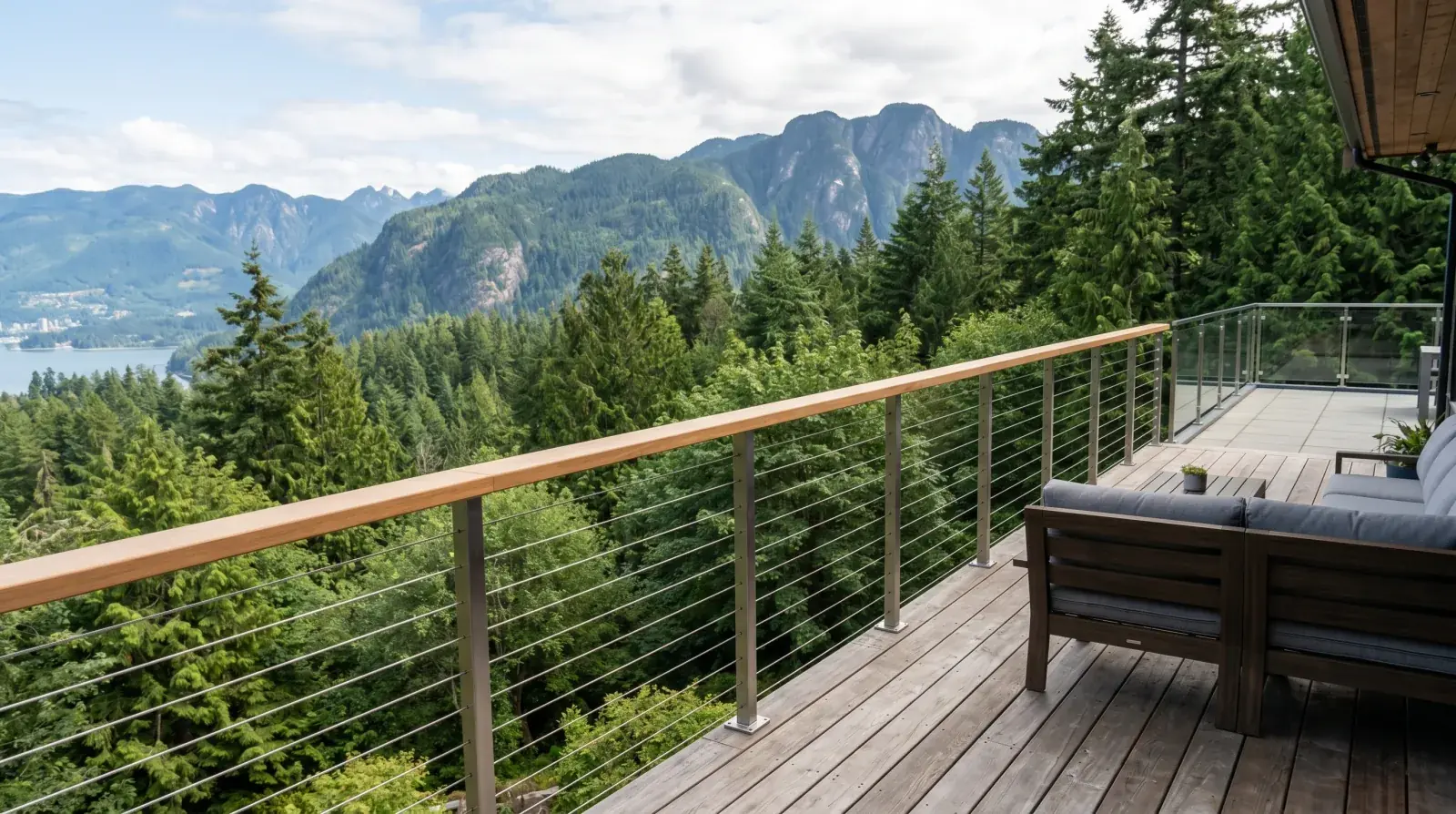
Cable railings have taken over the Vancouver deck render. North Shore custom builds, Burnaby Heights modern renovations, downtown rooftops, the look is everywhere right now. Stainless posts, taut horizontal cables, an uninterrupted view of the mountains or the inlet. Done well, it disappears against the landscape, which is exactly the point.
Done poorly, it fails inspection or it sags within a year. And the failure modes aren’t obvious from the photos.
The 100 mm sphere doesn’t care that the infill is cable
The BC Building Code’s rule for guard infill on a residential balcony is the same whether you’re using glass, balusters, or cable: a 100 mm sphere cannot pass between adjacent infill elements. The reason that rule is a problem for cable specifically is that cable can be pushed.
An inspector on a Burnaby deck doesn’t measure the cable spacing at rest. They lean a hand on it and check whether a sphere can squeeze through the deflected gap. If the cables move enough that the 100 mm rule fails under that load, the railing fails. This is the single most common reason a cable install gets written up, the at-rest spacing was fine, but the cables weren’t tight enough or the post spacing was too generous, and the deflection let the gap open.
So the design conversation isn’t really about cable tension on its own. It’s about how cable tension and post spacing work together to keep the infill rigid enough to pass the hand test.
Post spacing is where most kits fall short
A cable infill is essentially a series of clothesline runs between posts. The longer the run, the more the cable can deflect for a given tension. The shorter the run, the stiffer the system behaves.
For most of our cable rail installs on Vancouver and Burnaby decks, posts land around 1.2 metres (4 feet) on centre. On longer continuous runs we’ll add intermediate pickets, vertical members that the cables pass through without anchoring, to break the run into shorter effective spans without adding more anchor posts. That’s the trick to keeping a long deck rail tight without an obvious forest of posts.
Off-the-shelf cable kits often quote 1.5 m or even 1.8 m post spacing because they’re showing what’s possible on paper at maximum cable tension. In practice, at that spacing the system is at the edge of its envelope and small things, a sun-warmed cable, a slight stretch, drop it out of compliance. We design with margin.
Tension: numbers, but in context
Stainless cable manufacturers commonly call for somewhere in the range of 200 to 350 pounds of tension per cable on a standard residential run, depending on diameter and spacing. The right number for a given installation comes from the system manufacturer’s spec sheet, and we follow it.
What matters in practice is that the tension is applied with a proper tensioner, a threaded fitting that lets us tighten the cable progressively and verify the load. Hand-tight isn’t a number. A torque wrench against the tensioner is. Our installers carry the gauge and document the tension on every cable so there’s a record if a question comes up later.
Stainless 316 for the coast, galvanized is a few-years problem
Inland, you can get away with galvanized cable on a deck rail. On the Metro Vancouver coast, you can’t.
Galvanized cable rusts at the fittings within a few seasons in our climate, especially anywhere near the ocean. The cable itself often still looks acceptable; the swage and the tensioner go orange. That degradation eventually shows up as lost tension, which shows up as a sphere-rule failure on the next inspection or an unhappy owner.
We default to 316 stainless steel for any cable infill in the Metro Vancouver region. The chloride resistance is real, the fittings stay bright, and the system holds tension. On a North Shore waterfront or a downtown rooftop, this isn’t a luxury, it’s the basic spec.
Stairs are different
Cable on a flat run is one geometry. Cable on a stair is a different problem. Each cable on a sloped rail is a slightly different length, the tensioners have to accommodate that, and the 100 mm rule still applies, now measured perpendicular to the cables along the rake.
We’ve installed cable rail on stair flights in West Vancouver custom homes and the result, when detailed properly, reads as a continuous taut line up the stair. But it’s careful shop work. An off-the-shelf cable kit assembled on site by a deck crew is almost never going to produce a code-compliant cable stair rail. The fittings get racked, the tensioners can’t reach final load, and the cables don’t sit parallel.
For stairs, plan for a fabricated assembly designed for the specific stair geometry, not a kit.
Initial stretch and the follow-up tension
Stainless cable stretches a small amount in the first few weeks after install as the strands settle. That’s normal. A quality installation includes a return visit a few weeks after handoff to re-tension every cable to the original spec.
We bake that into the install schedule. The owner doesn’t have to call us back; we book the follow-up the same day we finish the install. After that initial settling, properly specified cables on a properly designed system hold tension for years. We recommend a periodic check, every three to five years is reasonable in our climate, and a re-tension if anything has drifted.
The strata layer
If the deck in question is on a strata or multifamily building, the railing decision is rarely just an owner decision. The strata’s bylaws often cover exterior elements visible from common property, and a balcony rail replacement is the textbook case where council approval is required. We’ve helped owners through this on strata guardrail replacement projects, the technical scope is one conversation, the documentation for the council is another.
The cable system itself isn’t usually the obstacle. The obstacle is documentation: load calculations, the manufacturer’s tested system data, finish samples, and a clear scope of work. We package that for the council so an approval moves in weeks instead of months.
What we won’t do
We won’t install a cable rail with stretched post spacing that we know will struggle to pass the hand test. We won’t substitute galvanized cable for stainless on a coastal install. And we won’t quote a long continuous run without intermediate pickets or shorter posts to control deflection.
Those aren’t preferences. They’re the things that decide whether the railing is going to pass and stay tight.
If you’re spec’ing cable on a Vancouver deck or thinking about replacing a railing that hasn’t aged well, bring us the deck dimensions and the post conditions and we’ll detail a system that actually behaves the way the renders show it.