The question we hear most often at our Burnaby shop is also the one with the least satisfying quick answer: “What does a wrought iron railing cost per linear foot?” The honest answer is “it depends on four specific variables”, and once you understand those variables, you can read any quote accurately and compare shops fairly. This is the 2026 breakdown of how custom wrought iron railing pricing works in Metro Vancouver: what goes into the per-linear-foot number, why quotes from different shops can vary dramatically, and how to tell a complete quote from a suspiciously cheap one.
If you want a real number on your specific railing, the fastest path is to request a quote with drawings or photos. What follows is the context that makes the quote you receive make sense.
Why no one can give you a single per-foot number
Every custom wrought iron railing is built for a specific site. The per-linear-foot price is a summary of dozens of decisions: how complex the design is, how the railing is finished for its exposure, what surface it anchors into, how long the total run is, whether a gate is included, whether existing railing needs to come out first. Two quotes on “60 ft of wrought iron railing” can differ significantly, not because one shop is greedy, but because the scope inside each project is different.
A complete quote accounts for all of that. A lowball quote usually hides it. The rest of this article walks through the four variables that actually move the number.
The four cost drivers that actually matter
1. Design complexity
This is the biggest variable. A straight run with uniform pickets and a simple top rail is the cheapest possible custom railing, the fabrication is almost all repetitive cutting and welding. Every element that breaks the pattern adds hours:
- Scrolls and curls, each one is bent, welded, and ground by hand
- Twisted pickets, twisting square bar takes extra time at the bench
- Finials and caps, decorative post tops add material and labour
- Curved rail sections, templating and rolling a curved top rail is several times the labour of a straight one
- Integrated gate sections, a gate within the railing scope adds hinges, latches, and tighter tolerances
On a typical Metro Vancouver residential railing, moving from “basic straight run” to “decorative with scrolls and twists” noticeably increases the fabrication line on the quote.
2. Finish and corrosion protection
Finish choice is the second biggest driver. Interior railings need nothing more than a basic primer and powder coat. Exterior railings need progressively more protection based on exposure:
- Interior, primer + powder coat, baseline finish
- Exterior, sandblasted + powder coat, adds cost versus baseline
- Duplex: hot-dip galvanized + powder coat for coastal exposure, further premium, justified by service life
- Full marine-grade 316L stainless construction, a significantly different price tier
On a waterfront West Vancouver project, the finish alone can be a meaningful share of the railing budget. See our galvanizing vs. powder coating for the Vancouver coast article for when each option is justified.
3. Site conditions and installation
Where the railing goes is often as consequential to the quote as what it is. The same length of railing can carry very different install lines depending on:
- Substrate, wood framing is fastest, followed by poured concrete; anchoring into existing brick, stone, or heritage masonry is slowest
- Access, ground-level install beats scaffold-required install
- Parking and site protection, central Vancouver downtown jobs often need permits for loading zones and sidewalk protection
- Working around other trades, coordinated installs on active construction sites involve more downtime
- Removal of existing railing, if the old railing has to come out first, demolition is its own line
4. Length of the run
Fabrication shops have fixed costs per project, site visit, shop drawings, mobilization, delivery. Spreading those across more linear feet drops the per-foot price:
- Short runs (roughly 10 to 20 lf), highest per-foot rate, fixed costs dominate
- Typical residential runs (30 to 60 lf), mid-range pricing
- Longer runs (60 to 150 lf), lower per-foot rate as fixed costs spread
- Very long runs (150+ lf), per-foot savings level off; bulk benefit minimal past this point
The opposite catch: very small projects (under about 15 lf) often carry a minimum project fee, so the effective per-foot rate is higher than the scale suggests. A small porch railing priced as a standalone project will read high on a per-foot basis because it is really a fixed-cost shop project.
What’s inside a complete quote
A complete Metro Vancouver wrought iron railing quote should have line items for:
- Site visit and measurements, usually folded into design fee
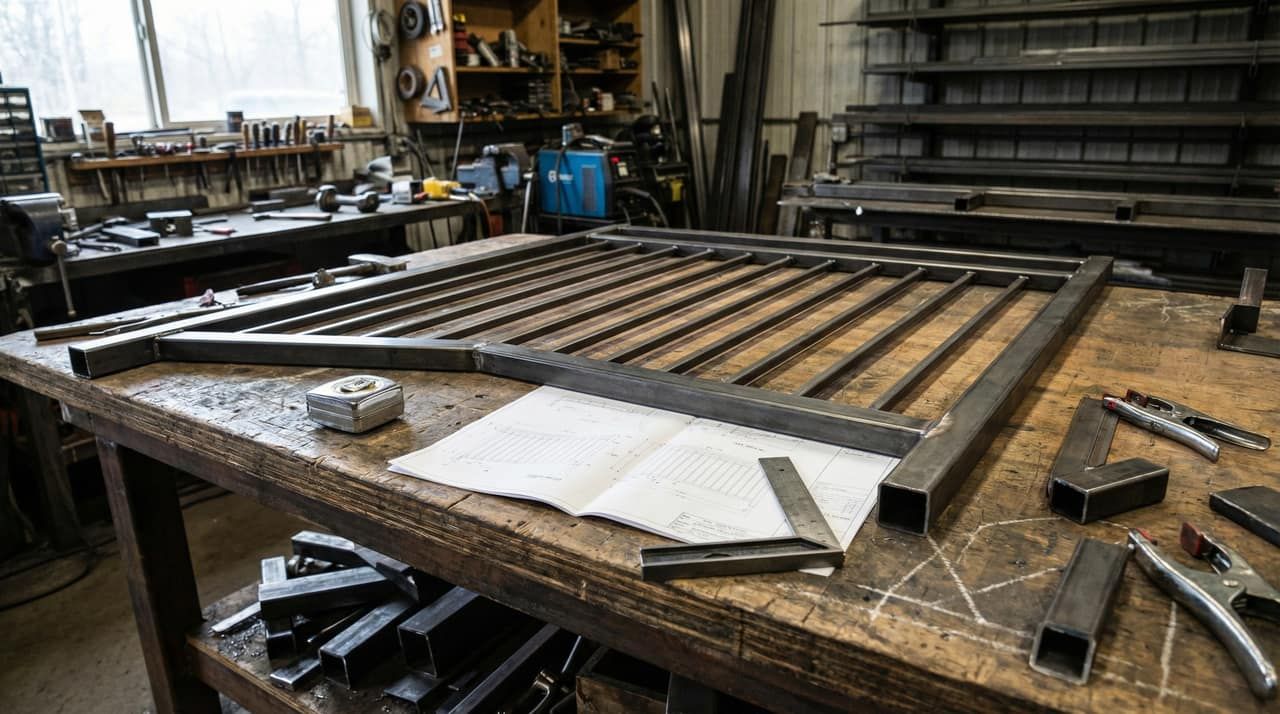
- Shop drawings, CAD drawings for fabrication, sometimes with engineer review
- Material, steel sections, pickets, hardware, anchors
- Fabrication labour, cutting, welding, grinding, assembly
- Decorative elements, forged scrolls, twists, custom details
- Finishing, sandblasting, galvanizing, powder coat, colour
- Delivery, bringing the assembled railing from shop to site
- Installation labour, anchoring, levelling, final adjustments
- Site protection and cleanup
- Contingency / change orders, usually excluded, noted as extra if scope changes
If a quote has only three or four line items, “Railing: one number per foot”, ask what’s included before comparing. The most common “missing” lines on low quotes are finishing (assumed to be “shop primer only”), installation (assumed to be priced separately), and site protection (assumed to be the client’s responsibility).
Where pre-fab systems fit
Not every project needs custom fabrication. For a code-compliant railing on a basic exterior deck in Burnaby or Coquitlam, a pre-fabricated steel picket system from a big-box store or a national railing distributor can work. The trade-offs are visible:
- Design, off-the-shelf pickets, limited colour options, generic detail
- Steel gauge, usually lighter sections than custom, shorter life in coastal conditions
- Finish, standard powder coat rather than duplex
- Joinery, bolted assembly vs. welded
- Service life, shorter than custom in every exposure category
The pre-fab option is real and sometimes the right answer. It is not the same product as what a custom shop builds, and price comparisons between the two are apples-to-oranges.
Typical project profiles we quote
Three representative Metro Vancouver scopes, without numbers, because the numbers depend on the specifics of your project:
Profile 1, Burnaby front porch, short straight railing with 3 steps
- Basic welded custom design, vertical pickets, simple top rail
- Powder coat black, interior-to-exterior transition
- Standard install into concrete porch and wood stair stringers
- Lower end of the custom range per linear foot; a short project so fixed costs weigh heavily
Profile 2, North Vancouver exterior deck, mid-length with gate
- Mid-range welded design with light forged detail
- Duplex finish (galvanized + powder coat) for coastal exposure
- Exterior install into wood deck framing, includes integrated gate
- Mid-range per linear foot; gate and duplex finish drive the rate upward
Profile 3, Kitsilano heritage porch restoration
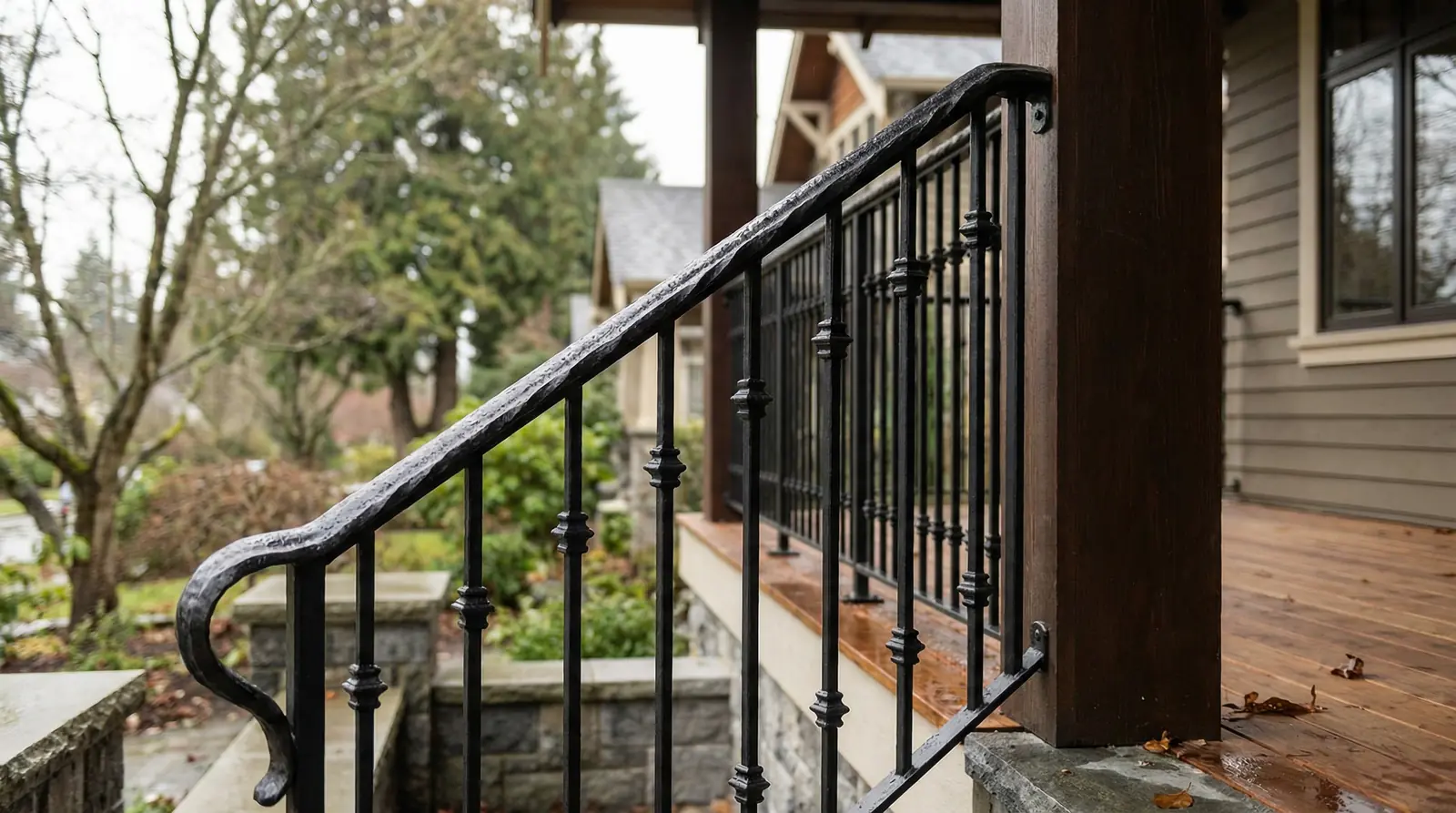
- Hand-forged heritage-matching scrolls and finials
- Match existing period detail, historically accurate black finish over duplex substrate
- Install into original stone base, working around existing porch framing
- High end of the per-linear-foot range; hand-forging and heritage fit drive the labour line
Each profile is normal for its type of work. The variation is not the fabricator’s margin, it is the scope inside each project. Send drawings or photos of your specific project and we will quote it.
How to compare quotes without getting burned
- Get three quotes from shops with comparable certification (C.W.B. certified is a baseline)
- Match the finish spec, if one quote is powder coat only and another is duplex, they are not comparable
- Confirm installation is included and look for site protection and cleanup lines
- Ask about change orders, how are scope changes priced during the project
- Check lead time, a quote that is dramatically cheaper but weeks behind the competition might be understaffed, not efficient
For a broader view of railing options and how pricing logic compares across materials, see our custom metal railing cost in Vancouver guide, which covers all railing types including aluminum, steel, and cable. For a real fixed-price quote on a Metro Vancouver project, from Whistler to White Rock, bring drawings or site photos to our Burnaby shop and we will work it through with you at the quoting bench.