A structural engineer hands you a set of drawings for your Vancouver project and somewhere in the general notes is a line that reads “all structural welding by a fabricator certified to CSA W47.1.” Most people read past it. It looks like one more code reference among dozens. But that single line decides which shops can legally touch the load-bearing steel in your building, and it’s worth understanding before you start collecting quotes.
The short version: CSA W47.1 is the Canadian standard for certifying companies that weld steel. The full title is Certification of companies for fusion welding of steel, and the word that matters most in there is “companies.” It does not certify a person. It certifies a shop.
What CSA W47.1 actually is
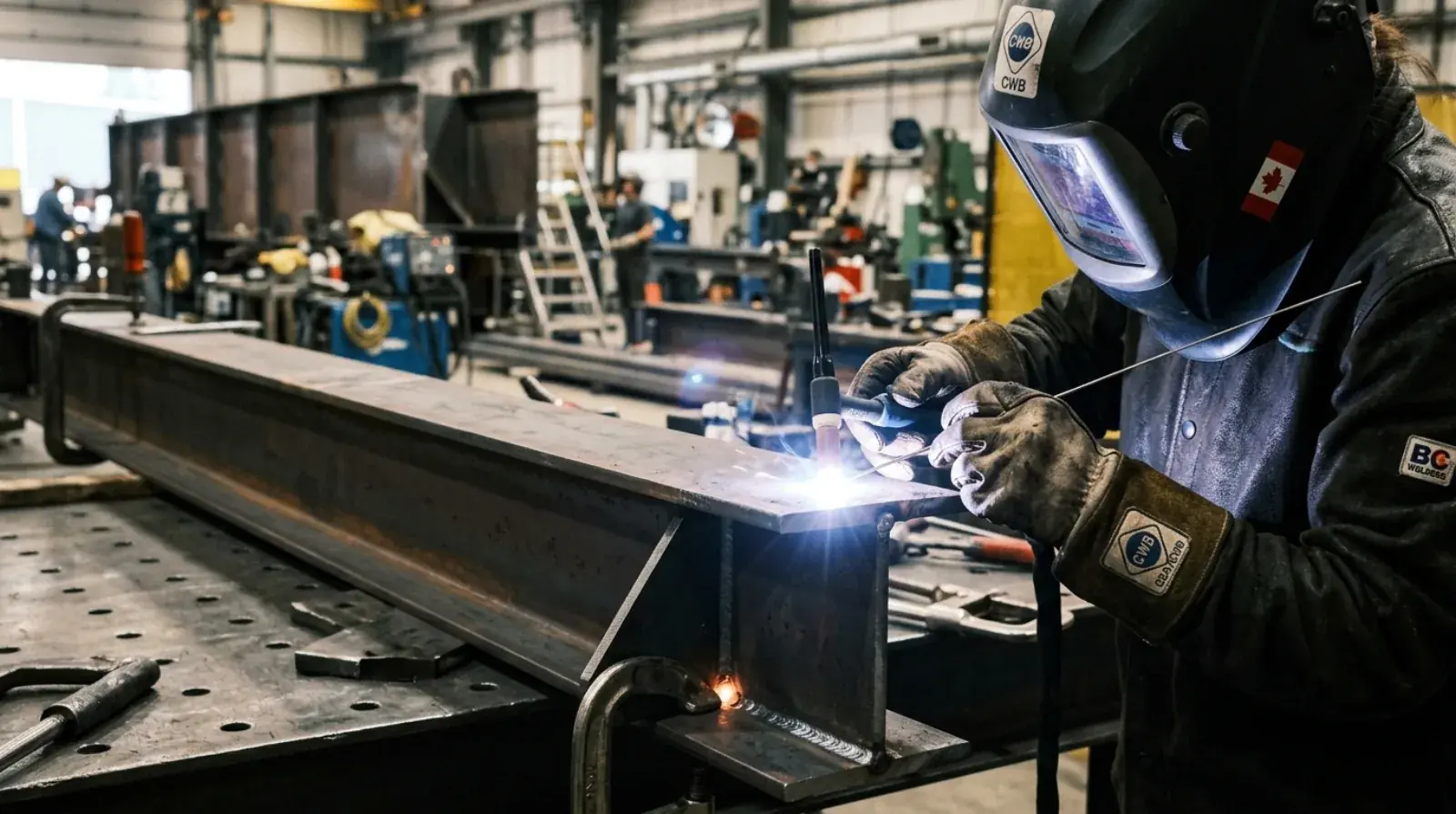
W47.1 is a national standard that sets out what a welding company has to have in place before it’s allowed to weld structural steel. It’s administered by the Canadian Welding Bureau, the body that audits shops and grants the certification. When you hear someone say their shop is “CWB certified,” what they almost always mean is that they hold certification to CSA W47.1.
The standard exists because structural welding is invisible once it’s done. A finished weld on a steel beam looks more or less the same whether it was done correctly or not. You can’t see whether the metal fused properly through its full thickness, whether the right filler was used, whether the joint was preheated when it needed to be. W47.1 is the system that controls all of that before the weld is ever made, because nobody can reliably judge it afterward by eye.
Three things get certified, not one
This is the part that trips up most clients. People assume “certified” means the welder passed a test. That’s only one slice of it.
W47.1 certification covers three separate things, and a shop needs all three:
- Certified welders. The individual welders hold current qualifications for the specific joints and positions they weld. A welder qualified for one joint type isn’t automatically qualified for another.
- Certified procedures. The shop has written welding procedure specifications, documents that spell out exactly how a given weld is made, down to the filler metal, the current, the technique. These procedures are tested and accepted, not just written.
- A welding engineer or supervisor. Someone qualified is responsible for the welding done in the shop. That accountability is built into the certification.
Take any one of those away and you don’t have W47.1. A shop full of talented welders with no written, tested procedures and no engineering responsibility is not certified, no matter how clean the beads look.
Why “the welder is good” isn’t the same thing
We’ve had clients tell us they almost went with another shop because the welds looked beautiful. And they probably were beautiful. A skilled welder can lay down a weld that looks flawless on the surface.
But a good-looking weld and a sound structural weld are not guaranteed to be the same thing. The appearance tells you about the cap, the visible top layer. It tells you very little about fusion at the root, about whether the procedure matched the steel grade and thickness, about whether the joint will hold under the loads an engineer designed it for. Certification controls the things you can’t see by controlling the process that produced them.
That’s the whole point. Skill matters enormously, but skill without a tested procedure and without oversight is the honour system. W47.1 replaces the honour system with documentation, qualification, and audits.
Why structural steel in BC needs a certified shop
If your project has load-bearing steel in it, a beam carrying a removed wall, steel columns, moment connections, a stair that’s part of the structure, expect a certified fabricator to be a requirement, not a preference.
There are two reasons. First, engineers in BC routinely specify CSA W47.1 certification directly on their structural drawings. When it’s in the notes, it’s a condition of the design, and a non-certified shop’s work won’t satisfy the engineer or the inspector reviewing the job. Second, the steel design standard itself, CSA S16, points back to W47.1 for how the welding is to be done. The two standards work together: S16 governs how the steel is designed, W47.1 governs how it’s welded.
In a seismic region like the Lower Mainland, this isn’t paperwork for its own sake. Steel connections in Vancouver buildings are designed to behave a certain way during an earthquake, and welds that don’t meet the procedure can change how a connection performs under that kind of loading. If you’re curious how much that matters, we get into it in our piece on seismic steel connections and the engineers who design them.
What the certification audit involves
Holding W47.1 isn’t a one-time test. The Canadian Welding Bureau audits certified shops, and those audits look at the same three pillars: are the welders’ qualifications current for the work they’re doing, are the welding procedure specifications written and accepted, and is the responsible welding engineer or supervisor actually in place and doing the job.
Inspectors review documentation and look at work in progress. Visits aren’t always announced ahead of time. The point of the ongoing audit is that certification reflects how the shop operates today, not how it operated the day it first qualified years ago. A shop can lose certification, or have its scope reduced, if it stops maintaining the system.
Divisions tell you the shop’s scope
W47.1 certification is granted by division, and the division reflects how much welding-engineering responsibility the shop carries in-house. A shop in a higher division employs its own welding engineer and can approve more of its own procedures. A shop in a lower division leans on an outside engineer for that approval. Neither is “bad”, but the division on a certificate tells you the kind and scale of structural work a shop is set up to take on. It’s worth asking about if your project is large or complex.
How to verify a shop is actually certified
A logo on a website is not proof. Anyone can put a badge on a footer. Here’s how to check for real, and it takes about five minutes:
Ask the shop for its CWB certificate number and its division. A certified shop will give you this without a second of hesitation, because they’re proud of it and they deal with the question constantly. Then check the number against the Canadian Welding Bureau’s directory of certified companies and confirm two things: that the certification is current, and that the division covers the kind of work you need done.
If a shop gets cagey when you ask for a certificate number, that tells you something on its own. This is the kind of question worth asking early, and it pairs well with the rest of the questions you should ask a metal fabricator before you hand over a deposit. Sorting certification out up front also makes the larger task of choosing a metal fabricator in Metro Vancouver a lot more straightforward, because it quickly narrows a long list down to the shops that can legally do structural work.
What it protects you from
Strip away the standards numbers and here’s what certification actually does for you as the person paying the bill.
It means the welds holding up your floor were made to a procedure that was tested, by a welder qualified for that exact joint, under someone whose job is to make sure it was done right. It means the work is far more likely to pass inspection the first time, which keeps your schedule from slipping while a re-weld gets sorted out. And it means the steel is built to perform under load and under seismic conditions for the life of the building, not just to look correct on the day it’s installed.
You’re not paying for a badge. You’re paying for a system that catches problems before they’re buried inside a finished weld where nobody can find them until something goes wrong.
If your engineer has called for a CSA W47.1-certified fabricator, or you simply want the structural steel in your Vancouver or Burnaby project welded by a certified shop, request a quote and we’ll give you our certification details before we talk about anything else.