Ask a GC what they need from their steel fabricator and the first answer is usually “steel on site when the schedule says.” Fair. But we have watched projects where every tonne arrived on the promised date and the crane still sat idle, because the steel showed up in the wrong order.
Delivery date gets all the attention. Delivery order deserves just as much. On the commercial structural steel packages we run from our Burnaby shop, the sequencing plan is built before the first piece is fabricated, and it shapes everything downstream: the shop drawing order, the fabrication schedule, how trucks get loaded, and what the crane does each morning.
The erection plan drives everything backwards
Sequencing starts at the end and works in reverse. The erector decides how the frame goes up: which grid lines first, how many lifts, where the crane sits, which zones open when. From that plan, the delivery schedule falls out. From the delivery schedule, the fabrication order. From the fabrication order, the shop drawing priorities.
Notice what that means. The shop is not fabricating in the order that is efficient for the shop. It is fabricating in the order the site needs, which sometimes means setting aside a batch of identical beams to build an awkward transfer girder first, because the girder is on grid line 1 and the beams are on grid line 6.
A fabricator who has never asked you for the erection plan is planning to fabricate in shop-convenient order and sort it out at shipping. On a suburban site with a big laydown yard, you might never notice. On a Vancouver or Burnaby infill site, you will notice the first morning.
Bundling and tagging, how a load stays legible
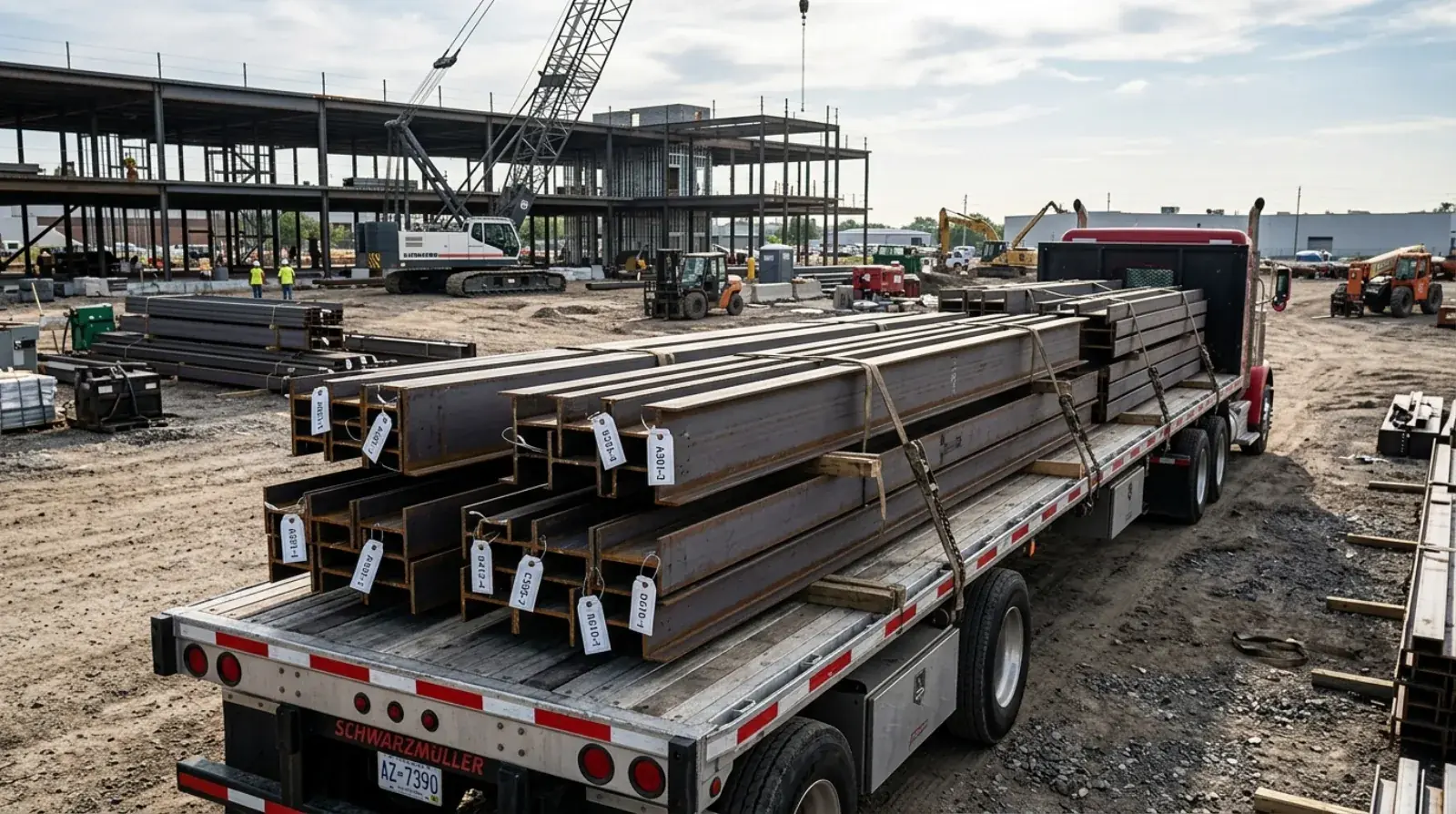
Every piece of steel in the package carries a piece mark, stamped or painted on, that ties it to the shop drawings and the erection drawings. That mark is the whole system. When it works, an ironworker can look at a manifest, look at a bundle, and know in seconds whether this truck carries this week’s steel.
Loads get bundled by erection stage, not by member type. A stage bundle might hold four columns, ten beams, two braces, and a bag of connection hardware, everything the crew needs to complete one zone, rather than a truck of nothing but beams. Each load ships with a manifest listing every piece mark on board, and the loading order matters too: trucks are loaded in reverse, so the first piece the crew needs is the first piece off.
This sounds like clerical work. It is actually schedule protection. The failure mode it prevents, a crew cutting bands on three bundles to find one beam, burns crane time at the most expensive point in the project. The same marks also close the loop on quality: a piece that fails a final check in the shop can be traced, replaced, and re-slotted into its load before the truck leaves Burnaby, instead of being discovered missing at the hook.
Zero laydown, the Metro Vancouver standard condition
On a lot of Metro Vancouver commercial sites, the building covers the entire property line to property line. There is no yard. Steel storage is a lane closure permit and whatever fits on a flatbed.
That makes just-in-time delivery the default, not an upgrade. Steel arrives in small sequenced loads, hours or a day before erection, and goes from trailer to hook. Some picks come straight off the truck bed. It works, and we do it routinely in Vancouver and New Westminster, but it removes every buffer from the system. There is no pile on site to absorb a late truck, a fabrication error, or a load built against last week’s erection plan.
So the coordination has to be tighter. The fabricator, the trucking, the erector, and the GC’s site logistics all work from one delivery schedule, updated as the erection plan moves. When the crane schedule slips a day, the trucks slip a day, and the shop holds the loads rather than pushing steel onto a site that cannot receive it. We covered how this fits into the wider package timeline in our post on the life of a steel package from IFC to erection.
Phased erection, splitting the building into zones
Larger projects rarely erect the whole frame in one continuous run. The building gets split into phases: steel goes up in zone A while zone B foundations cure, then the crane walks and zone B starts while decking follows behind in zone A. Done well, phasing overlaps trades and shortens the overall schedule.
For the fabricator, phasing is a detailing decision as much as a site decision. The zone boundaries determine which members get drawn, reviewed, and fabricated first. They also create real fabrication questions at the seams, beams that span between zones, bracing that ties two phases together, and those pieces need a defined home in one phase or the other before the shop drawing sequence is set.
This is why phasing needs to be settled early, at award or shortly after, not announced when fabrication is half done. Resequencing a shop that has already committed its fabrication order means some steel was built in the wrong priority, and the schedule pays for the difference.
When steel lands out of sequence anyway
It happens. A truck gets loaded against a stale plan, a piece fails inspection and misses its load, a site change reshuffles the erection order mid-stream. What it costs depends on what is missing.
If the out-of-sequence piece is filler, secondary beams, infill framing, the crew works around the hole and picks it up later. Annoying, survivable. If it is structural to the sequence, a column that carries the next lift, a transfer member that everything above depends on, erection in that zone stops. The fabricator ships the missing piece on a hot load, the crane re-rigs, and meanwhile the steel that did arrive sits in the one place urban sites do not have: spare ground.
The honest lesson from every out-of-sequence event we have seen is that the recovery always costs more than the prevention. A sequencing plan is a few meetings and some discipline in the shipping bay. The alternative is billed in crane hours.
Sequencing is one of the topics we walk GCs through before award, alongside submittals, scope gaps, and site logistics, in our guide to structural steel for general contractors. If you have a commercial project coming up anywhere in Metro Vancouver and you want a fabricator who builds the delivery schedule from your erection plan rather than the other way around, send us the drawings and we will show you how we would stage it. More on our full structural steel scope is here.