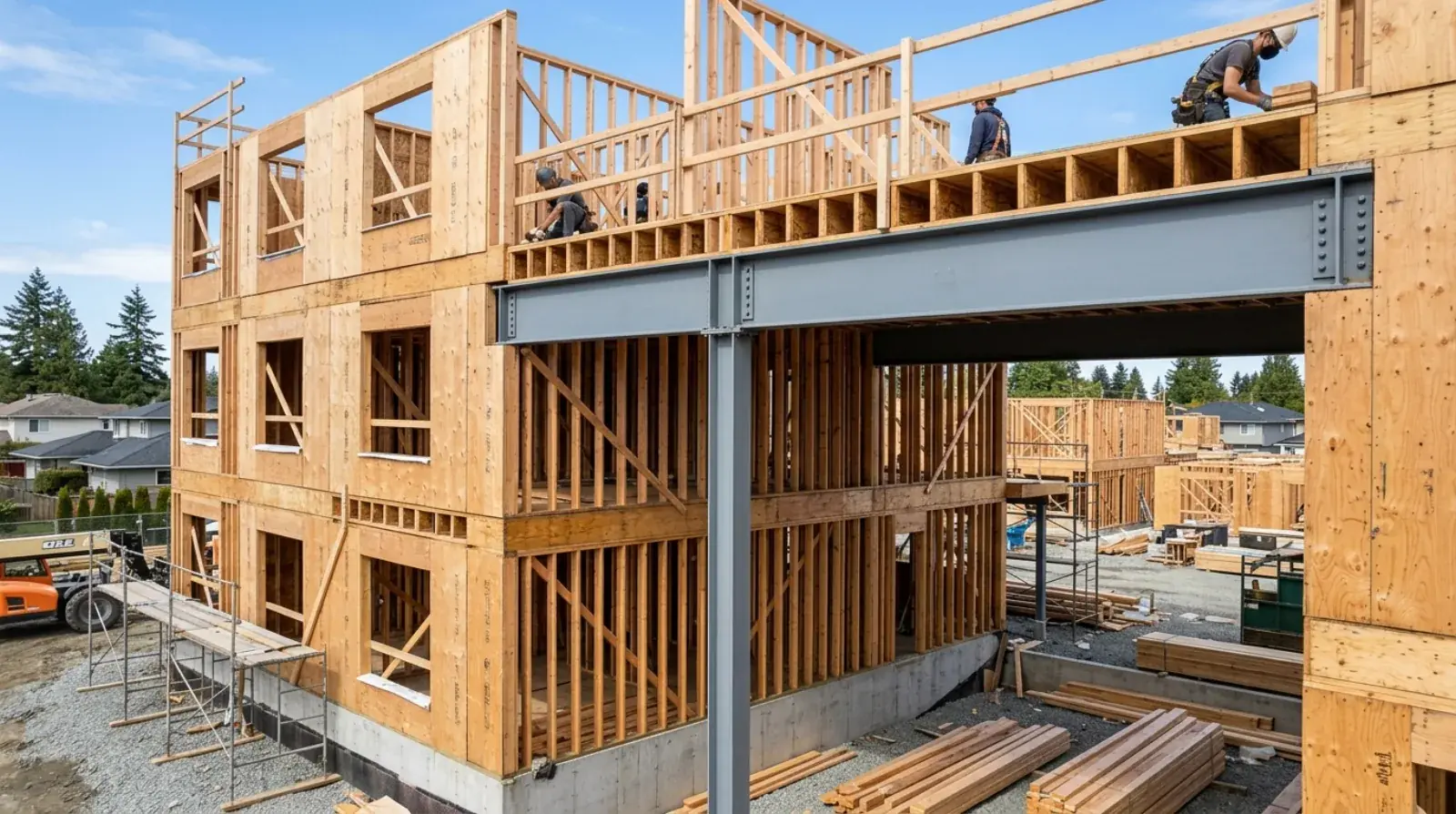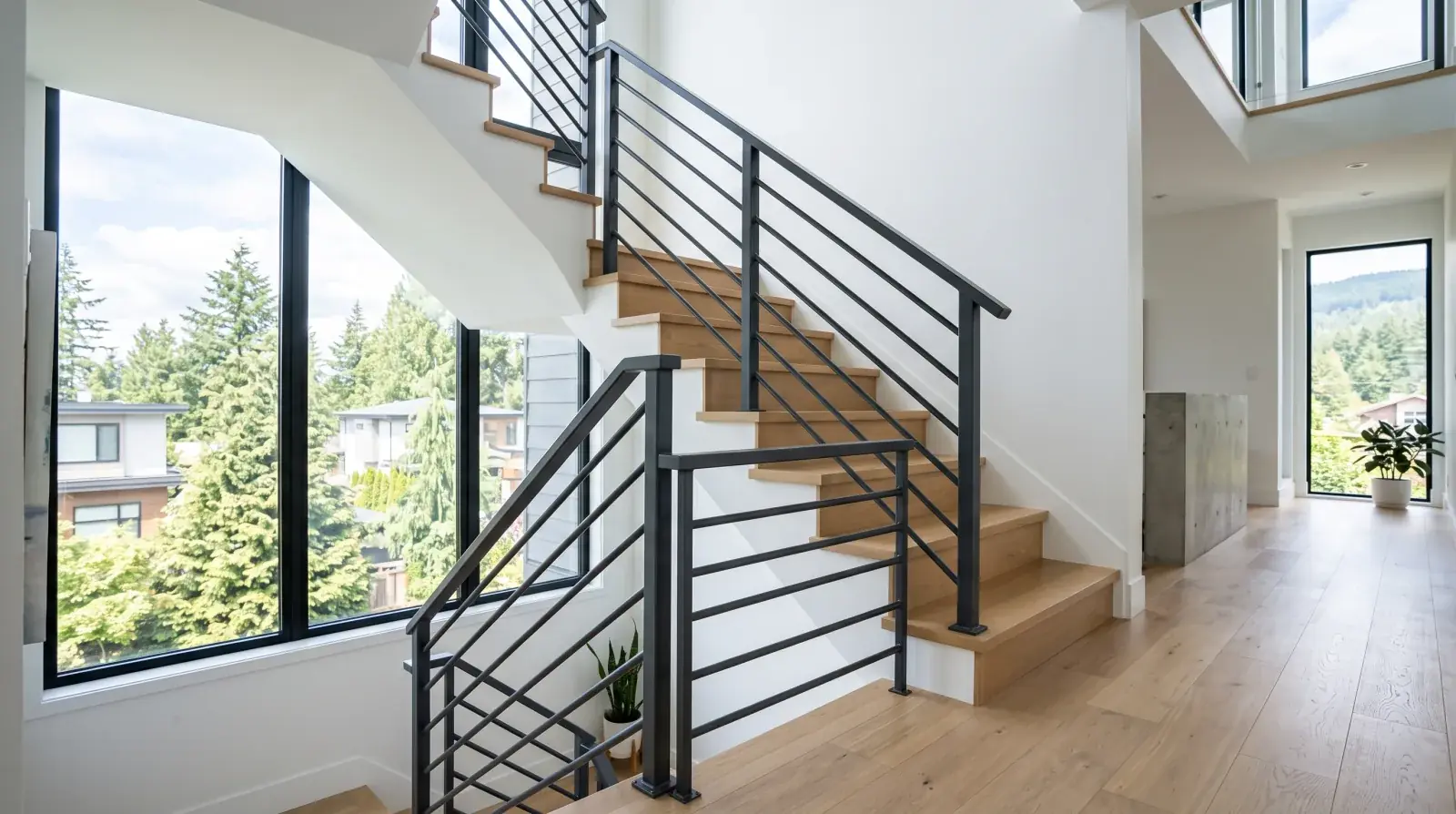
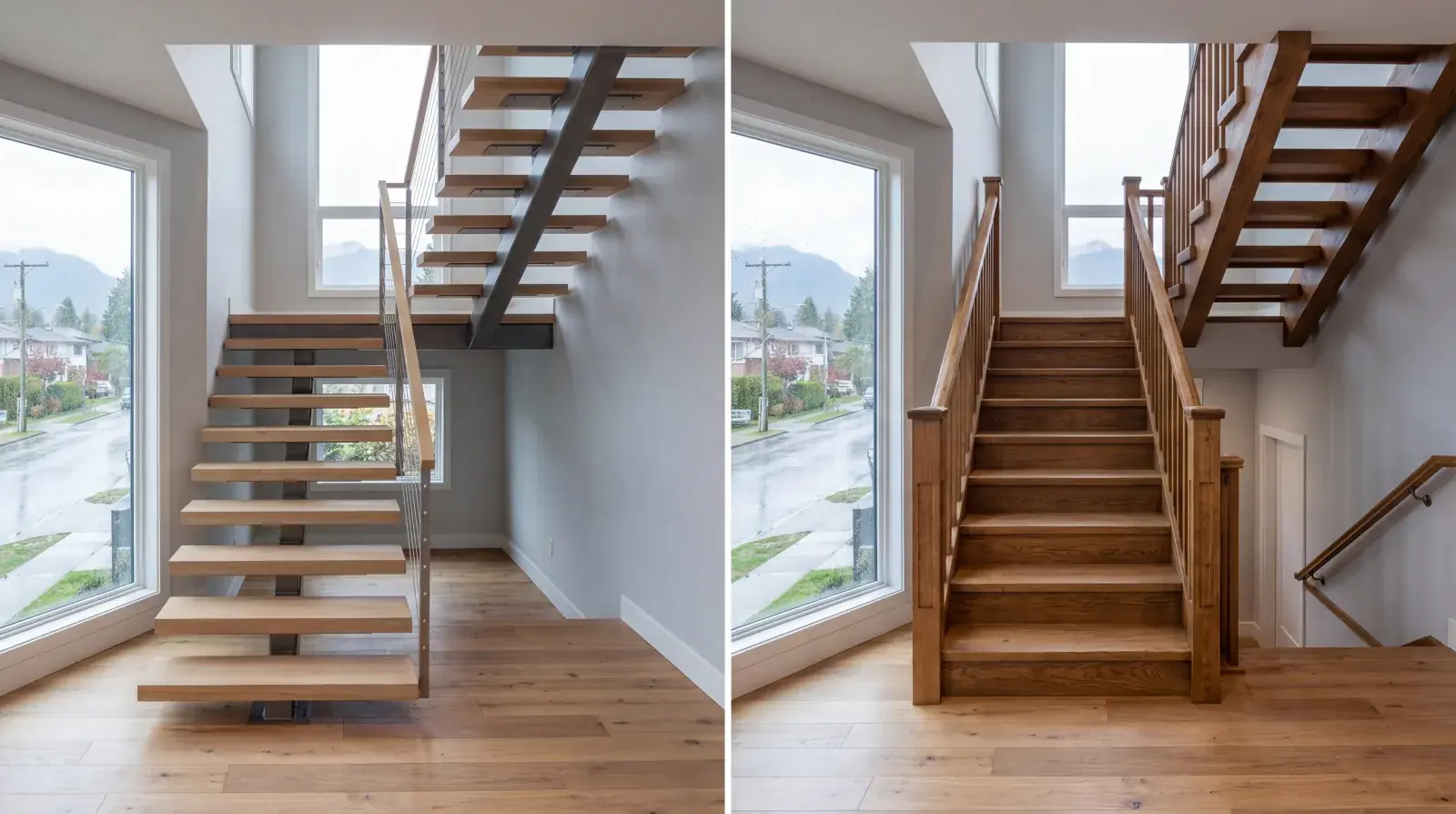
Every custom home build in Metro Vancouver eventually runs into the staircase decision. Wood is the default, it is what production builders frame, what most trim carpenters know, and what shows up on the cheapest quotes. Steel is the upgrade, more expensive, longer lead time, needs engineering, and usually the choice when the staircase is meant to be a visible architectural feature rather than just a way to move between floors.
At our Burnaby shop we fabricate custom steel stairs for homeowners, architects, and GCs across Metro Vancouver. The “steel or wood?” conversation comes up on almost every project. This is the honest breakdown of what each actually costs in 2026, where each one wins, and how to decide based on your real budget and priorities rather than on a photo from an architecture magazine.
What a wood staircase actually costs in Metro Vancouver
Production wood-framed staircases are the cheapest finished stair you can put in a house. The framing crew builds the carriage from three 2x12 stringers on site, usually in half a day. A trim carpenter comes in afterwards to install treads, risers, skirt boards, and the handrail. The whole thing gets covered in drywall underneath and stain or carpet on top.
| Wood staircase tier | Tier | Typical finish |
|---|---|---|
| Production carpet-grade | Baseline | Basic framing, carpeted treads, painted handrail |
| Standard engineered wood | Baseline, mid | Oak or maple engineered treads, painted risers, stock balusters |
| Solid hardwood with carpenter trim | Mid-range | Solid oak or walnut treads, trim skirt, upgraded balustrade |
| High-end millwork staircase | Premium | Full custom millwork, curved handrail, bespoke balustrade |
| Heritage restoration or curved millwork | Top-tier | Historic profile, curved stringers, hand-finished detail |
The baseline is what production builders spec on townhouse and infill projects across East Vancouver and New Westminster. The mid-range is what most Burnaby and Coquitlam custom homes get. The premium and top-tier overlap with steel pricing, which is where the comparison gets interesting.
What a steel staircase costs in Metro Vancouver
A custom steel staircase is engineered, fabricated in a shop, trucked to site, and installed in a sequence that rarely takes more than three days. The cost covers a lot more design and precision than a framed wood stair, but the per-hour labour is comparable, and the material itself is often cheaper than the solid hardwood you would put on a high-end wood stair.
| Steel staircase configuration | Tier | Notes |
|---|---|---|
| Double stringer, carpet or engineered treads | Baseline | Cheapest custom metal option |
| Mono stringer, hardwood treads, steel railing | Mid-range | Most common modern residential choice |
| Mono stringer with cable or glass railing upgrade | Premium | Railing system drives the scope upward |
| Floating cantilever stair | Premium | Hidden wall-pocket mounts, complex framing coordination |
| Curved mono stringer | Top-tier | Rolled beam, per-tread bracket geometry |
| Helical or spiral steel stair | Top-tier | Depending on diameter, material, and finish |
Every steel staircase is quoted per project including engineering, shop drawings, fabrication, finishing, and installation. Hardwood tread supply is sometimes itemized separately depending on who the GC is sourcing treads from.
The real cost gap
A direct comparison at equivalent quality levels:
| Quality tier | Wood stair | Steel stair |
|---|---|---|
| Entry residential | Baseline | Mid-range |
| Standard custom home | Baseline, mid | Premium |
| High-end residential | Premium | Premium |
| Architectural feature stair | Top-tier | Top-tier |
At the top of the range the cost gap closes. A millwork-grade wood staircase with curved stringers and custom balustrade on a high-end West Vancouver or Shaughnessy project can overlap with a steel mono stringer at comparable scope, and at that tier, steel with hardwood treads often delivers a cleaner, more modern result.
The crossover sits at the premium tier. Below that, wood is almost always cheaper. Above it, the decision shifts toward which material produces the result the homeowner actually wants.
Where wood wins
Wood is the better choice when the staircase is functional rather than architectural, the budget is tight, or the house style wants a traditional feel.
Production and infill housing. On a 2,400 sq ft infill house in East Vancouver or a row townhouse in Metrotown, a production wood stair is the right call. It is fast to build, the carpenter is already on site, and the architectural impact of the stair is minimal because it sits inside a wall.
Character and heritage homes. A 1920s Kitsilano craftsman or a restored Shaughnessy heritage home usually wants a wood staircase that matches the original period. Steel would look out of place. Real millwork, properly profiled, stained to match the existing woodwork, is the honest choice.
Tight schedules. If the framing crew is already on site and the stair needs to be walkable in a week so other trades can access the upper floor, wood wins on timeline. A steel stair is 8 to 12 weeks from quote to installation. A wood stair is 3 to 5 days from framing to usable.
Tight budgets. Custom steel stairs start at a higher baseline than wood. Below the custom-steel baseline, wood is the only realistic option.
Where steel wins
Steel is the right choice when the staircase is a design feature, when long-term performance matters, or when the floor plan calls for open structure.
Open-concept architecture. A mono stringer or floating steel stair lets light pass through. It opens sight lines between the main floor and the upper floor in a way that a wood stair with closed risers never can. On custom builds in Buckingham Heights, Deep Cove, and newer Burnaby architectural homes, open stair structures are usually steel.
Long-span runs. Steel can span farther between support points than wood. On a 9-foot floor-to-floor with no intermediate support, a steel mono stringer handles the load cleanly. A wood stringer at the same span would deflect noticeably under typical residential loads.
Zero deflection and squeak. Properly engineered steel stairs do not squeak, flex, or develop tread movement. Wood stairs eventually do. If you have ever walked a 30-year-old wood staircase in an older Burnaby home and felt the treads move under your weight, you know what the difference feels like.
Modern interior styles. The look of a visible steel structure, exposed bolts, a matte black finish, minimal railing, matches the architectural language of modern custom homes. Wood stairs can be finished in modern profiles but the structural logic is different.
Fire ratings in multi-family. Steel stairs with concrete-filled pans are the standard for egress stairs in BC multi-family construction because they meet fire resistance requirements without additional fireproofing. Wood cannot do that.
What actually drives the price up on steel
The headline steel stair numbers above are the starting point. These are the line items that move the final quote:
Tread material. Hardwood treads are the biggest variable. Engineered wood is the baseline; solid white oak steps up; walnut sits at the premium end; glass treads are the top tier. Every tread choice is a line item in the quote.
Railing system. Basic steel picket railing is cheapest. Cable infill adds to the stair scope. Glass infill adds more. Frameless glass with stainless standoffs sits at the top of the railing range.
Finish. Standard matte black powder coat is the baseline. Custom colour matching adds a small premium. Specialty finishes, hammered texture, bronze, two-tone, add more. For exterior stairs in Metro Vancouver’s climate, hot-dip galvanizing before powder coat adds a meaningful increment to the finish cost.
Configuration. Straight runs are cheapest. L-shapes step up. U-shape switchbacks add more. Curved runs sit at the premium end because every tread bracket and stringer section is unique.
Site access. A stair that has to be carried up two flights of an existing house to reach the installation location costs more to install than one that can be craned in through a new-construction roof opening. On renovation projects with limited access, the install premium is meaningful.
What drives the price up on wood
Wood has its own cost escalators, and the top of the wood staircase range can genuinely surprise people who assume wood means cheap.
Solid hardwood over engineered. Solid 2-inch white oak treads cost 3 to 4 times more than engineered oak, a meaningful swing on a typical staircase.
Custom balustrade. Stock balusters are inexpensive; turned custom balusters are a significant premium. On a stair with 30+ balusters, this line item alone adds meaningfully to the budget.
Curved stringers. Curved wood stringers require a specialty mill shop that can laminate thin hardwood strips around a form. These are four or five times the cost of straight stringers.
Site finishing. Sanding and finishing solid hardwood treads in place adds labour that’s billed per tread, another meaningful add on a typical run.
Add those together on a high-end wood stair and you end up near or above the cost of a mid-range steel staircase, with a result that looks traditional rather than modern.
Hybrid: steel stringer with wood treads
This is the single most popular configuration we build at our Burnaby shop for residential custom homes. A steel mono stringer or double stringer handles the structure. Solid hardwood treads, usually white oak or walnut, sit on brackets welded to the stringer.
The combination gets the structural logic and visual openness of a steel stair with the warmth and feel of real wood underfoot. Pricing sits squarely between pure wood and pure steel, every hybrid is quoted per project based on configuration, tread material, and railing.
For most modern custom homes in Burnaby, North Vancouver, and the west side of Vancouver, this is what we recommend when clients are weighing the two materials against each other. It is not a compromise, it is the best of both.
The BC Building Code angle
BC Building Code requirements affect cost differently for wood and steel:
Stair dimensions. Minimum 220 mm tread depth and maximum 200 mm rise for residential. Both materials can meet this, but steel allows more flexibility for exact tread thickness because the stringer and tread are separate components.
Guards and handrails. Any stair with more than three risers needs a guard at 900 mm minimum height (within a single dwelling where the drop is under 1,800 mm) or 1,070 mm above that. Handrails are required on at least one side for runs of more than three risers, graspable within a specific range. These apply to both wood and steel stairs.
Load requirements. Residential stairs must support 1.9 kPa (40 psf) live load plus the dead load of the assembly. Wood stairs meeting prescriptive Part 9 dimensions generally do not need stamped engineering, the BC Building Code’s tables cover them. Steel stairs are always outside Part 9 and require a sealed engineering drawing. That engineering is billed by the structural engineer directly and is included in every steel stair project.
Fire rating for multi-family. In buildings over three storeys or multi-family buildings, stairs that serve as fire exits must meet specific fire resistance ratings, steel with concrete fill handles this natively, wood needs fire-rated enclosures.
See our staircase building permit guide for Vancouver for more on the permit and engineering process that affects both material choices.
Making the decision on your project
If budget is the primary constraint and the staircase is a functional element inside a wall, pick wood. The math always favours wood at the baseline tier, and a well-built wood stair will serve a production home for decades.
If the staircase is visible from the living space, if you want an open-concept feel, or if you are building a custom home where the stair is part of the architectural vocabulary, pick steel, specifically a mono stringer with hardwood treads. The premium over a comparable wood stair is meaningful, but on a high-end custom home it’s a small share of the overall build budget for an element you see every day.
If the project is heritage or period-authentic, pick wood with proper millwork. Steel would read wrong in that context, and the cost of real heritage millwork is comparable to custom steel anyway.
For hybrid projects, modern aesthetic with warmth, pick a steel stringer with solid hardwood treads. This is what most Metro Vancouver higher-end custom homes actually use, and it is what we build most often at our shop.
If you are weighing options for an upcoming project, request a quote with the stair dimensions, your preferred tread material, and the architectural context. We will give you real numbers for both steel and hybrid configurations, along with the trade-offs specific to your site. For deeper cost breakdowns, the metal staircase cost guide covers everything the steel side of the decision involves.