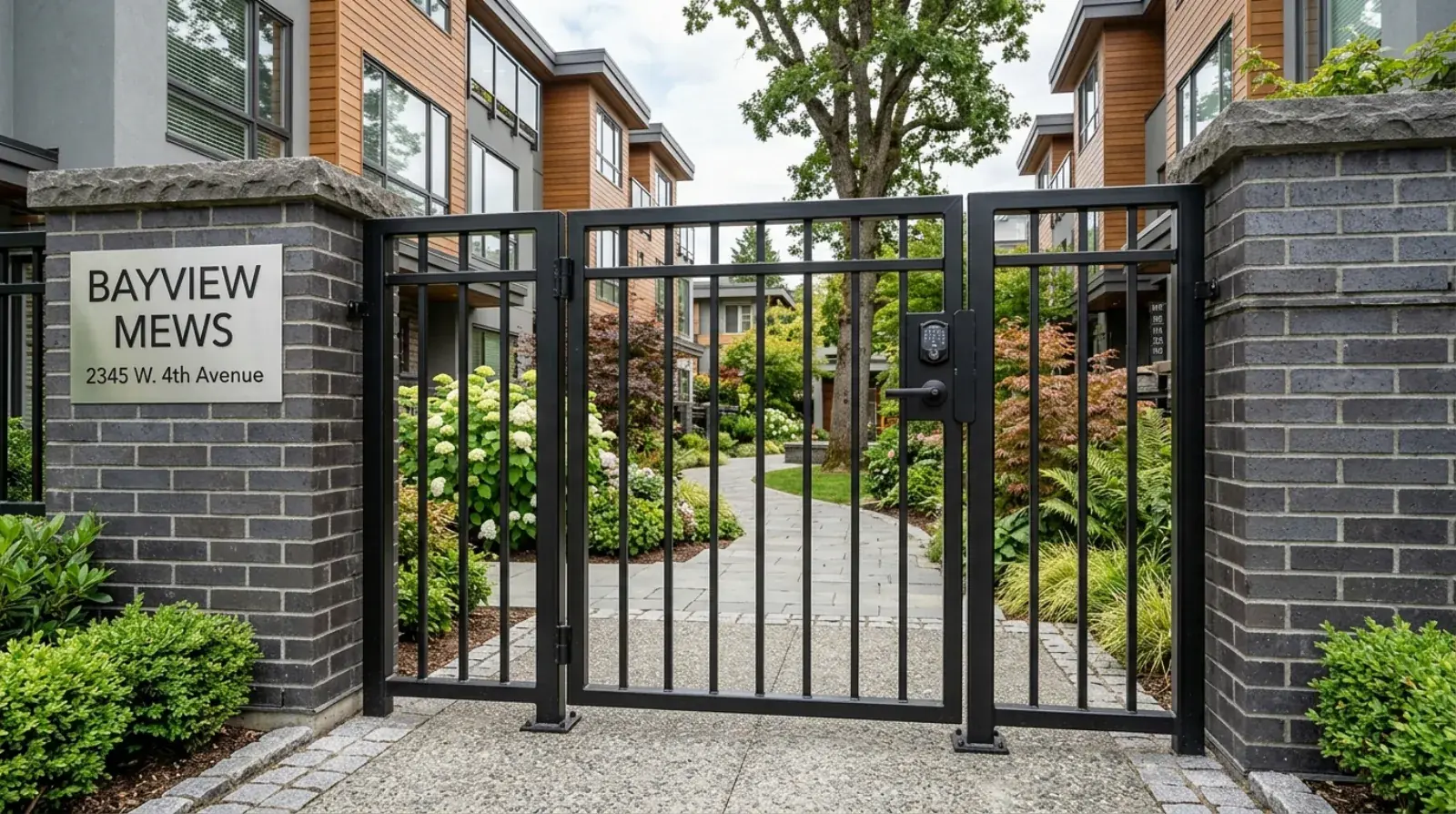
A gate on a single-family house in Point Grey gets opened maybe a dozen times a day, by people who own it and treat it accordingly. A pedestrian gate at the entrance to a Vancouver strata complex gets opened a hundred times or more, by residents, their guests, dog walkers, couriers dragging carts, and trades who have a key and zero reason to be gentle. That difference sounds small. It is the single thing that decides how a strata gate has to be built, and it is the thing most builders get wrong.
We fabricate gates for strata townhouse rows and condo courtyards across Metro Vancouver, and the calls we get are almost never about a homeowner’s gate wearing out. They’re about a shared gate that quit. The leaf has dropped, the latch won’t catch, the closer gave up, and now the council has a security hole and a list of frustrated owners. So before we talk about styles and finishes, it’s worth being clear about what makes a strata gate its own animal.
Shared use changes the whole spec
A house gate is a homeowner’s problem when it sags. A strata gate is everyone’s problem, all the time. That changes the engineering math more than people expect.
Cycle count is the headline. Commercial door and gate hardware is rated for cycles, the number of open-close motions before failure, and the good hinges and closers are rated into the hundreds of thousands. Residential hardware isn’t rated that way at all, because nobody assumed a house gate would see that kind of traffic. Put a residential-grade hinge and spring closer on a courtyard gate that a few dozen households use daily, and you’ve got a year, maybe two, before it’s done. We see that exact failure on older complexes constantly.
The frame matters too. A gate that swings a hundred times a day wants a stiffer leaf so it doesn’t rack and drop over time. We build strata leaves out of HSS (hollow structural section) tube rather than light angle, with welded corners rather than bolted, because a welded leaf holds square far longer under repetitive load. The steel is the cheap part of the longevity equation. It’s the hardware and the joint detailing that earn their keep.
Self-closing and self-latching is not optional at the pool
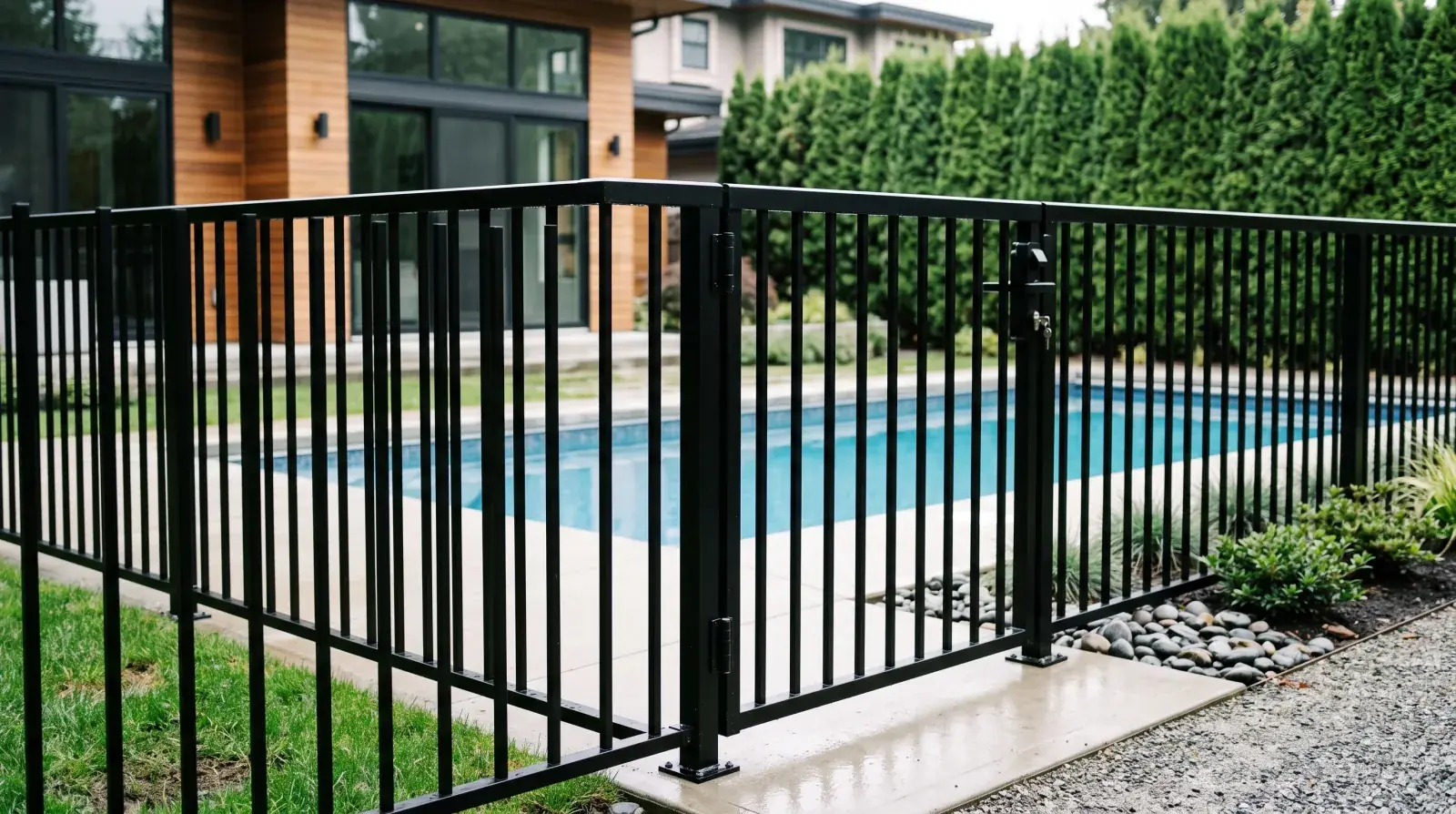
If the gate is part of a pool or hot tub enclosure, and a lot of Vancouver condo and townhouse complexes have one, it has to close and latch on its own. This isn’t a nice-to-have. Pool enclosure requirements fall under the pool regulation tied to BC’s Public Health Act, and they’re enforced by the regional health authority. In Vancouver that’s Vancouver Coastal Health, and they inspect these enclosures on multi-family properties.
In practice that means a self-closing hinge or closer that brings the gate fully shut every time, a self-latching mechanism that catches without anyone touching it, and a latch release mounted high enough that a small child can’t reach it from either side of the gate. The gate also can’t be left propped, we’ve seen complexes wedge a pool gate open for a summer party and forget about it, which is exactly the scenario the rule exists to prevent. When we build a pool enclosure gate, the closer and the high latch are part of the design from the first sketch, not bolted on after an inspector flags it.
Hardware that survives daily abuse
This is where strata gates live or die, so it’s worth slowing down on it.
The hinges carry everything. On a hard-use gate we run heavy commercial hinges, often a bearing hinge that takes the weight on a thrust bearing rather than grinding metal on metal every swing. The closer or spring hinge has to be rated for the cycle count and adjustable, because a closer that slams is a closer that gets propped open by residents who are sick of the noise, and a propped gate is a defeated gate.
Latches take the most direct abuse of anything on the gate. People push through with a hip, a stroller, a hand full of groceries. We use commercial latch hardware and reinforce the steel right at the latch and strike, because that’s the first place a lighter build wears out. If the gate carries an electric strike or maglock for the fob system, the frame gets built around that hardware with the mounting and conduit detailed in before the steel is finished.
One more thing that gets overlooked: the stop and the push zone. The spot where palms and shoulders hit the gate every day wears the finish faster than anywhere else. On a constant-use entry we’ll add a second powder coat pass or a tougher topcoat at those zones so the gate doesn’t show its wear in the first season.
Coordinating with fobs, intercoms, and access control
Most Vancouver stratas built in the last couple of decades run some kind of electronic access, fob readers, a maglock or electric strike, a buzzer-and-intercom panel at the pedestrian entry. A new gate has to play nicely with whatever system the building already owns.
We handle this the same way a commercial railing contractor coordinates with the other trades on a site: figure out the interface early, detail it into the steel, and don’t make the next trade fix our work. The gate frame gets built to house the strike or maglock, with conduit runs and a clean mounting point so the access control installer plugs into a gate that’s ready for them. The alternative, handing over a finished, powder-coated gate and asking someone to drill it on site for wiring, wrecks the finish and the warranty in one go.
If the strata is adding access control at the same time as the gate, we get the access control trade into the conversation before fabrication starts. Coordination on paper is cheap. Coordination with an angle grinder on a finished gate is not.
The council approval process
Here’s where a strata gate diverges hardest from a residential job. A homeowner decides on a gate over coffee. A strata has to go through council, and sometimes the whole ownership.
Common property alterations in a BC strata are governed by the Strata Property Act, and changing or adding a gate on common property generally needs council approval, and depending on the bylaws and the cost, sometimes a 3/4 vote at a general meeting, especially if the money comes out of the contingency reserve fund. That process moves at the speed of meeting schedules, not fabrication schedules.
What we’ve learned is to give council something real to approve. Shop drawings showing the gate, dimensions, hardware, and how it ties into the existing fence. A physical finish sample in the actual powder coat colour. A clear scope of what’s included. Councils approve faster when they can see exactly what they’re getting, and owners are far less likely to object at the AGM to something they can picture. Vague verbal proposals get tabled for another month. Drawings and a colour chip get signed.
Matching the existing complex
A strata gate should disappear into the property, not announce itself. The worst outcome is the one gate that’s obviously newer, taller, or a different shade than everything around it.
So we measure what’s already there, the picket or baluster spacing, the post profile, the rail heights, the finish colour, and build the gate to read as part of the same system. If the complex runs a clean contemporary steel look, that’s what the gate becomes: straight lines, matched spacing, blackened or powder-coated steel that sits in line with the existing fence. This is the same discipline that goes into deciding between a swing and a slide configuration on a driveway gate, the right answer depends on the site, the swing room, and how the gate has to behave for the people using it daily. For an overview of materials and styles across gate types, our guide to custom metal gates in Vancouver covers the ground.
Cost on a strata gate is driven by the same things as any custom steel: the size and weight of the leaf, the hardware grade, the finish system, whether engineering is required, and how much coordination the access control and site access demand. We don’t quote gates from a catalogue, because no two complexes have the same entry, the same existing fence, or the same access system to tie into.
If your council is staring down a gate that won’t latch, a pool enclosure that an inspector flagged, or a new entry that needs to match thirty-year-old fencing, request a quote and we’ll get you drawings and a finish sample your council can actually approve.