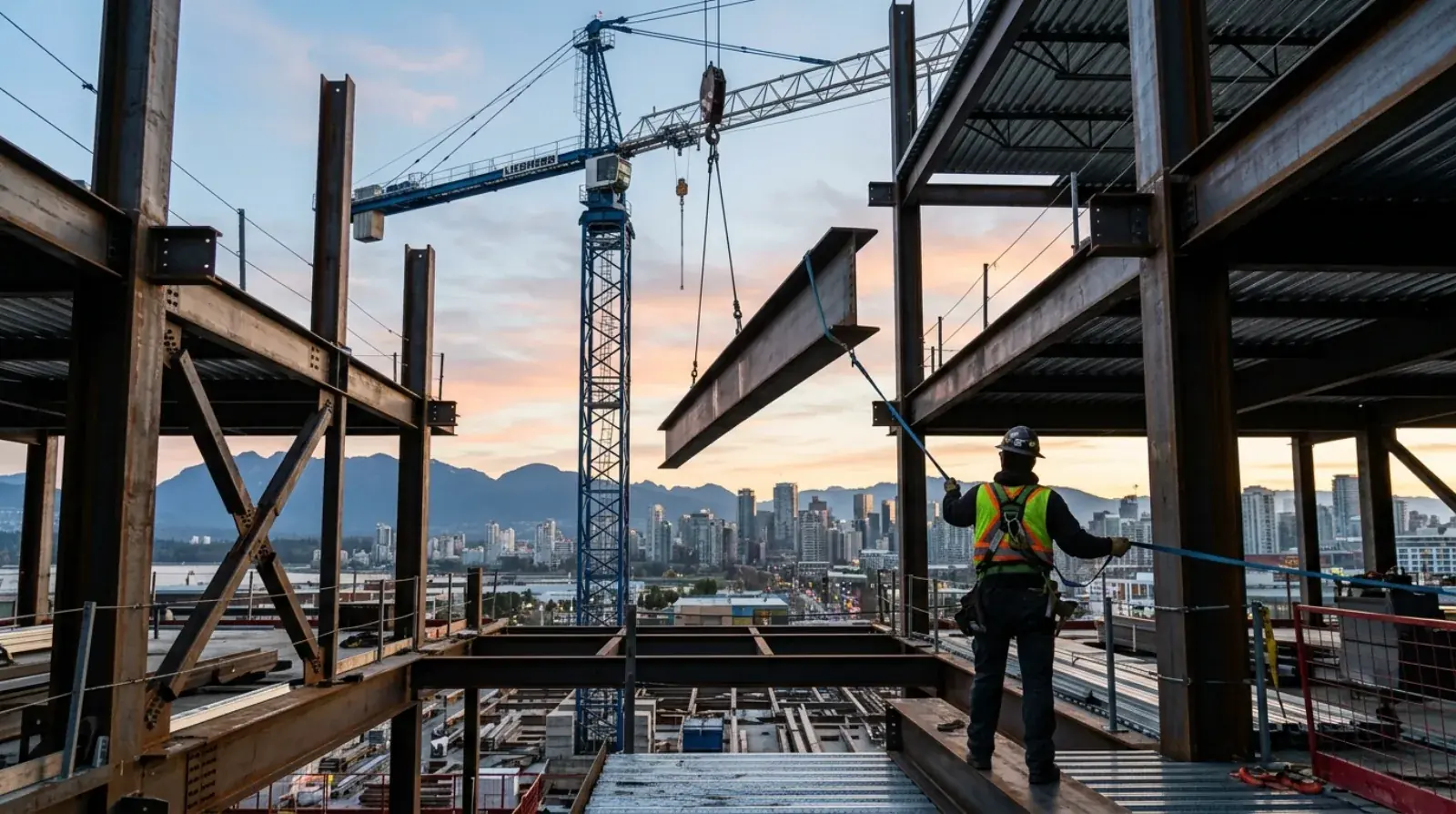
Erection day is the only day the steel package is visible. Months of detailing, review, and fabrication compress into a few days of crane work, and everyone on the project, including the neighbours, watches it happen. When it goes well it looks effortless. That look is bought in advance.
We fabricate and erect structural steel across Metro Vancouver from our Burnaby shop, and this post walks through what a good crane day involves, from the planning that happens weeks out to the last tensioned bolt.
The pick plan comes before the crane
Every lift the crane will make gets worked out on paper first. Which piece, in what order, picked from where, landed where, at what radius. For routine beams that is a sequence list. For heavy or awkward pieces it is a proper engineered pick: verified piece weight, crane capacity at the actual working radius, rigging arrangement, and the path the load will travel.
The reason this happens weeks early is that the hardest pick sizes the crane. Crane capacity falls off fast with radius, so a moderately heavy piece landed deep in the building can demand a bigger machine than a very heavy piece landed close. For a sense of what a heavy single-member pick involves, this video from one of our Vancouver projects shows a 40 foot, 13,000 pound steel beam going in: one piece, one pick, and a plan built around it.
Rigging gets the same forethought. Shackle and sling capacities, pick points that keep the piece stable in the air, tag lines for control. Ironworkers rig hundreds of routine picks from habit and skill, but the unusual ones, unsymmetrical pieces, assemblies that want to rotate, are identified in the plan, not discovered on the hook.
Mobile crane, tower crane, and who owns the hook
On sites with room, a mobile crane arrives for dedicated steel days: set up in the morning, fly steel all day, and the steel crew owns the hook. Simple to plan, efficient when the steel is sequenced, and the standard arrangement for low and mid-rise work around Metro Vancouver.
Urban projects change the arithmetic. On a downtown Vancouver or Burnaby high-rise site there is often a tower crane already standing, and the steel goes up on it, which means the steel crew is one of several trades sharing scheduled hook time. That changes behaviour. Loads must arrive manifested to the minute, because a truck that misses its window may wait days for the next one. Picks are planned to make every hook hour count. And the fabricator’s delivery discipline, the bundling and tagging we described in structural steel sequencing on commercial sites, stops being good practice and becomes the whole ballgame’s quieter cousin: the difference between a crew that erects and a crew that waits.
Either way, crane coordination is a three-way conversation between the erector, the GC’s site logistics, and the crane operator, and it starts when the erection plan is drafted, not when the crane is booked.
Lane closures, night windows, and the urban squeeze
Metro Vancouver infill sites add a constraint most erection guides skip: the crane often has to stand in the street. That means a lane closure or full road closure permit from the municipality, traffic control, and a working window the city defines, which may be early morning, a weekend, or overnight.
A permit window is a hard boundary. If the closure runs six hours, the plan is built backwards from six hours: crane set-up time, number of picks that realistically fit, trucks staged nearby so steel feeds the hook without a gap, and a defined stopping point that leaves the structure stable when the window closes. Preloading the risk matters too. Utility clearances checked, overhead lines identified, crane mats positioned, and the first truck confirmed loaded in sequence the night before. The crews that look calm at 3 a.m. on a Granville-corridor lift are the ones who did their improvising the week before.
Night windows also change small things people forget: lighting for signal visibility, noise limits on impact tools, and neighbours who will absolutely call the city about the wrench you ran at 2 a.m. It all goes in the plan.
Hanging steel is half the day, plumbing it is the other half
Steel goes together loose. Each piece is landed, pinned, and bolted snug so the frame stands, but a frame that is merely standing is not yet a frame that is finished. Columns leaning a fraction of a degree, beams a few millimetres off level, all of it within erection tolerance so far, and all of it needing correction before anything is final.
Plumbing and aligning is the unglamorous discipline that follows the picks. The crew works the frame with guy cables, turnbuckles, and survey instruments, pulling columns to vertical and lines to true, checking against the tolerances on the drawings. Only then does final bolt tensioning happen, snug-tight where the drawings allow, calibrated tensioning on slip-critical connections, locking the corrected geometry in place.
This sequencing is why an experienced erector resists pressure to fully tension early. Once connections are final-tensioned, the frame’s geometry is fixed, and fixing the wrong geometry means undoing work. Every trade that follows, deck, envelope, elevators, stairs, builds off the steel, so millimetres surrendered here surface as centimetres somewhere above the third floor.
Bolts where possible, welds where necessary, discipline everywhere
Field connections are bolted wherever the detailing allows, and that is a deliberate choice made back in the shop drawing phase. Bolting is faster, works in weather that shuts welding down, and inspects cleanly. Field welding still has its place, connections that geometry will not let you bolt, and heavy moment connections the engineer details as welded, but it arrives with requirements: the same CWB certification to CSA W47.1 that governs the shop floor, qualified welders, approved procedures, and inspection on site. That continuity between shop and field is part of what our CWB certified welding covers, and it is worth confirming any erector you hire can show the same.
Wrapped around all of it is the safety discipline that makes the rest possible. Ironworking is connected work at height under suspended loads, and a good crew runs it accordingly: morning toolbox talk covering the day’s picks, fall protection from the first connection, controlled access zones under the hook, one designated signaller talking to the operator, and the standing authority for anyone to stop a pick that does not look right. None of this slows a good crew down. It is what lets them move fast without gambling, and from the GC’s trailer, it is the most visible indicator of whether your steel contractor’s paperwork matches their practice.
A well-run erection day is the final exam for the whole package: the scope work, the shop drawings, the sequencing, the fabrication quality all get graded in public, by a crane. Our guide to structural steel for general contractors covers how to set the earlier stages up so this day goes the way this post describes. Planning steel for a Metro Vancouver site with real access constraints? Send us the drawings and the site plan, and we will tell you how we would fly it.