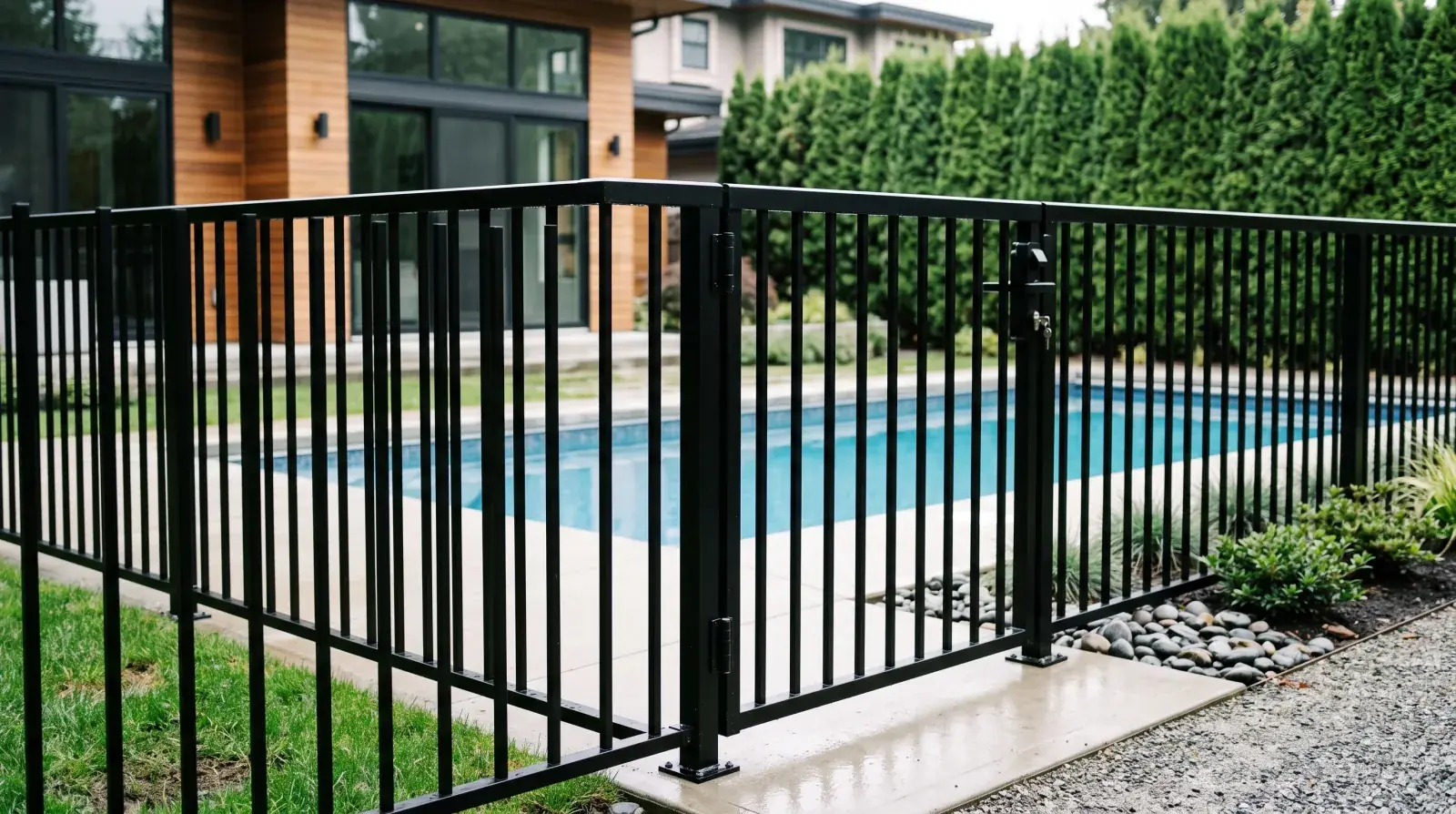
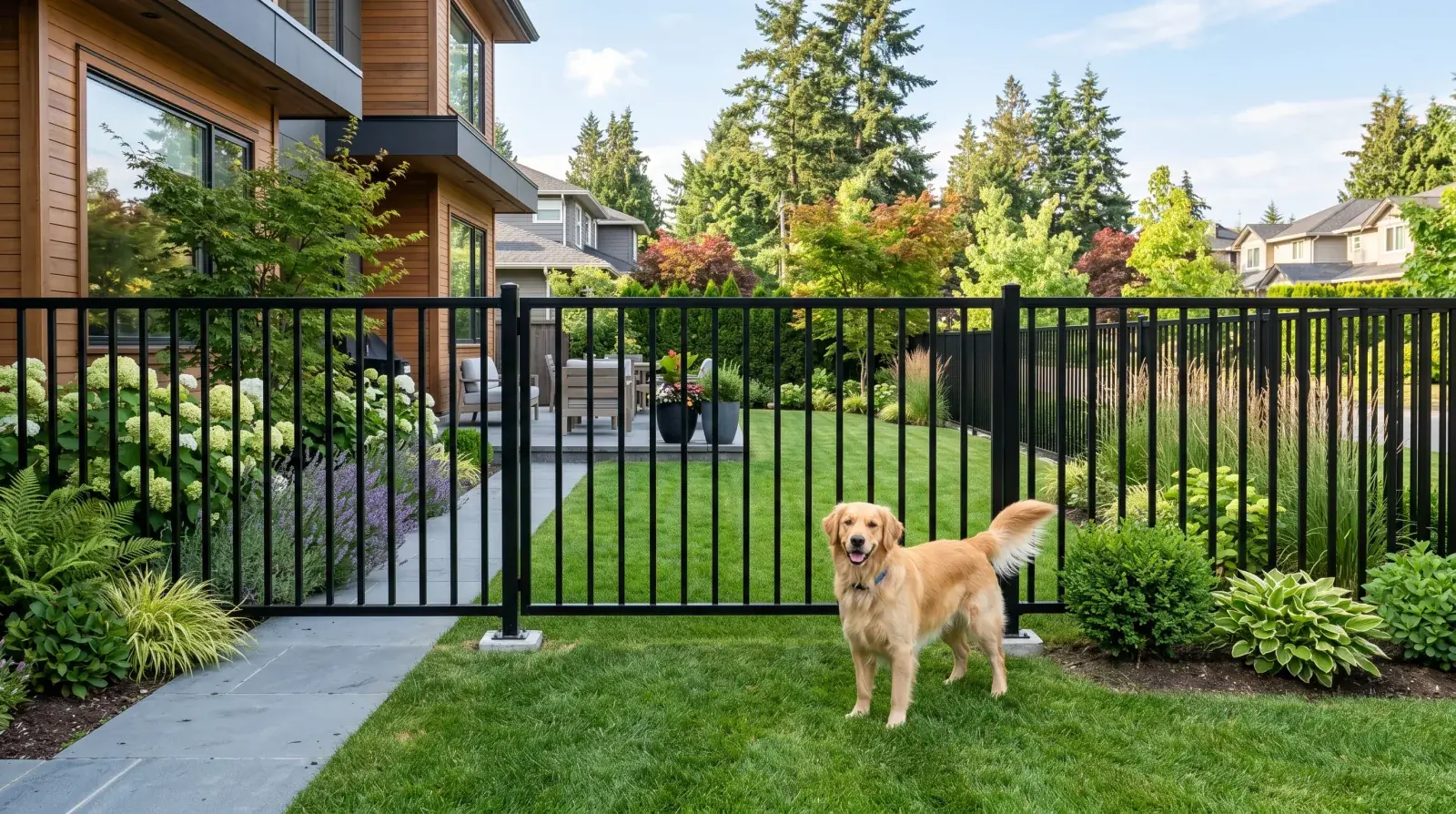
A custom steel dog fence is a deceptively specific project. The same shop that fabricates a decorative property line fence has to think completely differently when the design driver is an animal that has all day to look for a way out. The detail decisions aren’t about looks, they’re about whether the fence does its job.
We get the call regularly to replace fences that didn’t last a week against a determined dog. Here’s what actually goes into a fence designed for the animal, not just the property line.
Height isn’t a single number
The right height for a dog fence depends on the dog. A small breed contented by a 1.2-metre (4-foot) fence won’t notice it. A medium-energy dog that occasionally tries to see over the fence is fine at 1.2 to 1.5 metres. A high-energy athletic breed, a Lab, a Belgian Malinois, a Husky, needs 1.5 to 1.8 metres, and even then a motivated dog can clear that.
There’s no universal answer. The conversation starts with the specific dog: breed, size, age, and any history of jumping or escape attempts. A senior dog with arthritis isn’t going to clear a fence; a year-old athletic dog might clear anything under 1.8 metres.
The complication is that municipal bylaws cap fence height in front yards. Vancouver typically allows 1.2 metres in the front yard and taller in side and back yards. Burnaby and other municipalities have similar rules with slightly different specifics. If the dog needs more height than the front-yard bylaw allows, the secure area for the dog has to be the side or back yard, and the front yard fence is decorative rather than functional.
We design around this constraint, sometimes the front yard fence is a property-defining element, and a taller secure gate from front to back yard contains the dog without breaking the bylaw.
Picket spacing for the actual dog
The BC Building Code’s 100-millimetre sphere rule is the standard for guards protecting people. For a dog, the right spacing depends on the breed.
For most medium and large dogs, 100 mm matches the code requirement and works fine. For small breeds and puppies, Chihuahuas, Yorkies, miniature Dachshunds, 100 mm is too generous and the dog will squeeze through. We tighten to around 75 mm for small dogs, sometimes even tighter for puppies that will grow into a larger frame.
The rule of thumb we use: the spacing should be smaller than the dog’s chest at its narrowest point, with margin. If you’re not sure, measure the dog and bring the number to the design conversation.
The bottom of the fence is where diggers escape
A fence that terminates at grade, pickets stopping at the soil line, is a fence with a built-in escape route for any dog that digs. Some dogs will never dig; others discover the trick and use it immediately.
For known diggers we detail one of three solutions:
Concrete grade beam: a continuous concrete beam under the fence, set into the soil so the bottom of the pickets terminates in solid concrete. The dog can’t dig through concrete.
Horizontal underground skirt: a horizontal section of steel mesh or sheet extending inward from the base of the fence, buried under grass or mulch. When the dog digs at the fence line, it hits the horizontal skirt instead of finding open soil. This is invisible after install and effective for most diggers.
L-shaped footing: the bottom of the fence extends downward and then inward in an L, set into a trench. Combines the depth of a grade beam with the horizontal extent of a skirt.
The right answer depends on the soil, the landscaping, and the dog’s specific behaviour. For known persistent diggers, we recommend the grade beam, it’s the most definitive solution. For dogs that dig occasionally, the horizontal skirt is less invasive and usually sufficient.
Retrofitting these solutions after the fence is up is significantly harder than detailing them in originally. If digging is a risk, address it at the design stage.
Picket tops: flat or radiused, not pointed
A traditional ornamental fence has pointed picket tops, fleur-de-lis, spear tips, or other pointed details. These look fine on a heritage fence but they’re a real injury hazard for a dog attempting to climb the fence. A dog hung up on a pointed picket is among the worst injury scenarios in fencing.
For dog fences we use flat-topped pickets, round caps, or smooth radiused tops. The visual is still strong, a clean horizontal line at the top of the fence reads modern and intentional, and the safety risk disappears.
This is also true for shared fences where neighbouring properties might have dogs. A modern fence with safe picket tops is the responsible choice on any property with pets nearby.
Gate hardware: assume the dog will try everything
A dog with patience can manipulate gate hardware. Standard latches that lift with a paw, gates that aren’t tight against the post, and gates without self-closing hinges all fail eventually.
Our standard gate hardware on dog fences:
- Self-closing hinges: the gate returns to closed without needing to be pushed. People forget; the hinges don’t.
- Latch positioned high on the people side: out of reach of a tall dog standing on the gate.
- Two-step latch or secondary lock: a single-action latch can be opened by a smart dog with the right paw motion. A two-step latch, lift and pull, or rotate and slide, resists this.
- Tight gate-to-post clearance: a dog with a narrow head can fit through surprisingly small gaps. The gate has to close tight against the post.
For yards with multiple gates we use the same hardware throughout so the homeowner doesn’t have to remember which gate behaves which way. The discipline is consistency.
Bylaw vs guardrail vs garden fence
A common Vancouver dog fence installation actually combines three different functional requirements:
- The fence around the perimeter is governed by municipal bylaws for height, setback, and visibility from the street.
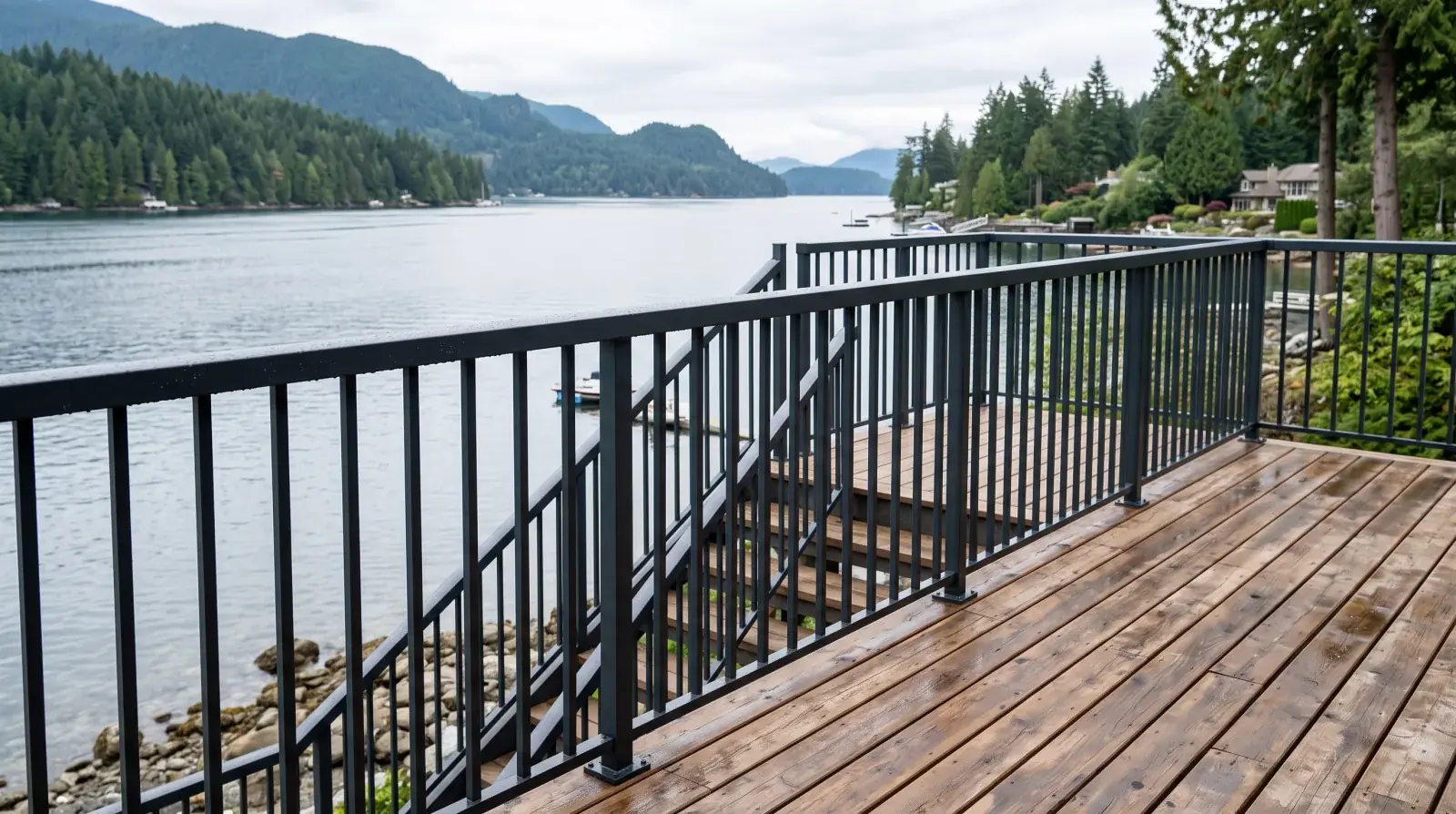
- Where the fence runs along the top of a retaining wall or any drop, it’s also a guardrail under the BC Building Code, with height and infill requirements.
- Where the fence is a freestanding garden fence on flat ground, neither the building code nor the front-yard bylaw drives the height, the dog does.
We design the assembly as one fence meeting all three sets of requirements where they overlap. The pickets, the height, and the post setting transition cleanly between the different functional zones without the fence reading as three different fences.
Finish and durability
For outdoor steel fencing in Metro Vancouver, the default is hot-dip galvanized with a powder coat. The galvanizing vs powder coating decision is well covered for our climate, hot-dip plus powder coat handles decades of rain, the colour stays consistent, and the finish doesn’t fail at the welds or the post bases.
Colours are flexible: matte black is the most common, but any RAL colour is available through powder coat. We match existing metalwork on the home or pick a colour that disappears against the landscape, depending on the design intent.
Coordinating with the rest of the property
If the property already has custom metalwork, a front gate, an entry railing, an architectural feature, the dog fence should usually coordinate with it. The picket profile, the post style, and the finish all read together when they match. Doing the dog fence as a separate kit fence next to a custom front gate makes the property look fragmented.
For coordinated installations we design the full property metalwork as a set: front gate, side gates, perimeter fence, and any additional features all worked out from the same design language. That way the property reads as designed rather than assembled from catalogues.
If you’re spec’ing a dog fence in Vancouver, Burnaby, or anywhere in Metro Vancouver, tell us about the dog and the yard and we’ll detail a fence that does its job, for the dog, for the bylaw, and for the look of the property.