Ask any structural steel fabricator where they want their welds made and you will get the same answer: in the shop, under a roof, with the piece fixtured at waist height. Field welding is a normal part of the trade and we do plenty of it, but every weld that moves from the site to the shop gets better, cheaper, and easier to prove.
This post explains why that is true, when field welds are genuinely unavoidable, and how a fabricator plans a structural steel package so a GC pays for as few field welds as possible.
Position is most of the story
Welding has positions, and they are not equal. Flat and horizontal welds let gravity help the welder: the molten pool sits where it is put, travel speed is higher, and the odds of a defect are lower. Vertical and overhead welds fight gravity the whole way. They demand more skill, run slower, and leave less margin for error.
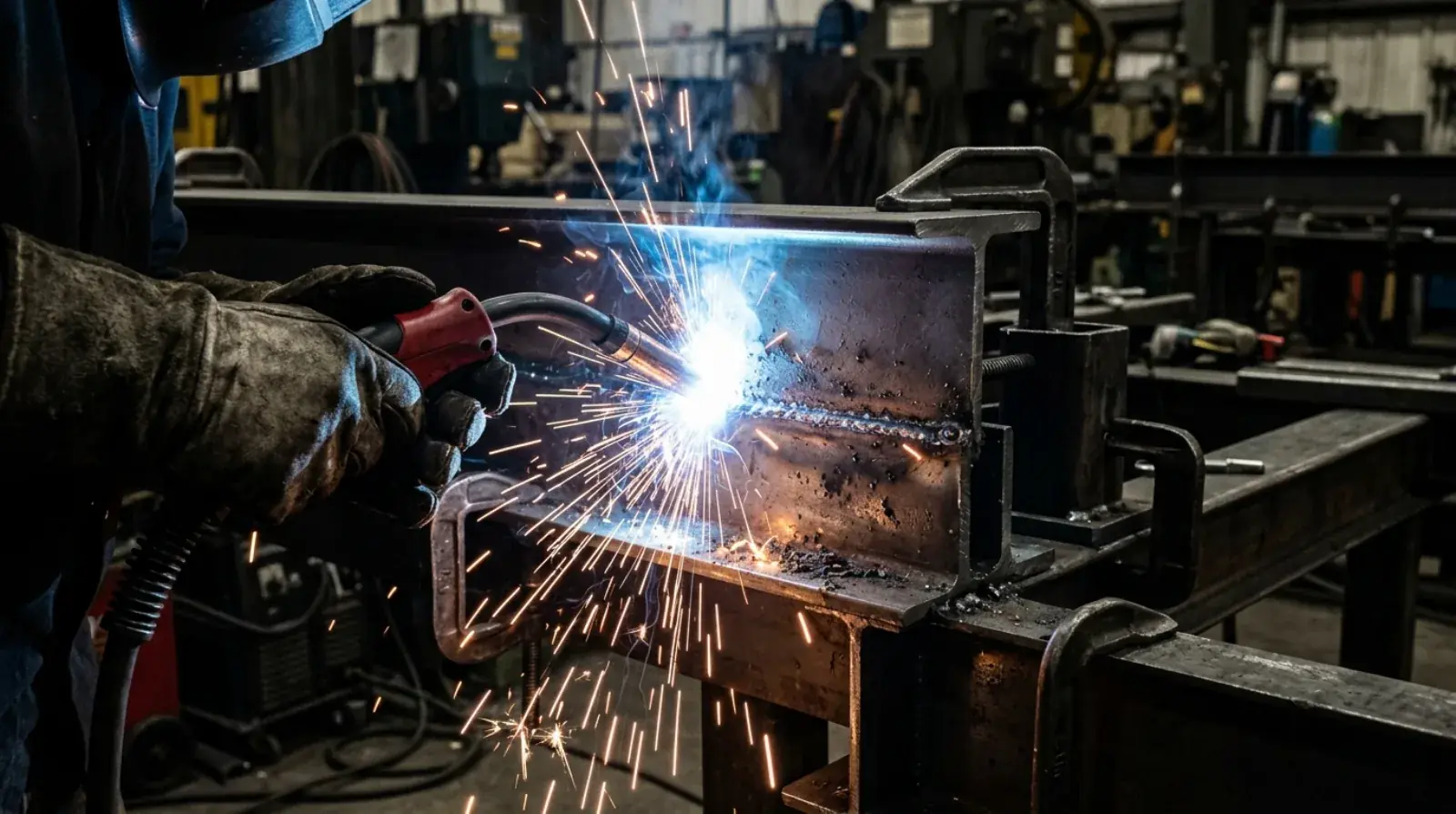
In our Burnaby shop, position is a choice. We fixture assemblies and rotate them so nearly every weld is made flat or horizontal, even on a piece that will stand vertically in the finished building. A column base plate gets welded with the column lying down. A stair stringer assembly gets turned over between sides.
On site, position is dictated by the building. The steel is already standing, so the welder welds the joint where it is: vertical on a column splice, overhead under a beam flange, whatever the geometry demands. A qualified welder can make sound welds in every position, and certification testing proves it. But the same welder, same joint, same day will produce faster and more consistent work in the shop, every time.
Environment and access do the rest
The shop gives a weld clean, dry, warm steel, steady power, good light, and a welder standing on the floor. The site frequently offers none of those.
Moisture is the big one in this region. Welding on wet steel risks hydrogen in the weld, which can crack it, so rain in Metro Vancouver means hoarding and preheat, or waiting. Cold steel needs preheating before welding. Wind strips shielding gas away from certain processes, which limits what can be run outdoors. None of this stops field welding, but all of it adds setup time, equipment, and judgment calls that a shop weld never needs.
Then there is access. A field welder often works from a boom lift or scaffold, with hot work permits, fire watch, and fume control if the work is inside an occupied building. Each of those is labour that produces no weld metal. When we ran the numbers on our own projects, from warehouse work in Delta to tenant improvements in downtown Vancouver, access and setup routinely cost more hours than the welding itself.
Inspection follows the same pattern. A shop weld gets inspected beside the work, at floor level, with the surface clean. A field weld gets inspected wherever it lives, sometimes from the same lift the welder just left. Same standard, harder verification.
When field welding is the right answer
None of this means field welding is bad work. It means field welding should be deliberate. Several situations call for it and no amount of planning removes them.
Connections to existing structures lead the list. When new steel ties into a building that has been standing for decades, the existing member is rarely where the drawings say, and drilling accurate bolt holes into it may be impractical. A field weld absorbs the tolerance that a bolted connection cannot.
Oversize assemblies are next. A truss or a long transfer girder that cannot be trucked in one piece needs field splices, and the engineer decides whether those splices are bolted or welded. Some seismic connections are designated as field welded by design, because the engineer wants weld behaviour at that joint. And modification or repair work directed on site is field welding by definition.
The point for a GC: when a field weld appears in a package, it should be there for a reason someone can state. If nobody can say why a joint is field welded instead of bolted, that is a question worth asking before erection, not during it.
One certification covers both, and it is not optional
Structural welding in Canada runs under CSA W47.1, the company certification standard administered by the Canadian Welding Bureau. The certification belongs to the company, and it travels with the company’s work. Our shop welds in Burnaby and our field welds on a site in North Vancouver sit under the same certificate, the same approved welding procedures, the same qualified welders, and the same supervision requirements.
That matters because a surprising amount of field welding on construction sites happens outside this system. A trade with a welder and a machine tacking something structural to the frame is not the same thing as certified structural welding, and when the building inspector or the engineer of record asks for the paperwork, there is none. The requirements reach BC projects through the BC Building Code, and our CWB certified welding page covers what the certification involves.
For a GC, the check is simple: every structural weld on your project, shop or field, should trace back to a W47.1 certified company. Ask for the certificate before award, not after a failed inspection.
How we plan a package to keep welding in the shop
The shop-versus-field balance is settled at the detailing stage, months before a crane arrives. Three habits drive it.
First, we choose shipping splits early. Every assembly is welded up to the largest size that can be trucked from Burnaby and lifted at the site, and the splits between assemblies are detailed as bolted connections wherever the engineer’s design allows.
Second, we raise constructability comments during shop drawings. When a drawn detail calls for a field weld that could be a bolted connection carrying the same forces, we propose the change through the proper submittal channel. Engineers accept these more often than not, because nobody wants avoidable field welding either.
Third, we plan the field welds that survive. Position, process, preheat, weather protection, and inspection access all get decided before erection day, because a field weld improvised on site is the slowest kind. This planning is part of why our crane days run the way they do: bolted steel goes up fast, and the few welds that remain are ready to run.
The result on a well-planned package is a site where most connections are wrenches, not welding leads, and the schedule shows it.
If you are tendering a steel package and want to understand where the welding in it will happen, our guide to structural steel for general contractors covers the questions to ask, or send us your drawings and we will walk you through the shop-versus-field split on your actual scope.