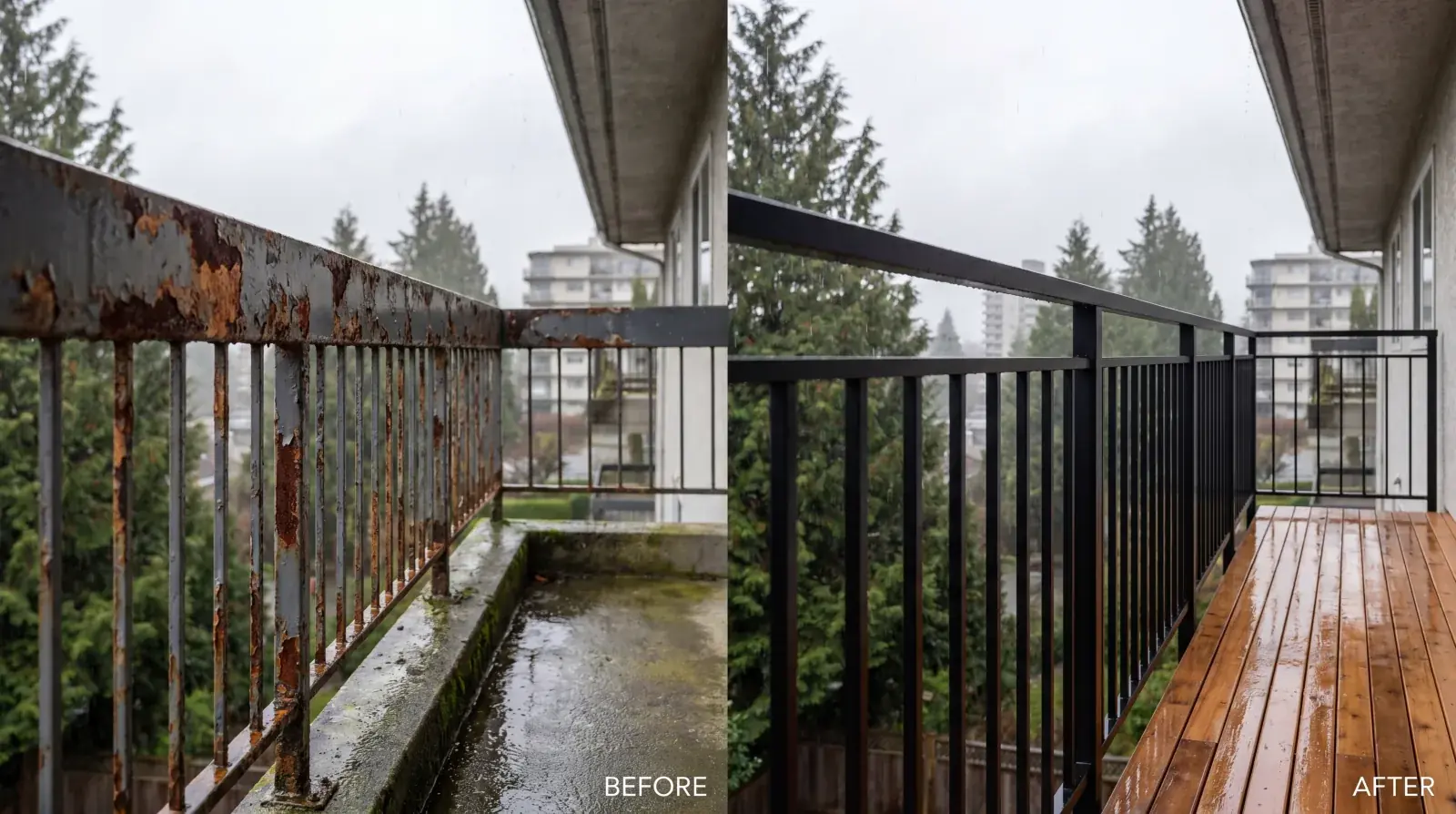
Vancouver rain does not forgive a bad railing finish. We regularly get calls from homeowners who noticed a few rust spots on a deck railing and assumed a can of black spray paint would fix it, only to find that the rust goes deeper than the surface and the railing that looked solid from across the yard is no longer safe to lean on.
Not every rusted railing needs replacement. But every rusted railing needs an honest assessment, and most of the ones we look at in Metro Vancouver have gone past the repair stage before the owner noticed. This is how to tell the difference, what full replacement actually costs, and how to make sure the new railing does not end up in the same condition in 12 years.
The quick assessment: repair or replace?
You can do this in five minutes with a screwdriver and a flashlight. Walk along the railing and check three things.
1. Press a screwdriver into every rusted area. Use firm pressure, not a punch. Sound metal will not give. Compromised metal will either flake off in chunks or let the screwdriver punch through. If you can push the tip of a screwdriver through the metal anywhere on a guardrail, that section is structurally unsafe and needs replacement.
2. Inspect the base plates and anchor points. Look where the railing meets the deck, balcony, or wall. Check under the base plate if you can access it. If there is rust flaking off the base plate, rust staining running down the deck below, or visible corrosion at the bolt heads, the mounting is compromised. Base plate corrosion is always structural because those points carry the guard’s lateral load from BC Building Code, a rusted base plate means the railing can separate from the deck under a person’s weight pushing against it.
3. Examine the welds and post-to-rail joints. Rust that has eaten into a weld bead means the joint has lost strength. This is particularly important at the post-to-top-rail connections and at any splice joints along the top rail. A weld with deep pitting cannot be trusted to carry load anymore.
If all three tests come back clean, the metal is solid, the base plates are intact, the welds are just cosmetically rusted, you may have a repairable railing. If any of the three fail, you are looking at replacement.
What surface rust repair actually involves
For a railing that passes the screwdriver and base plate tests but has visible surface rust, a proper repair is possible and much cheaper than replacement.
The process:
- Mechanical rust removal. Wire wheel, sandpaper, or needle scaler to remove all loose rust and scale down to clean metal. Chemical rust converters work on light surface rust but do not remove heavier scale.
- Degreasing. Wipe down with solvent to remove any residual oil or contaminants before priming.
- Rust-inhibiting primer. Epoxy primer or zinc-rich primer applied to the cleaned metal. This is the critical step that prevents future corrosion from starting where the repair was done.
- Topcoat. Two coats of quality exterior enamel or polyurethane paint, or a professionally applied powder coat if you can bring the railing to a shop. Matte black is the most common Vancouver choice and matches most existing railings closely enough for touch-ups to blend.
| Repair type | Scope tier | When it works |
|---|---|---|
| Touch-up at localized spots | Baseline | Isolated rust, sound base metal, <10% of railing affected |
| Full surface rehab, sanded and recoated in place | Baseline, mid | Widespread surface rust, structurally sound, access allows on-site work |
| Remove, shop-blast and powder coat, reinstall | Mid-range | Rust too advanced for in-place repair, but metal still sound |
| Full replacement with new custom steel | Premium | Any structural rust, base plate failure, or weld corrosion |
Most DIY rust repairs fail because step 1 or step 3 gets skipped. Painting over rust without removing it thoroughly is the most common mistake, the rust continues underneath the paint and the new coating lifts within 18 months in Vancouver’s wet climate.
When the repair conversation shifts to replacement
In practice, maybe 30% of the rusted railings we look at in Metro Vancouver are genuinely repairable. The rest have at least one of these conditions that make replacement the correct call:
Base plate corrosion. The most common reason for replacement. Water pools on deck surfaces at the base of posts, gets wicked under the base plate, and sits there. After 10 to 15 years on a poorly finished railing, the steel plate is eaten through. You cannot repair this without removing the railing anyway, at which point new fabrication is usually the better value.
Through-section pitting on guardrail members. If the top rail or post has rust pits that have reduced the cross-section by more than 20%, the structural capacity is compromised. BC Code requires guards to resist a specific lateral load, and pitted metal cannot be counted on to meet that load. Full replacement is the correct response.
Weld joint corrosion. Welds concentrate stress and are the first place a compromised connection will fail. Rust that has eaten into the weld bead or the heat-affected zone around the weld means the connection is no longer rated for load. Replacement is the safe call.
Galvanic corrosion between dissimilar metals. We see this often on older aluminum railings held together with steel bolts, or steel railings bolted to aluminum brackets. The corrosion happens at the contact point between the two metals and spreads outward. You cannot repair it selectively, the whole connection has to be redesigned with compatible materials, which usually means replacement.
Widespread finish failure. If the original powder coat or paint is flaking off across more than half the railing, the system has failed and touching up is a losing battle. The labour to prep, clean, and recoat an entire railing in place often exceeds the cost of new fabrication, and the result is inferior to a shop-applied finish.
What a replacement actually costs
A typical rusted railing replacement project in Metro Vancouver has three cost components: the new railing fabrication and installation, the removal and disposal of the old railing, and any structural repairs discovered during removal.
New railing fabrication and installation
| Replacement material | Tier | Notes |
|---|---|---|
| Prefab aluminum picket | Baseline | Quickest and cheapest; limited design |
| Custom welded steel, galvanized + powder coat | Mid-range | Most common replacement spec |
| Stainless steel 316 (marine grade) | Premium | For waterfront and direct salt exposure |
| Cable railing with steel posts | Mid-range | Preserves view, modern appearance |
| Glass-and-metal hybrid | Premium | Premium option, more maintenance |
| Custom wrought iron / ornamental | Mid-range | Heritage or traditional aesthetic |
Every replacement is quoted per project. Request a quote for pricing on your scope.
Removal and disposal
Removal of the existing railing and disposal is quoted per project. Higher numbers apply to:
- Railings that have to be cut into pieces because the connection hardware is rusted solid
- Railings with concrete embedment that needs chiselling out
- Second-storey and higher balconies that require carrying materials up and down stairs or rigging them over the edge
- Hazardous paint (pre-1990 lead-based paint requires specific handling and disposal)
Structural repairs at the mounting points
This is the wildcard in any replacement project and the thing most homeowners do not budget for. When we pull a rusted railing off, we find one of three conditions:
Condition 1: Clean mounting structure (about 30% of replacements). Base plates pop off, the deck surface underneath is sound, and the new railing can be installed with new bolts into the existing structure. No additional repair cost.
Condition 2: Localized repair needed (about 50% of replacements). A couple of bolt holes are wallowed out, or a small section of rim joist is soft from water infiltration. The repair gets handled during the new railing install and is itemized separately.
Condition 3: Substantial repair needed (about 20% of replacements). The rim joist is rotted for several feet along the railing line, the deck ledger needs replacement, or the waterproofing membrane has failed and is leaking into the structure below. Repair costs can be significant and may involve a carpenter or deck builder in addition to our crew. On the worst cases we have seen in older Burnaby and New Westminster homes, hidden structural damage has multiplied the original railing replacement budget.
The safe move is to budget 10 to 20% contingency on any railing replacement project for unexpected structural repairs. On a project where the contingency is not needed, that money stays in your pocket. On a project where it is needed, you have the budget to do the job properly rather than rushing a half-repair.
Why railings rust in Metro Vancouver (and how to prevent it next time)
Understanding what caused the original railing to fail helps avoid the same outcome on the replacement.
Inadequate initial finishing. By far the most common cause. The original installer applied a spray-can primer over bare mild steel and topcoated with a hardware-store enamel paint. It looked fine for 3 to 5 years and then started rusting at every joint, scratch, and base plate. A proper shop finish, sandblast, hot-dip galvanize, powder coat, costs 2 to 3× more upfront but lasts 25 to 40 years instead of 10 to 15.
Scratches and chips never touched up. Even a well-finished railing will accumulate small scratches and chips from furniture, pets, and general use. If those exposed spots of bare steel are not touched up promptly, rust starts and spreads underneath the surrounding coating. A small tube of matching paint and a 10-minute annual inspection prevents most of this.
Galvanic corrosion at bolted connections. Steel bolts through aluminum, stainless bolts through mild steel, dissimilar metal contact at brackets, all of these create conditions for accelerated corrosion at the joint. Proper design uses matching metals or isolates dissimilar ones with nylon or rubber washers.
Base plate water pooling. Flat base plates on a deck surface collect water that wicks underneath and sits. Over time this rusts through the plate from both directions. Modern railing designs use sloped or drainage-cut base plates, or raised mounts that keep water moving away from the plate.
Wrong material choice for the environment. Mild steel in direct salt spray will corrode no matter how good the finish is, you need stainless 316 or a very specific duplex finish system for that environment. Some waterfront properties were built with mild steel railings that were never going to last on that site. Replacement in the right material solves the problem permanently.
See our galvanizing vs powder coating for coastal Vancouver article for more on finish systems and when each is appropriate. Our marine-grade metalwork guide covers stainless steel selection for waterfront sites.
The replacement spec that actually lasts in Vancouver
Based on what we install and what we see coming back for repair 15 years later, here is the replacement spec that holds up in Metro Vancouver’s climate:
For inland residential sites (most of Burnaby, Vancouver outside the waterfront, Coquitlam, New Westminster, Tri-Cities):
- Mild steel fabrication (A36 or A500 HSS)
- Hot-dip galvanized to ASTM A123 (not brush-applied cold galvanizing)
- Powder coat over the galvanized surface (duplex system)
- Stainless steel fasteners (grade 304 minimum) with nylon or neoprene isolation washers at dissimilar metal contacts
- Sloped base plates or drainage cuts to prevent water pooling
- Sealed post-to-rail joints to prevent moisture intrusion
This spec typically lasts 25 to 40 years with minimal maintenance.
For waterfront and direct salt exposure sites (West Vancouver waterfront, Deep Cove, False Creek, Horseshoe Bay):
- Stainless steel 316 fabrication throughout
- Electropolished finish or powder coat over the stainless
- 316 stainless fasteners
- Freshwater rinse as part of annual maintenance
This spec lasts 50+ years in the harshest Metro Vancouver conditions.
For strata and multi-family buildings:
- Engineered design with sealed drawings
- Galvanized and powder-coated steel for inland buildings, stainless for direct-exposure balconies
- Standardized components across all units for consistent appearance and easier future maintenance
- Document the spec and material certificates for the strata’s records
For the strata project scoping angle, our balcony railing replacement cost guide covers the multi-unit pricing and project management side of the work.
Getting a real quote on your railing
If you have a rusted railing and you are not sure whether it is repair or replacement, the fastest path to a real answer is a site visit. We can tell from 10 minutes on site whether the rust is cosmetic or structural, and we can give you a price for either the repair or the replacement.
For a quote request, send us:
- Photos, several angles including base plates, post-to-rail joints, and any visibly rusted areas
- Linear footage, rough estimate is fine at this stage
- Current railing material if you know it
- Site location, helps us estimate travel time for the site visit
- Urgency, is this an insurance or strata requirement with a deadline, or is it planning for next spring?
Request a quote with that information and we will respond within 2 to 3 business days. For urgent situations where a railing is actively unsafe, call the shop directly and we can usually get there within a week. A rusted railing that fails the screwdriver test should not be waited on, it is a liability issue until it is replaced.