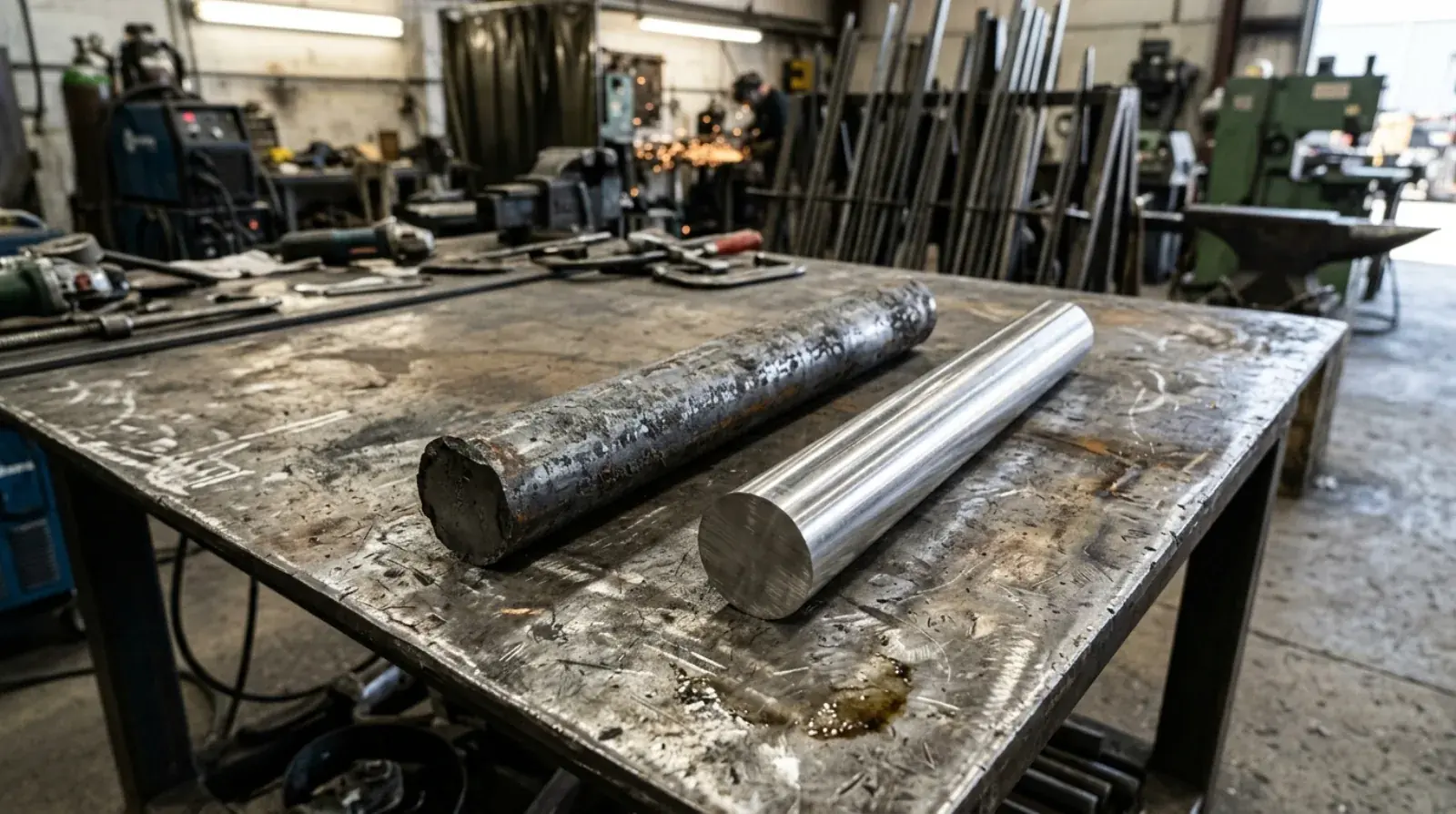
Pull two steel bars off our rack in Burnaby and they can look almost the same. Same dull grey, same square-ish shape, same weight in your hand. But one might cost noticeably more than the other, take a finish completely differently, and hold a tolerance the other never will. The difference isn’t the alloy. It’s how the steel was made, hot-rolled or cold-rolled.
This trips up homeowners and even some designers, because the labels sound like a small detail. They’re not. Getting the wrong one specified means either paying for precision a structural beam will never use, or fighting a rough mill-scale surface on a part that needed to be clean and bright. So here’s how each is made, what it looks like, where it belongs, and how to call it out so your project gets the right material the first time.
How each one is actually made
Hot-rolled steel is formed hot. The steel goes through the rolling mill above its recrystallization temperature, roughly 1,000°C, glowing red-orange, where it’s soft enough to be squeezed and shaped into beams, bars, plate, and hollow sections. Then it cools in open air. As it cools and shrinks, you can’t hold tight dimensions, so hot-rolled stock comes out with slightly looser sizing and softly rounded edges.
Cold-rolled steel starts as hot-rolled steel. The mill takes that hot-rolled product, lets it cool fully, then runs it through more rollers at room temperature. Working the steel cold does a few things at once: it squeezes the dimensions down to a tighter tolerance, smooths the surface, sharpens the edges to crisp squares, and hardens the metal because you’re deforming its grain structure. It’s the same base steel, a 1018 mild steel is 1018 whether it’s hot or cold finished, just put through more steps.
That extra processing is the whole story. Everything that follows comes back to it.
The visible differences you can see and feel
The fastest tell is the surface. Hot-rolled steel carries mill scale, a thin bluish-grey layer of iron oxide that forms as the hot steel meets the air on its way out of the mill. It gives raw hot-rolled that mottled blue-grey colour, a little rough to the touch, slightly inconsistent across the length. Designers in Vancouver have come to love that surface for blackened, industrial looks, and we get asked for it by name on restaurant and loft projects.
Cold-rolled steel has no scale. The surface is smooth, uniform, and a brighter grey, sometimes faintly oily from the rolling process. Run your hand along a cold-rolled flat bar and the edges are sharp and square; the hot-rolled equivalent has that softer, rounded edge.
Dimensionally, cold-rolled holds tighter. If a part has to slot into a machined assembly or sit flush against another precise component, the consistency of cold-rolled matters. Hot-rolled can vary enough across a batch that you’d have to dress it to fit a tight joint.
Where hot-rolled belongs
Most of what comes out of our shop is hot-rolled, and that’s the correct default. Structural shapes are all hot-rolled, wide-flange beams, channels, angles, and the hollow structural sections (HSS) we use constantly for posts, frames, and railings. You can’t economically cold-work a heavy structural section, so the category simply doesn’t exist in cold-rolled.
For a residential structural steel beam carrying a load over a removed wall in an East Vancouver character home, hot-rolled is what gets specified, sealed by the engineer, and bolted in. Same for railings, stair stringers, canopies, gates, and the bulk of architectural metalwork. The slight surface texture and looser tolerance don’t matter when the part is welded into an assembly and then finished. And when the design calls for that raw blackened look, hot-rolled mill scale is exactly what you want, you can’t replicate it with cold-rolled.
Where cold-rolled earns its place
Cold-rolled comes into its own when precision or surface appearance drives the part. Think tight-tolerance machine parts, small brackets that have to fit a fixed bolt pattern, decorative pieces where a flawless smooth face will be left exposed, and furniture-grade work, a steel table base or a console where every surface is seen and felt up close.
It’s also the standard for sheet and strip. Cold-rolled sheet is what you reach for when you need a clean, consistent flat surface across a panel. On a furniture piece going into a Yaletown condo where the client will run their hand along the steel daily, the smoothness of cold-rolled is the difference between something that feels finished and something that feels raw.
The decision often pairs with finish and material choices we cover in MIG vs TIG welding for residential metalwork, the cleaner the base material and the more visible the welds, the more the finishing detail shows.
The cost and tolerance trade-off
Cold-rolled costs more per pound. It has to, it’s hot-rolled steel plus extra rolling, sometimes an annealing step, and tighter quality control. You’re paying for the precision and the surface.
The question is whether your part needs what you’d be paying for. A structural frame doesn’t care about a fraction of a millimetre or a mirror-smooth face; it gets coated, and it carries load through its section size and connections, not its surface finish. Specifying cold-rolled there is money spent on a quality the part will never use. Flip it around: a precise exposed bracket built from hot-rolled means extra labour dressing edges and dealing with mill scale, and it still won’t match cold-rolled’s consistency.
Cost overall is driven by scope, material, finish, and site conditions, not by a price-per-pound chart. The hot-rolled-versus-cold-rolled choice is one input among several, but it’s one worth getting right because it’s cheap to specify correctly and expensive to fix after fabrication.
Finishing changes everything
Here’s where the choice connects straight to how your steel will look in five years. Mill scale is a poor base for most coatings. It flakes over time, and when it goes, it takes the paint or powder coat with it. So before we powder coat a hot-rolled part, we blast the scale back to clean bright steel so the finish keys into bare metal.
Hot-dip galvanizing handles it chemically, the steel goes through an acid pickle bath that strips the scale before it’s dipped in molten zinc. For exterior steel anywhere on the coast, from a North Vancouver deck railing to a West Vancouver gate, we lean on galvanizing or a duplex galvanize-plus-powder system because of the rain and salt air. The Canadian Standards Association publishes the governing spec for that coating, CSA G164 hot-dip galvanizing of irregularly shaped articles, and the scale-removal pickle is built into the process.
The blackened mill-scale look
When a designer wants the raw blue-grey mill scale kept as the finish, we go the opposite direction. We don’t blast it off, we clean and degrease it, then seal it with a clear matte lacquer or a hot-wax finish to lock the look in and stop the scale rubbing off onto hands and clothing. It’s an interior-only approach. Left bare outdoors, raw hot-rolled with intact scale will still rust where the scale is broken or thin, because mill scale isn’t a corrosion barrier. Indoors, sealed properly, it’s a finish you genuinely can’t fake with paint, and it’s become a signature look on Vancouver loft and hospitality projects.
How to specify it without guessing
You don’t need to memorize steel grades to get this right. Tell your fabricator two things: what the part has to do, and how it will be finished.
- If it’s structural, getting coated, or a little surface texture is fine, it’s hot-rolled.
- If it needs tight tolerances, a bright exposed surface, or it’s furniture-grade, call out cold-rolled.
- If you want the raw blue-grey mill-scale look kept and sealed, say so explicitly, otherwise it gets cleaned off during normal finishing prep, and you can’t put it back.
That last point catches people. The default assumption in a shop is that mill scale comes off, because most parts get coated. If the scale is the look you’re after, it has to be on the drawing or in the conversation up front. The same thinking applies to choosing the fabrication approach itself, which we walk through in forged vs welded ironwork, the material spec and the build method get decided together, not in isolation.
Steel selection is one of the first decisions on a project and one of the easiest to get wrong by leaving it unstated. If you’re planning a railing, a stair, a structural beam, or a furniture-grade piece anywhere in Metro Vancouver and you’re not sure which steel it should be, request a quote and we’ll spec the material, the finish, and the look together before anything gets cut.