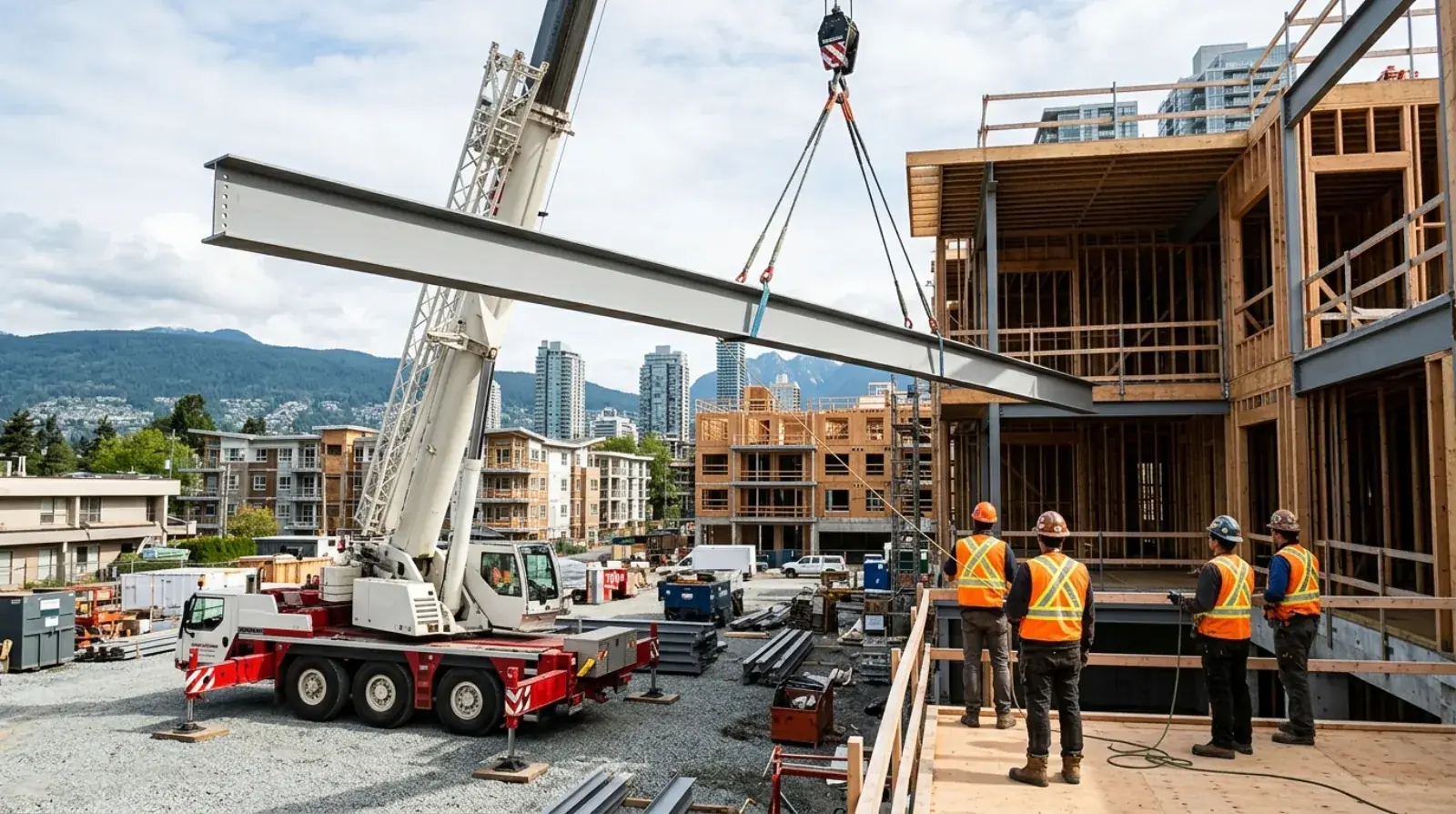
A single steel beam does not sound like a story until you put real numbers on it. This one was 40 feet long and weighed 13,000 pounds, and everything about moving it, from the Burnaby shop floor to its final bearing points, had to be planned before the first cut. You can watch the install on our channel to see the pick itself.
Most people watching a beam swing into place see thirty seconds of crane work. The fabricator sees three weeks of decisions that all had to be right for those thirty seconds to look boring. Boring is the goal. Here is what sits behind it.
Why a beam gets this big in the first place
Long clear spans are the usual reason. When a design opens up a space, a column-free floor, a wide storefront, a drive aisle that trucks have to swing through, the loads that intermediate columns would have carried get collected into one long member instead. Span and load compound each other: doubling a span does not double the required beam, it does considerably worse than that, because deflection limits and bending demand both climb steeply with length.
In Metro Vancouver there is a second driver, and that is seismic design. Members and connections here are designed to CSA S16 with the seismic provisions the BC Building Code requires for this region. The engineer of record runs those numbers and lands on a section. Our job starts when that section shows up on a sealed drawing, and part of that job is telling the GC early what a member this size means for transport, craneage, and site access, because those costs live outside the steel itself.
Fabrication: the easy part, done carefully
Honestly, fabricating a big beam is the most controlled part of the whole exercise. The material comes in with mill certificates. It is cut to length, connection holes are drilled to the shop drawings, and stiffeners, cap plates, or connection plates are welded on under our documented CSA W47.1 procedures. Our Burnaby shop is CWB certified, so every structural weld has a qualified welder, a qualified procedure, and an inspection record behind it.
Accuracy is the whole game at this stage. On a beam this long, a bolt group that is out by a small amount at one end becomes a field problem you cannot shim your way out of, because nobody is going to hang a 13,000 pound member in the air while they ream holes. Every hole pattern was checked against the mating connection geometry before the beam left the shop. Fit-up problems are cheap in Burnaby and brutally expensive hanging from a hook.
Finish matters less on a concealed structural member, and this class of beam typically ships shop-primed. If a beam like this were exposed to weather, galvanizing would enter the conversation, and at 40 feet the galvanizing kettle length becomes a real detailing constraint. That conversation has to happen before shop drawings, not after.
Getting 40 feet of steel through Metro Vancouver
A 40 foot beam does not ride on a standard delivery truck. The move takes a trailer suited to the length and load, securement to BC transport regulations, and, depending on dimensions and route, permits and route planning arranged before the wheels turn. Bridges, trolley wires, tight intersections, and posted structures all get checked in advance. This is the trucking company’s specialty, and we work with carriers who move oversized steel around the Lower Mainland every week, but the fabricator owns the schedule risk, so we book the move as soon as the fabrication date firms up.
Timing is the part GCs feel. A load like this arrives in a window, and the site has to be ready for it: crane set up, ground crew briefed, laydown or direct-pick decision made. On a tight urban site there is often nowhere to put the beam down, which means the delivery is timed so the beam comes off the trailer and goes straight into the structure. That is elegant when it works and unforgiving when any one party is late. We have found the fix is unglamorous: one delivery plan, in writing, that the fabricator, the trucker, the crane operator, and the superintendent have all read.
The pick: planned twice, lifted once
A 13,000 pound load is well within the reach of mobile cranes, but chart capacity is not the question. Capacity at the working radius is. The crane has to reach from where it can physically set up, over whatever is in the way, to where the beam lands, and the radius that geometry produces decides the machine. On urban Vancouver sites the crane position is usually the hardest constraint on the whole install, and sometimes it dictates lane closures and traffic coordination that need their own lead time.
Rigging follows the same logic. Slings and shackles rated for the load with the required factors, pick points placed so the beam hangs level, tag lines on both ends to control rotation as it flies. The beam was picked, flown, and lowered onto its bearings, held while the connection bolts went in, and only released once the engineer-specified bolting was complete. The crane letting go is the real end of the lift, not the beam touching down.
Connection detailing is what makes that sequence fast. Because the holes lined up, the bolts went in by hand and the crane time stayed short. Crane time is the most expensive clock on the site that day, and clean fabrication is how you keep it short.
What this means when you are pricing a steel scope
A big beam is a good reminder that a structural steel package is more than the steel. When you review a quote, look for who carries transport, who carries the crane, and who carries the traffic and access coordination, because on a member this size those items are real money and real schedule. Our post on how to read a structural steel quote walks through where those lines usually hide.
For GCs, the practical takeaways from this project are short. Get the fabricator’s input on transport and craneage while the engineer is still sizing members, because sometimes two shorter members with a splice beat one long one once the whole delivery chain is priced. Settle who owns the pick in the contract. And hold everyone to a single written delivery plan, because a beam this size punishes assumptions.
We supply and install beams like this across Metro Vancouver, from single-member scopes to full frames, and we build the logistics into the quote instead of leaving them as surprises. There is more on how we work with builders on our structural steel for general contractors page. If you have a heavy member or a full package coming up, send the drawings through request a quote and we will price the steel and the thirty seconds of crane work that make it a structure.