The phrase “custom ironwork” gets thrown around a lot in Metro Vancouver. Most of what shows up under that heading on contractor sites and design blogs is not custom in any real sense, it is a stock railing system or a catalogue gate cut to a different length. That is fine, and there is a place for it on a tight-budget project. But it is worth knowing what the term actually covers when you are commissioning real custom work in Vancouver, Burnaby, or anywhere else on the lower mainland.
This post walks through what gets called custom in our shop, what the design-to-install sequence really looks like, where the lead time goes, and how to tell a fabrication shop from a reseller before you sign anything.
What “custom” actually means in this trade
A stock railing system is engineered once, manufactured at scale, and assembled on site with proprietary fasteners. The post spacing, picket profile, and top rail extrusion are fixed. You pick a colour, a height, and a length. The supplier cuts and ships it. None of that is wrong, for a straight 30-foot deck guard on a Coquitlam townhouse, it can be the right answer.
Custom ironwork starts with a problem the catalogue cannot solve. The deck has a curve, the stair has an unusual riser, the gate has to span 14 feet in a single leaf, the home has a heritage character that needs a specific profile. Or the design calls for a finish, joinery, or material the prefab industry does not offer, blackened mild steel with no top coat, hot-rolled flat bar instead of cold-formed tube, a stainless inlay through a powder-coated body. At that point, somebody has to draw it, engineer it, build it, and finish it for that specific project. That is custom.
The fabrication shop draws shop drawings, full scale, dimensioned, with welds and fasteners called out, gets the engineering sealed where required, builds it on the bench, finishes it, and installs it. Nothing on the piece exists in a catalogue. Every fabricator’s name in Vancouver who actually works this way produces drawings, not collages.
What gets commissioned as custom
The split in our Burnaby shop is roughly:
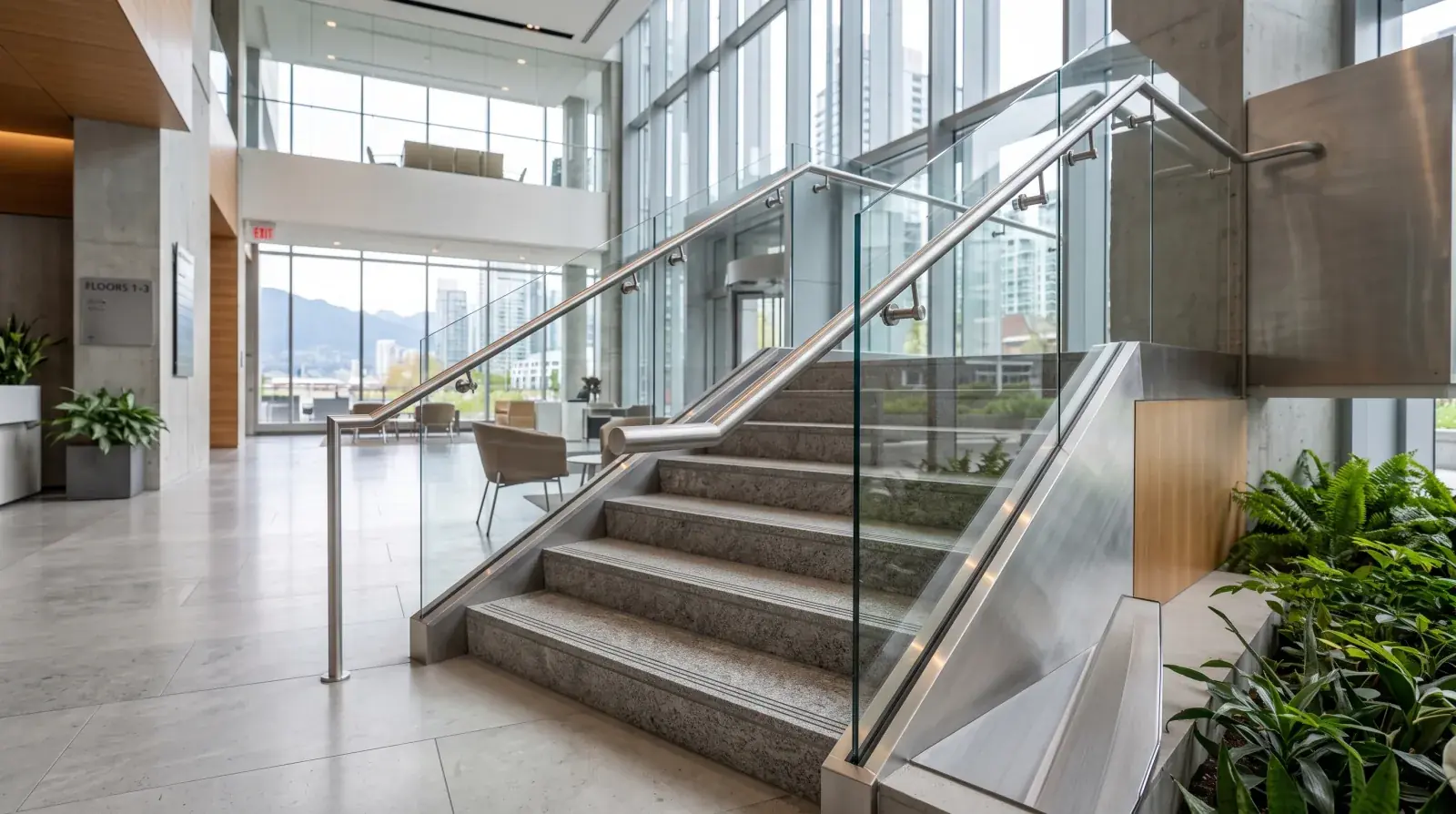
- Interior staircases, mono stringer, double stringer, floating, and spiral configurations, with hardwood, steel, or glass treads. Some are full-height entry stairs; some are loft access pieces or basement secondary stairs with a more industrial finish.
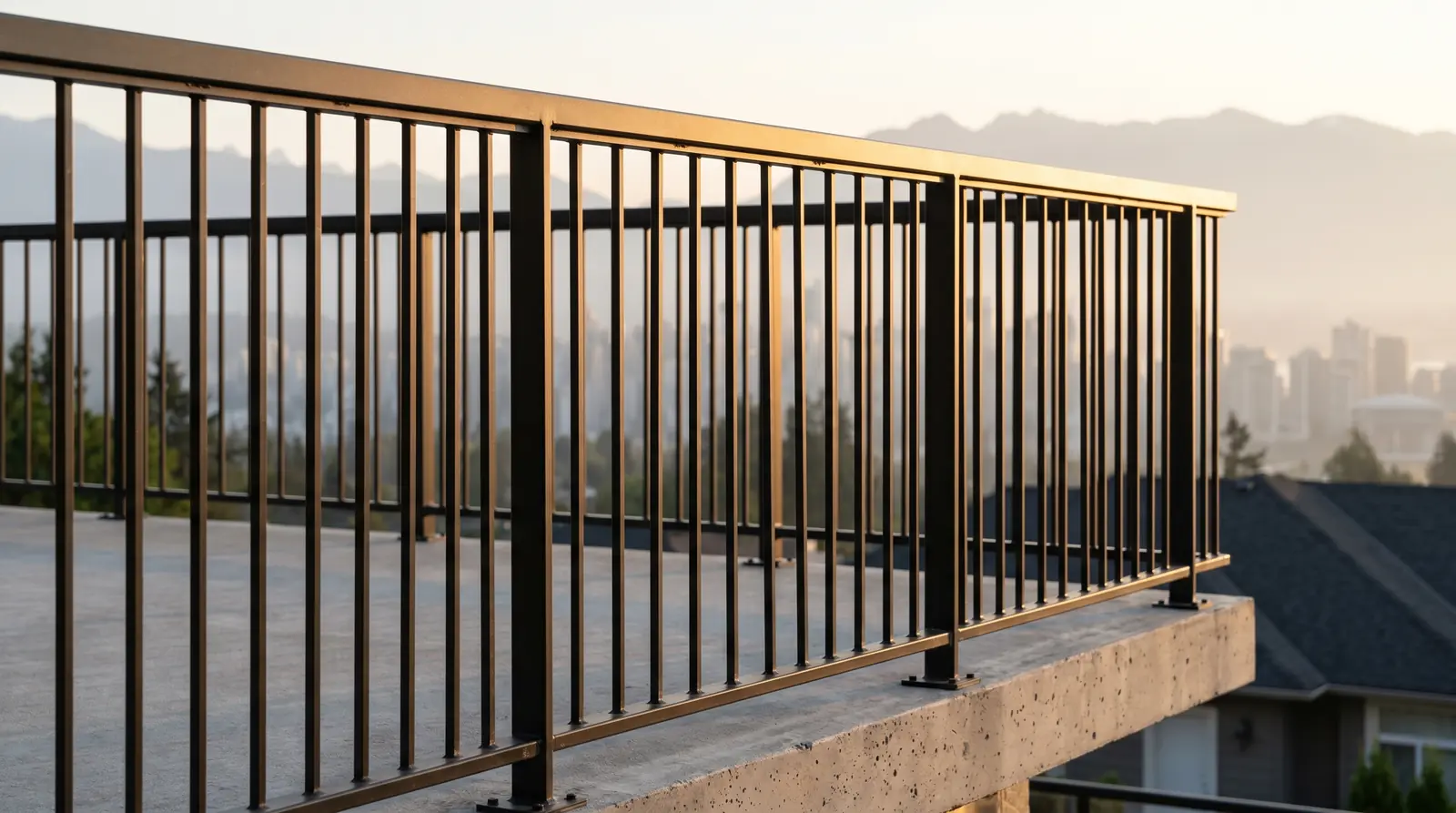
- Exterior guard railings, deck and balcony guards on West Vancouver waterfront homes, North Vancouver new builds, and infill houses across East Vancouver. Rain exposure dictates everything from finish to fastener spec.
- Gates and fences, driveway gates (swing and slide), pedestrian gates, security fences, and decorative screens. Gates with automation are roughly half our gate work now and need coordination with the electrical trade.
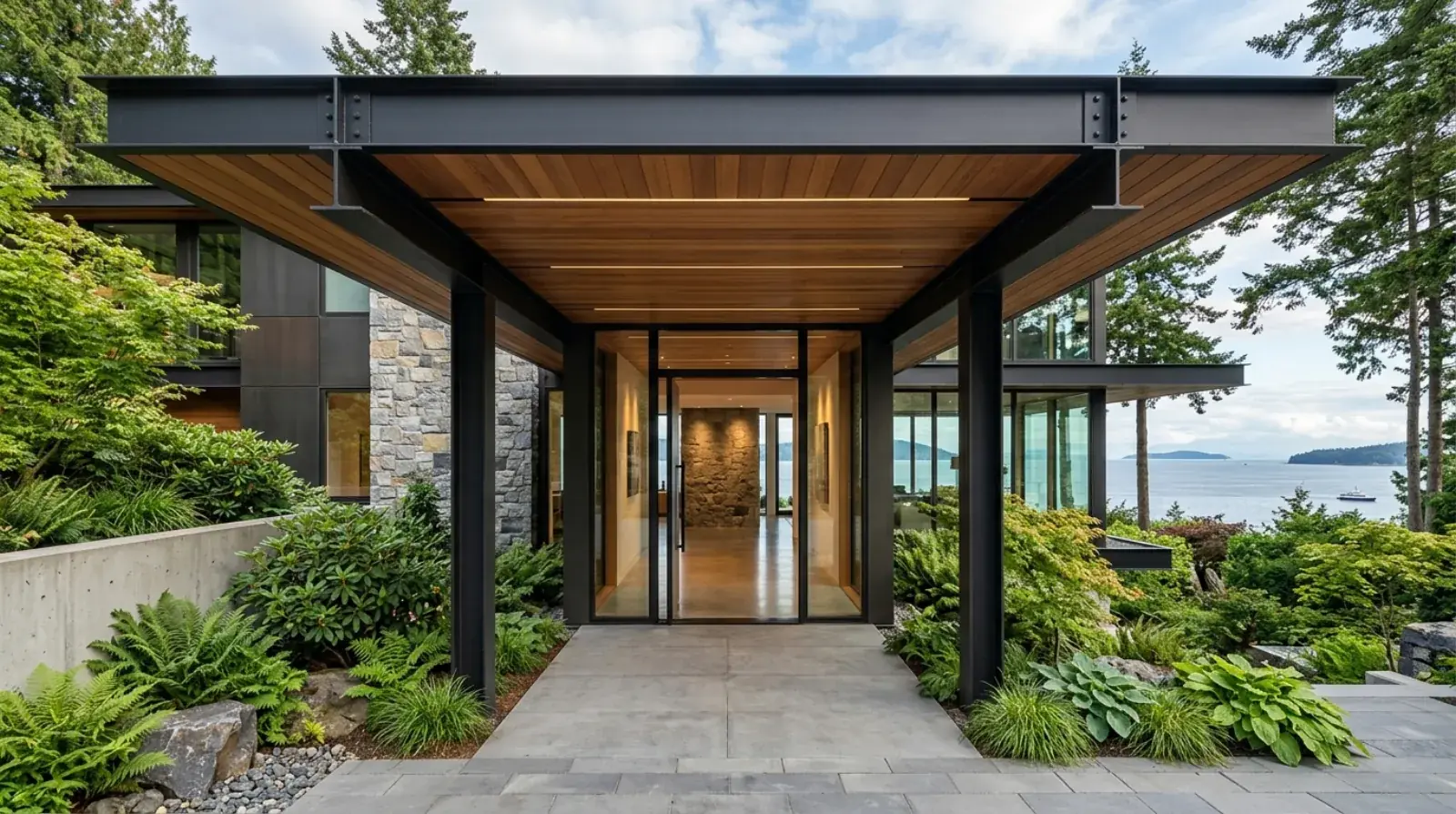
- Canopies and entry covers, steel-framed glass or metal-clad canopies above commercial entries and high-end residential front doors. These get the most engineering scrutiny because of snow load and uplift on the North Shore.
- Architectural feature pieces, wine room frames, fireplace surrounds, custom desks and tables, room dividers, partition screens. No code applies here; it is purely about getting the steel work to fit the architectural intent.
- Misc. metals on commercial projects, every clip, lintel, ladder, bollard, and embed on a structural steel package. Burnaby industrial parks and Vancouver mid-rise projects buy the most of this.
About 60% of our custom work right now is modern steel, clean lines, flat bar, square tube, blackened or powder-coated. The remaining 40% includes restoration of heritage pieces in Shaughnessy and the West End plus the small number of new builds going for a period look. The full restoration workflow for heritage pieces is its own subject; we cover it in detail in our Heritage ironwork restoration in Vancouver’s Shaughnessy & West End post.
The commissioning sequence
A real custom project follows roughly the same arc whether the piece is a single 8-foot interior handrail or a full structural steel package on a multi-storey project.
1. Design conversation and site visit
A 30-minute conversation, usually followed by a site visit if the project is anywhere within Burnaby, Vancouver, Coquitlam, the North Shore, or up to Squamish or Whistler on commercial work. We measure, photograph, and ask about budget, timeline, and intent. If the architect has done elevations, we work from those.
2. Concept and budgetary estimate
A sketch or simple rendering of what the piece will look like, with a rough budgetary number based on past projects of similar scope. The budgetary number lets a homeowner or GC decide whether to keep going. It is not a final quote, that comes after shop drawings.
3. Shop drawings
Detailed dimensioned drawings showing every member, every weld, every connection, and every finish. This is the document we build from. Clients sign off on shop drawings before fabrication starts. A round of revisions is normal; three or four rounds is a sign the design is still being developed and the project is not ready to fabricate.
4. Structural engineering
Required on stairs, guards, gates of any size, canopies, and any structural steel element. A registered P.Eng. reviews the drawings, confirms the loads, and seals the document. The seal is what the building inspector checks at framing inspection. On a residential railing, engineering is usually 1 to 2 weeks; on a commercial misc. metals package, it can be 4 to 6 weeks.
5. Fabrication and finishing
Steel cutting, welding, grinding, and assembly happens at our Burnaby shop. Finishing is either in-house (powder coat, blackening, oil) or sent to a partner galvanizer for hot-dip work. Finishing is where lead time stretches when galvanizers are busy, booking an outside finisher in advance avoids the delay.
6. Site install
A typical residential railing is 1 to 2 days on site. A staircase is 2 to 4 days. A driveway gate with automation is 3 to 5 days because the electrical and concrete pad work has to be coordinated. We hold a final shop walkthrough with the client before anything leaves Burnaby, last-minute surprises are easier to address in the shop than on a Vancouver job site.
Custom vs off-the-shelf, where each is the right answer
Custom is the right answer when the architecture is unusual, the design statement matters, the run involves slopes or curves, or the site has to last decades with minimal maintenance. The Naikoon penthouse railings we built, recognized at the VRCA Awards of Excellence, would not have come from a catalogue.
Off-the-shelf is the right answer when the project is a stock-spec deck guard, a long straight run, the budget is tight, and the owner does not care whether the railing is one-of-one. There is no shame in choosing it, and a good fabricator will tell you when it is the right call.
The trap is in the middle, projects sold as “custom” that are really off-the-shelf with a paint colour change. A fabricator should be able to show you shop drawings on previous projects of similar scope. If they show you a colour swatch and a dimension instead, you are buying off-the-shelf.
Modern steel vs traditional wrought-iron looks
Almost all our current custom work in Burnaby, Vancouver, and the North Shore is modern. Clean lines, square or rectangular profiles, blackened or matte black powder-coat, often with a flat-bar top rail. The contemporary architecture going up in East Vancouver, Burnaby, and on the West Vancouver waterfront pairs naturally with this language.
Traditional wrought-iron looks, scrolls, finials, twisted balusters, volutes, fit a small number of contexts. Restoration on Shaughnessy and West End heritage homes is the obvious one. Some period-style new builds also call for it. Outside those cases, traditional ornamentation can read as out of step with the architecture and dates the project visually within a few years. We will fabricate either, but we ask which direction the architecture is pulling before recommending.
Code, certification, and finishes
Anything load-bearing or safety-critical, guards, handrails, stairs, structural steel, has to meet the 2024 BC Building Code. The current code requires minimum 1,070 mm guard height on residential decks above 1,800 mm grade, picket spacing such that a 100 mm sphere cannot pass, and graspable handrails on stairs of more than three risers.
Welds on any structural piece, staircase stringers, gate hinges, canopy frames, must be performed under a Canadian Welding Bureau certified shop’s qualified procedures, per CSA W47.1. Our shop has been CWB-certified to CSA W47.1 Division 2 for the structural steel work, and we follow CSA W59 for the welded steel construction itself. Verify this on any shop you are considering, the certificate is public and the CWB lists certified companies.
Finish choice depends on exposure. For exterior custom ironwork in Metro Vancouver, and especially for anything within sight of salt water in West Vancouver, North Vancouver, or along Burrard Inlet, hot-dip galvanizing under a powder coat or wet paint is what we specify. The duplex system has demonstrated significantly extended service life over either coating alone and is the conservative call for a piece you want to last 30+ years.
Interior pieces have more options. A blackened oil finish on mild steel reads warm and develops a patina over time; a flat black powder coat is more uniform and easier to touch up; a clear coat over hot-rolled steel preserves the mill scale for an industrial look. Each finish has a maintenance trade-off, a designer or architect should walk through this with the client before fabrication starts.
What to look for in a fabrication shop
Before you commission anything, three checks separate a real fabrication shop from a reseller or a backyard welder.
Certification. A CWB certificate to CSA W47.1 is the baseline. The CWB site lists certified companies; if a shop’s name is not on it, the shop is not certified, regardless of what their website says.
Shop drawings on past projects. Ask to see two or three. Real shop drawings are dimensioned, show welds and fasteners, and look like fabrication documents. A photo gallery is not a shop drawing.
In-house or partnered finishing. Painting and powder coating in-house, or a long relationship with a hot-dip galvanizer, both shave weeks off lead time and reduce coordination errors. Shops that send pieces to whoever is cheapest each month tend to have inconsistent finishes and longer schedules.
The best signal of a good shop is that the people running it talk about steel, grades, profiles, joinery, finish, more than about marketing language. If the conversation is about the work, you are in the right place. If it is about positioning and process buzzwords, the work probably comes from somewhere else and is being marked up.
For pricing on a specific custom ironwork project in Metro Vancouver, request a quote, the variables are too project-specific to ballpark without the design conversation.