A canopy is the most weather-exposed steel on most buildings. It stands in the rain by design, catches wind-driven marine air off the Strait of Georgia, and drips onto the storefront and sidewalk below where every stain shows. The structural design decides whether it stands up. The finish system decides what it looks like in year fifteen, and in coastal BC the gap between a good finish decision and a cheap one is not subtle.
We fabricate and finish steel canopy structures at our Burnaby shop, and the finish conversation happens on every single project. This post lays out how the main systems behave in this specific climate, and which decisions need to be locked while the canopy is still on paper.
Why paint-only is the wrong bet in Vancouver rain
Paint is a barrier coating. As long as the film is perfect, the steel under it stays dry. The problem is that no film on a canopy stays perfect. Fabricated steel has edges, welds, bolt heads, and drilled holes where coating thickness drops. Installation adds scratches. Thermal movement flexes the film over decades. Each defect is an opening, and coastal Vancouver supplies the rest: persistent moisture for most of the year, marine air carrying chlorides, and enough UV to chalk the surface.
Once moisture reaches steel through a defect, rust forms and creeps sideways under the surrounding paint, lifting it from below. That is why a failed painted canopy shows blistering and rust bloom spreading from every weld and edge, rather than even fading. In this climate, paint-only exterior systems are a maintenance subscription, with recoating needed every 8 to 15 years and access costs, over an entrance, above a sidewalk, that often exceed the coating cost itself.
Paint has its place on canopy steel that is concealed or fully sheltered. For exposed frames in Metro Vancouver, we treat it as a base layer decision that the owner will pay for again and again.
Hot-dip galvanizing, the coastal baseline
Hot-dip galvanizing per ASTM A123 works on a different principle. The completed steel assembly is immersed in molten zinc, and the zinc does not sit on the surface the way paint does; it reacts with the steel to form metallurgically bonded zinc-iron layers over every face the liquid touches, including inside HSS members and around weld profiles.
The protection is sacrificial. At a scratch, a drilled hole, or a cut edge, the exposed steel is surrounded by zinc that corrodes preferentially and protects it. Damage that would start a rust bloom on a painted frame stays a grey mark on a galvanized one. In the Metro Vancouver coastal environment, that translates to decades of service, on the order of 50 years and more depending on exposure, with no recoating cycle.
Galvanizing does impose rules on the fabricator, which is why it must be planned rather than appended. Closed sections need vent and drain holes so the zinc can flow and gases can escape; the frame must fit the galvanizer’s kettle or be designed in bolted sections; and the finished surface is matte grey with some texture at welds, which either suits the architecture or gets a colour coat over it. We detail for the kettle from the first shop drawing on every galvanized canopy.
Duplex systems, when the architect needs a colour
Most architectural canopies cannot ship in kettle grey. The answer is the duplex system: hot-dip galvanizing for corrosion protection, powder coat over it for colour, gloss control, and UV resistance. The zinc surface is prepared, typically sweep blasting and a conversion pretreatment, then powder is applied and cured.
The two layers genuinely cooperate. The powder coat shields the zinc from weathering, slowing zinc consumption. The zinc stops underfilm creep, so a chip in the powder coat stays a chip instead of growing into a blister field. The result is a combined service life longer than the two systems would deliver separately, and a finish that keeps its colour above a storefront for decades of coastal weather. This is our standard recommendation for exposed canopy steel anywhere in Metro Vancouver, and it is what we specify on our own projects when the client asks us to choose.
The practical comparison between the two coating families, including where powder coat alone is defensible, is covered in our post on galvanizing versus powder coating in coastal Vancouver.
Fasteners, the small parts that make the big stains
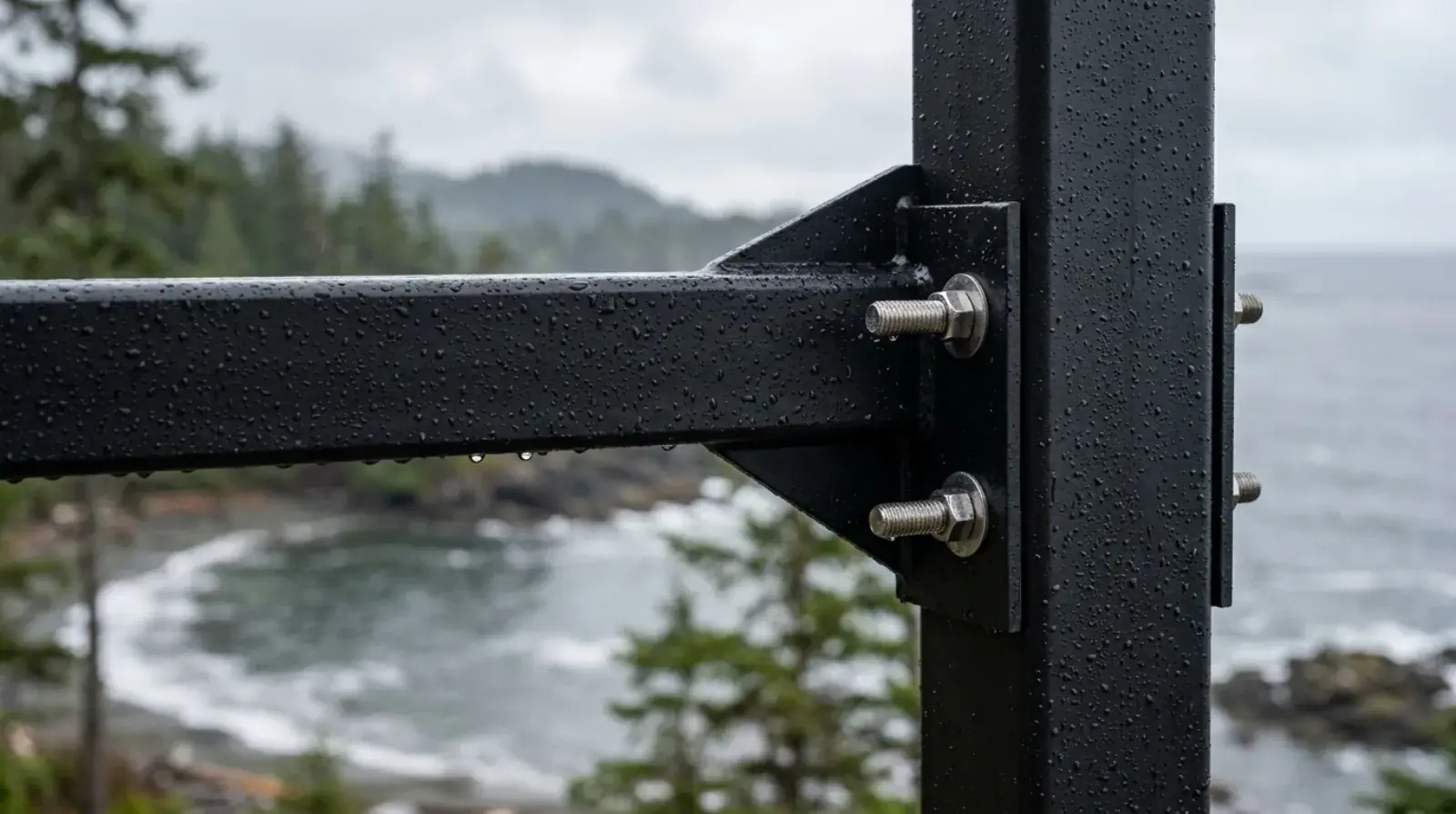
The most common canopy finish failure we see in the field is not the frame at all. It is a brown streak running from a bolt head down a white fascia, or across the glass of the storefront below. Frames get specified carefully and then fastened with whatever plated hardware was on the shelf, and the hardware corrodes first, precisely at the drip points where water leaves the structure.
The fix costs almost nothing at design time: exposed fasteners in Grade 316 stainless. The 316 alloy resists chloride attack from marine air better than 304, which matters within reach of the coast, and the premium over plated hardware across one canopy’s worth of bolts is trivial next to the cost of ever removing a streak from architectural cladding. Isolation matters too. Stainless against galvanized steel needs washers or coatings at the contact points so dissimilar metals do not set up their own corrosion cell in the wet.
The same logic scales up for waterfront sites in West Vancouver, North Vancouver, and anywhere salt spray reaches, where hardware, welds, and finish all step up a grade. Our post on marine-grade metalwork in coastal Vancouver covers that saltier end of the spectrum.
Lock the finish during design, not after fabrication
Finish reads like the last line of the specification, and on canopies it behaves like one of the first. The decisions that need to be made while the design is still moving:
The system itself. Galvanized, duplex, or a defensible paint case for sheltered steel. This drives detailing: vent holes, kettle-sized assemblies, and bolted splices all have to exist on the shop drawings, and a CWB-certified shop welding to CSA W47.1 will also sequence its welds knowing the frame is headed for the zinc bath.
Colour, gloss, and texture, with a physical sample approved, because powder over galvanizing has a character that a screen rendering does not show.
Fastener grade and isolation details on the drawings, so 316 stainless is a requirement rather than a hope.
Touch-up and site-damage protocol, agreed before erection, so a scratched member gets repaired to a standard instead of to whatever is in the truck.
Drip management. Where water leaves the canopy decides where any future staining would land, so drip edges and drainage, covered in our connection detailing post alongside the structural interface, belong in the same design conversation.
A canopy engineered to BC Building Code loads and finished to a coastal-grade system is effectively a permanent building element. The same frame with a shortcut finish is a maintenance item with a countdown running. The rest of our structural steel and finishing scope is on the steel structure projects page; if you are specifying a canopy and want the finish system priced both ways before you lock it, send us the drawings and we will quote the comparison honestly.