A canopy gets designed once, fabricated once, and installed once. Then somebody owns it for thirty or forty years, through every storm the Strait of Georgia sends across the city. We build steel canopy structures at our Burnaby shop, and we also get the phone calls fifteen years later, which means we have seen exactly which maintenance habits keep a canopy sound and which quiet neglect turns a small problem into a steel repair.
This post is for the people who own that middle period: building operators, strata councils, and property managers anywhere in Metro Vancouver with a steel canopy over an entrance, a walkway, or a loading area. None of what follows requires a technical background. It requires a ladder, dry weather, and one honest hour a year.
The annual walkaround
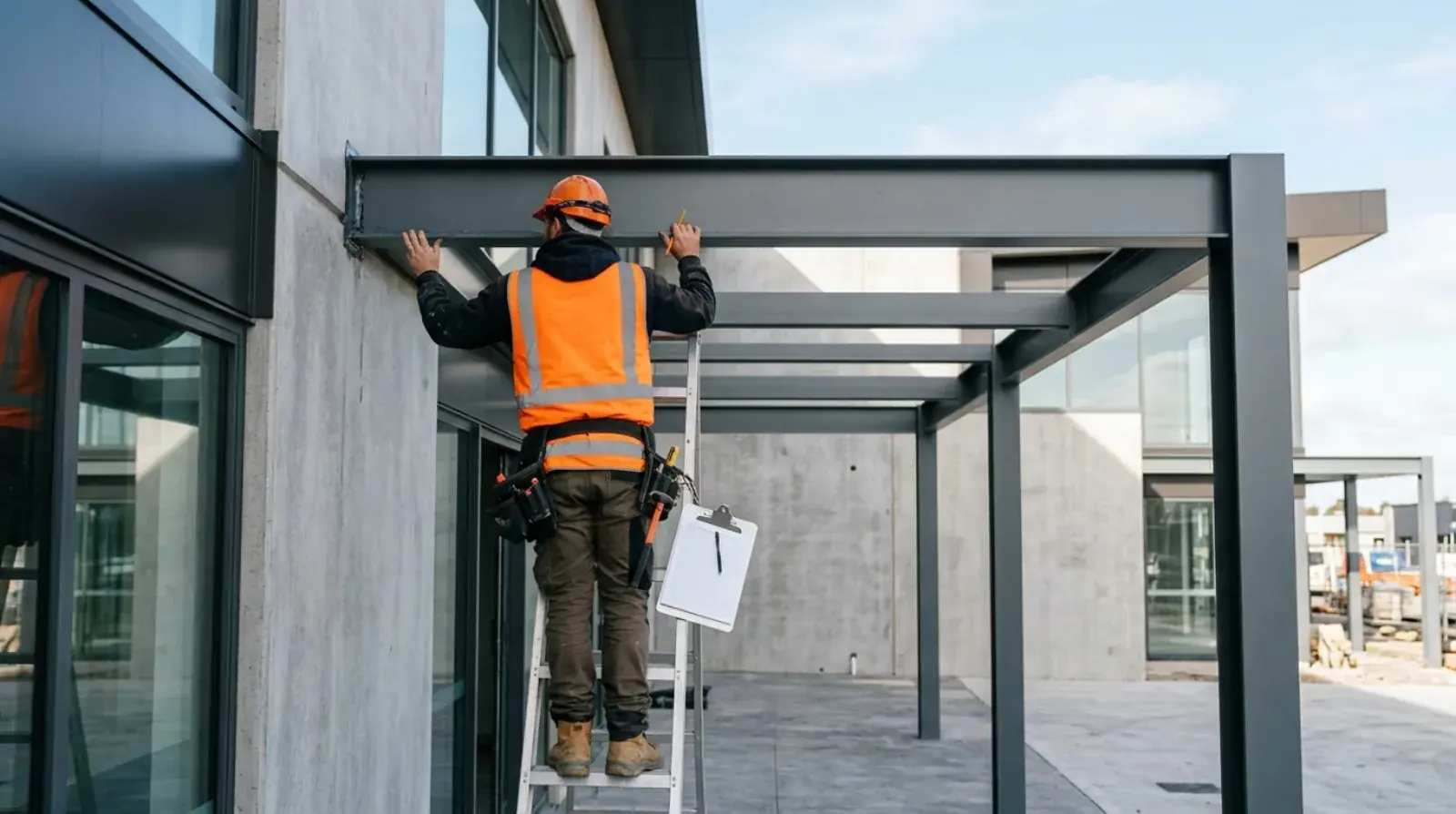
Pick a date and keep it. October is the right month in this region, after the leaves have mostly come down and before the serious rain arrives, because everything you fix in October gets tested from November to March. The inspection itself is a slow walk with a checklist and a phone camera: under the canopy looking up, above it if access allows, and along the line where it meets the building.
Photograph everything, even when it looks fine. A canopy ages slowly, and the most useful diagnostic tool five years from now is a photo of the same weld, the same sealant joint, and the same column base taken every year from the same spot. Rust that appears in one season tells a different story from rust that crept in over five, and the photos are how you tell those stories apart.
Water first, always
Every canopy is a small roof, and small roofs fail the way big ones do: the water stops going where it was designed to go. Scuppers, gutters, and internal drains clog with leaves, needles, moss, and the grit that Vancouver’s street trees and winter road sanding supply in quantity. Once the drainage path blocks, water ponds on the roof panel, overflows edges that were never meant to be wet, and works into the connection at the building face.
So the first job of the annual visit is the least glamorous: clear every drainage path and then prove it works by running a hose. Look for the evidence of past ponding too, staining rings on the roof panel, streaks down the fascia, moss growing where water lingers. Those marks tell you the water has already been going somewhere wrong between your visits, and a canopy that drains freely every October is a canopy that mostly stays out of trouble.
The host connection and its sealant
Where the canopy meets the building is the most consequential joint on the whole structure, and it is protected by one of the cheapest materials on it: a bead of sealant. That sealant keeps rain out of the wall assembly behind the canopy connection. When it cracks, shrinks, or pulls away, water gets into the wall, and wall repairs cost many multiples of anything on the canopy itself.
Look at the joint from close up. Sound sealant is continuous, flexible, and bonded on both sides. Failed sealant shows cracks, gaps, or a bead that has hardened and split from one face. Look below the joint as well, because staining, efflorescence, or paint bubbling on the wall under the connection is water announcing itself. Sealant renewal is inexpensive, routine work; the discipline is doing it when the joint fails rather than when the wall does.
Coating breaches and fastener corrosion
Steel coatings fail from small breaches outward, not evenly across the surface. So the coating part of the inspection is a hunt for specific damage. Column bases collect impacts from carts, bikes, snow shovels, and pressure washers. Welded joints and edges carry thinner coating than flat surfaces and rust first. Any spot where another trade drilled, clamped, or welded onto the canopy after installation is a breach until proven otherwise.
Fasteners deserve their own look. A rust streak running down from a bolt head is the classic early sign, and it matters what is rusting: a streak from a corroding fastener is a hardware swap, while rust at the steel around the fastener means water is getting behind the connection. On coastal projects we specify stainless or galvanized hardware for exactly this reason, but replacement parts added over the years are not always what the original spec called for.
Small chips caught early are touch-up work. The same chips left through five wet winters become scale, section loss, and a repair invoice. The difference between those two outcomes is nothing but the annual visit.
Fabricator or painter, who to call
When the walkaround finds something, the next question is who fixes it, and the split is clean.
A painter, or more precisely a coating contractor, is the right call when the steel underneath is sound: faded topcoat, chalking, scattered chips, surface rust that wire-brushes back to solid metal. That is maintenance of the finish, and a good coating outfit handles it.
A fabricator is the right call when the structure itself is in question. Rust that has thinned a member rather than stained it. A cracked weld. Movement, gaps, or crushed sealant at the host connection suggesting the anchors have worked loose. Any member bent by a vehicle strike, however slight it looks. These are structural findings, and the wrong response is paint, because paint makes a structural problem invisible without making it smaller. A fabricator can assess the member, replace or reinforce steel, and re-verify connections, with welding done under CWB certification to CSA W47.1 through the CWB Group rather than patched by whoever owns a welder.
If you are unsure which side of the line a finding sits on, send the photos to a fabricator first. Steel that turns out to be sound costs you an email; steel that turns out not to be was worth the question. Our shop reviews this kind of photo set for building operators around Metro Vancouver regularly, and the rest of our engineered work is on the steel structure projects page.
What a recoat cycle involves
Every coating system has a service life, and planning the renewal beats discovering the need. For a painted canopy, a recoat is a small project: access equipment, surface preparation to remove failed coating, spot priming of any bare steel, then a full new topcoat, all scheduled into a dry weather window, which in Vancouver means booking the work for summer and not hoping for one in February.
A duplex system, hot-dip galvanizing with paint or powder over it, changes the timeline in the owner’s favour. When the topcoat weathers, the zinc underneath is still protecting the steel, so cosmetic aging is not an emergency. The smart moment to renew the topcoat is when it has visibly aged but before the zinc itself starts being consumed, because recoating over intact zinc is straightforward and the cycle can then repeat for decades.
Where recoating fits your budget planning, alongside every other cost factor in canopy ownership, our commercial canopy cost guide lays out the drivers without pretending one number fits every structure. And if your canopy has a finding you want assessed, or it has simply never had a proper inspection, get in touch and send the photos. An hour of attention in October is the cheapest structural work you will ever buy.