When a client in Vancouver asks us how to keep their exterior steel from rusting, the honest answer is usually the same: send it to the galvanizer before it gets installed. People picture galvanizing as a kind of paint. It isn’t. The steel gets lowered into a bath of molten zinc, and what comes out is protected by chemistry, not by a film sitting on the surface. Here’s what actually happens between the time finished steel leaves our shop and the time it shows up coated in that familiar matte grey.
The steel has to be surgically clean first
Zinc will not bond to a dirty surface, so most of the galvanizing process is cleaning. The steel goes through three baths before it ever touches zinc. First a hot caustic solution strips off grease, oil, and any paint markings or layout crayon we left on it. Then it drops into an acid bath, the pickle, which dissolves mill scale and rust down to clean bare steel. The last stop before the kettle is flux, a zinc ammonium chloride solution that does two jobs at once: it cleans off the last traces of oxide and leaves a protective film so the steel doesn’t flash-rust in the few seconds between the flux tank and the zinc.
This is also why we don’t leave heavy weld slag, paint, or grease on anything headed for galvanizing. The cleaning baths are good, but they’re not magic. Anything the acid can’t reach comes out as a bare spot.
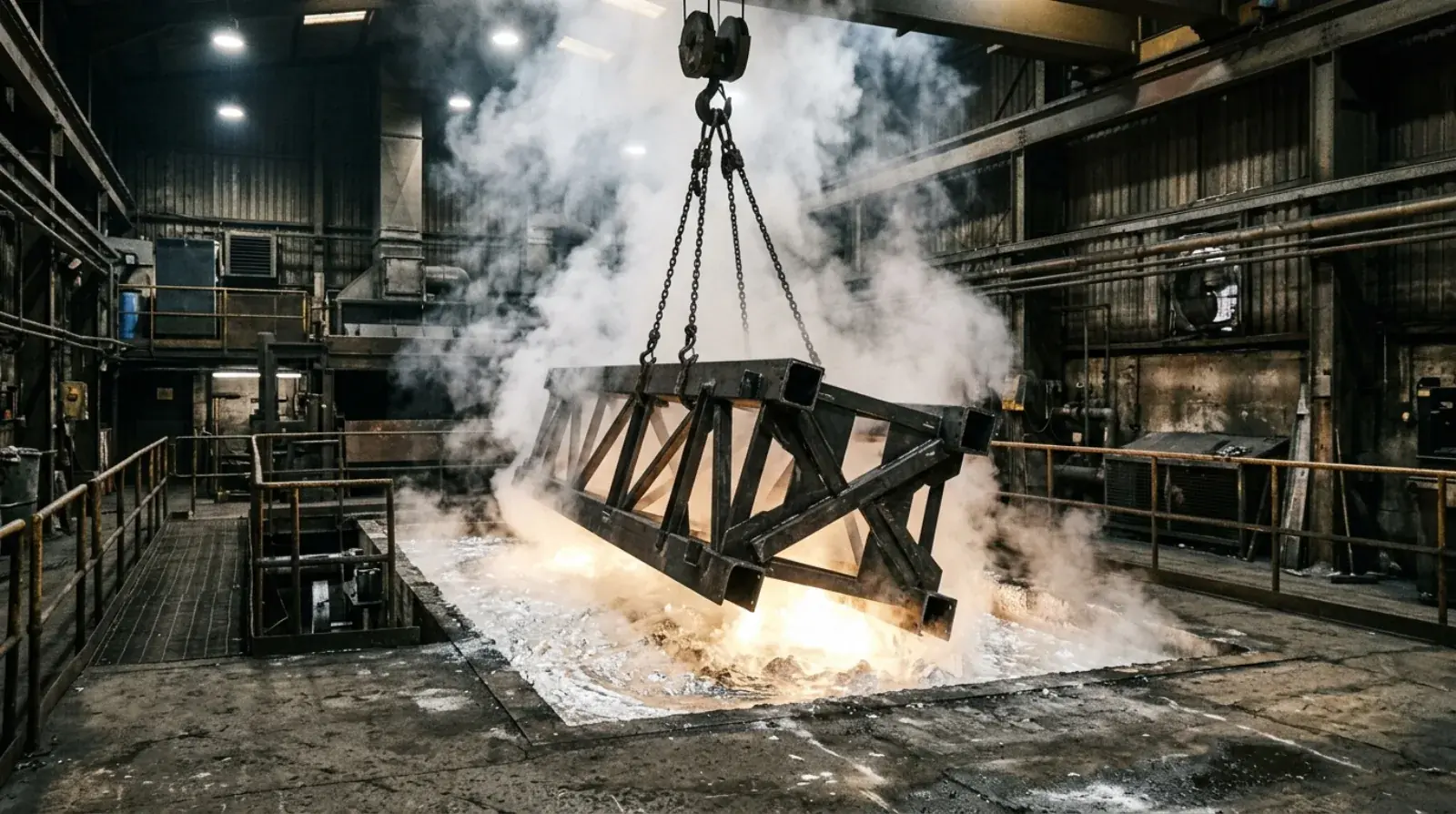
The dip: molten zinc at about 450 C
The clean, fluxed steel is lowered into a kettle of molten zinc held at roughly 450 C. The American Galvanizers Association puts the working range at 435 to 455 C. At that temperature something more interesting than coating happens. The iron in the steel and the zinc in the bath react with each other and grow a stack of zinc-iron alloy layers, hardest at the steel surface and softening toward the outside, with a layer of nearly pure zinc on the very top.
That’s the part worth understanding. Paint and powder coat are films that stick to the steel mechanically. The galvanized layers are metallurgically bonded, meaning they’re part of the steel now, not a skin over it. You can’t peel galvanizing. It’s measured in the standard, ASTM A123, the Standard Specification for Zinc (Hot-Dip Galvanized) Coatings on Iron and Steel Products, which sets the minimum coating thickness by steel category. When we spec galvanizing on a drawing, ASTM A123 is the line we reference.
Once the reaction has built the coating, the part is pulled out slowly, excess zinc is allowed to drain and is sometimes vibrated off, and the steel cools in air or a quench. The reaction keeps going for a moment as the part comes out hot, which is why dip time and withdrawal speed matter to the final look.
Why galvanizing beats paint for protecting steel
Galvanizing protects steel two different ways, and the second one is the reason it’s the go-to for anything that lives outdoors.
The first is the obvious one. The zinc is a barrier. As long as it covers the steel, air and water can’t reach the iron, so the steel can’t rust. The second mechanism is the one paint can’t match. Zinc is more reactive than iron, which means when both are exposed, the zinc corrodes first and the steel is left alone. This is called sacrificial or cathodic protection. Scratch through a galvanized rail to bare steel, drill a hole, nick a cut edge, and the zinc around that spot protects the exposed steel instead of letting it rust. A chip in paint starts rusting at the chip. A chip in galvanizing doesn’t, until the surrounding zinc is used up, which on the coast takes years.
For Vancouver, where steel lives in rain most of the year and salt air near the water, that self-healing behaviour is exactly what you want. We get into the trade-offs against other finishes in our piece on galvanizing vs powder coating for coastal Vancouver.
The design rules that have to happen in our shop
Here’s where galvanizing stops being the galvanizer’s problem and becomes ours as the fabricator. The dip imposes design rules, and if we ignore them the part comes back ruined or never makes it into the kettle at all.
The big one is venting and draining. Anything hollow has to let the molten zinc flow in and out and let air escape, so we drill vent and drain holes into closed sections. This isn’t optional. The American Galvanizers Association warns that cleaning solution or rinse water trapped inside a sealed tube flashes to steam in the bath, and the pressure can hit 3,600 psi, which is enough to rupture the steel. An undrained HSS post is a genuine hazard at the kettle, not just a cosmetic risk. So when we fabricate an exterior railing or a gate frame, the vent and drain holes are detailed in from the start, placed at the high and low points the part will sit at during the dip.
The other rule is about warping. A part going from shop temperature to 450 C and back will move if it’s badly proportioned. The worst offenders are pieces that combine very thin and very thick steel in the same assembly, and large flat unsupported plates, because they heat and cool unevenly. We design symmetrical sections, add stiffeners where a plate wants to oilcan, and talk to the galvanizer about how the part should hang in the bath. Getting this right is part of the same discipline we bring to any custom metal fabrication job where the finishing process talks back to the design.
What galvanized steel looks like, and how it ages
Fresh out of the kettle, galvanizing shows a crystalline pattern called spangle. Sometimes it’s bright and almost reflective, sometimes it’s a muted matte, and it depends mostly on the steel’s chemistry, not on anything we or the galvanizer did wrong. Clients sometimes worry the dull batches are defective. They aren’t.
Left outdoors, all of it weathers the same direction. Within a year or so a thin zinc carbonate patina forms and the surface settles into a flat, even grey. That patina is doing work, slowing the rate the zinc gets used up. So the raw galvanized look ages into something quieter and more uniform than it starts. If a client likes the industrial grey, we leave it. Many of our exterior structural jobs stay bare galvanized on purpose.
When to galvanize, powder coat, or do both
Not every job needs galvanizing, and not every job wants the bare grey. Here’s how we sort it.
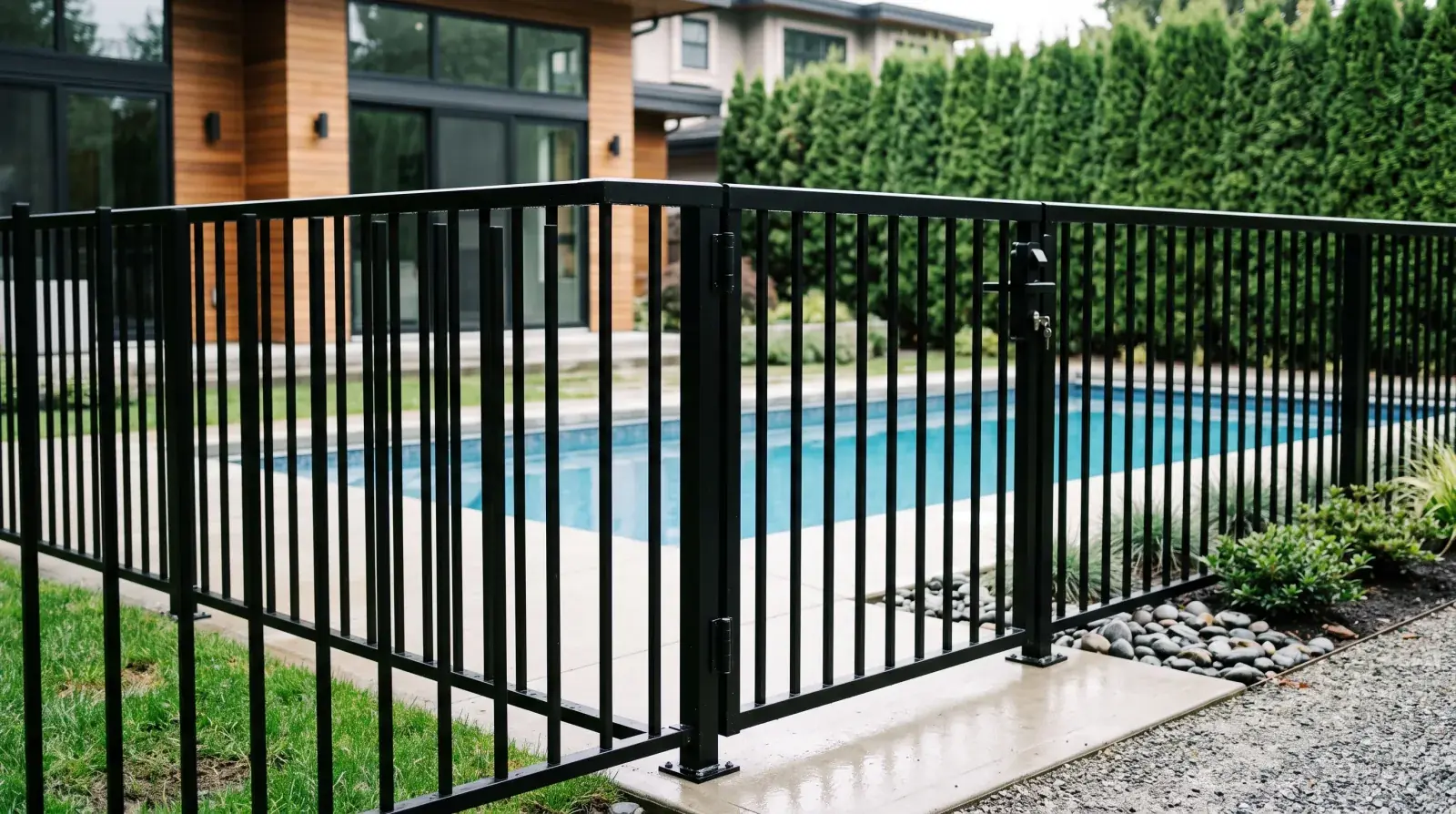
Interior steel that stays dry, like an indoor mono stringer stair, usually gets blackened or powder coated and never sees a galvanizing kettle. Powder coat is a durable, colour-fast finish, but on its own it’s still a film, and on the coast a scratch through powder coat to bare steel will rust. Exterior steel that can live with the industrial grey, like a lot of structural and railing work, gets hot-dip galvanized and nothing else.
The third option is both, and for high-value exterior steel it’s often the right answer. Galvanize first for corrosion protection, then powder coat over it for colour and a smoother surface. That combination is a duplex system, and it outlasts either finish used alone because the powder coat protects the zinc while the zinc protects the steel. We walk through the full comparison in powder coating vs paint vs galvanizing. The catch is that the galvanized surface has to be properly prepared so the powder bonds, which is a coordination step we manage with the coater rather than leaving to chance.
Why it’s the default for exterior steel in Vancouver
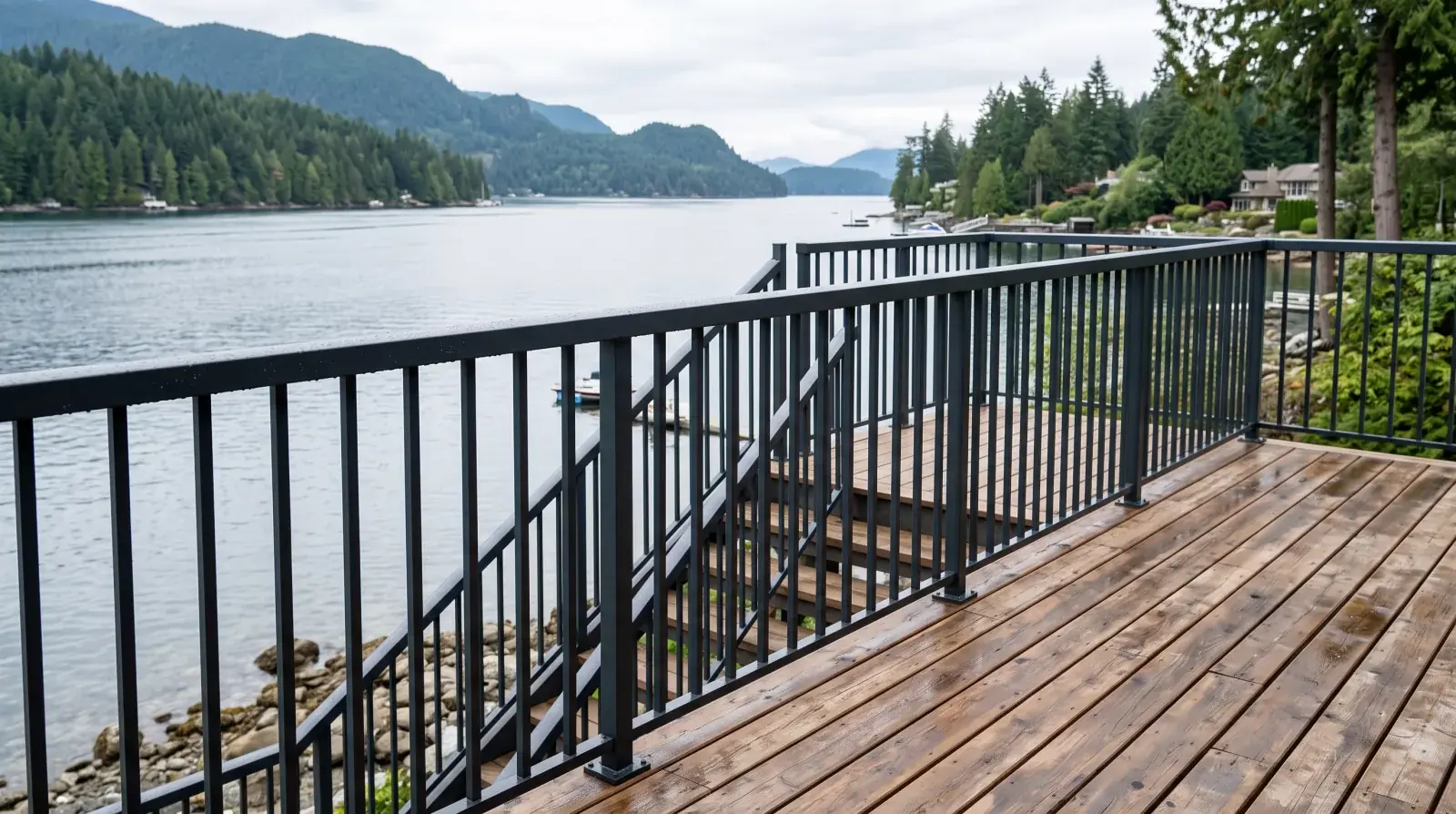
Steel and constant rain don’t get along. Add the salt air on the North Shore and near the water in Vancouver proper, and bare or painted steel outdoors is on a clock. Galvanizing resets that clock to decades instead of years, with no maintenance, because the protection is built into the steel rather than brushed onto it. The cost of galvanizing is driven by the size and weight of the part, the coating thickness specified, and the trip to and from the galvanizer, and it’s worth pricing into any exterior job from the start rather than treating it as an upgrade.
That’s why, when we quote exterior structural steel, stairs, railings, or gates for clients across Metro Vancouver, hot-dip galvanizing is usually in the plan from the first drawing, with the vent holes, the dip orientation, and any duplex powder coat already accounted for. If you’ve got exterior steel coming up and you’re weighing how to protect it, request a quote and we’ll spec the finish to the site and the look you’re after.